January 24, 2025
Administrative, IT and Nursing Series Dominated January 2025 Federal Postings
By Jan. 24, 2025, the FederalHiringData archive showed administrative, management-analysis, IT and nursing series at the top of federal announcement volume.
By Evan Mercer

By Jan. 24, 2025, the FederalHiringData archive contained 18,624 January-closing federal announcements. The leading occupation series were not a single technical niche. They were the broad administrative and professional series that keep large federal organizations running.
Miscellaneous Administration and Program (0301) led with 1,366 announcements. Management and Program Analysis (0343) followed with 950, Information Technology Management (2210) with 822, and Nurse (0610) with 590.
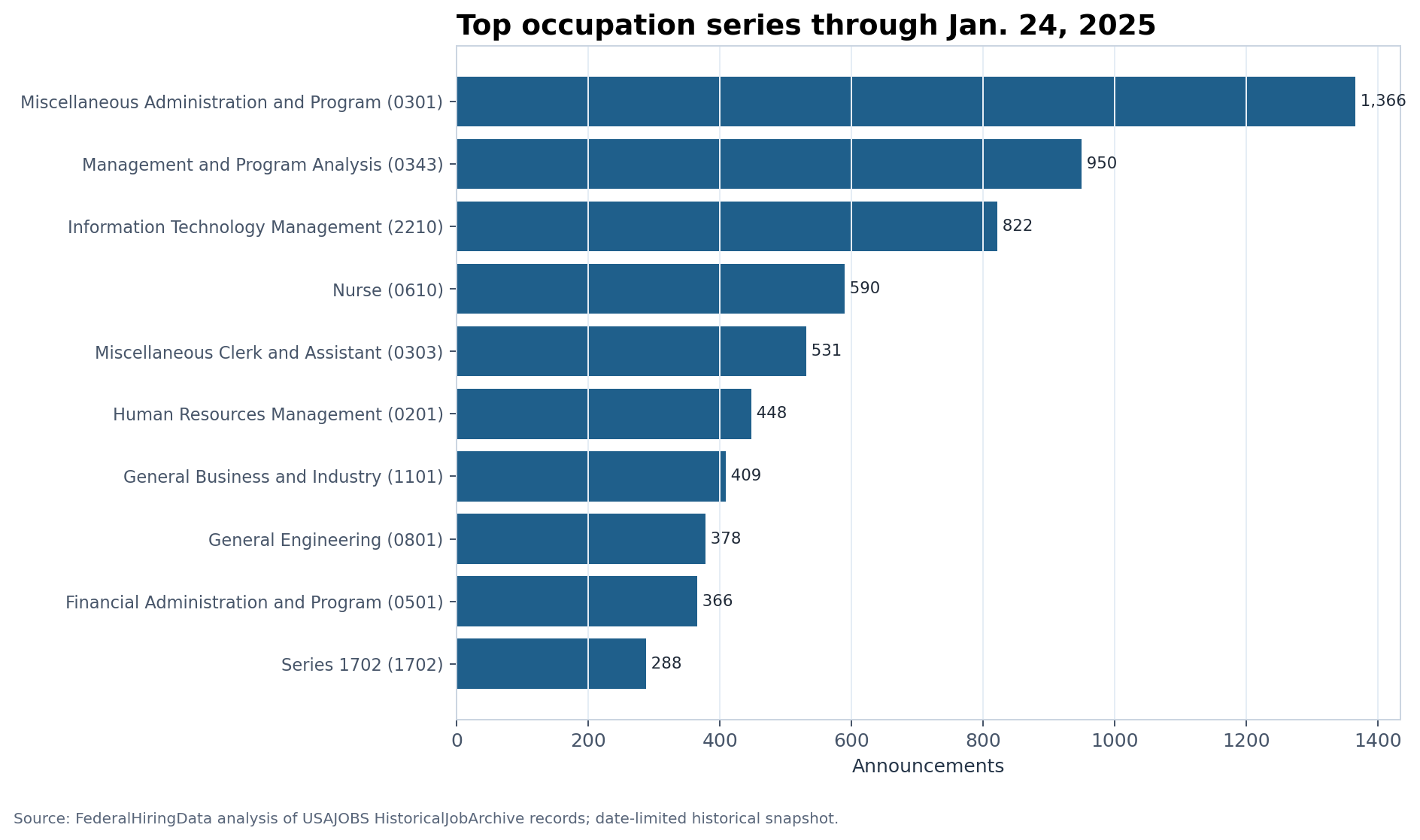
Top occupation series
| Series | Announcements | Avg. max salary |
|---|---|---|
| Miscellaneous Administration and Program (0301) | 1,366 | $126,336 |
| Management and Program Analysis (0343) | 950 | $144,581 |
| Information Technology Management (2210) | 822 | $147,948 |
| Nurse (0610) | 590 | $151,180 |
| Miscellaneous Clerk and Assistant (0303) | 531 | $50,048 |
| Human Resources Management (0201) | 448 | $132,517 |
| General Business and Industry (1101) | 409 | $99,406 |
| General Engineering (0801) | 378 | $158,398 |
| Financial Administration and Program (0501) | 366 | $130,220 |
| Series 1702 (1702) | 288 | $26,192 |
The visible demand was broad, not just technical
The ranking puts a useful frame around early-2025 federal demand. IT was high on the list, but so were administrative program roles, management analysis, clerical support, human resources, business and industry, engineering, and financial administration.
That mix matters because USAJOBS users often search by title first. Title searches can miss the larger pattern. Occupation series show where agencies were repeatedly advertising, even when job titles varied across components.
Health care was visible inside the series list
Nurse (0610) ranked fourth in the Jan. 24 snapshot, and Medical Officer (0602) was prominent in the salary analysis. Those are very different labor markets from general administration or IT. A nurse announcement may be tied to patient care, staffing models, shift schedules, and special salary rules; a 0301 announcement may cover program management, mission support, or policy work.
FederalHiringData therefore treats the series list as an occupational map, not as a direct comparison of job quality or career path.
Salary ceilings differed sharply by series
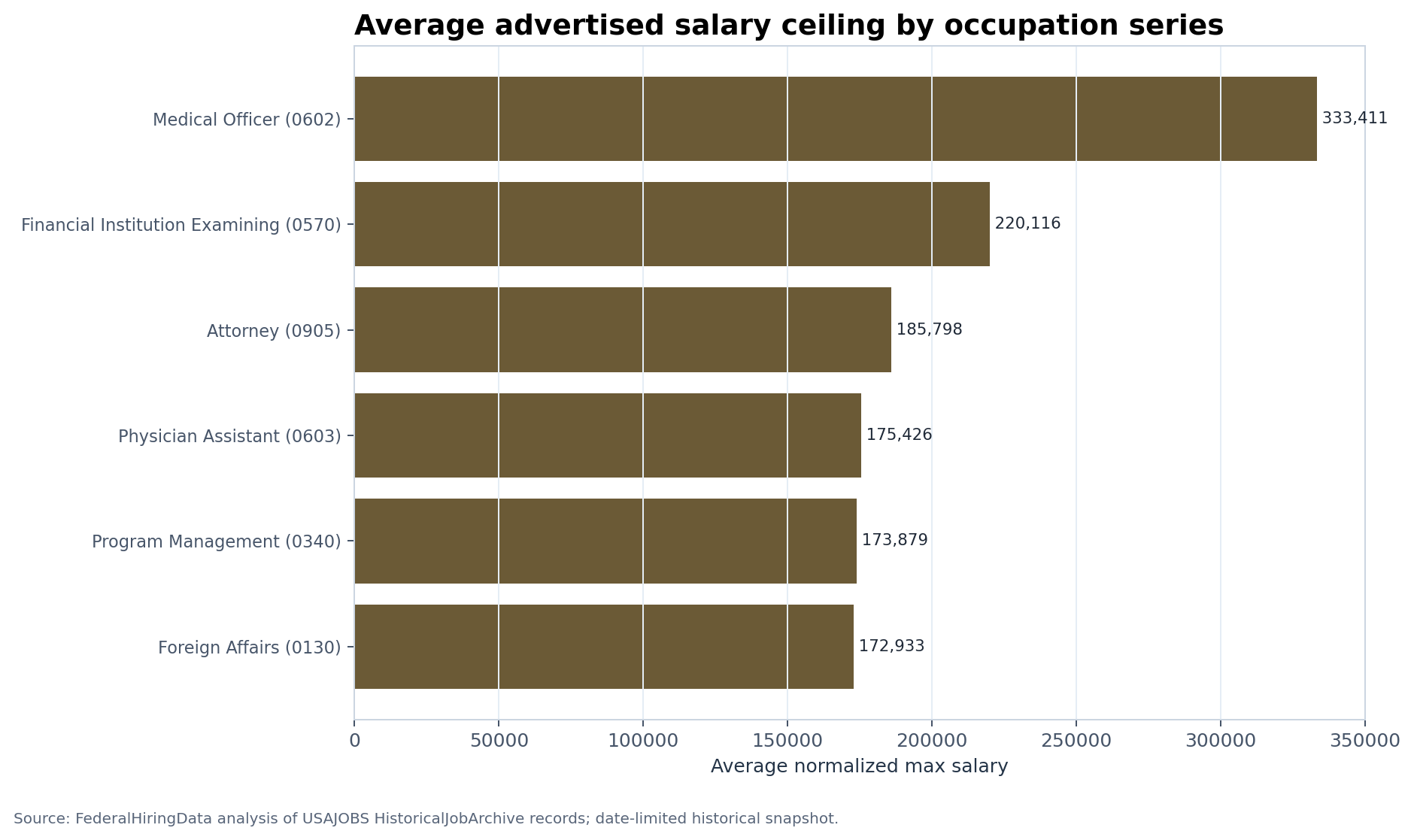
The same archive records show that high-volume series and high-salary series were not always the same.
| Series | Records | Avg. max salary | Median max | Highest max |
|---|---|---|---|---|
| Medical Officer (0602) | 217 | $333,411 | $320,000 | $400,000 |
| Financial Institution Examining (0570) | 69 | $220,116 | $221,235 | $316,600 |
| Attorney (0905) | 148 | $185,798 | $191,900 | $284,600 |
| Physician Assistant (0603) | 44 | $175,426 | $172,218 | $246,400 |
| Program Management (0340) | 217 | $173,879 | $181,216 | $291,900 |
| Foreign Affairs (0130) | 45 | $172,933 | $181,216 | $221,900 |
Medical Officer (0602) had a much higher advertised salary ceiling than the top administrative and IT series, with an average normalized maximum above $333,000 in this Jan. 24 snapshot. That does not mean a medical officer would receive that salary. It means the announcements included high maximums, often for specialized clinical roles.
What this means for search behavior
For applicants, the practical lesson is to search by both keyword and series where possible. A title-only search can miss similar work posted under a different title. A series-only search can be too broad. The best view combines title, series, agency, location, grade, and pay filters.
For analysts, January 2025 shows how public posting demand was distributed across the federal labor market. Administrative and analysis series provided the largest visible announcement base, IT remained a major category, and health-care series supplied both volume and high salary ceilings.
Methodology and limitations
This article is a FederalHiringData historical reconstruction. It uses USAJOBS HistoricalJobArchive records with announcement close dates on or before 2025-01-24. The analysis date shown to readers is 2025-01-24; the actual publication timestamp is preserved separately in the production Article row and in Article schema metadata.
The dataset counts job announcements, not hires, selections, applicants, certificates, or filled positions. A single announcement may represent one vacancy, many vacancies, or a continuing recruitment need. FederalHiringData normalizes fields such as agency, occupation series, salary range, location count, and open/close dates where the source data supports it, but the underlying announcement text remains the controlling source.
The article uses 18,624 archive records in its primary snapshot. Historical USAJOBS announcements can be amended, cancelled, or structured differently across agencies. Salary maximums are advertised maximums from normalized announcement data and should not be read as guaranteed pay for any applicant. Advertised locations are not the same as OPM duty-station employment counts.
The historical-as-of date is a reporting cutoff, not a claim that this web page existed on that date. FederalHiringData preserved the actual publication and edit timestamps in the article record and uses the January 2025 date to tell readers which archive slice the analysis reflects. Question Intelligence helped select the topic because people search for these answers, but forum posts are not used as evidence for the numerical claims.
Null or ambiguous source fields are not silently converted into confident labels. When the article describes agency, occupation, salary, duration, or location patterns, it is describing the normalized rows available for that specific cutoff. Later backfills can improve coverage, but this pilot avoids retroactively using later January or later-year data in articles assigned to earlier January cutoffs.
Sources: FederalHiringData HistoricalJobArchive; USAJOBS; USAJOBS API documentation. Photo: Yohan Marion via Unsplash, used under the Unsplash License.
Keep reading
Related federal hiring research
Article data window: FY2019-FY2025
Contract Spending and Federal Headcount Often Moved Independently
Across a bounded 28-agency sample, contract-obligation growth and covered headcount growth had only a 0.169 correlation; five agencies increased obligations while headcount fell.
Article data window: Jan. 1-14, 2026
Federal Healthcare Hiring Led Early January 2026 Job Announcements
Veterans Health Administration, nurse roles, medical officers, and other clinical and support occupations drove the strongest healthcare signal in the early January archive.
Article data window: Jan. 1-14, 2026
Federal Hiring Trends: Jan. 1-7 vs Jan. 8-14, 2026
Veterans Health Administration stayed dominant, nurse and medical roles strengthened, and remote-work signals remained too sparse for a public trend claim.
Federal Hiring Data Weekly
Subscribe to Federal Hiring Data Weekly.
Subscribe to Federal Hiring Data Weekly. Confirm your email after signing up to receive federal hiring trends, salary data, agency movements, and original research.