August 20, 2026
106,533 Applications, 2,610 Academy Graduates: Why the FAA Still Has a Controller Shortage
FAA has abundant applicant interest, but its audited funnel reaches only 2,610 Academy graduates before years of facility training. The binding constraint is certification capacity.
By Evan Mercer
Published August 20, 2026Last edited August 20, 2026
The Federal Aviation Administration has never lacked people willing to become air traffic controllers. A January 2026 Government Accountability Office article said about 200,000 people had applied over the previous several years. The larger question is what happened after they raised their hands.
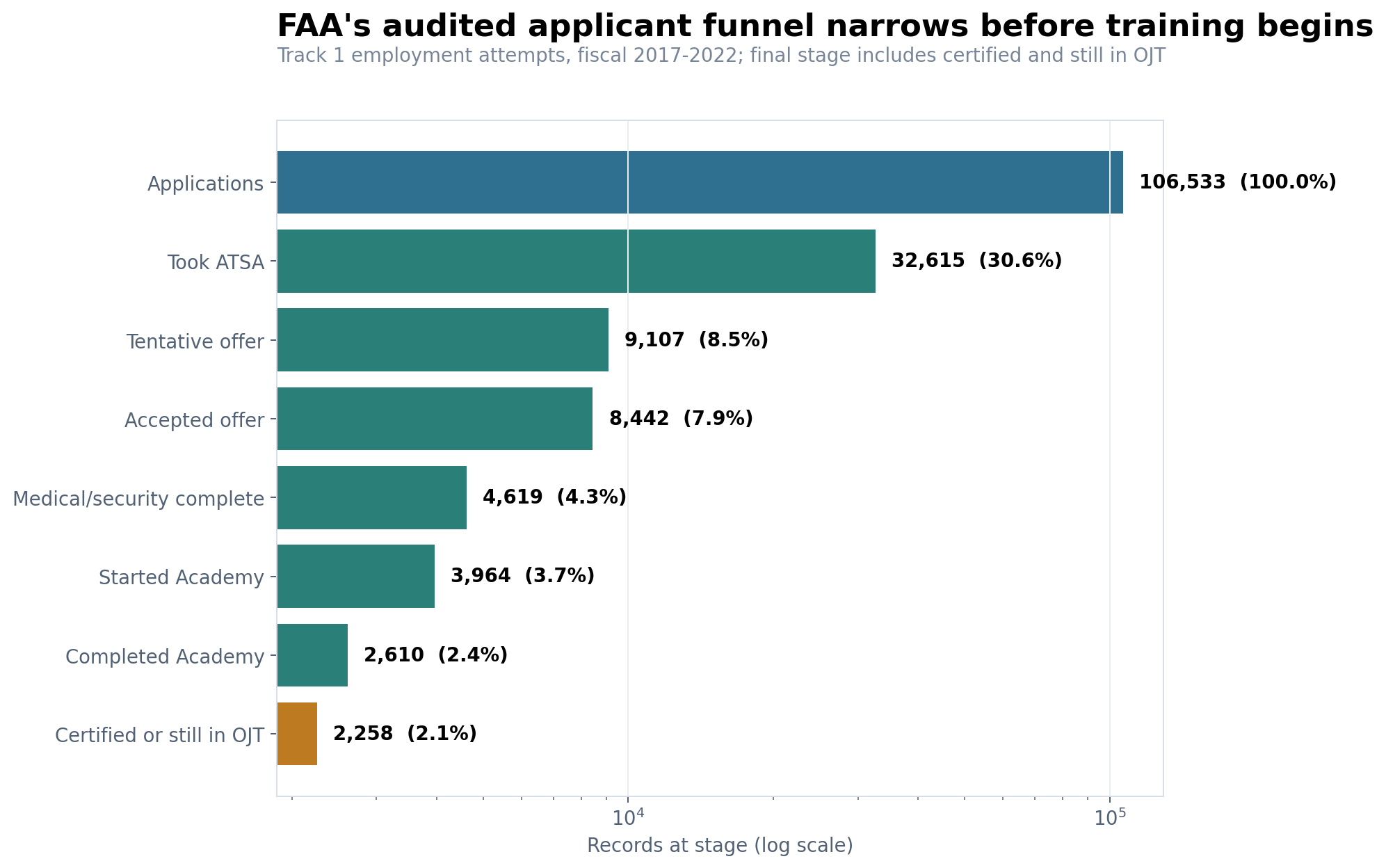
The most precise public answer is smaller than 200,000 and more revealing. GAO reconstructed 106,533 Track 1 application attempts from fiscal 2017 through 2022. Only 32,615 reached the Air Traffic Skills Assessment. There were 9,107 tentative offers, 3,964 starts at the FAA Academy and 2,610 Academy completions. GAO's final observed group contained 2,258 people who had either become fully certified or were still in facility training.
That last number is not a count of certified professional controllers. Nor are the 106,533 applications unique people: GAO says one person could apply more than once, and it matched records by employment attempt. The agency's broad "about 200,000" description captures public interest, but it cannot be used as the denominator for a certification rate.
The audited cohort still establishes the central fact. FAA does not have a raw applicant-interest problem. It has a conversion problem spread across testing, medical and security reviews, the Academy, and years of facility training. The final stage depends on certified controllers taking time away from live operations to train the people who are supposed to relieve them.
| Track 1 stage, FY2017-FY2022 | Records | Share of application attempts |
|---|---|---|
| Applications | 106,533 | 100.0% |
| Took the ATSA | 32,615 | 30.6% |
| Tentative offer provided | 9,107 | 8.5% |
| Tentative offer accepted | 8,442 | 7.9% |
| Medical and security completed | 4,619 | 4.3% |
| Started FAA Academy | 3,964 | 3.7% |
| Completed FAA Academy | 2,610 | 2.4% |
| Fully certified or still in facility OJT | 2,258 | 2.1% |
What does the 200,000-applicant claim actually measure?
GAO's January 2026 public summary says about 200,000 applicants expressed interest over several years. Its underlying December 2025 report does not define a 200,000-person cohort. It does report 132,152 applications from fiscal 2017 through 2024 after merging three FAA systems, and it limits the outcome analysis to 106,533 Track 1 attempts from fiscal 2017 through 2022 because full certification can take years.
That distinction matters. Calling 106,533 records "people" would overstate the pool because some candidates applied repeatedly. Calling the final 2,258 "certified" would overstate the output because it includes people still in on-the-job training. GAO also describes the cohort as illustrative rather than exact: it excluded 233 unreliable records and retained 338 records with missing clearance fields.
Even with those cautions, the losses are too large to dismiss as record-linkage noise. About 62% of invited candidates did not take the ATSA, and another 32% of test takers did not advance because of their scores.
The 2022 campaign shows why a giant top-of-funnel number can be misleading. It generated 57,970 applications, but 11,662 applicants took the ATSA, 3,801 received tentative offers, 1,038 started the Academy and 637 graduated. GAO observed 621 as either certified or still in training. More interest filled the first box; it did not expand every box that followed.
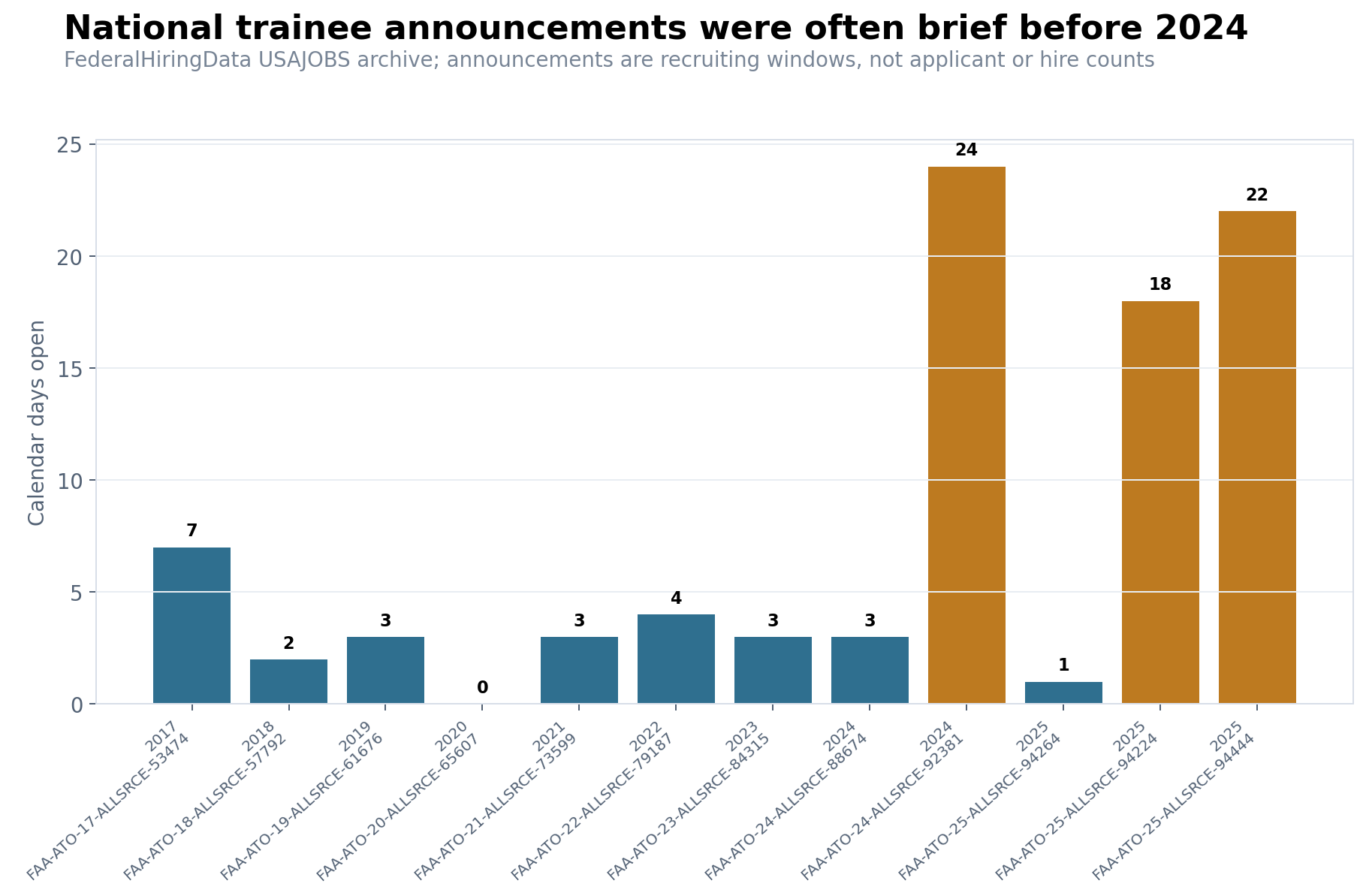
FederalHiringData's USAJOBS archive supplies a second view. National trainee announcements were commonly open for a week or less from 2017 through early 2024, while later campaigns stayed open much longer. Postings document recruiting windows, not applications, vacancies or hires.
Why can a tentative offer still lead to years of waiting?
The first large post-offer reduction occurs before Oklahoma City. GAO found 8,442 accepted tentative offers but 4,619 completed medical and security reviews. For all applicants in the cohort, medical clearance averaged four to eight months. Candidates sent for further psychological evaluation waited more than two years on average.
The pending workload grew even as FAA tried to accelerate decisions. It rose from about 2,600 candidates in August 2024 to 4,600 in June 2025, with roughly 1,000 awaiting further psychological evaluation at the later date. Recruiting success can accumulate as pending inventory instead of reaching the Academy.
The occupation also has a narrow entry clock. A first appointment generally must occur before age 31. A prior-experience track permits entry through age 35 but requires 52 consecutive weeks of relevant experience during the previous five years.
FAA reports meaningful recent improvements. Its 2026 Controller Workforce Plan says the agency removed about five months from hiring and moved 2025 applicants into the Academy four times faster than before. The April 2026 hiring campaign closed at 8,000 applications. Faster processing can reduce candidate loss. It cannot by itself create classroom seats, instructors or facility training hours.
Why is Academy graduation only the middle of the pipeline?
FAA's Academy teaches basics and then routes trainees into terminal or en route instruction. GAO describes the full Academy period as roughly four to six months, with a 70% passing threshold.
In the audited Track 1 cohort, 3,964 people started the Academy and 2,610 completed it, a 65.8% completion rate. That is a real safety and aptitude screen, not merely an administrative delay. It is also a capacity limit. FAA's workforce plan directly states: "Training capacity remains the primary constraint on workforce growth."
Academy graduation produces a developmental controller, not a certified professional controller. Graduates report to a facility, learn positions one by one and work live traffic under the supervision of certified controllers. FAA tells applicants to expect another two to three years of facility training. GAO's broader estimate is two to six years from application to full certification, depending on the facility and the person's progress.
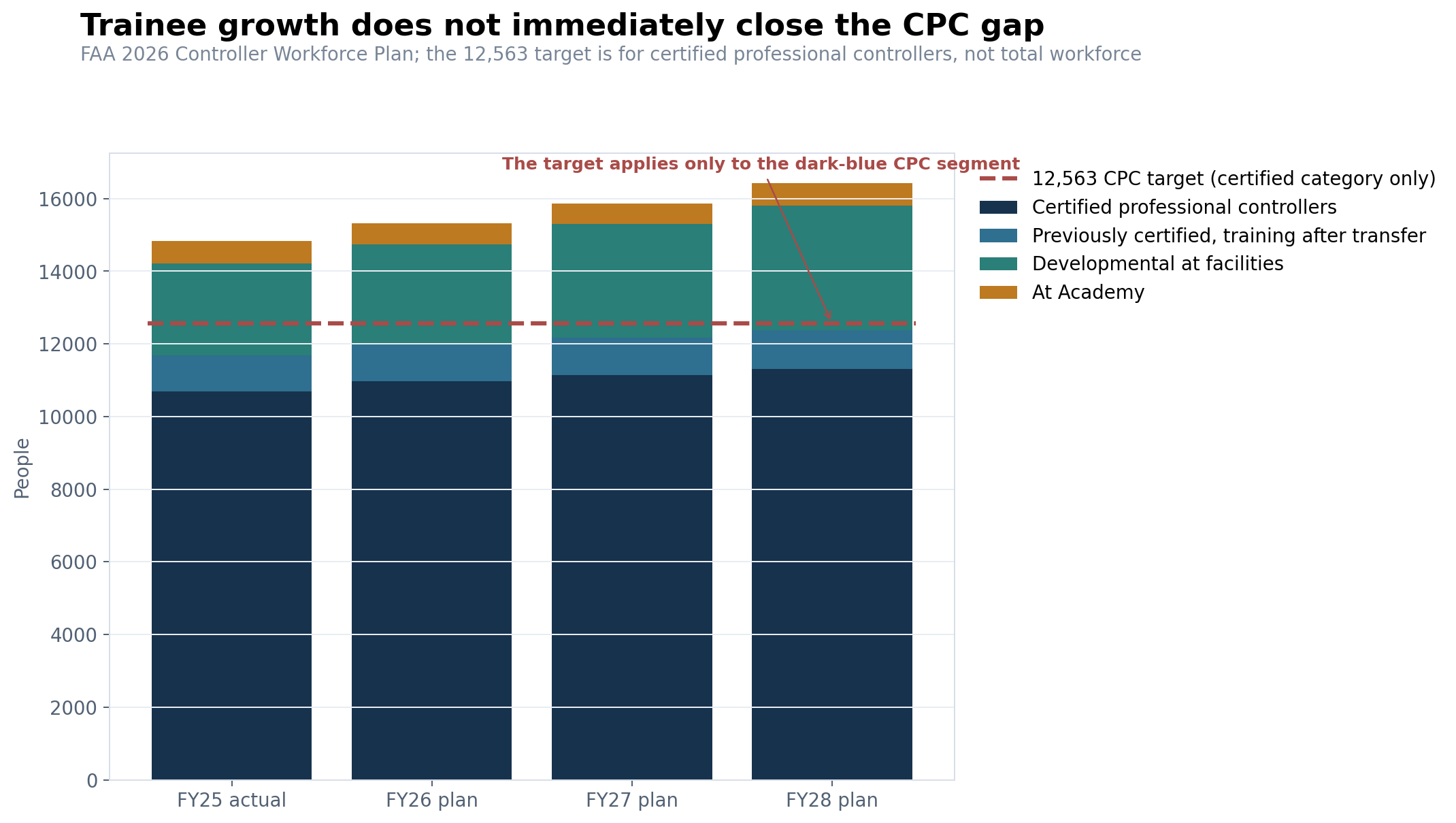
This creates a lag between record hiring and usable certified capacity. FAA's September 2025 snapshot counted 10,693 certified professional controllers, 1,001 previously certified controllers training after a transfer, 2,529 developmental controllers at facilities, 608 Academy students and one person on detail. That is 14,832 people across categories, but only the 10,693 CPCs count toward FAA's 12,563 full-staffing CPC target.
| FAA workforce category | FY2025 actual | FY2028 plan |
|---|---|---|
| Certified professional controllers | 10,693 | 11,312 |
| Certified controllers training after transfer | 1,001 | 1,060 |
| Developmental controllers at facilities | 2,529 | 3,433 |
| Academy students | 608 | 619 |
| Total, including people on detail | 14,832 | 16,425 |
| Gap between CPC count and 12,563 CPC target | 1,870 | 1,251 |
How does the shortage slow the training needed to fix it?
The strongest evidence of the feedback loop comes from the Transportation Department inspector general's June 2026 facility-training audit. Facility on-the-job training is one-on-one. A certified controller monitors and instructs a trainee while both work live traffic. When a facility is short, the same CPC may be needed to cover a position, take leave, work overtime and train a new arrival.
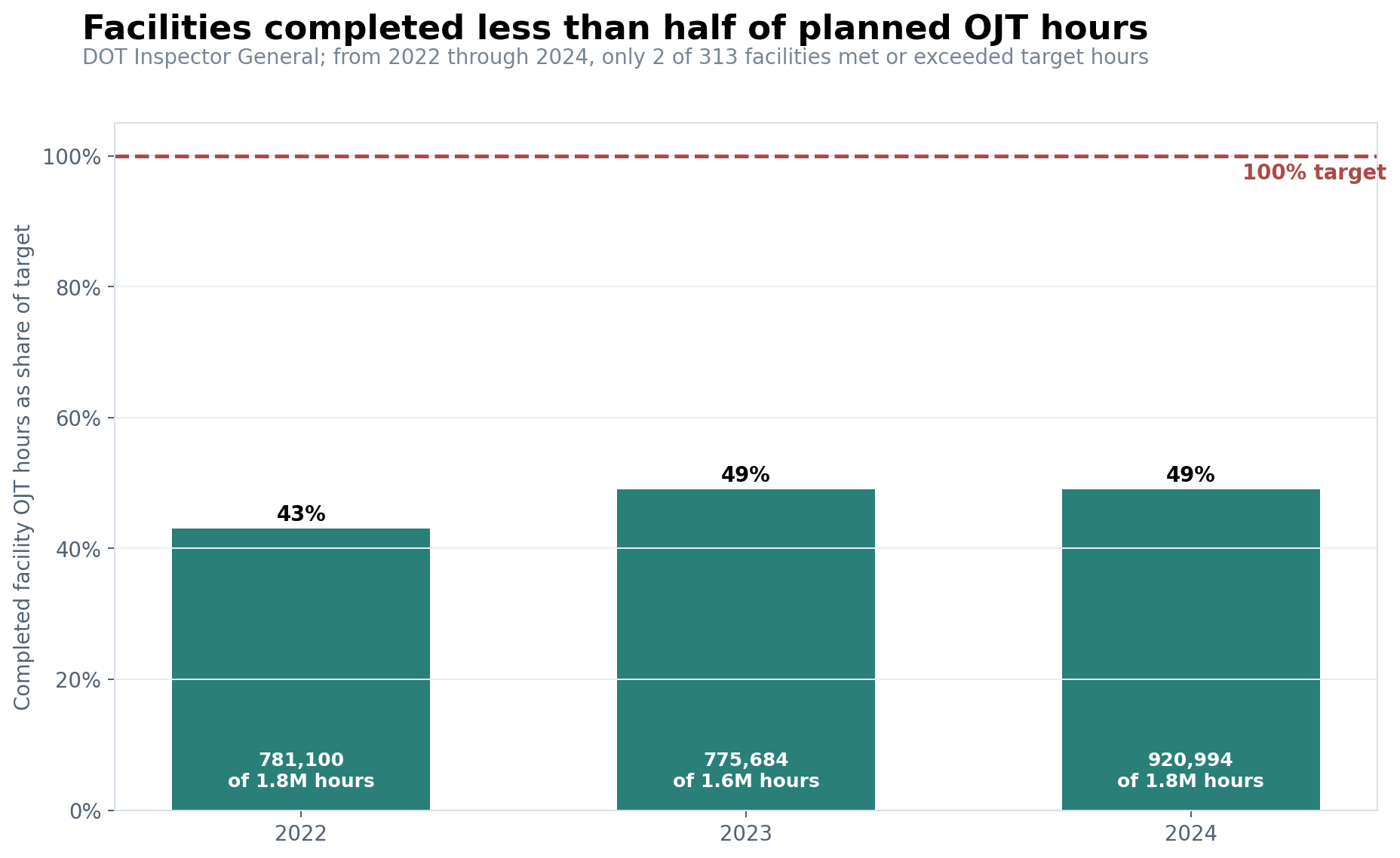
FAA's National Training Initiative set hourly targets to make training more regular. From 2022 through 2024, facilities collectively completed only 43% to 49% of target hours. Just 2 of 313 facilities met or exceeded their target hours across that period. During one week in spring 2025, 2,293 of 3,132 trainees, or 73%, missed their hourly expectation. OIG found 45% of trainees were not consistently receiving on-position training at least once a week.
| Facility OJT measure | FY2022 | FY2023 | FY2024 |
|---|---|---|---|
| Target hours | 1.80 million | 1.60 million | 1.80 million |
| Completed hours | 781,100 | 775,684 | 920,994 |
| Share of target | 43% | 49% | 49% |
Seven facilities told OIG that staffing shortages and leave were their largest impediments. At a thinly staffed facility, a partly certified controller may need to work traffic in positions already earned rather than train on the next one. OIG also raised concerns about instructor preparation and performance measurement.
FAA's response is important counterevidence. The agency said OIG's weekly statistic covered on-position instruction and omitted classroom, simulation and other training. It also said some recorded impediments, including planned leave and unavailable traffic, are normal. The National Training Initiative did coincide with a large improvement: average facility certification time fell from a December 2022 peak of 137 weeks to 83.11 weeks in December 2025, below the 99.62-week July 2022 baseline.
Both findings can be true. Certification became faster while most facilities continued to miss an ambitious hourly target. The improvement shows management and technology can increase throughput. The remaining gap shows why Academy output alone is not a staffing solution.
What does overtime reveal about the staffing constraint?
FAA has increasingly used overtime to cover the system while rebuilding. Controller overtime rose from $64 million in fiscal 2008 to $259 million in fiscal 2025. Reported overtime use increased from 2.4% to 7.3% of straight time. The sharpest sustained rise began after 2021.
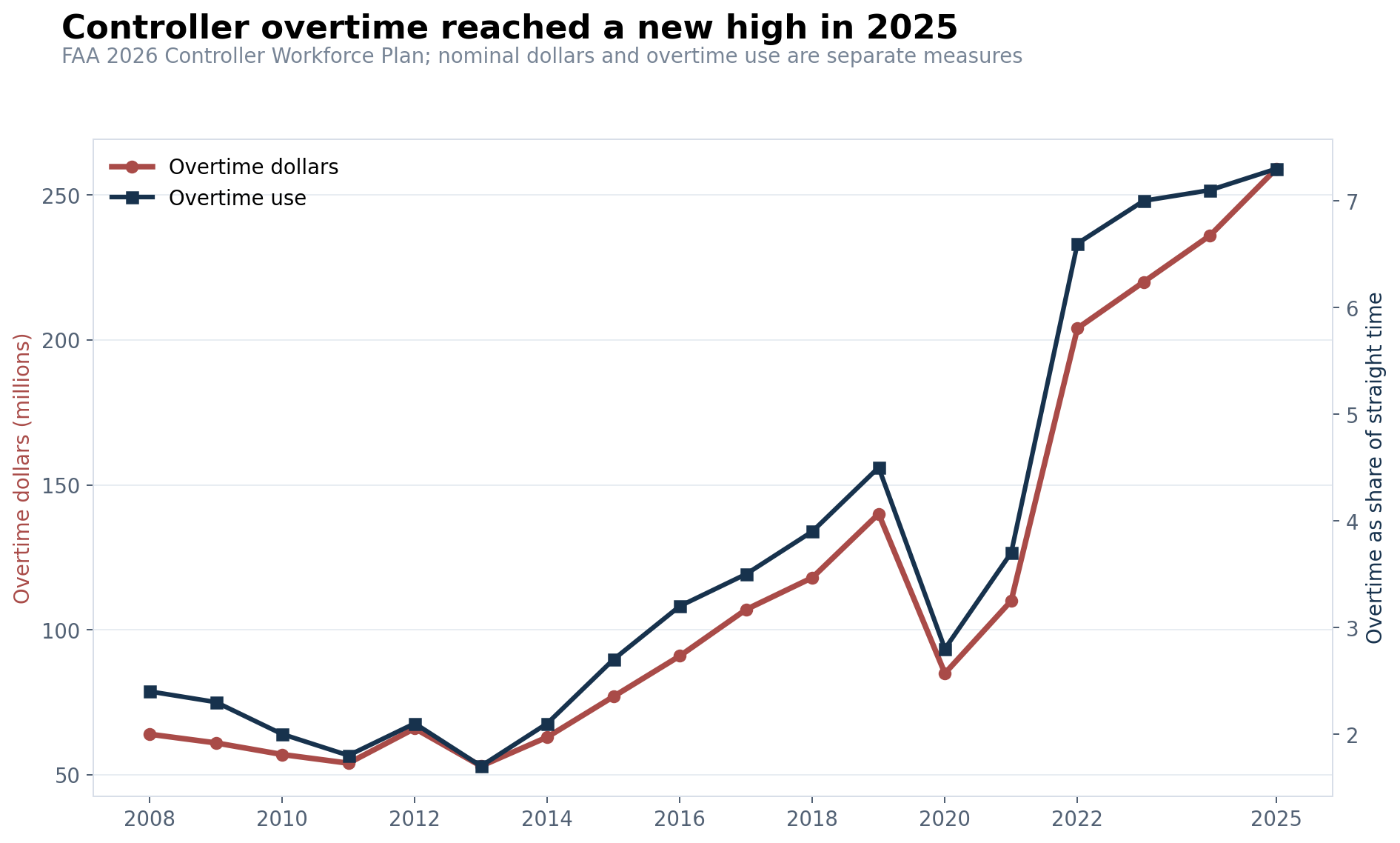
Overtime is not proof that every facility is unsafe, and dollar totals are nominal rather than inflation-adjusted. FAA's own plan nevertheless says recent overtime grew beyond a reasonable level and links chronic use to fatigue, burnout and retention risk. The National Transportation Safety Board pushed for longer rest periods in 2024; FAA then required at least 10 hours between shifts and 12 before a midnight shift.
The relationship to training is circular. Overtime supplies an experienced controller for today's operation. A six-day schedule can leave less flexibility for instruction and recovery. Delayed certification then preserves the shortage that made overtime necessary.
How much does the 1981 strike still explain?
The 1981 Professional Air Traffic Controllers Organization strike and the firing of more than 11,000 controllers created a historic staffing shock. FAA hired heavily from 1982 through 1990, especially in the first half of that period. By the late 1990s and early 2000s, oversight agencies were warning that the replacement cohort would become retirement-eligible together.
That wave arrived, but it is no longer a sufficient explanation. FAA's current plan identifies fiscal 2007 as the peak retirement year for controllers hired after the strike and says the retirement wave has passed. The agency recorded 1,159 retirements over the most recent five years and expects 717 from fiscal 2026 through 2028. Only about 24% of controllers retire in the first year they become eligible.
Later shutdowns interrupted hiring and training. COVID-19 paused Academy instruction for four months, reduced capacity for roughly two years and slowed facility OJT. FAA also missed hiring plans in fiscal 2013-2015, 2019 and 2021.
| Period | What changed | Why it matters now |
|---|---|---|
| 1981-1990 | More than 11,000 strikers fired; mass replacement hiring followed | Created a large cohort with similar retirement timing |
| FY2007 | FAA identifies the peak replacement-cohort retirement year | The old retirement wave has passed |
| 2013-2015 | Shutdown and hiring shortfalls | Reduced the cohort now reaching full experience |
| 2018-2021 | Shutdown, pandemic Academy pause and OJT restrictions | Depressed hiring and delayed certification |
| 2022-2026 | Record applicant interest, faster entry and expanding training | Pipeline is growing, but the facility bottleneck remains |
Is the rebuilding effort producing measurable gains?
FAA hired 2,028 trainees in fiscal 2025, a record and slightly above its goal. It plans 2,200 hires in 2026, 2,300 in 2027 and 2,400 in 2028. It expanded Academy on-site capacity nearly 30% in 2025, reported filling almost every available seat and raised Academy student pay by 30%. The agency also uses retention incentives for eligible controllers; about 400 accepted in fiscal 2025 at a reported cost of $12.3 million.
OPM data shows a broader recovery. FederalHiringData's read-only workforce warehouse counted 17,776 FAA employees in occupational series 2152 in December 2022 and 19,800 in June 2026. Accessions exceeded separations by 482 in 2023, 504 in 2024, 586 in 2025 and 608 during the first six months of 2026.
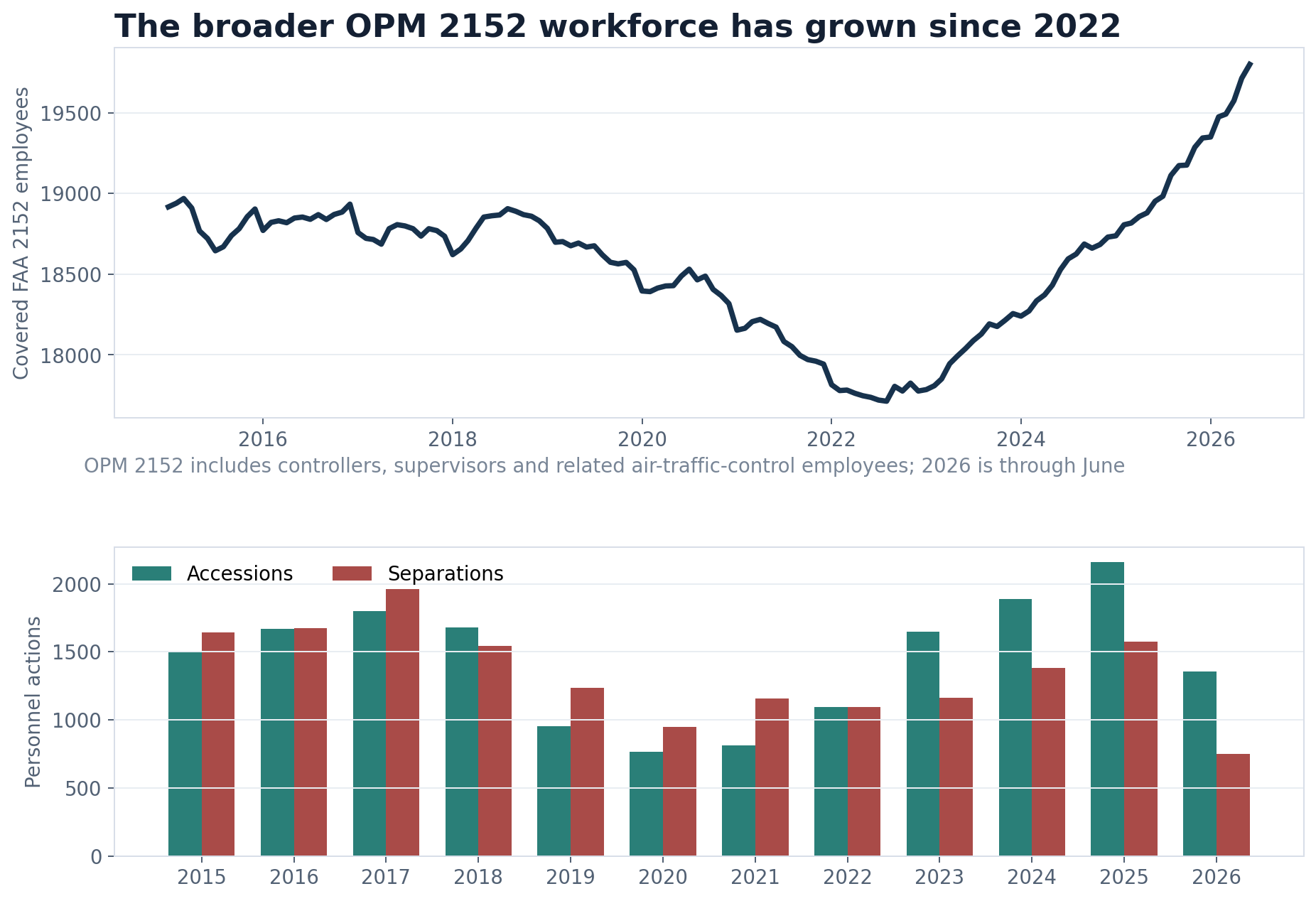
That 19,800 is not an operational CPC count. OPM series 2152 includes controllers, supervisors and related employees. It shows the broader occupation is growing, not that every facility has reached its CPC target.
FAA also offers a useful challenge to simple shortage narratives. Its 2026 plan says total controller headcount is 3% below the fiscal 2000 high while traffic is 16% below that high. Separately, GAO reports that flights rose about 10% from 2015 through 2024 while its controller total fell 6%. Those comparisons use different starting points and measures. The fair conclusion is not that traffic alone explains the shortage. Distribution, certification level, facility complexity, scheduling and training capacity determine whether aggregate headcount can staff the operation.
Which reforms can change the conversion rate?
Several current reforms attack different stages of the funnel. None is a complete substitute for the others.
| Reform | Evidence of progress | Remaining limit |
|---|---|---|
| Faster pre-employment processing | FAA says it cut about five months and moved 2025 applicants to the Academy four times faster | Medical and psychological review can still take years for some candidates |
| Expanded Academy capacity | On-site capacity rose nearly 30% in 2025; instructors also increased | FAA still calls training capacity the primary constraint |
| Enhanced Collegiate Training Initiative | Approved programs can provide Academy-equivalent training and let graduates bypass Oklahoma City | Graduates still face ATSA, selection, medical/security and facility certification; the pathway is new |
| Facility simulators | FAA estimates simulation can reduce certification time by up to 27% when paired with live OJT | Some facilities share equipment and reported waits as long as four months |
| Higher OJT instructor premium | Supplemental pay rose from 10% to 25% and training hours increased | OIG found instructor cost rose 160% while hours rose less than 20% |
| Scheduling changes | FAA says raising average position time from about four hours to more than five could help meet staffing goals | Scheduling remains largely local and manual; this is a plan, not a measured result |
Enhanced CTI adds training capacity outside the Academy. Approved programs can deliver Academy-equivalent instruction and send qualified graduates directly to facilities after the usual selection and clearances. The program should be judged on certification and retention, not the number of colleges approved.
Simulation is similarly promising but conditional. A tower or radar simulator can give trainees repetitions that live traffic may not provide on demand. It does not eliminate the need to demonstrate proficiency with real aircraft under a certified controller's supervision.
Why the applicant pool did not become a staffed system
The controller pipeline is not a single hiring event. It is a sequence of constrained systems. A massive application window can overwhelm testing. A test score does not complete medical review. A tentative offer does not create an Academy seat. An Academy graduate does not fill a certified position. A facility cannot manufacture instruction hours when its experienced controllers are already covering traffic and overtime.
The current direction is better than the bleakest reading of the numbers. Hiring is at a record, OPM's broader 2152 workforce is growing, Academy capacity has expanded and average facility certification time has fallen. Yet FAA's own projection reaches 11,312 CPCs in fiscal 2028, still 1,251 below its 12,563 target. The plan also forecasts 1,711 to 1,843 annual losses, including 743 to 775 Academy attritions each year.
That is why 200,000 expressions of interest could coexist with a shortage. Interest arrives at the widest end of the funnel. The scarce resource is the capacity to evaluate, teach and certify candidates without weakening the live system that must train them.
The scorecard is not application volume alone. It is new CPCs, time to Academy, Academy completion, facility certification time, training hours, and retention. Those measures show whether faster entry becomes durable capacity rather than a larger queue. FAA publishes pieces of that scorecard, but its disconnected hiring and training systems still make a single end-to-end measure difficult.
Methodology and limitations
The applicant funnel comes from GAO's merged FAA hiring and training records for Track 1 employment attempts in fiscal 2017-2022. GAO's broader merged file contained 132,152 applications through fiscal 2024, but later cohorts did not have enough time for comparable outcomes. This article does not treat application attempts as unique people or the final certified-or-training group as fully certified.
Current workforce categories, hiring plans, overtime, retirement projections and reform claims come from FAA's 2026 Controller Workforce Plan. The plan's September 2025 facility total is 14,223, plus 608 Academy students and one person on detail. GAO lists 13,164 controllers for fiscal 2025 under an apparently similar facility definition. The public documents do not reconcile the 1,059-person difference, so their totals are not silently joined into one trend line.
Facility training evidence comes from the Transportation Department inspector general. FAA's response and documented improvement in average certification time are included. A separate Academy audit announced in February 2026 is not complete, so no findings are attributed to it.
OPM calculations filter FAA subelement TD03 and occupational series 2152 in FederalHiringData's local research warehouse. That series is broader than FAA's CPC definition. USAJOBS calculations use archived national FAA trainee announcements; postings do not measure applications, vacancies, selections or hires. Historical milestones use GAO and FAA reports whose workforce definitions change over time.
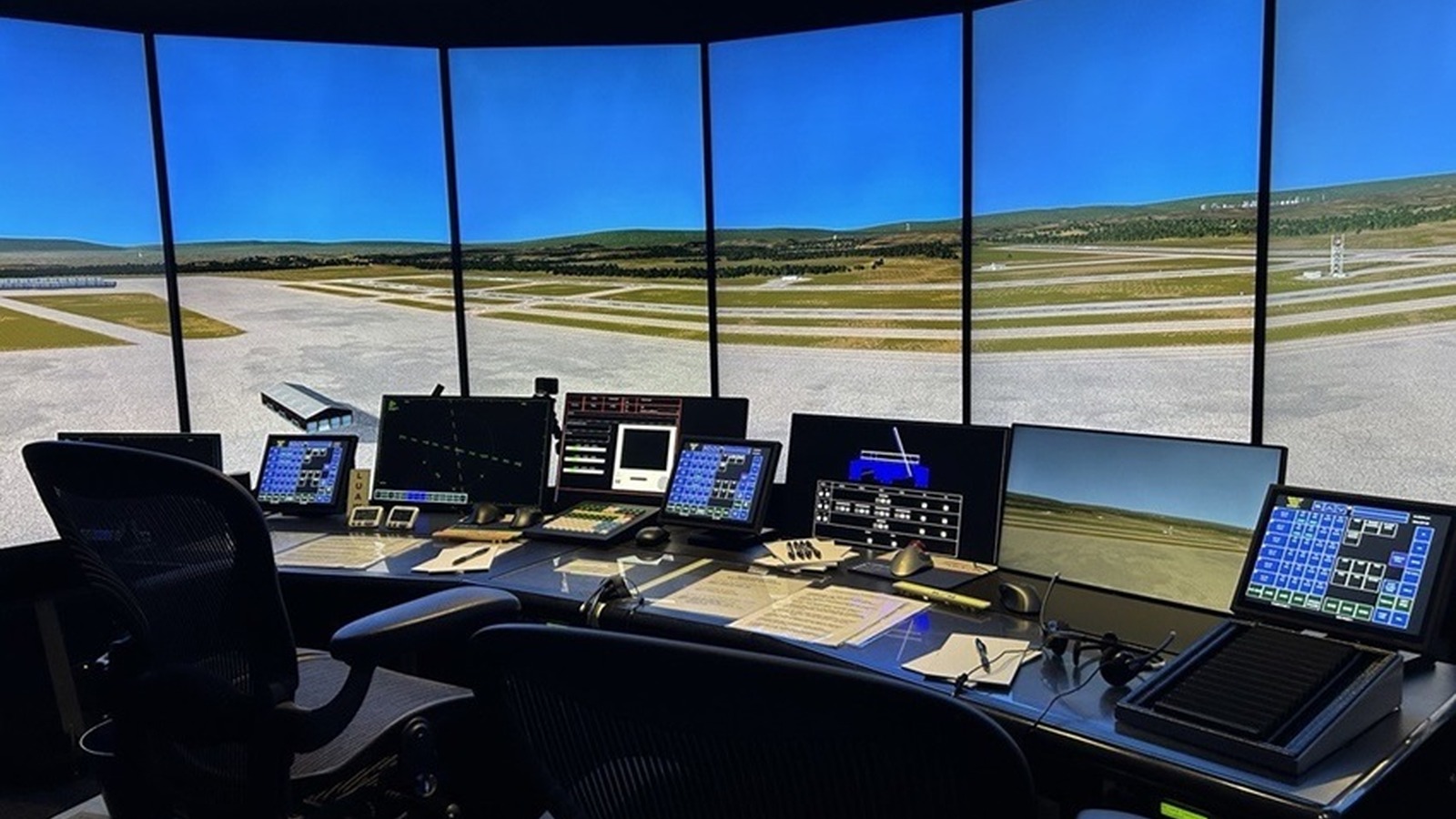
The hero image shows an FAA air traffic control tower simulator, a federal-government image from the FAA's Summer Slice. Explore current FAA jobs, federal workforce statistics, agency profiles and more FederalHiringData investigations.
Keep reading
Related federal hiring research
Article data window: FY2019-FY2025
Contract Spending and Federal Headcount Often Moved Independently
Across a bounded 28-agency sample, contract-obligation growth and covered headcount growth had only a 0.169 correlation; five agencies increased obligations while headcount fell.
Article data window: Jan. 1-14, 2026
Federal Healthcare Hiring Led Early January 2026 Job Announcements
Veterans Health Administration, nurse roles, medical officers, and other clinical and support occupations drove the strongest healthcare signal in the early January archive.
Article data window: Jan. 1-14, 2026
Federal Hiring Trends: Jan. 1-7 vs Jan. 8-14, 2026
Veterans Health Administration stayed dominant, nurse and medical roles strengthened, and remote-work signals remained too sparse for a public trend claim.
Federal Hiring Data Weekly
Subscribe to Federal Hiring Data Weekly.
Subscribe to Federal Hiring Data Weekly. Confirm your email after signing up to receive federal hiring trends, salary data, agency movements, and original research.