August 18, 2026
Federal 1811 Hiring by the Numbers: 12,376 Criminal Investigator Announcements
A March 2017-August 2026 archive shows where 12,376 Criminal Investigation series announcements appeared, what they paid and how often 2026 records named a clearance level.
Published August 18, 2026Last edited August 18, 2026
Federal criminal-investigator jobs are concentrated but not confined to a single famous agency. FederalHiringData found 12,376 public announcements linked to occupational series 1811 from March 2017 through Aug. 14, 2026.
The Drug Enforcement Administration led the archive with 2,065 announcements. Several inspectors general, ATF, Immigration and Customs Enforcement, the Secret Service and Army Criminal Investigation also appeared prominently.
What 1811 means
OPM's 1811 qualification standard applies to Criminal Investigation positions. The classification standard describes work planning, conducting or managing investigations of suspected criminal violations of federal law.
That is narrower than "law enforcement" as a whole. Police (0083), security administration (0080), general inspection and compliance (1801), general investigation (1810), park ranger (0025) and other series can involve enforcement or public safety without being 1811 positions.
Which organizations advertised the most
| Hiring-agency label | 1811 announcements |
|---|---|
| Drug Enforcement Administration | 2,065 |
| Office of Inspector General | 1,183 |
| Bureau of Alcohol, Tobacco, Firearms, and Explosives | 1,081 |
| Office of the Inspector General | 634 |
| Immigration and Customs Enforcement | 535 |
| Office of the Inspector General, USPS | 533 |
| Veterans Affairs, Inspector General | 455 |
| U.S. Secret Service | 431 |
| Other Agencies and Independent Organizations | 408 |
| United States Army Criminal Investigation Division | 392 |
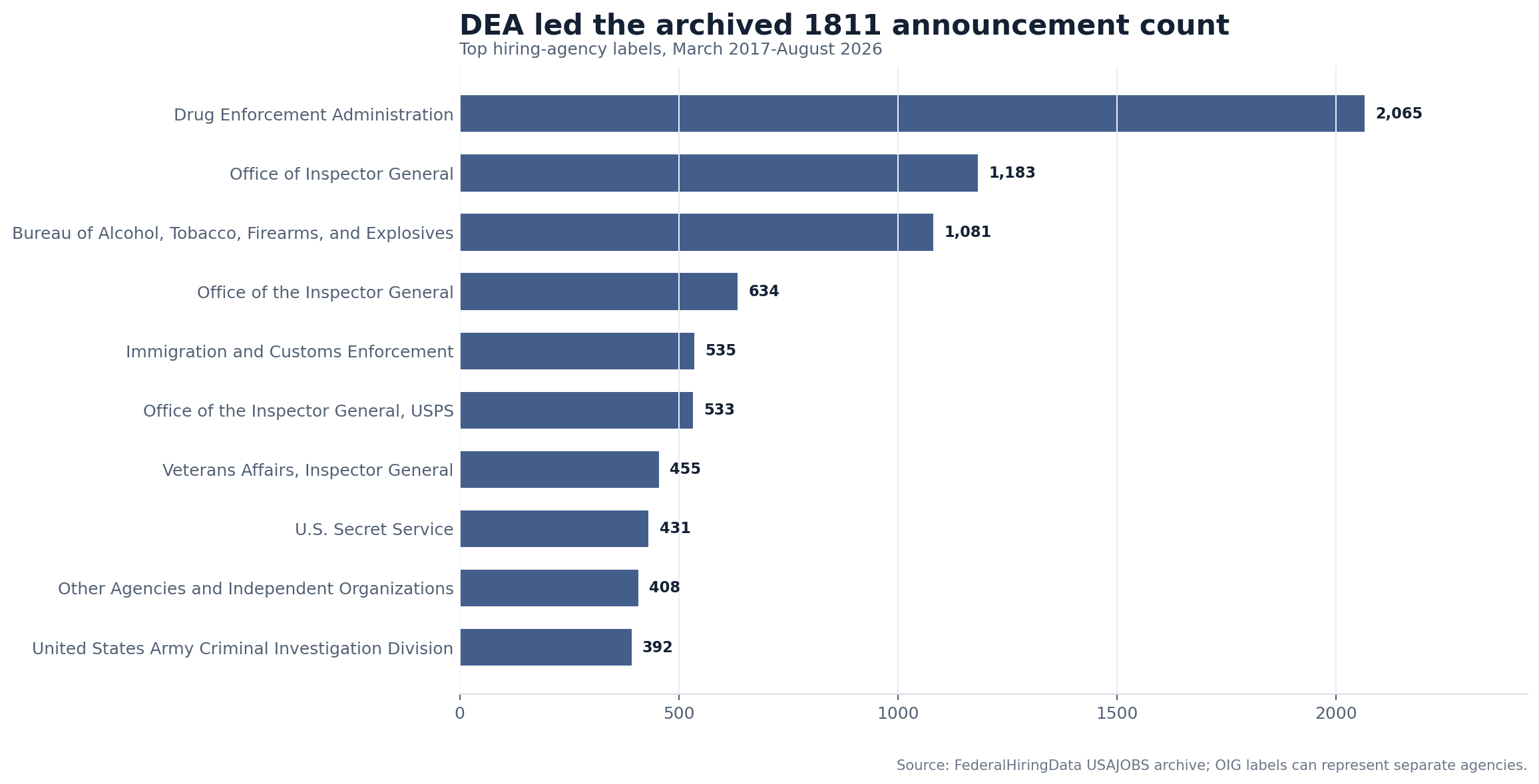
The two generic Office of Inspector General labels in the archive should not be collapsed into one organization. USAJOBS agency labels can represent distinct inspectors general, and a broad label is not enough to assign every record to a cabinet department without a stable organization code.
Series 1811 is narrower than the title "special agent"
Some agencies use "special agent" in an 1811 title, but titles alone are not a safe series classifier. Other investigative, inspection or protective work can use similar language under 1801, 1810 or another series. Conversely, an 1811 announcement may use a supervisory or senior-executive variation rather than putting "criminal investigator" first in the title.
FederalHiringData therefore counts normalized occupation links rather than keyword matches. That choice avoids pulling every job that mentions investigations into the 1811 total and avoids missing an 1811 record whose title emphasizes a specialty.
Volume changed over time
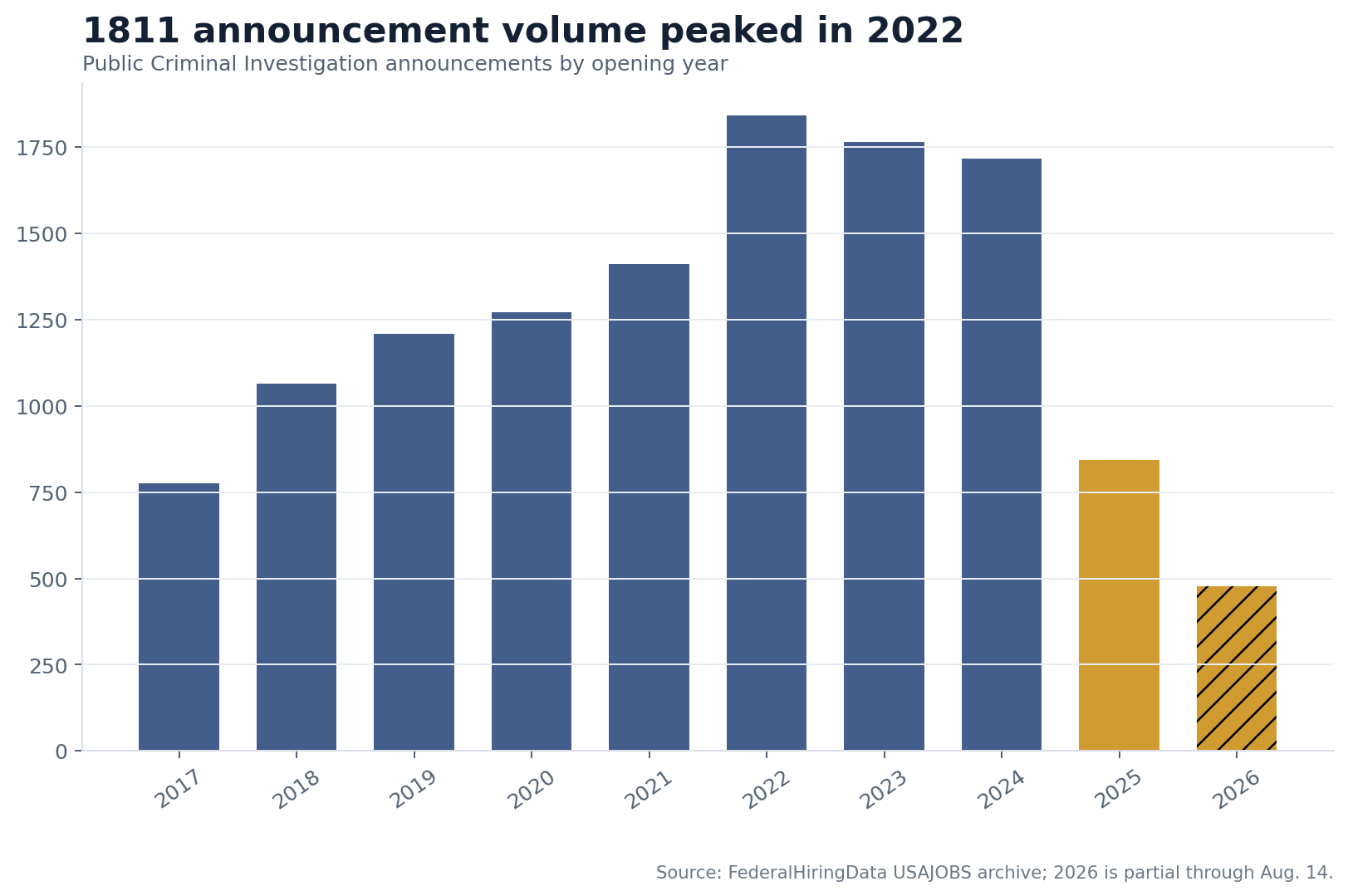
Annual 1811 volume rose from 776 announcements in 2017 to 1,843 in 2022, then eased to 1,766 in 2023 and 1,718 in 2024. The archive contains 842 opening in 2025 and 477 through Aug. 14, 2026.
The lower partial-year counts do not prove the number of agents hired fell by the same amount. Announcements are not hires, one announcement can list many vacancies, and agencies can use standing registers or other authorities.
The annual path also gives context to the current market. A single large agency campaign can move a small occupation's yearly total, while several inspector-general offices may recruit in small batches. Readers should treat the line as public recruiting activity, not authorized agent strength or completed academy classes.
Pay, clearance and telework signals
Among 1811 announcements with a valid annual salary range, the median advertised maximum was $137,243 and the 75th percentile was $159,950. Those are announcement ceilings, not starting salaries or guaranteed compensation.
In the 2026 current-source cohort, 288 of 477 1811 announcements named a Confidential, Secret, Top Secret or Top Secret/SCI level. Another 88 were telework eligible but not remote; none was confirmed remote. Field coverage for older archive rows is not comparable, so those percentages should not be projected backward.
What applicants should verify
Read the medical, physical, firearms, mobility, age, travel, clearance and law-enforcement retirement provisions in each announcement. Requirements vary by agency and position. A series label identifies the occupation, not a universal set of hiring conditions.
Applicants should also check the grade range and promotion potential. The archive cannot tell whether an individual was referred, passed an assessment, received a tentative offer or entered on duty.
Methodology and limitations
FederalHiringData joined active and historical announcements to normalized occupation links and retained distinct controls carrying series 1811. Annual counts use opening year. Salary statistics include only annual maximums from $1,000 through $500,000. Current remote, telework and clearance details use 2026 `Job` source rows because comparable fields are not present across the older Abigail archive.
Forum questions established demand for an 1811 overview. All definitions come from OPM and all counts come from the FederalHiringData archive.
Keep reading
Related federal hiring research
Article data window: FY2019-FY2025
Contract Spending and Federal Headcount Often Moved Independently
Across a bounded 28-agency sample, contract-obligation growth and covered headcount growth had only a 0.169 correlation; five agencies increased obligations while headcount fell.
Article data window: Jan. 1-14, 2026
Federal Healthcare Hiring Led Early January 2026 Job Announcements
Veterans Health Administration, nurse roles, medical officers, and other clinical and support occupations drove the strongest healthcare signal in the early January archive.
Article data window: Jan. 1-14, 2026
Federal Hiring Trends: Jan. 1-7 vs Jan. 8-14, 2026
Veterans Health Administration stayed dominant, nurse and medical roles strengthened, and remote-work signals remained too sparse for a public trend claim.
Federal Hiring Data Weekly
Subscribe to Federal Hiring Data Weekly.
Subscribe to Federal Hiring Data Weekly. Confirm your email after signing up to receive federal hiring trends, salary data, agency movements, and original research.