August 18, 2026
Federal 2210 Jobs by the Numbers: 120,410 IT Announcements Since 2017
The archive contains 120,410 Information Technology Management announcements, with a $122,683 median advertised annual maximum among valid salary ranges.
Published August 18, 2026Last edited August 18, 2026
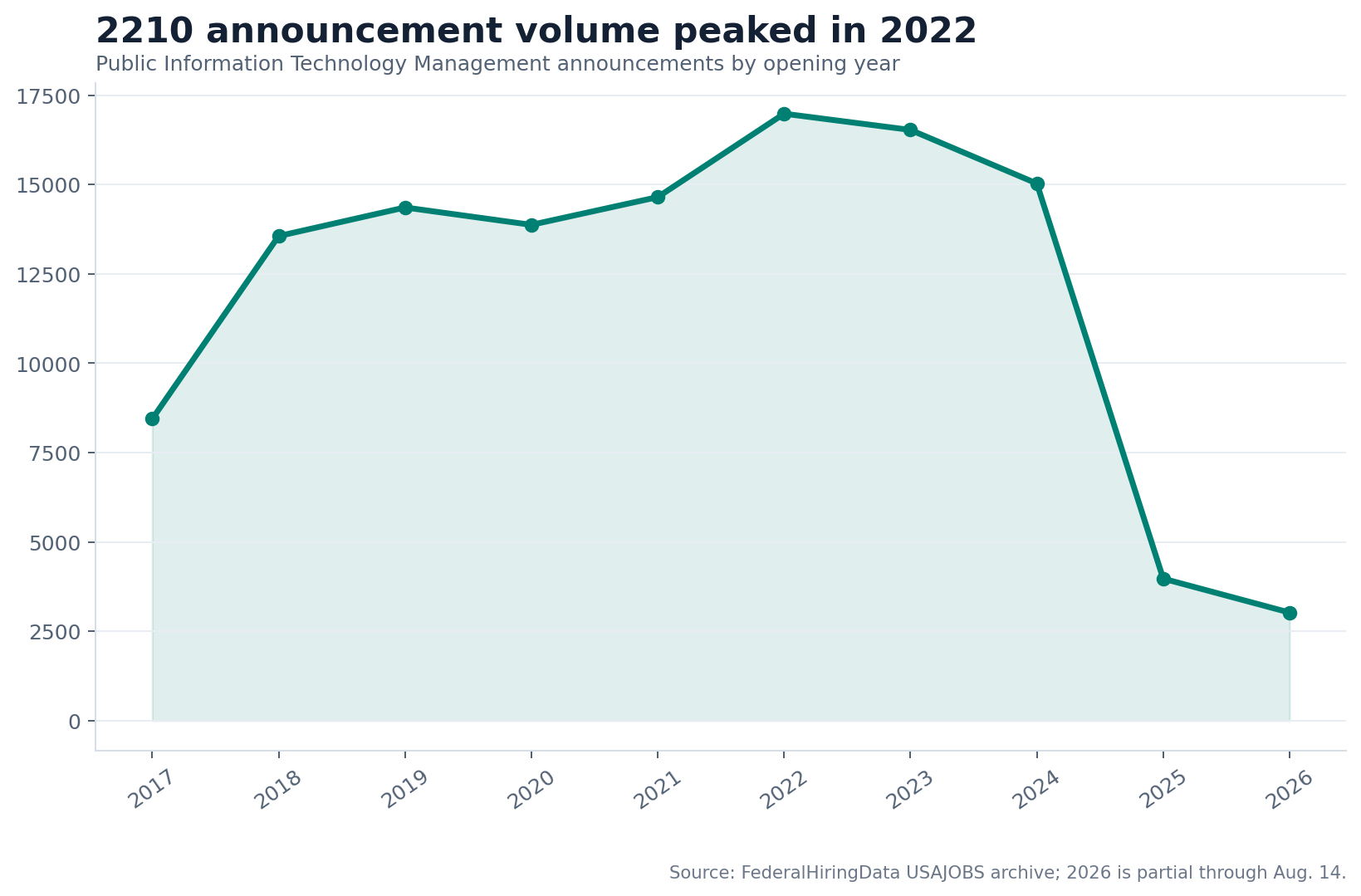
Information Technology Management, series 2210, is one of the federal government's largest professional job families. FederalHiringData found 120,410 public 2210 announcements opening from March 2017 through Aug. 14, 2026.
Among announcements with valid annual salary fields, the median advertised maximum was $122,683. The 75th percentile was $151,308. Those are salary ceilings, not guaranteed offers or private-sector comparisons.
What 2210 includes
OPM's current 2210 standard covers Information Technology Management work across agencies. Announcements can involve cybersecurity, systems administration, customer support, policy, networks, applications, cloud services, data, program management and supervision.
The series code is therefore a more stable research key than a title search for "cyber" or "IT specialist," but it still contains many specialties.
Where the announcements appeared
U.S. Army Cyber Command led with 5,360 archived announcements. Army National Guard Units recorded 4,381, Air National Guard Units 4,334, and Defense Information Systems Agency 4,167.
| Hiring-agency label | 2210 announcements |
|---|---|
| U.S. Army Cyber Command | 5,360 |
| Army National Guard Units | 4,381 |
| Air National Guard Units | 4,334 |
| Defense Information Systems Agency | 4,167 |
| Deputy Assistant Secretary for Information and Technology | 3,721 |
| U.S. Marine Corps | 2,779 |
| United States Fleet Forces Command | 2,601 |
| Office of the Chief Information Officer | 2,437 |
| Defense Finance and Accounting Service | 2,284 |
| Internal Revenue Service | 2,127 |
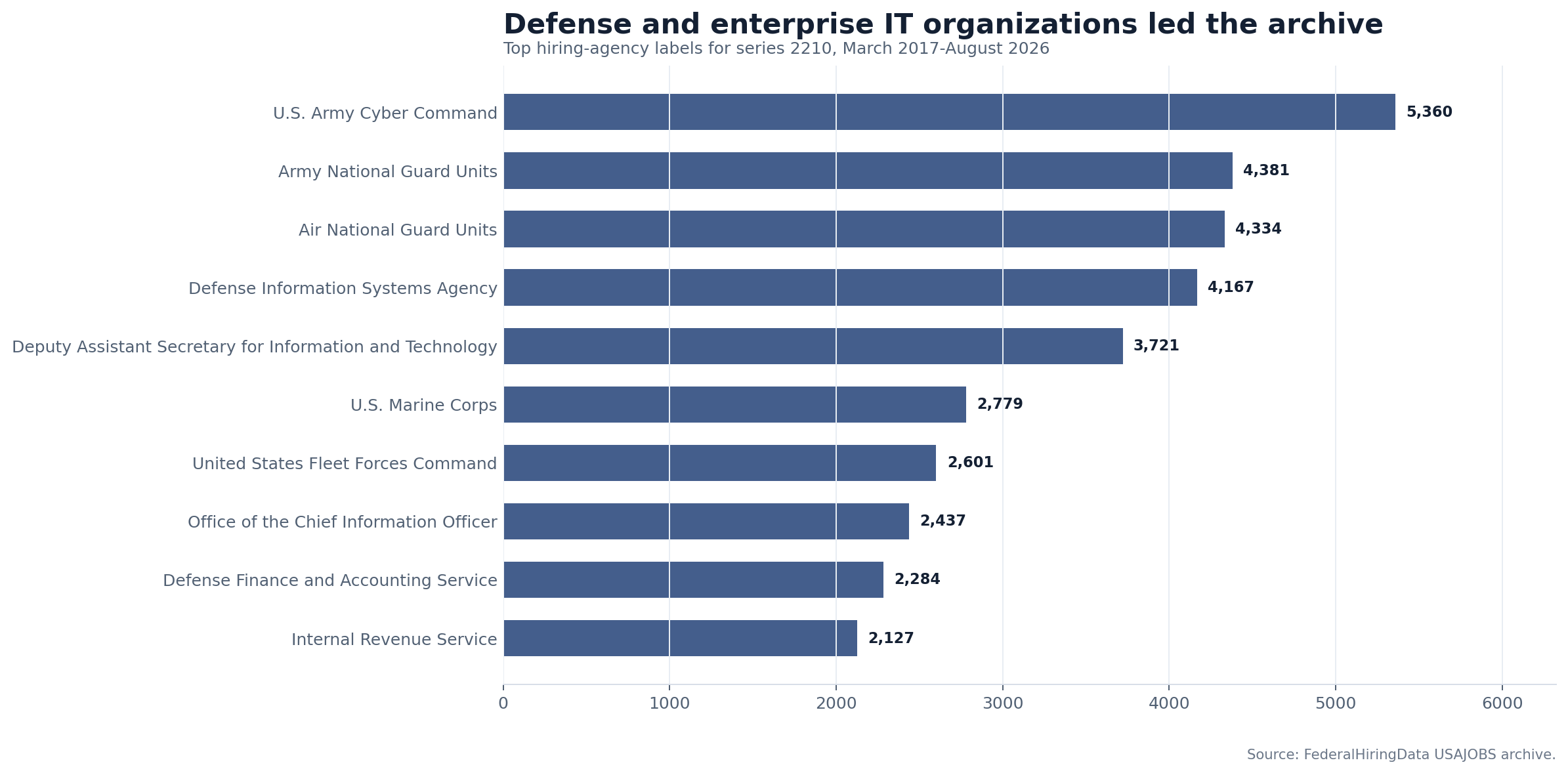
Defense dominates the top of the table, but the IRS, VA technology office, finance agencies and independent organizations also produced substantial volume. A 2210 search should not be limited to agencies with "technology" in their names.
The agency labels also reveal different kinds of IT work. Cyber Command and DISA suggest enterprise networks and cyber missions; National Guard components combine federal and state-linked operating environments; IRS and finance agencies operate large civilian transaction systems. Series 2210 is the common classification thread, not a promise that the underlying duties are interchangeable.
Volume and the partial-year drop
Annual volume rose from 8,442 in 2017 to 16,982 in 2022, then recorded 16,528 in 2023 and 15,029 in 2024. The archive contains 3,971 in 2025 and 3,022 through Aug. 14, 2026.
Announcement counts do not equal hires, and the 2025-2026 decline should not be converted into a precise workforce-loss claim. A separate OPM workforce analysis found the 2210 workforce smaller by May 2026, but the datasets measure different events.
The archive also cannot tell whether fewer announcements reflect fewer vacancies, broader multi-vacancy notices, internal hiring, budget decisions or changes in recruiting practice. It can establish the public announcement count and timing. Any explanation for the decline requires additional evidence.
Remote, telework and clearance in 2026
The 2026 current-source 2210 cohort contains 3,022 announcements. Only 1 was confirmed remote; 840 were telework eligible but not remote. 1,440 named a Confidential through Top Secret/SCI level.
These characteristics overlap. A telework-eligible IT job can require a clearance, and a clearance-required job is not necessarily on-site every day. Older archive records do not carry comparable remote and clearance fields, so this is a 2026 cross-section rather than a trend.
How to interpret the salary numbers
The salary statistics include only annual ranges. Hourly, daily, fee-basis and other intervals are excluded rather than converted with assumptions. An advertised maximum can reflect a high grade, locality, special salary rate, supervisory scope or a range spanning several grades and locations.
Applicants should compare the announcement's low end, grade, duty station and promotion potential. The maximum is not the salary every selectee receives.
The 2210 qualification framework is also changing toward competency-based standards. That makes the actual announcement's specialized-experience and assessment language especially important. A series-wide salary statistic cannot substitute for checking the grade, specialty and required competencies of a particular job.
What the archive cannot answer
It cannot compare federal IT compensation with matched private-sector roles, because the warehouse does not contain a defensible private-sector occupation, geography, seniority and benefits comparison. It also cannot show application counts, referral odds, interview rates or time to hire.
Methodology and limitations
FederalHiringData retained distinct active and historical announcement controls linked to normalized series 2210. Annual counts use opening year. Salary summaries include `Per Year` maximums between $1,000 and $500,000. The 2026 remote, telework and clearance section uses current-source records only because older fields are not comparable.
Forum discussions identified the demand for pay, remote and clearance context. OPM supplies the occupation definition; FederalHiringData supplies the archive counts.
Keep reading
Related federal hiring research
Article data window: FY2019-FY2025
Contract Spending and Federal Headcount Often Moved Independently
Across a bounded 28-agency sample, contract-obligation growth and covered headcount growth had only a 0.169 correlation; five agencies increased obligations while headcount fell.
Article data window: Jan. 1-14, 2026
Federal Healthcare Hiring Led Early January 2026 Job Announcements
Veterans Health Administration, nurse roles, medical officers, and other clinical and support occupations drove the strongest healthcare signal in the early January archive.
Article data window: Jan. 1-14, 2026
Federal Hiring Trends: Jan. 1-7 vs Jan. 8-14, 2026
Veterans Health Administration stayed dominant, nurse and medical roles strengthened, and remote-work signals remained too sparse for a public trend claim.
Federal Hiring Data Weekly
Subscribe to Federal Hiring Data Weekly.
Subscribe to Federal Hiring Data Weekly. Confirm your email after signing up to receive federal hiring trends, salary data, agency movements, and original research.