August 18, 2026
Federal FOIA Backlog Hit 339,671 as DHS Carried Nearly Half
The federal FOIA backlog rose 27% in fiscal 2025. DHS held 168,505 pending requests while request volume grew and two different public staffing measures moved downward.
By Evan Mercer
Published August 18, 2026Last edited August 18, 2026

The federal government's Freedom of Information Act backlog reached 339,671 requests at the end of fiscal 2025, the highest year-end total in FOIA.gov's public series going back to 2008.
Nearly half of that backlog sat at one department. The Department of Homeland Security reported 168,505 backlogged requests, or 49.6% of the governmentwide total.
The increase was not simply a story of agencies receiving more requests, although demand did rise sharply. Federal agencies received 1.71 million requests in fiscal 2025, up 13.7% from the prior year. The backlog grew faster, by 27.2%, while agencies reported fewer full-time-equivalent FOIA staff.
FederalHiringData combined the official FOIA.gov annual files with Office of Personnel Management workforce records and the public USAJOBS announcement archive. The sources point to a widening capacity problem, but they do not prove that one staffing measure caused the backlog. FOIA.gov staff totals, OPM occupation counts and job announcements measure different things.
The national backlog rose by more than 72,000 requests
| Federal FOIA measure | FY2024 | FY2025 | Change |
|---|---|---|---|
| Requests received | 1,501,432 | 1,707,197 | +13.7% |
| Requests processed | 1,499,265 | 1,635,055 | +9.1% |
| Year-end backlog | 267,056 | 339,671 | +27.2% |
| Reported FOIA staff | 5,628.46 | 4,823.17 | -14.3% |
Agencies processed 135,790 more requests than they had in fiscal 2024. That increase was not enough to keep up with the additional 205,765 requests received or to eliminate work carried into the year.
The resulting 72,615-request backlog increase was larger than the annual growth in processed requests. Put differently, processing expanded, but demand and prior unresolved work expanded faster.
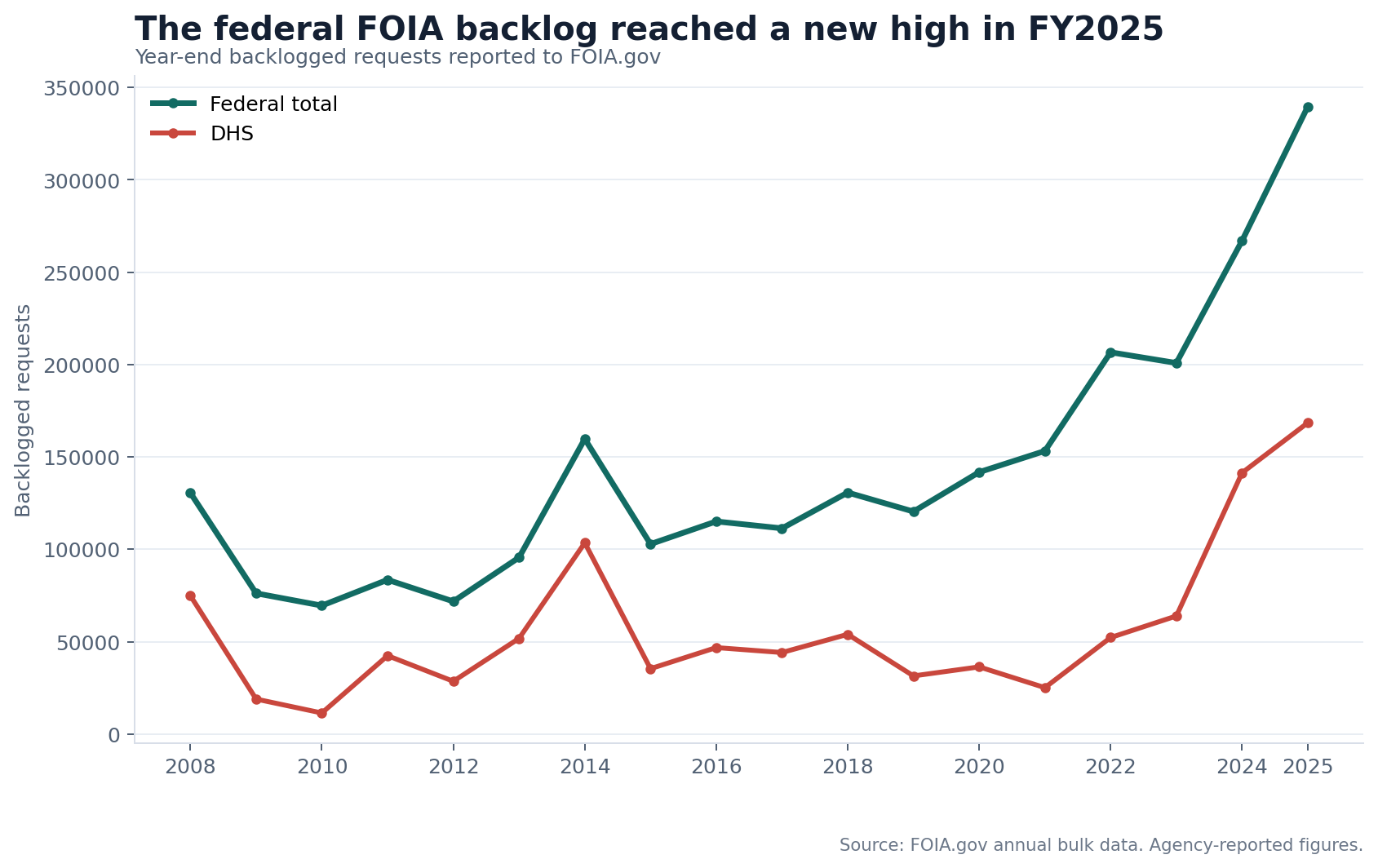
The longer history matters. The federal backlog was 69,526 in fiscal 2010 and remained below 160,000 through fiscal 2021. It rose to 206,636 in 2022, dipped slightly in 2023, and then increased in each of the next two years. The fiscal 2025 total was almost five times the 2010 level.
Those figures are agency-reported administrative data. They show workload entering, leaving and remaining in the FOIA system; they do not show whether every request had the same complexity or required the same amount of staff time.
DHS accounted for 49.6% of the federal backlog
DHS received more than 1 million FOIA requests in fiscal 2025, almost 60% of all requests reported governmentwide. It processed just under 995,000 and ended the year with 168,505 backlogged requests.
| DHS FOIA measure | FY2024 | FY2025 | Change |
|---|---|---|---|
| Requests received | 911,535 | 1,019,496 | +11.8% |
| Requests processed | 894,939 | 994,992 | +11.2% |
| Year-end backlog | 141,420 | 168,505 | +19.2% |
| Reported FOIA staff | 809 | 562 | -30.5% |
| Oldest pending request | 2,528 days | 2,684 days | +156 days |
DHS's 2025 backlog was not a new phenomenon. Its year-end total exceeded 100,000 in 2014, fell to 25,102 in 2021, and then rose in three of the next four years. The fiscal 2025 count was more than six times its 2021 level.
The department's oldest pending request was 2,684 days old at year-end, according to the annual data. That measure refers to the oldest case in the reported inventory. It does not mean a typical requester waited that long.
The workload is also unevenly distributed inside DHS. The annual department total combines components with very different missions and request populations, including immigration, border, transportation-security and emergency-management records. A department-level ratio cannot identify which component needs which skills.
The staffing signals moved downward, but the denominators differ
FOIA.gov asks agencies to report the number of full-time-equivalent staff devoted to FOIA. That federal total declined from 5,628.46 in fiscal 2024 to 4,823.17 in fiscal 2025. DHS reported a decline from 809 to 562.
Using those reported figures, the federal backlog per reported FOIA staff member rose from 47.4 to 70.4. At DHS it rose from 174.8 to 299.8.
Those ratios are FederalHiringData calculations, not measures published by FOIA.gov. They should be read as workload indicators, not individual caseloads. Agencies can count partial staff time as fractions, and some processing work may be performed by attorneys, program specialists, contractors or employees whose primary occupation is not FOIA.
OPM provides a second, narrower view through occupational series 0306, Government Information. The public OPM files counted 2,791 employees governmentwide in series 0306 in fiscal 2025, down from 2,902 in fiscal 2024. DHS declined from 437 to 417.
| Workforce measure | FY2024 | FY2025 | Change |
|---|---|---|---|
| Federal FOIA.gov staff | 5,628.46 | 4,823.17 | -14.3% |
| Federal OPM series 0306 | 2,902 | 2,791 | -3.8% |
| DHS FOIA.gov staff | 809 | 562 | -30.5% |
| DHS OPM series 0306 | 437 | 417 | -4.6% |
| DHS total OPM workforce | 227,566 | 230,497 | +1.3% |
The gap between those measures is important. FOIA.gov staffing covers reported work devoted to FOIA. OPM series 0306 covers employees classified in one occupation. Neither is a complete substitute for the other, and neither establishes the staffing of every DHS component.
The DHS comparison also rules out an overly broad explanation. The department's total OPM-visible workforce rose 1.3% while its FOIA backlog grew 19.2%. The relevant question is not whether DHS as a whole had fewer employees. It is whether its FOIA programs had the right capacity, skills and allocation for a request load exceeding 1 million.
Request growth appears at least as important as occupation counts
The evidence does not support a one-line claim that FOIA backlogs rose because agencies cut Government Information Specialists.
From fiscal 2024 to 2025, federal requests received increased by 205,765. The OPM series 0306 count declined by 111. At DHS, requests increased by 107,961 while the series 0306 count declined by 20.
Those movements coincided, but they are different kinds of observations. Request volume measures incoming cases. Series 0306 headcount is a point-in-time occupational count. Processing capacity also depends on case complexity, technology, litigation, consultation with other agencies, records systems, management choices and staff outside series 0306.
The most defensible finding is narrower: request growth outpaced processing growth while both reported FOIA staffing and the relevant OPM occupation count moved downward. That combination left more unresolved work at year-end, especially at DHS.
Public recruiting for series 0306 was limited at the research snapshot
FederalHiringData's public USAJOBS archive contained 4,412 historical announcements associated with series 0306, including 528 from DHS. The archive reaches back to March 2017 for this series.
At the Aug. 18 research snapshot, only one series 0306 announcement was classified as active, and it was outside DHS. That is a point-in-time announcement count, not a measure of all hiring activity. An agency can fill multiple positions from one announcement, use other occupational series, hire through pathways not visible as a conventional announcement, or have postings open and close between snapshots.
Historical DHS series 0306 announcements had a median advertised window of nine days. Other federal agencies had a median of 11 days. These durations measure the period in which applications were accepted, not the time required to review, select or onboard candidates.
Readers can search current federal jobs and browse the historical announcement archive. The active count will change as USAJOBS announcements open and close.
What the data can and cannot answer
The annual records can show that the FOIA system received more requests, processed more requests and still accumulated a larger backlog. They can show where the backlog was concentrated and how reported staffing changed.
They cannot identify the cause of every delayed request. A simple staffing ratio does not capture differences between a narrow document request and a case involving millions of pages, classified information, law-enforcement records or consultation across agencies.
The data also cannot establish that hiring more employees in one occupational series would reduce the backlog by a predictable amount. A responsible staffing analysis would require component-level workload, case complexity, staff allocation, contractor support, technology performance and processing-time distributions.
What the public record does establish is that fiscal 2025 placed substantially more pressure on the system. Agencies received a record 1.7 million requests, the backlog reached 339,671, and DHS alone carried nearly half of the unresolved total.
Methodology and limitations
FederalHiringData downloaded the complete annual agency bulk files published by FOIA.gov for fiscal 2008 through 2025. Federal totals use the official "All agencies" rows. DHS totals use the Department of Homeland Security rows. Backlog is the reported year-end count; received and processed are annual flows. Staff is the agency-reported FOIA full-time-equivalent measure.
The workforce comparison uses OPM monthly Employment, Accessions and Separations files. Series 0306 is Government Information. Fiscal-year employment counts use the September snapshot; total DHS headcount uses the same timing. OPM's public coverage rules and agency coding apply.
USAJOBS counts use unique announcement control numbers linked to occupational series 0306. An announcement is not the same as a vacancy, application, selection, hire or employee. Active status is a research-snapshot classification and changes over time.
The analysis labels agency-reported figures as reported facts and ratios or percentage changes as FederalHiringData calculations. It does not infer causation from staffing and backlog movements. FOIA.gov staff, OPM series 0306 headcount and USAJOBS announcements remain separate denominators throughout.
Primary sources: FOIA.gov data, the FOIA dataset download page, and OPM Federal Workforce Data. Related FederalHiringData pages: current jobs, workforce statistics, agency research, and the historical archive.
Hero photo: Wesley Tingey on Unsplash, used under the Unsplash License.
Keep reading
Related federal hiring research
Article data window: FY2019-FY2025
Contract Spending and Federal Headcount Often Moved Independently
Across a bounded 28-agency sample, contract-obligation growth and covered headcount growth had only a 0.169 correlation; five agencies increased obligations while headcount fell.
Article data window: Jan. 1-14, 2026
Federal Healthcare Hiring Led Early January 2026 Job Announcements
Veterans Health Administration, nurse roles, medical officers, and other clinical and support occupations drove the strongest healthcare signal in the early January archive.
Article data window: Jan. 1-14, 2026
Federal Hiring Trends: Jan. 1-7 vs Jan. 8-14, 2026
Veterans Health Administration stayed dominant, nurse and medical roles strengthened, and remote-work signals remained too sparse for a public trend claim.
Federal Hiring Data Weekly
Subscribe to Federal Hiring Data Weekly.
Subscribe to Federal Hiring Data Weekly. Confirm your email after signing up to receive federal hiring trends, salary data, agency movements, and original research.