November 30, 2025
Why Federal Job Announcements Spiked in Late September 2025, Then Fell
A two-page resume transition concentrated 4,412 announcement closings on Sept. 26, followed by an abrupt weekend drop and a slower fall period shaped by a government shutdown.
By Federal Hiring Data Research Team

On Saturday, Sept. 27, 2025, federal job seekers opened USAJOBS and saw something startling: many of the announcements they had been watching were gone. In one widely discussed r/usajobs thread, applicants wondered whether the site was broken, the approaching shutdown was already affecting hiring or agencies had abruptly stopped recruiting.
The archive shows that the disappearance was real, but the daily pattern points first to a scheduled operational transition. 4,412 announcements closed on Friday, Sept. 26. Only eight closed the next day and 14 on Sunday. OPM had instructed agencies to close all open job opportunity announcements by Sept. 26 before a new two-page resume standard took effect.
The federal funding lapse that began Oct. 1 then added a second disruption. These events overlap in time, so the archive should not be used to assign every later increase or decrease to one cause. It does, however, show exactly when the public inventory changed.
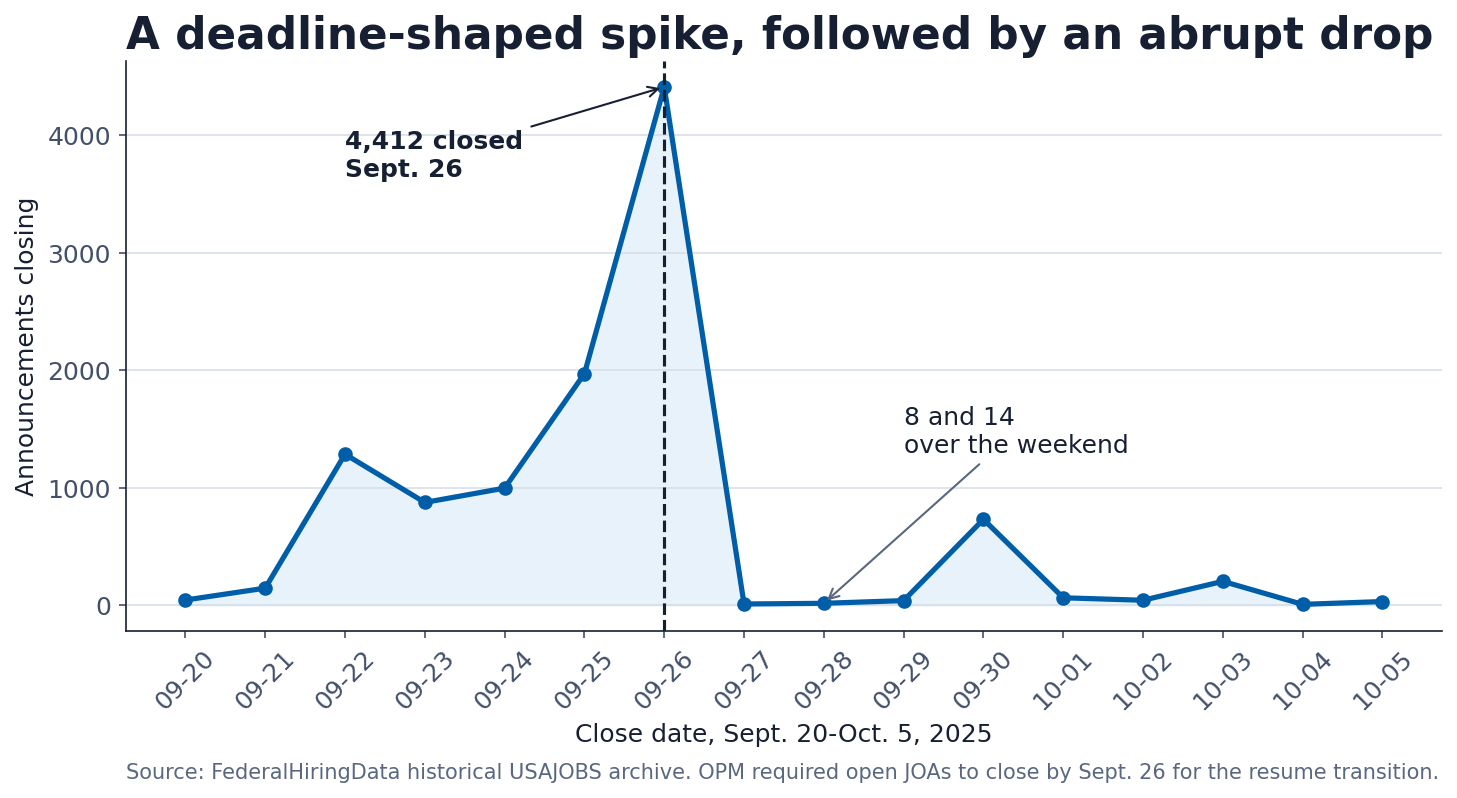
The Sept. 26 deadline is visible in the data
OPM's agency guidance was unusually specific: agencies were to close open JOAs by Friday, Sept. 26, and could begin posting announcements under the new resume rules after the transition. The policy did not mean every job was cancelled. It created a common closure date for announcements that otherwise might have remained open longer.
The daily archive mirrors that instruction:
| Close date | Announcements | VHA announcements |
|---|---|---|
| Sept. 22 | 1,284 | 478 |
| Sept. 23 | 873 | 208 |
| Sept. 24 | 995 | 292 |
| Sept. 25 | 1,970 | 855 |
| Sept. 26 | 4,412 | 2,115 |
| Sept. 27 | 8 | 2 |
| Sept. 28 | 14 | 2 |
| Sept. 29 | 37 | 7 |
| Sept. 30 | 729 | 414 |
Nearly 48% of the Sept. 26 closings were VHA announcements. That matters because VHA operated many recurring or open-continuous recruiting announcements. Moving those postings onto a common deadline amplified the visible peak.
The week beginning Sept. 22 recorded 9,556 closures, more than double the 4,271 from the preceding week. The following week recorded 1,102, an 88.5% drop. Those numbers describe close dates, not newly created jobs. A deadline can shift the date on which an existing announcement leaves the public search without changing the underlying position.
One day was larger than the preceding week
The 4,412 announcements closing on Sept. 26 exceeded the 4,271 that closed during the entire week beginning Sept. 15. Sept. 26 alone also included 2,115 VHA announcements, compared with 1,287 VHA announcements across that preceding week. This is the kind of concentration that a monthly chart hides.
The daily sequence began building before Friday: 1,284 closed Monday, 873 Tuesday, 995 Wednesday and 1,970 Thursday. The Friday peak then accounted for 46.2% of all closings in the Sept. 22 week. The immediate weekend collapse makes the common deadline much more plausible than a story in which thousands of unrelated agencies independently reached the same natural stopping point.
Even so, “closed” is not synonymous with “cancelled.” Some applications remained valid under the announcement that accepted them. Some needs could be reposted under the new rules. The archive records the public lifecycle of each announcement, not the disposition of every underlying hiring action.
Why applicants thought the jobs had vanished
Public search is a snapshot of open announcements. If thousands of postings close together, the visible inventory can collapse overnight even though the historical archive correctly retains them. That is why an active-only search and a historical archive answer different questions.
For an applicant on Sept. 27, the practical observation was “there are far fewer jobs to browse.” For a researcher looking backward, the important question is “where did those previously open announcements go?” The archive answers that: a large share moved into the closed cohort on Sept. 26.
Forum participants quickly connected the change to the two-page resume transition. Their reports are useful evidence of what users experienced and which questions they had. The official OPM instructions, not the comments, establish the policy deadline.
The two-page standard changed the application boundary
OPM announced that most federal resumes submitted through USAJOBS would be limited to two pages. Agency guidance addressed how open announcements should cross that boundary, while applicant guidance explained what information to prioritize. Certain positions and document arrangements required separate instructions, so applicants still needed to read each announcement carefully.
Closing existing announcements prevented one posting from collecting applications under materially different resume-length rules on opposite sides of the implementation date. That operational rationale is consistent with the concentrated close-date pattern. The archive does not reveal whether every agency handled reposting in exactly the same way or how many closed announcements later reappeared under a new control number.
The data also warn against comparing September 2025 with another month as though every close date reflected organic demand. September's 21,144 closures were the highest monthly total from April through November, but 4,412 occurred on one required deadline day. Remove the context and the month looks like a hiring boom. Include it and the month looks like a backlog of announcement closures passing through a policy gate.
Then came the funding lapse
The next major date was Oct. 1, when a lapse in appropriations began. OPM had published contingency guidance for agencies preparing for a possible lapse. During a shutdown, agency operations vary according to funding source, excepted work and contingency plans. It would be inaccurate to say that all recruiting stopped uniformly.
Weekly archive counts remained low relative to the Sept. 22 peak, then gradually rebuilt:
| Week beginning | Announcements closing |
|---|---|
| Sept. 22 | 9,556 |
| Sept. 29 | 1,102 |
| Oct. 6 | 1,334 |
| Oct. 13 | 2,056 |
| Oct. 20 | 2,220 |
| Oct. 27 | 2,358 |
| Nov. 3 | 2,253 |
| Nov. 10 | 2,174 |
| Nov. 17 | 1,470 |
| Nov. 24 | 374 |
A close-date series during a shutdown is especially difficult to interpret. Some announcements may have been scheduled to close regardless of staffing levels. Some may have been extended, cancelled or reposted. Some agency HR functions continued under different authorities. The falling Thanksgiving-week count may also contain ordinary calendar effects.
The safest conclusion is sequential, not causal: the Sept. 26 resume transition produced an unmistakable closure spike; the public inventory dropped immediately afterward; and the lower-volume period overlapped a prolonged funding lapse.
The recovery was partial and uneven
By the week of Oct. 27, weekly closings had reached 2,358, more than double the 1,102 in the week of Sept. 29. That was still less than one-quarter of the deadline week. The weeks of Nov. 3 and Nov. 10 remained near 2,200 before the series declined later in November.
Those movements show that the system did not remain empty after the transition. Agencies continued to post and close announcements, but the flow did not immediately return to the unusual late-September level. Because the funding lapse overlapped this period, the data cannot isolate a clean “resume-rule recovery curve.”
A useful follow-up would match likely repostings and examine new open dates after Sept. 27. That requires careful identity work because a reopened opportunity can have revised text, a different close date or a new control number. This article does not treat similar titles as proof that two announcements represent the same hiring action.
What the episode teaches about job-count headlines
Daily public job totals can be useful, but they are fragile without flow data. A drop in open postings can happen because fewer jobs opened, more jobs closed or both. A spike in historical closures can happen because of demand, seasonality, applicant limits or an administrative deadline.
This episode offers a concrete example. Anyone looking only at the number of open announcements on Sept. 27 could reasonably report a dramatic disappearance. Anyone looking only at the September historical total could reasonably report a dramatic surge. Both observations are incomplete until the common Sept. 26 close date is visible.
That distinction remains useful today. FederalHiringData's active job search is designed for opportunities that can still be pursued. Historical pages and research articles preserve closed announcements so readers can understand how the market changed rather than treating vanished listings as missing data.
What applicants should take from it
Applicants do not need to infer the status of a saved job from broad rumors. The announcement record, application dashboard and agency contact are the relevant sources for a specific application. An announcement closing before a rule transition does not by itself say that submitted applications were discarded.
More broadly, sudden swings in the USAJOBS total can reflect system rules. When the total changes sharply, check whether a common deadline, appropriations event or site transition occurred before concluding that federal demand changed by the same amount.
Methodology and limitations
FederalHiringData counted HistoricalJobArchive records by close date from Aug. 25 through Nov. 30, 2025, with daily detail from Sept. 20 through Oct. 5. Counts are distinct announcements. The historical evidence cutoff is Nov. 30, 2025.
Official sources include OPM's agency guidance on the two-page limit, applicant guidance, the Sept. 2 implementation release, and lapse guidance. The r/usajobs discussion was used as a demand and experience signal, not as a factual authority.
The analysis does not identify reposted announcements across changed control numbers, applications, referrals, selections or hires. Timing alignment supports an operational explanation for the Sept. 26 spike, but later weekly patterns cannot be causally divided between the resume transition, shutdown, hiring policy, seasonality and agency decisions. Photo: G. Edward Johnson via Wikimedia Commons, licensed CC BY 4.0.
Keep reading
Related federal hiring research
Article data window: FY2019-FY2025
Contract Spending and Federal Headcount Often Moved Independently
Across a bounded 28-agency sample, contract-obligation growth and covered headcount growth had only a 0.169 correlation; five agencies increased obligations while headcount fell.
Article data window: Jan. 1-14, 2026
Federal Healthcare Hiring Led Early January 2026 Job Announcements
Veterans Health Administration, nurse roles, medical officers, and other clinical and support occupations drove the strongest healthcare signal in the early January archive.
Article data window: Jan. 1-14, 2026
Federal Hiring Trends: Jan. 1-7 vs Jan. 8-14, 2026
Veterans Health Administration stayed dominant, nurse and medical roles strengthened, and remote-work signals remained too sparse for a public trend claim.
Federal Hiring Data Weekly
Subscribe to Federal Hiring Data Weekly.
Subscribe to Federal Hiring Data Weekly. Confirm your email after signing up to receive federal hiring trends, salary data, agency movements, and original research.