September 30, 2025
Federal Job Postings Continued During the 2025 Hiring Freeze. Here's What the Archive Shows
More than 81,000 federal job announcements closed from April through September 2025, showing continued advertised activity during a freeze that included exceptions and agency-specific implementation.
By Evan Mercer

A hiring freeze can sound like an off switch: the government stops hiring, job announcements disappear and applicants wait for the switch to be turned back on. The USAJOBS archive shows a more complicated reality.
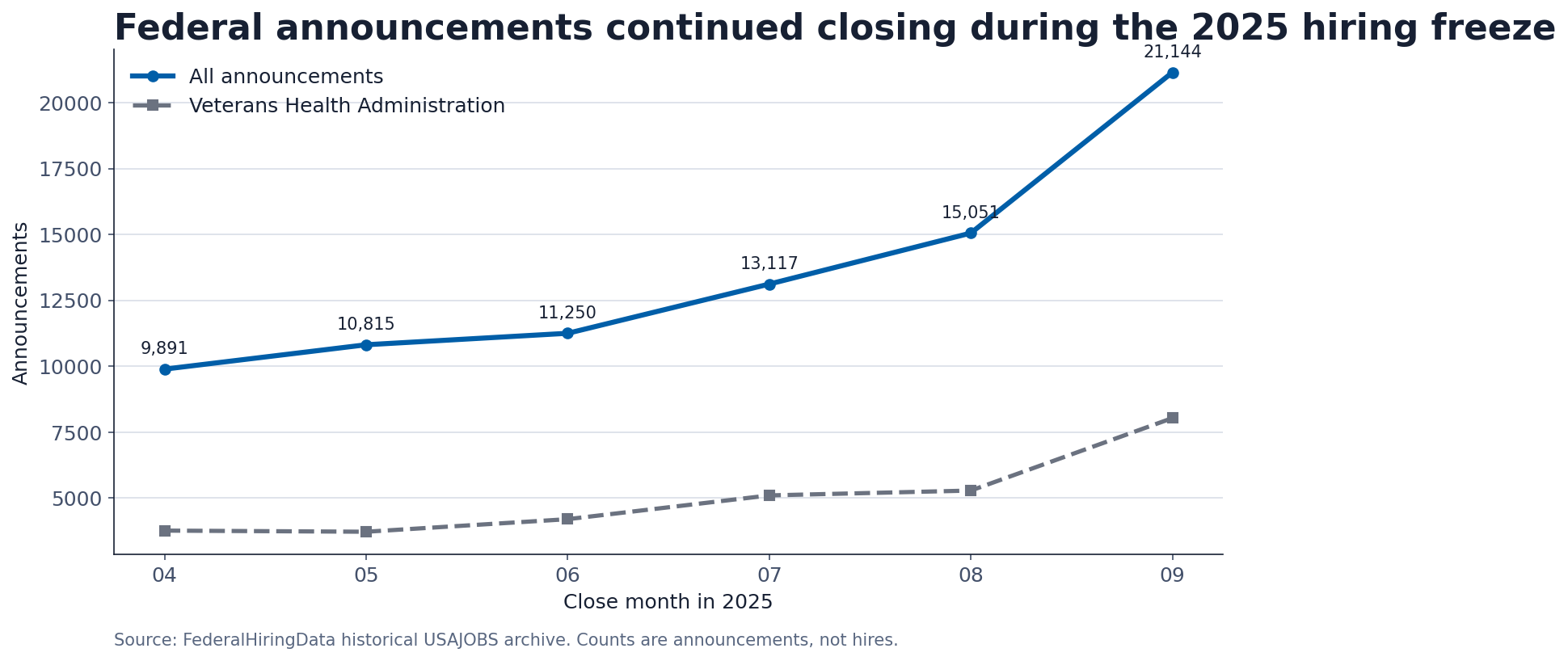
81,268 federal job announcements closed between April 1 and Sept. 30, 2025. Monthly volume rose from 9,891 in April to 21,144 in September. The Veterans Health Administration alone accounted for 30,108 of those announcements, or 37.0% of the six-month total.
Those numbers do not mean 81,268 people were hired. They do not show that every posting produced a selection, or that every selection was exempt from the freeze. They show something narrower and still useful: agencies continued to advertise and close a substantial number of opportunities while the federal hiring freeze was in force.
What the archive records
The analysis groups announcements by their USAJOBS close date. That provides a consistent, auditable monthly cohort, but it is not the same as counting jobs first posted during each month. A posting that opened earlier and closed in April appears in April. Open-continuous announcements and postings with multiple vacancies can also make announcement volume differ from positions or hires.
| Close month | All announcements | VHA announcements | VHA share |
|---|---|---|---|
| April 2025 | 9,891 | 3,766 | 38.1% |
| May 2025 | 10,815 | 3,723 | 34.4% |
| June 2025 | 11,250 | 4,200 | 37.3% |
| July 2025 | 13,117 | 5,101 | 38.9% |
| August 2025 | 15,051 | 5,285 | 35.1% |
| September 2025 | 21,144 | 8,033 | 38.0% |
The monthly line did not fall to zero. It increased in every month after April. September was exceptional, but readers should not interpret that month as a sudden doubling of underlying hiring demand. A separate operational deadline caused many open announcements to close on Sept. 26, concentrating normal closure activity into one week.
The important finding is therefore not that the freeze had no effect. This archive alone cannot estimate the counterfactual number of postings that would have appeared without the freeze. The finding is that a freeze and continued job advertising coexisted.
The six months were not one flat period
The first three months in the window recorded 31,956 closings. The next three recorded 49,312, a 54.3% increase. VHA moved from 11,689 in April-June to 18,419 in July-September. Those are large differences, but they combine several mechanisms: announcements opened at different times, recurring recruitment, agency choices and the Sept. 26 operational deadline.
The rise also began before September. July recorded 13,117 closings, 16.6% more than June, and August recorded 15,051, 14.7% more than July. That sequence rules out an explanation based solely on one day in September. It does not reveal whether agencies were increasing new recruiting, working through approvals, closing older announcements or changing their use of USAJOBS.
A complete flow analysis would compare openings and closings, follow reposted controls, distinguish single-vacancy from multi-vacancy announcements and connect public postings to personnel actions. Public archive data do not provide all of those links. The monthly series is therefore best viewed as a record of how much advertised activity passed through a close date, not a direct count of new demand.
This matters when policy language is broad. The freeze applied government-wide with specified exceptions, but the observed announcement mix was highly concentrated. A large healthcare component can sustain visible volume even while other agencies or occupations become much quieter. Government-wide totals can conceal those uneven effects.
Why a hiring freeze did not mean zero announcements
The official policy itself contained boundaries and exceptions. The White House's April 17 memorandum extended the January freeze through July 15, and a July 7 memorandum extended it through Oct. 15. The documents restricted filling vacant civilian positions and creating new positions, but they also preserved exceptions required by law and categories connected to immigration enforcement, national security and public safety. Agency implementation and approvals mattered.
OPM's published guidance further explained how agencies were to handle exemptions, offers and personnel actions. That makes a simple equation such as “posting equals prohibited hire” unreliable. An announcement could concern an excepted function, replace a departing worker, cover a position with separate authority, support internal movement, remain open from an earlier period or ultimately result in no hire.
The archive does not contain the approval chain for each announcement. It cannot tell us which exception, if any, applied. It can tell us that federal recruiting infrastructure continued to operate across healthcare, defense, public safety and other mission areas.
Healthcare remained the largest visible concentration
VHA represented more than one-third of all announcements in every month in this six-month window. Its monthly count ranged from 3,723 in May to 8,033 in September. Across April through September, VHA's 30,108 announcements were larger than the next several individual agency totals combined.
This concentration is consistent with the way VHA uses USAJOBS for recurring clinical and support needs. It should not be interpreted as 30,108 new VHA employees. One announcement can advertise more than one vacancy, remain open for recurring needs or close without a selection. Still, the pattern shows that healthcare recruiting remained unusually visible during a period of broad restraint.
The same distinction matters for applicants. A posted vacancy is a real application opportunity, but it is not evidence that the agency has completed every internal approval or will fill every advertised slot. Applicants should rely on the announcement's own eligibility, vacancies, contact and closing information rather than assuming that a government-wide policy has one identical effect everywhere.
September needs its own explanation
The jump from 15,051 August closings to 21,144 September closings was a 40.5% increase. Almost half of September's announcements closed in the week beginning Sept. 22. OPM had directed agencies to close open job opportunity announcements by Friday, Sept. 26, as USAJOBS moved to a two-page resume standard.
That deadline changes how the September total should be read. Close-date data capture operational timing as well as hiring demand. Moving the closure of many existing announcements to one day raises the monthly count without necessarily creating new openings. This is exactly why FederalHiringData keeps the underlying daily record rather than presenting one monthly number without context.
The archive therefore supports two findings at once. Advertised federal opportunities persisted through the freeze. And part of the late-summer rise, especially the September peak, reflects the timing of a system-wide transition.
What this evidence can and cannot settle
The data rebut the narrow claim that no federal job announcements existed during the freeze. They do not rebut concerns that federal hiring became harder, slower or more selective. USAJOBS announcements do not reveal applications received, certificates issued, interviews, tentative offers, final offers or onboarding dates.
The records also cannot show how many would have been advertised under normal conditions. A meaningful causal estimate would need a comparison group or model for expected posting volume, plus agency-level information about exemptions and approvals. This article makes no such estimate.
For job seekers, the practical lesson is to separate three stages that are often collapsed in public discussion:
- Advertisement: an agency posts an opportunity and accepts applications.
- Selection authority: the agency has permission and resources to move a hiring action forward.
- Completed hire: a selected person clears the process and enters on duty.
FederalHiringData observes the first stage well. It does not observe the full second or third stage from public USAJOBS records alone.
What a stronger follow-up would require
A future causal study would need more than another month of postings. It would need historical baselines for the same agencies and occupations, controls for recurring announcement practices, exact policy-exception coding and a reliable connection to OPM accessions. It would also need to account for the possibility that agencies changed the way they packaged vacancies into announcements.
That is why this article stops at a descriptive conclusion. The archive is strong enough to show that the public opportunity channel remained active and to measure its composition. It is not strong enough to estimate how many hires the freeze prevented or delayed. Keeping that boundary visible makes the result less dramatic, but much more useful.
A better way to read policy-period job counts
Archive counts are most useful when treated as signals of advertised demand, not as a hiring scoreboard. A sustained concentration in healthcare can show where recruiting remained active. A sudden one-day spike can reveal a procedural deadline. A decline can flag an event worth investigating, but not prove why it occurred.
Readers can explore current opportunities on FederalHiringData's active job search, compare broader public measures on Statistics, and browse the rest of the research archive. Current jobs and historical closed announcements are kept distinct so that an old posting is never presented as open.
Methodology and limitations
FederalHiringData counted distinct HistoricalJobArchive records with close dates from April 1 through Sept. 30, 2025. VHA announcements were identified by the normalized hiring-agency name “Veterans Health Administration.” The historical cutoff is Sept. 30, 2025; later workforce releases were not used to characterize conditions at that date.
Official context comes from the White House April 17 hiring-freeze extension, the July 7 extension, and OPM hiring-freeze FAQs. Forum discussions were used only to identify the public question; they were not treated as proof of policy or hiring outcomes.
Announcement counts are not vacancies, applications, selections, hires or onboarded employees. Close-date cohorts can be affected by administrative deadlines, open-continuous postings and changes to an announcement's close date. Photo: United States Federal Aviation Administration via Wikimedia Commons, public domain as a U.S. federal government work.
Keep reading
Related federal hiring research
Article data window: FY2019-FY2025
Contract Spending and Federal Headcount Often Moved Independently
Across a bounded 28-agency sample, contract-obligation growth and covered headcount growth had only a 0.169 correlation; five agencies increased obligations while headcount fell.
Article data window: Jan. 1-14, 2026
Federal Healthcare Hiring Led Early January 2026 Job Announcements
Veterans Health Administration, nurse roles, medical officers, and other clinical and support occupations drove the strongest healthcare signal in the early January archive.
Article data window: Jan. 1-14, 2026
Federal Hiring Trends: Jan. 1-7 vs Jan. 8-14, 2026
Veterans Health Administration stayed dominant, nurse and medical roles strengthened, and remote-work signals remained too sparse for a public trend claim.
Federal Hiring Data Weekly
Subscribe to Federal Hiring Data Weekly.
Subscribe to Federal Hiring Data Weekly. Confirm your email after signing up to receive federal hiring trends, salary data, agency movements, and original research.