August 18, 2026
How Long USAJOBS Announcements Stay Open: 3.09 Million Records
Across 3,085,636 announcements, the median application window was 14 days and 566,705 closed within a week.
Published August 18, 2026Last edited August 18, 2026
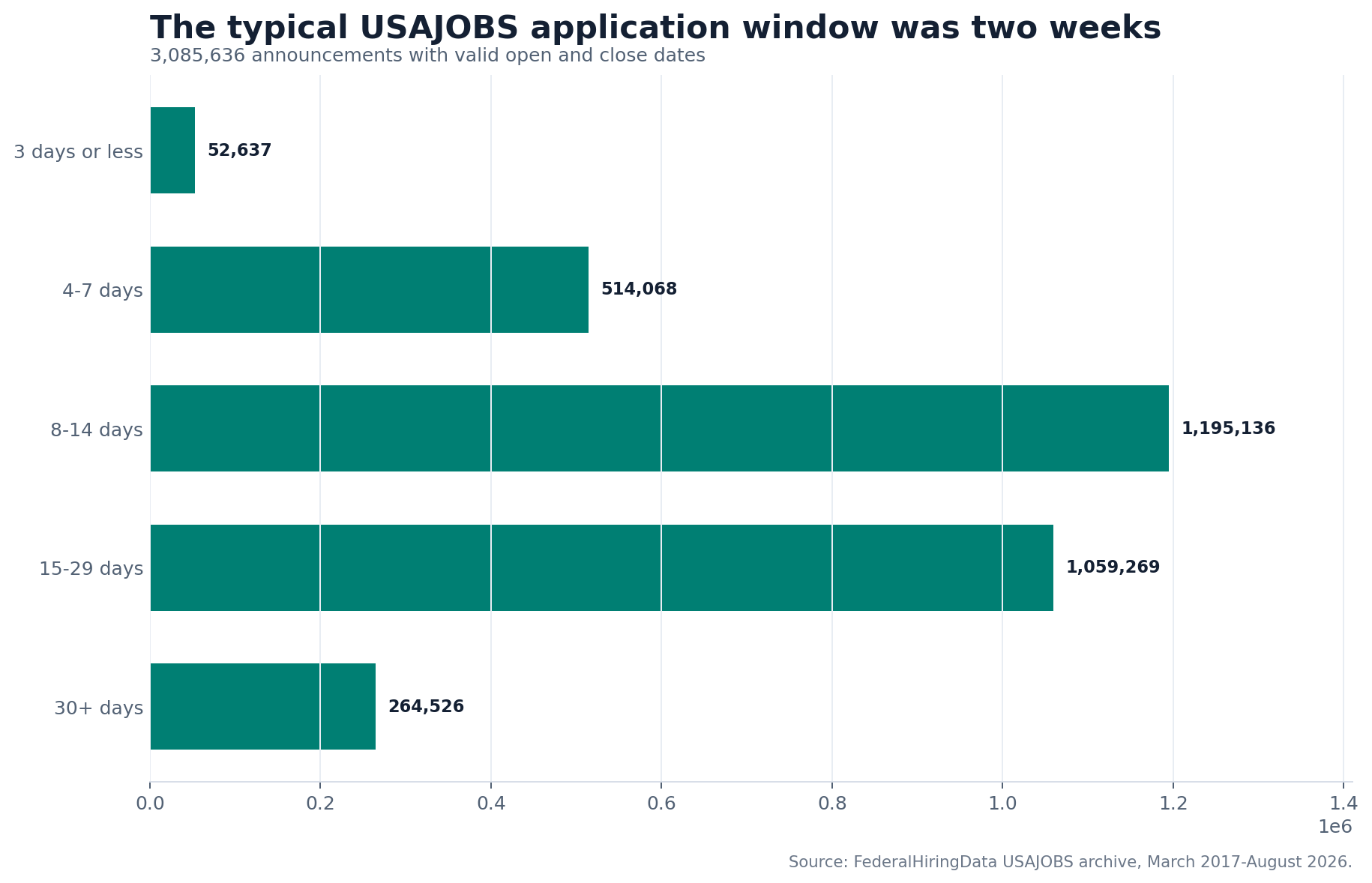
The typical public USAJOBS announcement does not remain open for a month. Across 3,085,636 active and historical records with valid dates, the median application window was 14 days. The middle half ran from 8 to 17 days, and the 90th percentile was 26 days.
FederalHiringData counted 566,705 announcements open seven days or less. Another 1,195,136 ran eight to fourteen days. Together, those groups account for 57.1% of the analyzed archive.
Short windows are common, but three-day postings are not the norm
Only 52,637 announcements, or 1.7%, were open three days or less. The much larger short-window group is four through seven days.
At the other end, 264,526 announcements stayed open at least 30 days. That is 8.6% of the cohort. Long windows are therefore meaningful without being typical. They often include standing registers, recurring recruitment or unusually broad location and specialty coverage, although the date fields alone cannot prove which mechanism applied to each record.
That matters for applicants who wait until a weekend to begin. USAJOBS explains that the opening date is the first application day and the closing date is the last, generally ending at 11:59 p.m. Eastern Time.
The archive-wide median was remarkably stable
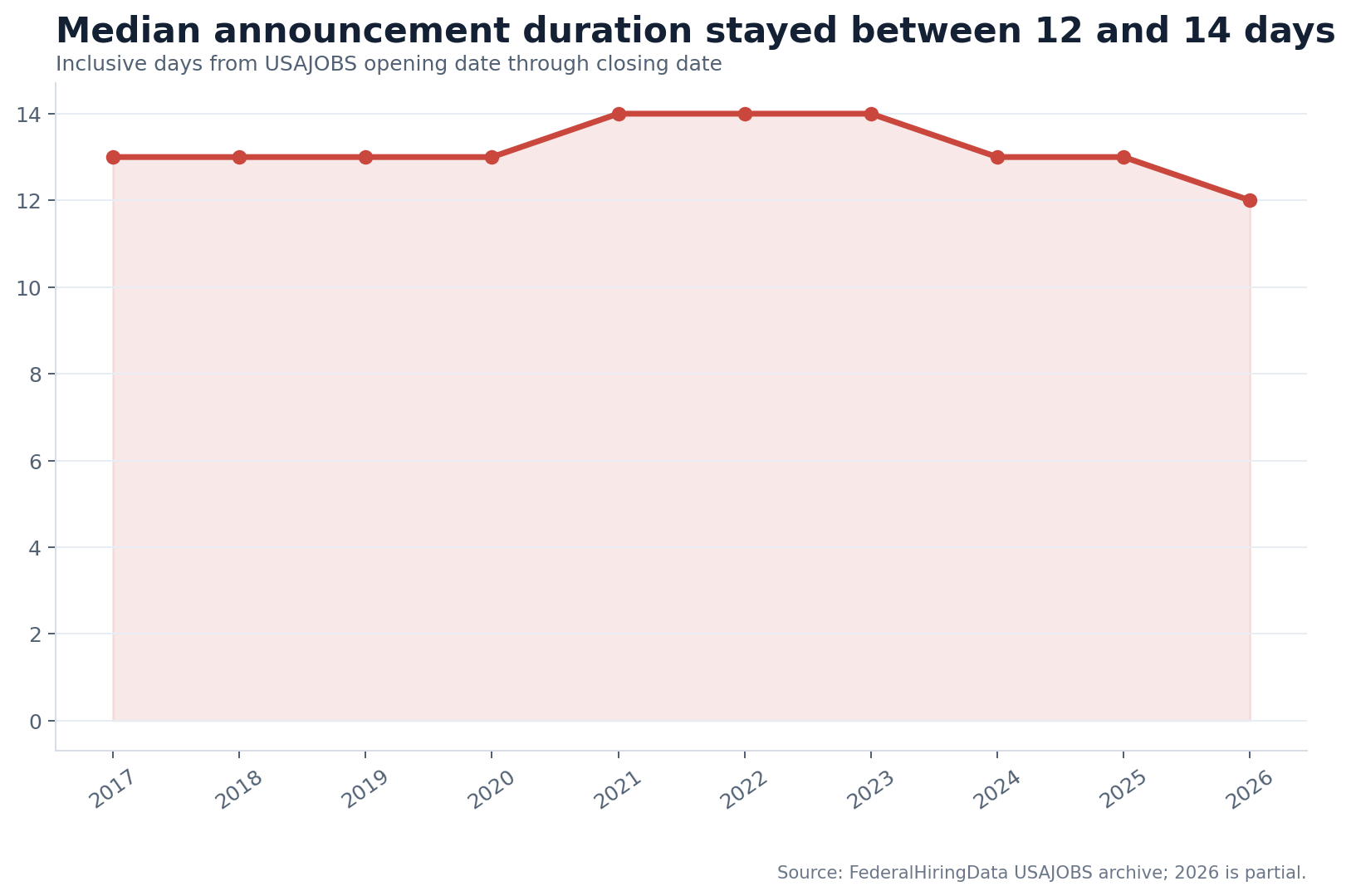
Annual medians remained between 12 and 14 days from 2017 through 2026. The share open seven days or less did move: it was roughly 21% in 2017-2020, fell to about 15% in 2022-2023, and was 19.6% in partial-year 2026.
The stable median should not be mistaken for identical distributions. Two years can share a 13-day midpoint while differing in the number of three-day postings or long open-continuous notices. That is why the analysis reports both quantiles and duration buckets rather than relying on one average.
That is a descriptive pattern. It does not establish why agencies changed posting windows or whether applicant competition changed.
Some occupations move faster than others
Among series with at least 10,000 archived announcements, Human Resources Management (0201) had a 10-day median and 31.0% open seven days or less. Security Administration (0080) and Human Resources Assistance (0203) were each about 30.4% seven days or less. Information Technology Management (2210) had an 11-day median and 27.8% in the seven-day group.
| Series | Occupation | Announcements | Median days | 7 days or less |
|---|---|---|---|---|
| 0201 | Human Resources Management | 77,172 | 10 | 31.0% |
| 0080 | Security Administration | 30,698 | 10 | 30.4% |
| 0203 | Human Resources Assistance | 22,980 | 9 | 30.4% |
| 0343 | Management And Program Analysis | 128,801 | 10 | 30.2% |
| 0081 | Fire Protection and Prevention | 12,520 | 9 | 29.6% |
| 0404 | Biological Science Technician | 10,221 | 11 | 28.8% |
| 2210 | Information Technology Management | 120,410 | 11 | 27.8% |
| 0318 | Secretary | 23,635 | 11 | 25.9% |
| 0501 | Financial Administration And Program | 44,376 | 12 | 25.7% |
| 0671 | Health System Specialist | 18,539 | 11 | 25.7% |
These comparisons describe public application windows, not the time from application to referral, interview, offer or onboarding. FederalHiringData does not observe those downstream applicant events.
Closing types complicate the calendar
USAJOBS describes fixed closing dates, open-continuous announcements and applicant cut-offs. A cut-off announcement can close after receiving a stated number of applications. Open-continuous announcements can review groups of applicants before the final date.
The archive's date difference measures the advertised outer window. It cannot tell when an applicant cap was reached unless that event is separately preserved, and it cannot show interim review dates consistently at archive scale. That is why the forum question about applicant limits is merged here as a documented limitation instead of receiving a page with a false percentage.
What applicants can do with the result
Treat a seven-day window as normal enough to plan for. Keep a reusable federal resume, transcripts and status documents ready. Save searches for the series and locations that matter. Read the required-documents section before the final day, because obtaining an SF-50, license or transcript can take longer than completing the form.
Long windows require attention too. An open-continuous notice can have interim cut-off dates, and an announcement that remains open for months does not guarantee that every application waits until the final close date for review.
Methodology and limitations
FederalHiringData calculated inclusive calendar days as close date minus open date plus one. The cohort excludes negative intervals and windows longer than 731 inclusive days as likely special cases or data anomalies. Each control number appears once in the overall distribution. Occupation counts can overlap for multi-series announcements.
The archive spans March 2017 through Aug. 14, 2026. Counts are announcements, not vacancies, applications or hires. Forum signals established demand for the question; USAJOBS guidance and the archive supply the evidence.
Keep reading
Related federal hiring research
Article data window: FY2019-FY2025
Contract Spending and Federal Headcount Often Moved Independently
Across a bounded 28-agency sample, contract-obligation growth and covered headcount growth had only a 0.169 correlation; five agencies increased obligations while headcount fell.
Article data window: Jan. 1-14, 2026
Federal Healthcare Hiring Led Early January 2026 Job Announcements
Veterans Health Administration, nurse roles, medical officers, and other clinical and support occupations drove the strongest healthcare signal in the early January archive.
Article data window: Jan. 1-14, 2026
Federal Hiring Trends: Jan. 1-7 vs Jan. 8-14, 2026
Veterans Health Administration stayed dominant, nurse and medical roles strengthened, and remote-work signals remained too sparse for a public trend claim.
Federal Hiring Data Weekly
Subscribe to Federal Hiring Data Weekly.
Subscribe to Federal Hiring Data Weekly. Confirm your email after signing up to receive federal hiring trends, salary data, agency movements, and original research.