August 18, 2026
IRS Workforce Fell 29% as GAO Warned of Filing-Season Risks
The IRS had 29,663 fewer covered civilian employees in June 2026 than in January 2025. GAO says workforce-planning gaps and post-filing pressures pose risks to future operations.
By Evan Mercer
Published August 18, 2026Last edited August 18, 2026

The Internal Revenue Service's public workforce count fell by 29.1% between January 2025 and June 2026, a loss of 29,663 covered civilian employees in Office of Personnel Management data.
That decline gives new scale to a Government Accountability Office warning about future tax-filing operations. GAO reported in March that 17,047 IRS employees left through deferred-resignation and early-retirement programs during 2025, including 5,162 staff from units that process returns and provide customer service.
The 2025 filing season was mostly insulated because affected filing-season employees were required to remain until it ended, GAO found. The watchdog's concern was what came next: a correspondence backlog above pre-pandemic levels, workforce-planning uncertainty, major technology work and fewer experienced employees.
FederalHiringData's newer OPM series shows that the public headcount continued falling after the period at the center of GAO's review. That does not forecast the outcome of a future filing season. It does show the size and persistence of the workforce change behind GAO's warning.
The public count fell from 101,826 to 72,163
OPM recorded 101,826 covered civilian IRS employees in January 2025. By December, the count was 77,661. It fell further to 72,163 by June 2026, the latest month available in the local federal workforce warehouse.
| OPM workforce snapshot | IRS employees | Change from January 2025 |
|---|---|---|
| January 2025 | 101,826 | — |
| December 2025 | 77,661 | -24,165 |
| June 2026 | 72,163 | -29,663 |
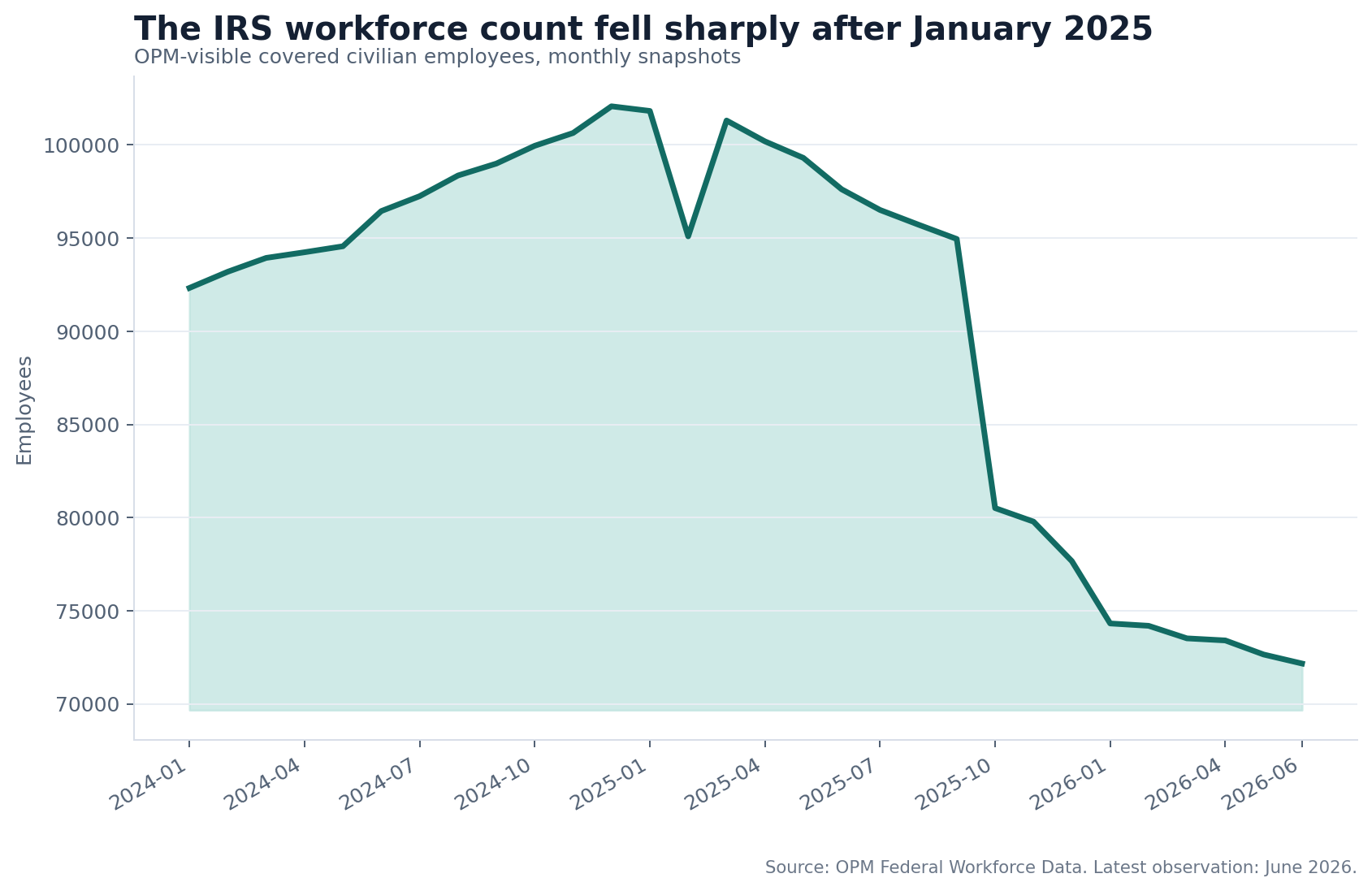
The monthly personnel-action files reinforce the direction of the headcount series. OPM recorded 3,386 accessions and 31,785 separations at the IRS during calendar 2025. Through June 2026, it recorded 1,317 accessions and 3,012 separations.
Accessions include new hires, transfers and other entries into the covered workforce. Separations include retirements, resignations, terminations and other exits. They are not identical to GAO's count of employees leaving through specific 2025 programs.
That distinction is essential. GAO used IRS administrative data and program definitions. OPM uses governmentwide public-data definitions and month-end employment snapshots. The two sources should not be forced to produce the same number. They independently document a large reduction.
GAO said 2025 performance masked future risk
GAO's report, *2025 Tax Filing: Management of Agency Reforms and Workforce Planning Needed to Address Severe Risks to Future IRS Operations*, separates the completed 2025 filing season from the agency's future capacity.
The watchdog found that return-processing and customer-service performance during the filing season was generally similar to prior years. IRS processed paper returns faster than it had in 2024, although it did not meet its 13-day goal. The agency also maintained a high level of telephone service.
But unresolved taxpayer correspondence remained above pre-pandemic levels at the end of the filing season and fiscal year. GAO said IRS did not have a plan to reduce that backlog.
The workforce timing helps explain the apparent contradiction. GAO reported that employees in filing-season units who accepted deferred resignation or early retirement generally stayed through the filing season. The larger operational effect appeared afterward, when fewer employees were available for post-filing work.
GAO identified 17,047 employees leaving through those programs in 2025, roughly 17% of the January workforce in IRS data. Of that group, 5,162 worked in filing-season units responsible for return processing and customer service.
This is a reported GAO fact, not a FederalHiringData estimate. FederalHiringData's contribution is the independent OPM time series through June 2026 and recruiting context from the USAJOBS archive.
Workforce planning was the central management problem
GAO did not argue that any particular headcount automatically guarantees a successful filing season. Its criticism focused on planning and execution.
IRS officials told GAO they were developing a new strategic workforce plan and that prior plans were on hold. The report said the agency risked being unable to systematically identify future workforce needs and strategies if the new plan did not address its workforce challenges.
The watchdog also found no team responsible for day-to-day management of agency reforms and coordination across initiatives. That matters because IRS was simultaneously changing its organization, implementing tax-law changes, modernizing technology and operating with fewer employees.
An internal IRS report from December 2025 said critical technology systems would not be ready at the start of the 2026 filing season and that return-processing and customer-service functions would enter the season undertrained or understaffed, according to GAO.
GAO made recommendations covering the correspondence backlog, strategic workforce planning and an implementation team for agency reforms. IRS neither agreed nor disagreed with the recommendations, the report said.
The public data cannot determine whether each recommendation has since been fully implemented. It can show that the OPM-visible headcount in June 2026 remained well below its January 2025 level.
The scale of departures exceeded visible accessions
The 2025 OPM personnel-action totals produced a replacement ratio of about 11 accessions for every 100 separations. That is a FederalHiringData calculation and should be read as a broad indicator, not a hiring-performance score.
Several caveats apply. An accession can include a transfer rather than a person new to government. A separation can include movement to another covered agency. Monthly action files count recorded events under OPM's definitions. Temporary and seasonal employment can also make IRS staffing more variable than a simple annual comparison suggests.
Even with those limits, the imbalance was too large to be explained as ordinary monthly noise. The December 2025 workforce was 23.7% below January. The additional decline through June 2026 brought the total reduction to 29.1%.
The latest observation does not establish the agency's staffing today. OPM releases the workforce files on a lag, and June is the latest complete month available for this analysis.
Public recruiting narrowed sharply after 2024
FederalHiringData's USAJOBS archive contained 7,955 IRS announcements that opened in 2024, compared with 408 in 2025. The archive had 330 announcements opening in 2026 through the Aug. 18 research snapshot.
| Announcement opening year | Unique IRS announcements |
|---|---|
| 2022 | 5,415 |
| 2023 | 6,493 |
| 2024 | 7,955 |
| 2025 | 408 |
| 2026 through Aug. 18 snapshot | 330 |
The 94.9% decline from 2024 to 2025 is an announcement count, not a hiring count. One announcement can advertise multiple vacancies or locations. Agencies can use internal placement, reassignment or other authorities that do not appear as conventional public announcements. USAJOBS also does not reveal selections or onboarding.
At the research snapshot, the warehouse classified 62 IRS announcements as active. Recent groups included tax examining technicians, Internal Revenue Agents, program managers, management analysts, quality-review specialists and information-technology roles.
That activity shows the IRS had not stopped recruiting. It was much smaller than the announcement volume visible in 2024 and was concentrated in selected occupations. Readers can browse current IRS listings; the active count will change as announcements open and close.
Why filing-season capacity is not one number
IRS handles more than electronic tax returns. Its workforce answers calls, processes paper returns, resolves identity-theft cases, reviews correspondence, administers business returns, enforces tax law, maintains technology and supports in-person service.
GAO described a tradeoff during 2025: prioritizing a high level of telephone service contributed to other costs, including correspondence work. That illustrates why aggregate headcount cannot answer whether the agency has the right capacity in the right function.
Automation and electronic filing can reduce labor needed for some tasks. New tax provisions, aging systems and complicated cases can add work elsewhere. Contractors may support technology or operations without appearing in OPM employee counts. Experience and training are not visible in the headline total.
The proper conclusion is not that a 29% smaller workforce guarantees poor performance. It is that the IRS lost nearly 30,000 employees visible in OPM data while GAO documented planning gaps, a persistent correspondence backlog and specific post-filing performance risks.
What this means for job seekers and taxpayers
For job seekers, the IRS remains a large federal employer with public openings in tax administration, information technology, program management, human resources and operations. The scale of active announcements should not be confused with a return to the 2024 recruiting environment.
For taxpayers, the data does not provide a reliable wait-time forecast. Service can vary by channel and case type, and GAO's 2025 performance findings cannot simply be projected into 2026 or 2027.
For policymakers, the evidence makes workforce planning measurable. A plan should connect staffing levels and occupational skills to return processing, taxpayer assistance, correspondence, enforcement and modernization. Without that connection, a smaller or larger aggregate workforce does not show whether mission risks have been addressed.
Methodology and limitations
FederalHiringData downloaded the official GAO-26-108116 report and extracted its native PDF text. Reported GAO findings remain labeled as such.
The independent workforce analysis queries OPM Employment, Accessions and Separations files using the exact IRS agency-subelement code TR93. Headcount is the sum of covered civilian employee records in month-end snapshots. Calendar-year action totals sum monthly files. June 2026 is the latest OPM observation in the warehouse.
The USAJOBS analysis counts unique announcement control numbers whose normalized agency is Internal Revenue Service. Opening-year counts include active and historical public announcements. An announcement is not a vacancy, application, selection, hire or employee. Active status is a time-sensitive research snapshot.
GAO and OPM use different source systems, periods and definitions. GAO's 17,047 figure covers employees leaving through named 2025 programs. OPM's separations cover a wider set of personnel actions. FederalHiringData does not merge them or claim that one validates every element of the other.
The analysis does not measure current filing-season performance, workload per employee, contractor capacity, employee experience, training readiness or the effect of any individual departure. It does not predict tax-return delays. It shows a documented workforce reduction alongside an official warning about planning and operational risk.
Primary sources: GAO-26-108116, the official report PDF, and OPM Federal Workforce Data. Related FederalHiringData pages: current federal jobs, workforce statistics, agency data, and the historical announcement archive.
Hero photo: Wallstreethotrod via Wikimedia Commons, public domain.
Keep reading
Related federal hiring research
Article data window: FY2019-FY2025
Contract Spending and Federal Headcount Often Moved Independently
Across a bounded 28-agency sample, contract-obligation growth and covered headcount growth had only a 0.169 correlation; five agencies increased obligations while headcount fell.
Article data window: Jan. 1-14, 2026
Federal Healthcare Hiring Led Early January 2026 Job Announcements
Veterans Health Administration, nurse roles, medical officers, and other clinical and support occupations drove the strongest healthcare signal in the early January archive.
Article data window: Jan. 1-14, 2026
Federal Hiring Trends: Jan. 1-7 vs Jan. 8-14, 2026
Veterans Health Administration stayed dominant, nurse and medical roles strengthened, and remote-work signals remained too sparse for a public trend claim.
Federal Hiring Data Weekly
Subscribe to Federal Hiring Data Weekly.
Subscribe to Federal Hiring Data Weekly. Confirm your email after signing up to receive federal hiring trends, salary data, agency movements, and original research.