January 17, 2025
Most Early January 2025 Federal Announcements Closed Within Two Weeks
A Jan. 17 snapshot shows a median federal announcement duration of 13 days, with about 62.8 percent closing within two weeks.

Federal job announcements often move faster than people expect. In a FederalHiringData reconstruction of 13,225 announcements closing by Jan. 17, 2025, the median announcement was open for 13 days. About 8,303 announcements, or 62.8%, closed within two weeks.
That is the answer to a common job-seeker question in plain terms: many federal postings are not open for a month. In this early-January archive snapshot, the middle posting stayed open less than two weeks.
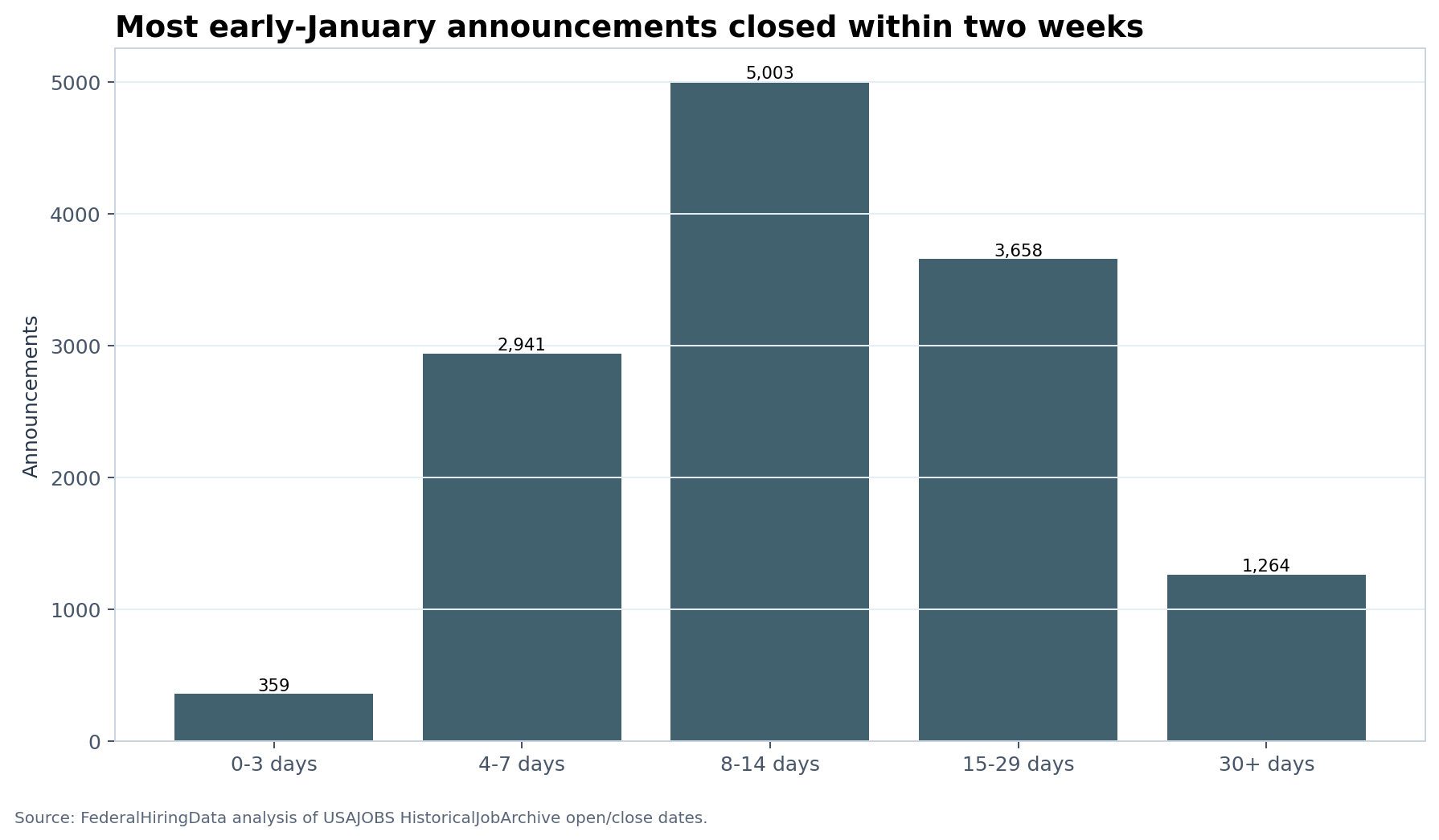
Announcement duration by bucket
| Duration bucket | Announcements | Share |
|---|---|---|
| 0-3 days | 359 | 2.7% |
| 4-7 days | 2,941 | 22.2% |
| 8-14 days | 5,003 | 37.8% |
| 15-29 days | 3,658 | 27.7% |
| 30+ days | 1,264 | 9.6% |
The distribution is centered in the 8-14 day bucket, with a substantial short-posting group. The archive found 3,300 announcements open seven days or less and 1,264 open 30 days or more.
Why short windows matter
Short postings make federal job search behavior more important. A person checking USAJOBS once every few weeks can miss a meaningful share of opportunities. The January 2025 data does not prove that every short posting was difficult to compete for, but it does show that the public window for many announcements was brief.
Short windows can appear for different reasons: standard agency posting practices, forecasted applicant volume, specialized hiring needs, open-continuous staffing patterns, or announcements that are tied to a specific applicant pool. The archive alone cannot identify the agency's reason for every duration.
Agency differences
Some agencies had more short-window behavior than others, but the safest comparison is descriptive.
| Agency | Announcements | Median days open | Average days open |
|---|---|---|---|
| Other Agencies and Independent Organizations | 202 | 6 | 10.5 |
| Customs and Border Protection | 135 | 7 | 8.5 |
| United States Fleet Forces Command | 104 | 7 | 8.9 |
| Naval Air Systems Command | 94 | 7 | 17.2 |
| Forest Service | 88 | 7 | 8.7 |
| Naval Supply Systems Command | 57 | 7 | 10.0 |
| Air Force Global Strike Command | 56 | 7 | 14.4 |
| Department of the Air Force | 96 | 8 | 10.8 |
Agency practices vary by role type, location, hiring authority, and occupational market. A healthcare posting at VHA, a seasonal posting at a land-management agency, and an analyst posting at a headquarters office can all have different duration logic.
What applicants should learn from the data
The practical lesson is not to panic over a short close date. It is to build a routine that assumes short close dates exist. Saved searches, clear eligibility filters, prepared resume versions, and early document gathering matter because the public window can be narrow.
The reverse is also true. A 30-day or longer announcement should not automatically be read as less competitive or less serious. Some broad recruiting announcements intentionally stay open longer, and some announcements list multiple locations or future vacancies.
What the data can and cannot answer
FederalHiringData can measure the open-date to close-date span recorded in the announcement archive. It cannot measure how long HR took after close, when referral notices went out, whether every applicant was reviewed, or how many people were interviewed. Those are later process steps that usually do not appear in public USAJOBS announcement records.
Still, the duration evidence is useful. It shows that by mid-January 2025, the federal job market visible to applicants was moving on a weekly cadence, not just a monthly one.
Methodology and limitations
This article is a FederalHiringData historical reconstruction. It uses USAJOBS HistoricalJobArchive records with announcement close dates on or before 2025-01-17. The analysis date shown to readers is 2025-01-17; the actual publication timestamp is preserved separately in the production Article row and in Article schema metadata.
The dataset counts job announcements, not hires, selections, applicants, certificates, or filled positions. A single announcement may represent one vacancy, many vacancies, or a continuing recruitment need. FederalHiringData normalizes fields such as agency, occupation series, salary range, location count, and open/close dates where the source data supports it, but the underlying announcement text remains the controlling source.
The article uses 13,225 archive records in its primary snapshot. Historical USAJOBS announcements can be amended, cancelled, or structured differently across agencies. Salary maximums are advertised maximums from normalized announcement data and should not be read as guaranteed pay for any applicant. Advertised locations are not the same as OPM duty-station employment counts.
The historical-as-of date is a reporting cutoff, not a claim that this web page existed on that date. FederalHiringData preserved the actual publication and edit timestamps in the article record and uses the January 2025 date to tell readers which archive slice the analysis reflects. Question Intelligence helped select the topic because people search for these answers, but forum posts are not used as evidence for the numerical claims.
Null or ambiguous source fields are not silently converted into confident labels. When the article describes agency, occupation, salary, duration, or location patterns, it is describing the normalized rows available for that specific cutoff. Later backfills can improve coverage, but this pilot avoids retroactively using later January or later-year data in articles assigned to earlier January cutoffs.
Sources: FederalHiringData HistoricalJobArchive; USAJOBS; USAJOBS API documentation. Photo: Nathan Dumlao via Unsplash, used under the Unsplash License.
Keep reading
Related federal hiring research
Article data window: FY2019-FY2025
Contract Spending and Federal Headcount Often Moved Independently
Across a bounded 28-agency sample, contract-obligation growth and covered headcount growth had only a 0.169 correlation; five agencies increased obligations while headcount fell.
Article data window: Jan. 1-14, 2026
Federal Healthcare Hiring Led Early January 2026 Job Announcements
Veterans Health Administration, nurse roles, medical officers, and other clinical and support occupations drove the strongest healthcare signal in the early January archive.
Article data window: Jan. 1-14, 2026
Federal Hiring Trends: Jan. 1-7 vs Jan. 8-14, 2026
Veterans Health Administration stayed dominant, nurse and medical roles strengthened, and remote-work signals remained too sparse for a public trend claim.
Federal Hiring Data Weekly
Subscribe to Federal Hiring Data Weekly.
Subscribe to Federal Hiring Data Weekly. Confirm your email after signing up to receive federal hiring trends, salary data, agency movements, and original research.