January 22, 2025
Most January 2025 Federal Announcements Named One Location
A Jan. 22 archive snapshot found most federal announcements named one advertised location, while a small set of broad postings listed many places.
By Federal Hiring Data Research Team
Most federal job announcements in the January 2025 archive were geographically specific. In a Jan. 22 FederalHiringData snapshot of 16,655 January-closing announcements, the median announcement named one advertised location, and 15,235 announcements had one normalized location.
At the same time, a smaller set of broad announcements listed many possible locations. FederalHiringData found 572 announcements with five or more locations and 156 with twenty or more.
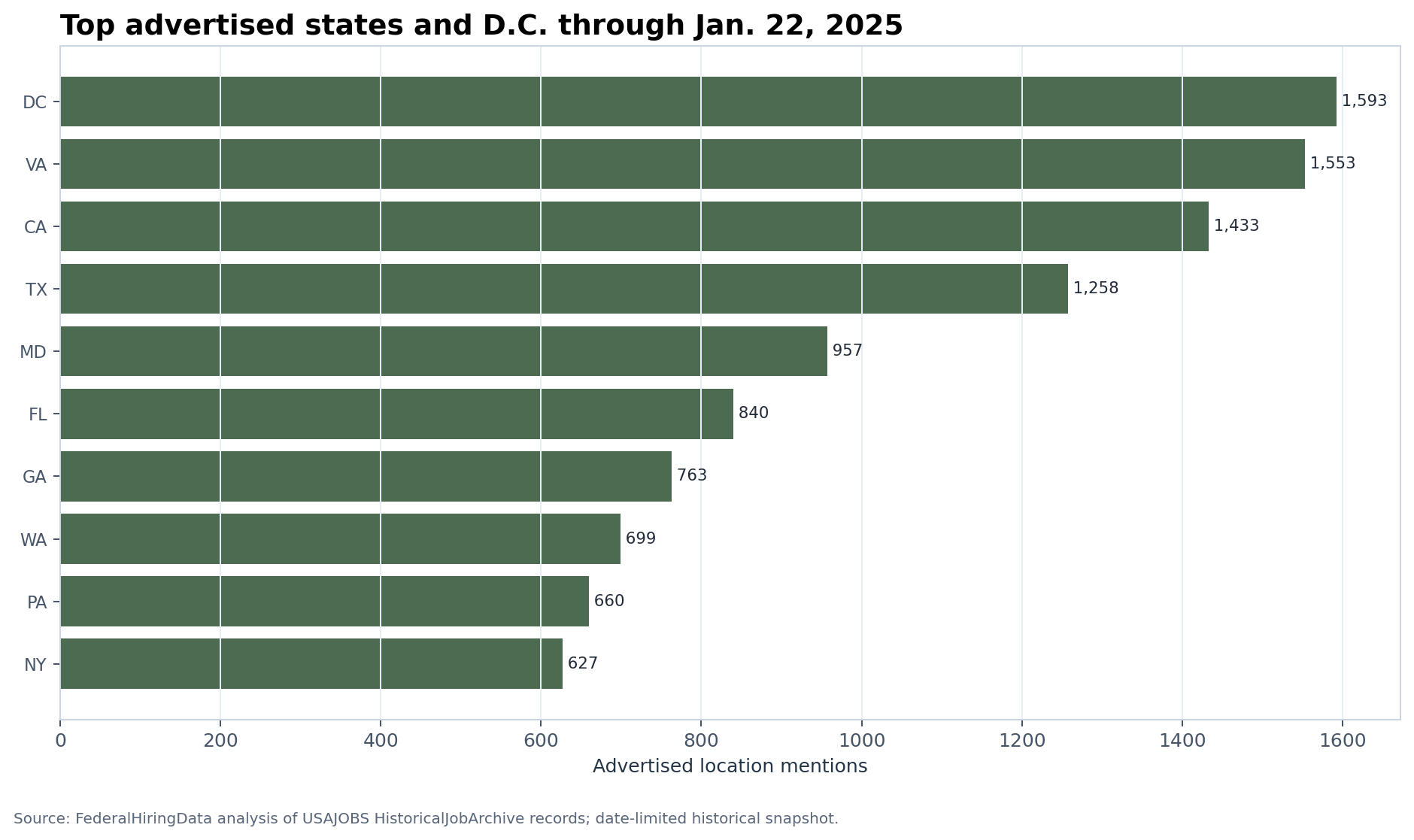
Top advertised states and D.C.
| State/D.C. | Advertised location mentions | Share of snapshot |
|---|---|---|
| DC | 1,593 | 9.6% |
| VA | 1,553 | 9.3% |
| CA | 1,433 | 8.6% |
| TX | 1,258 | 7.6% |
| MD | 957 | 5.7% |
| FL | 840 | 5.0% |
| GA | 763 | 4.6% |
| WA | 699 | 4.2% |
| PA | 660 | 4.0% |
| NY | 627 | 3.8% |
Washington, D.C., Virginia, California, Texas, Maryland, Florida, Georgia, and Washington state were the leading location labels in the Jan. 22 snapshot. These counts are advertised-location mentions, not workforce headcount and not proof of final duty station.
The one-location norm
The one-location result is useful because it counters a common misunderstanding. USAJOBS can feel like a national job board where everything is everywhere, but most announcements in this snapshot named one location after FederalHiringData normalized the location data.
That does not mean every one-location announcement was simple. A posting may still include telework language, bargaining-unit language, travel requirements, or multiple vacancies at the same duty station. But for mapping and filtering, one normalized advertised location was the normal case.
Broad postings still matter
The broad-posting minority should not be ignored. A small number of announcements listed dozens or hundreds of places. Those postings can dominate map bubbles and location filters if handled naively.
| Agency | Announcements | Avg. locations | 5+ locations | 20+ locations |
|---|---|---|---|---|
| Internal Revenue Service | 479 | 59.7 | 190 | 112 |
| Veterans Health Administration | 2,840 | 1.2 | 37 | 1 |
| Defense Logistics Agency | 242 | 1.7 | 25 | 0 |
| Bureau of Land Management | 159 | 2.3 | 20 | 0 |
| National Park Service | 342 | 1.4 | 12 | 0 |
| Defense Commissary Agency | 175 | 7.5 | 10 | 7 |
| Forest Service | 108 | 1.9 | 9 | 0 |
| U.S. Army Corps of Engineers | 452 | 1.2 | 7 | 0 |
This is why FederalHiringData separates exact mappable locations from broad, variable, and negotiable location signals. A posting with hundreds of locations should not be treated the same way as a job physically advertised in one city.
How to interpret location rankings
Location counts answer a specific question: where did announcements say work could be located? They do not answer where federal employees ultimately worked, where applicants lived, or where future hiring occurred. A remote-eligible or negotiable announcement may have a different practical geography than a single-city announcement.
For job seekers, the location lesson is to search at multiple levels. A city-only search can miss statewide or region-wide announcements. A state-only search can include broad postings that do not guarantee a position in a specific city. A remote filter should be used carefully because telework eligibility is not the same as fully remote work.
For map readers, the same caution applies in reverse. A large map marker can reflect multiple nearby announcements, many locations attached to one announcement, or a mix of exact and broad source labels. The safest public map is therefore one that explains whether a point is exact, broad, negotiable, or excluded from mapping.
Methodology and limitations
This article is a FederalHiringData historical reconstruction. It uses USAJOBS HistoricalJobArchive records with announcement close dates on or before 2025-01-22. The analysis date shown to readers is 2025-01-22; the actual publication timestamp is preserved separately in the production Article row and in Article schema metadata.
The dataset counts job announcements, not hires, selections, applicants, certificates, or filled positions. A single announcement may represent one vacancy, many vacancies, or a continuing recruitment need. FederalHiringData normalizes fields such as agency, occupation series, salary range, location count, and open/close dates where the source data supports it, but the underlying announcement text remains the controlling source.
The article uses 16,655 archive records in its primary snapshot. Historical USAJOBS announcements can be amended, cancelled, or structured differently across agencies. Salary maximums are advertised maximums from normalized announcement data and should not be read as guaranteed pay for any applicant. Advertised locations are not the same as OPM duty-station employment counts.
The historical-as-of date is a reporting cutoff, not a claim that this web page existed on that date. FederalHiringData preserved the actual publication and edit timestamps in the article record and uses the January 2025 date to tell readers which archive slice the analysis reflects. Question Intelligence helped select the topic because people search for these answers, but forum posts are not used as evidence for the numerical claims.
Null or ambiguous source fields are not silently converted into confident labels. When the article describes agency, occupation, salary, duration, or location patterns, it is describing the normalized rows available for that specific cutoff. Later backfills can improve coverage, but this pilot avoids retroactively using later January or later-year data in articles assigned to earlier January cutoffs.
Sources: FederalHiringData HistoricalJobArchive; USAJOBS; USAJOBS API documentation. Photo: Joey Csunyo via Unsplash, used under the Unsplash License.
Keep reading
Related federal hiring research
Article data window: FY2019-FY2025
Contract Spending and Federal Headcount Often Moved Independently
Across a bounded 28-agency sample, contract-obligation growth and covered headcount growth had only a 0.169 correlation; five agencies increased obligations while headcount fell.
Article data window: Jan. 1-14, 2026
Federal Healthcare Hiring Led Early January 2026 Job Announcements
Veterans Health Administration, nurse roles, medical officers, and other clinical and support occupations drove the strongest healthcare signal in the early January archive.
Article data window: Jan. 1-14, 2026
Federal Hiring Trends: Jan. 1-7 vs Jan. 8-14, 2026
Veterans Health Administration stayed dominant, nurse and medical roles strengthened, and remote-work signals remained too sparse for a public trend claim.
Federal Hiring Data Weekly
Subscribe to Federal Hiring Data Weekly.
Subscribe to Federal Hiring Data Weekly. Confirm your email after signing up to receive federal hiring trends, salary data, agency movements, and original research.