December 31, 2025
Where Overseas Federal Job Announcements Were Concentrated in 2025
Japan and Germany were the most frequent country signals among 4,715 federal announcements with international locations closing from April through November 2025.
By Federal Hiring Data Editorial Desk

Federal work outside the United States was not spread evenly across the world in 2025. Among 4,715 USAJOBS announcements with at least one normalized international location closing from April through November, Japan appeared on 1,594 and Germany on 1,213. Italy, South Korea and the United Kingdom formed the next tier.
The agency list explains much of that geography. Marine Corps, Army installation, Navy installation, Department of Defense Education Activity and U.S. Air Forces in Europe announcements dominated the overseas cohort. These were largely defense-community and installation-support opportunities, not a general cross-section of every kind of U.S. work abroad.
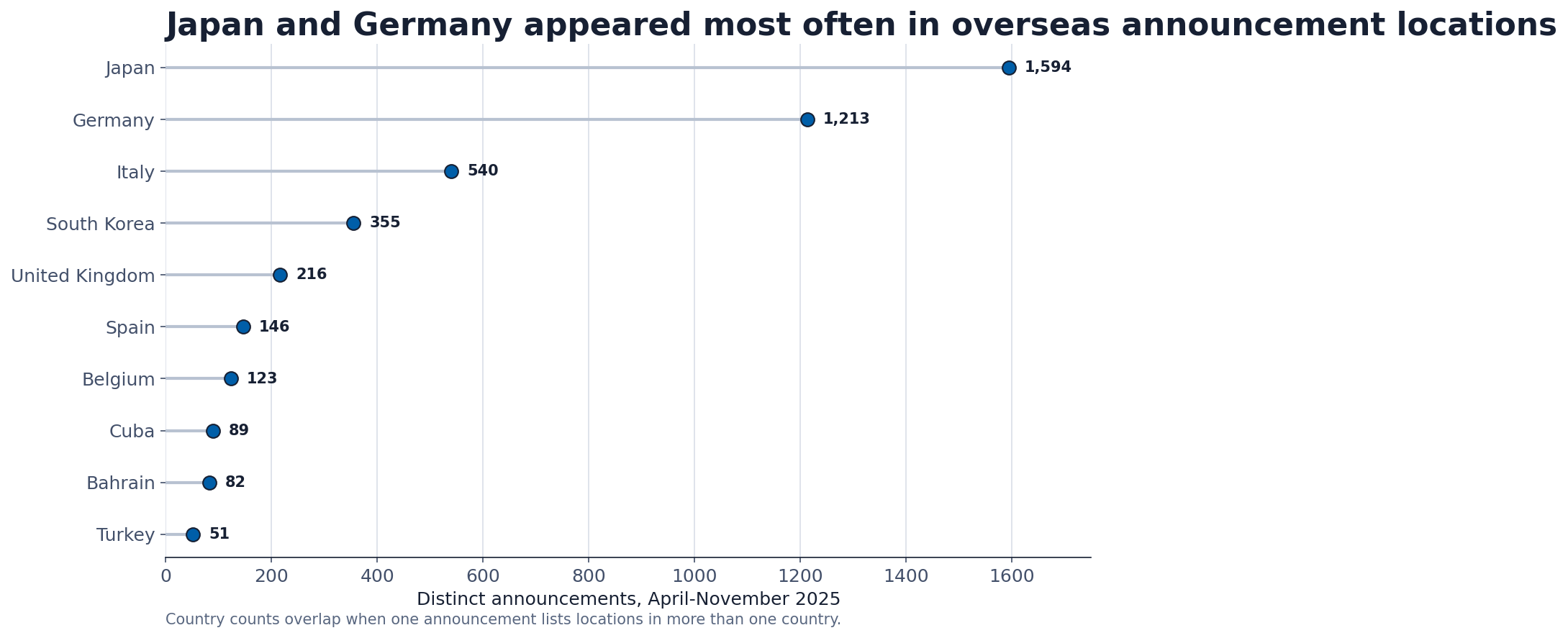
Japan and Germany were the leading location signals
| Country | Announcements | Distinct city labels |
|---|---|---|
| Japan | 1,594 | 36 |
| Germany | 1,213 | 26 |
| Italy | 540 | 11 |
| South Korea | 355 | 18 |
| United Kingdom | 216 | 15 |
| Spain | 146 | 5 |
| Belgium | 123 | 5 |
| Cuba | 89 | 1 |
| Bahrain | 82 | 3 |
| Turkey | 51 | 5 |
Country rows overlap when one announcement lists duty locations in more than one country. They should not be added together or treated as mutually exclusive shares. The 4,715 total counts distinct announcements at least once, while each country row answers how many announcements named that country.
Japan's prominence was broad enough to span 36 normalized city labels. Germany spanned 26. That suggests the pattern was not driven by one isolated installation, though major defense communities clearly contributed much of the volume.
Smaller but distinctive clusters appeared in places such as Antarctica, the Netherlands, Singapore, Australia and Mexico. A low country count can still represent a valuable opportunity for a specialized applicant; it simply means those locations appeared less often in this close-date cohort.
Defense organizations shaped the overseas market
| Hiring agency or component | Announcements |
|---|---|
| U.S. Marine Corps | 752 |
| Army Installation Management Command | 647 |
| Commander, Navy Installations | 532 |
| Department of Defense Education Activity | 493 |
| U.S. Air Forces, Europe | 463 |
| Military Treatment Facilities under DHA | 351 |
| Pacific Air Forces | 227 |
| United States Fleet Forces Command | 127 |
| Drug Enforcement Administration | 97 |
| Defense Logistics Agency | 93 |
The leading organizations point to a practical reality: many overseas civilian jobs support installations, military communities, schools, logistics, recreation, healthcare and base operations. That does not make them military positions. They are civilian announcements connected to an overseas federal mission.
Agency names in USAJOBS can vary across components. Army Installation Management Command and United States Army Installation Management Command, for example, appeared as separate source labels in the archive. FederalHiringData did not merge differently named organizations merely because they look related. That conservative rule prevents an attractive but potentially false total.
The occupations were broader than diplomacy
The most frequent series included Education and Training Technician (1702), Recreation Aid and Assistant (0189), Miscellaneous Clerk and Assistant (0303), General Business and Industry (1101), General Education and Training (1701), Criminal Investigation (1811) and Information Technology Management (2210).
| Occupational series | Announcements |
|---|---|
| 1702 | 446 |
| 0189 | 404 |
| 0303 | 322 |
| 1101 | 307 |
| 1701 | 266 |
| 0301 | 158 |
| 1811 | 129 |
| 2210 | 96 |
| 7404 | 93 |
| 0343 | 92 |
This mix fits the installation pattern. Schools need education staff; bases need recreation, administrative, business, food-service and technical workers; investigative and IT functions also operate internationally. Applicants searching only for embassy work would miss much of the observable overseas federal market.
At the same time, an overseas location does not guarantee relocation assistance, housing support or an allowance. Those details vary by appointment, location and announcement. Some jobs may be limited to people already in the commuting area or eligible through a specific hiring path.
Volume rose into September, then changed with the broader market
Monthly overseas announcement counts were 527 in April, 664 in May, 630 in June, 657 in July, 677 in August and 940 in September. They then fell to 368 in October and 252 in November.
The September peak coincided with the USAJOBS two-page resume transition that pushed many announcements onto a Sept. 26 close date. October and November overlapped the federal funding lapse. The monthly pattern therefore should not be interpreted as a clean measure of underlying overseas staffing demand.
It is safer to use the eight-month window to identify durable concentrations: Japan and Germany at the country level, defense-connected components at the agency level, and installation-support work in the occupation mix.
What overseas applicants should check
Location is only the start. Applicants should read the announcement for citizenship, residency, status, tour length, return rights, family-member preference, security clearance, medical requirements and relocation provisions. A role physically located overseas is different from a remote U.S. job performed while living abroad.
The “This job is open to” section is especially important. Some announcements may be open to the public; others prioritize current federal employees, military spouses, family members overseas or candidates with another status. The archive recorded 4,080 announcements across all locations carrying the “Family of overseas employees” path in the broader April-November cohort, but that path alone does not define every overseas job.
Use current job search to verify which overseas roles remain open. Historical counts explain where announcements were concentrated in 2025; they do not mean those particular postings can still accept applications.
Methodology and limitations
FederalHiringData selected distinct HistoricalJobArchive announcements with close dates from April 1 through Nov. 30, 2025, joined to at least one HistoricalJobArchiveLocation row marked international. The historical evidence cutoff is Dec. 31, 2025. Country, agency and occupational-series counts were calculated independently.
Multi-location announcements can appear in more than one country row. The analysis counts announcements, not vacancies, applications, hires or people stationed abroad. It does not evaluate relocation benefits, allowances or applicant eligibility. Normalized country and city labels reflect the available USAJOBS source data and FederalHiringData's conservative location classification.
Official background comes from USAJOBS and its developer documentation. Public discussions about OCONUS searches helped identify the question but were not used to establish counts or benefits. Photo: Airman 1st Class Eve Daugherty, U.S. Air Force, via Wikimedia Commons.jpg), public domain.
Keep reading
Related federal hiring research
Article data window: FY2019-FY2025
Contract Spending and Federal Headcount Often Moved Independently
Across a bounded 28-agency sample, contract-obligation growth and covered headcount growth had only a 0.169 correlation; five agencies increased obligations while headcount fell.
Article data window: Jan. 1-14, 2026
Federal Healthcare Hiring Led Early January 2026 Job Announcements
Veterans Health Administration, nurse roles, medical officers, and other clinical and support occupations drove the strongest healthcare signal in the early January archive.
Article data window: Jan. 1-14, 2026
Federal Hiring Trends: Jan. 1-7 vs Jan. 8-14, 2026
Veterans Health Administration stayed dominant, nurse and medical roles strengthened, and remote-work signals remained too sparse for a public trend claim.
Federal Hiring Data Weekly
Subscribe to Federal Hiring Data Weekly.
Subscribe to Federal Hiring Data Weekly. Confirm your email after signing up to receive federal hiring trends, salary data, agency movements, and original research.