December 31, 2025
Who Could Apply? Public vs. Internal Federal Job Announcements in 2025
Among 95,843 announcements closing from April through November 2025, 55.4% named the public and 39.9% named internal agency candidates, with substantial overlap among eligibility paths.
A federal job can appear in search results and still be unavailable to a particular applicant. The deciding section is “This job is open to,” where an announcement names one or more hiring paths: the public, current agency employees, federal employees in the competitive or excepted service, veterans, military spouses and other eligible groups.
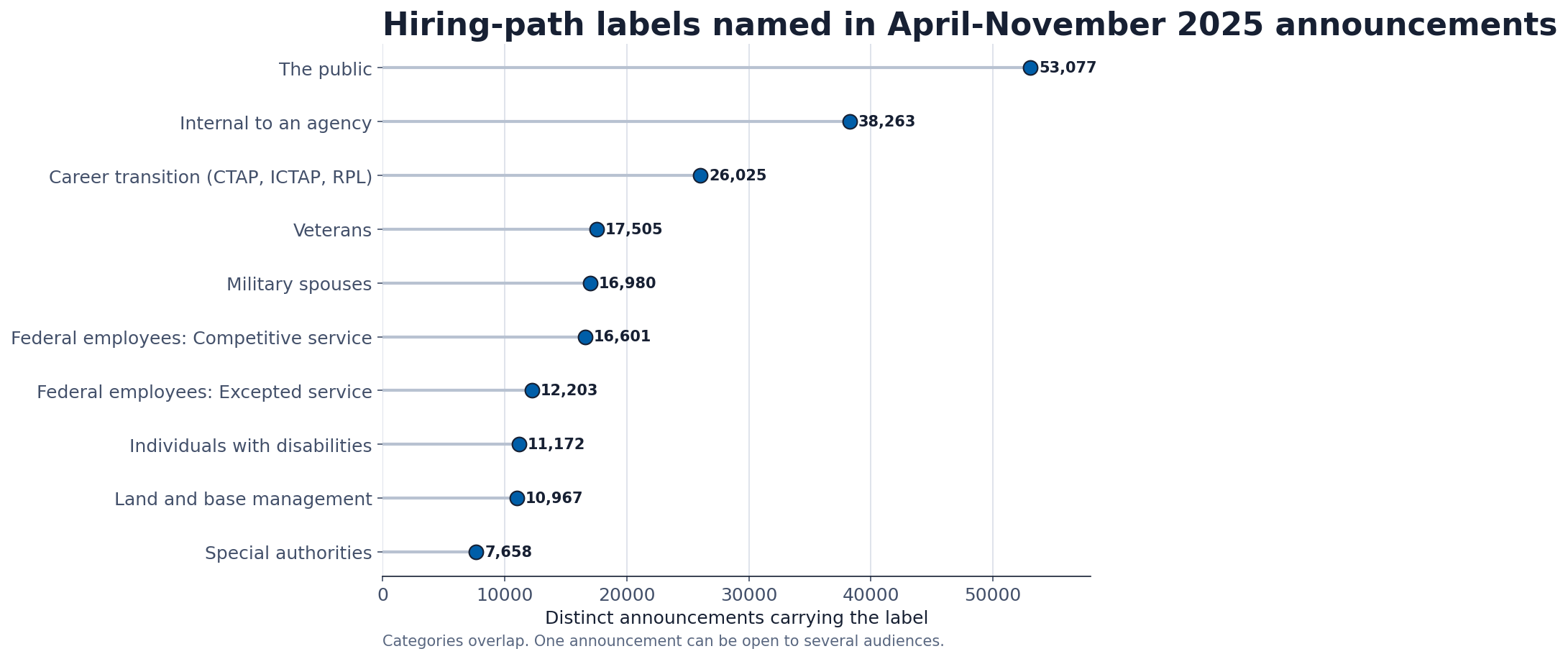
In 95,843 USAJOBS announcements closing from April through November 2025, 53,077 named “The public” and 38,263 named “Internal to an agency.” Those groups overlapped. The archive found 9,335 announcements carrying both labels, while tens of thousands listed additional eligibility paths.
The result is not a clean public-versus-private split. Federal eligibility works more like overlapping lanes. The same announcement may admit applicants through several lanes, and a person must establish eligibility before the agency evaluates qualifications.
The public path was common, but not universal
“The public” appeared on 55.4% of announcements in the eight-month cohort. “Internal to an agency” appeared on 39.9%. Because 9.7% carried both labels, adding those percentages would double-count part of the archive.
| Eligibility pattern | Announcements | Share of all announcements |
|---|---|---|
| The public | 53,077 | 55.4% |
| Internal to an agency | 38,263 | 39.9% |
| Public, without internal label | 43,742 | 45.6% |
| Internal, without public label | 28,928 | 30.2% |
| Both public and internal labels | 9,335 | 9.7% |
| Neither of those two labels | 13,838 | 14.4% |
“Neither” does not mean nobody could apply. Those announcements could name veterans, military spouses, career-transition candidates, people with disabilities, students, recent graduates or another specific audience.
The labels also describe eligibility, not preference or eventual selection. A member of the public who meets the qualifications can apply to a public announcement. That does not guarantee referral. A current federal employee may qualify under more than one path, but still must provide the documents the announcement requests.
Other paths were substantial
The archive recorded 26,025 announcements with a Career Transition Assistance Plan, Interagency Career Transition Assistance Plan or Reemployment Priority List label. Veterans appeared on 17,505, military spouses on 16,980 and individuals with disabilities on 11,172.
| Hiring-path label | Announcements |
|---|---|
| Career transition (CTAP, ICTAP, RPL) | 26,025 |
| Federal employees - competitive service | 16,601 |
| Veterans | 17,505 |
| Military spouses | 16,980 |
| Federal employees - excepted service | 12,203 |
| Individuals with disabilities | 11,172 |
| Land and base management | 10,967 |
| Special authorities | 7,658 |
| National Guard and reserves | 4,718 |
| Family of overseas employees | 4,080 |
These rows cannot be summed into a total applicant market. One announcement can appear in several rows. For example, an announcement may be open to competitive-service employees, veterans and military spouses at the same time.
Eligibility and qualifications are separate tests
USAJOBS describes eligibility as belonging to a group the agency is permitted to consider. Qualifications concern the experience, education and other requirements needed to do the job. An applicant can be highly qualified but ineligible for a restricted announcement. An eligible applicant can still lack the specialized experience needed for referral.
This distinction explains a common source of frustration. A search result may match a person's title, grade and location, yet the announcement's audience excludes them. Conversely, an applicant may see a specialized hiring path and assume it lowers the qualification bar. It does not; the announcement's qualification section still applies.
For current federal employees, “internal to an agency” is narrower than federal service generally. It commonly limits consideration to employees of the hiring agency. Separate competitive-service or excepted-service paths may reach employees elsewhere in government, depending on the announcement and the applicant's status.
Why agencies use more than one path
Public announcements can broaden the applicant pool. Internal or status-based announcements can support merit-promotion procedures, priority placement obligations or authorities targeted to particular groups. An agency may post related opportunities under different control numbers to reach different audiences.
The archive cannot identify the agency's motive for choosing each path. It also cannot tell which path an eventual selectee used. The labels are still valuable because they show the formal audience an announcement invited, rather than guessing from the title or agency.
Across this 2025 cohort, the public path was the single most frequent label. But nearly half the announcements either omitted it or paired it with a different access route. That is why a count of all USAJOBS announcements is not the same as a count of jobs open to an applicant with no federal status.
How job seekers can use the labels
Start with the “This job is open to” section before investing time in the questionnaire and documents. Then open each path description and compare it with your own status. If you rely on a path, provide the required evidence, such as an SF-50, veterans documentation or Schedule A letter when the announcement calls for it.
Do not assume that a saved profile setting proves eligibility. USAJOBS lets users identify paths in a profile to improve search, but the applicant remains responsible for reading the announcement. Also check whether a public and a status announcement are parallel versions of the same underlying need; their deadlines and required documents may differ.
FederalHiringData's job search preserves announcement details and offers filters for current opportunities. The historical archive is useful for understanding which paths agencies used over time, but a closed 2025 announcement is not currently accepting applications.
Methodology and limitations
FederalHiringData analyzed 95,843 HistoricalJobArchive records with close dates from April 1 through Nov. 30, 2025. Hiring-path data were parsed from each announcement's stored USAJOBS audience labels. All records in this cohort had nonblank path metadata.
Categories overlap. Counts represent distinct announcements carrying a label, not unique positions, applicants or hires. Text matching was used for the public, internal, federal-employee, veteran and career-transition summary measures; expanded JSON labels produced the detailed ranking. The analysis does not infer Direct Hire authority from audience labels because those concepts are different.
Official explanations come from USAJOBS guidance on unique hiring paths, federal employee paths, and eligibility. Forum discussion informed the question but not the counts. Photo: Ensign John Land, U.S. Navy, via Wikimedia Commons, public domain.
Keep reading
Related federal hiring research
Article data window: FY2019-FY2025
Contract Spending and Federal Headcount Often Moved Independently
Across a bounded 28-agency sample, contract-obligation growth and covered headcount growth had only a 0.169 correlation; five agencies increased obligations while headcount fell.
Article data window: Jan. 1-14, 2026
Federal Healthcare Hiring Led Early January 2026 Job Announcements
Veterans Health Administration, nurse roles, medical officers, and other clinical and support occupations drove the strongest healthcare signal in the early January archive.
Article data window: Jan. 1-14, 2026
Federal Hiring Trends: Jan. 1-7 vs Jan. 8-14, 2026
Veterans Health Administration stayed dominant, nurse and medical roles strengthened, and remote-work signals remained too sparse for a public trend claim.
Federal Hiring Data Weekly
Subscribe to Federal Hiring Data Weekly.
Subscribe to Federal Hiring Data Weekly. Confirm your email after signing up to receive federal hiring trends, salary data, agency movements, and original research.