August 18, 2026
Remote Is Not Telework: What 93,496 Federal Announcements Show
Only 142 of 93,496 analyzed 2026 announcements were confirmed remote. Another 12,860 were telework eligible but not remote.
Published August 18, 2026Last edited August 18, 2026
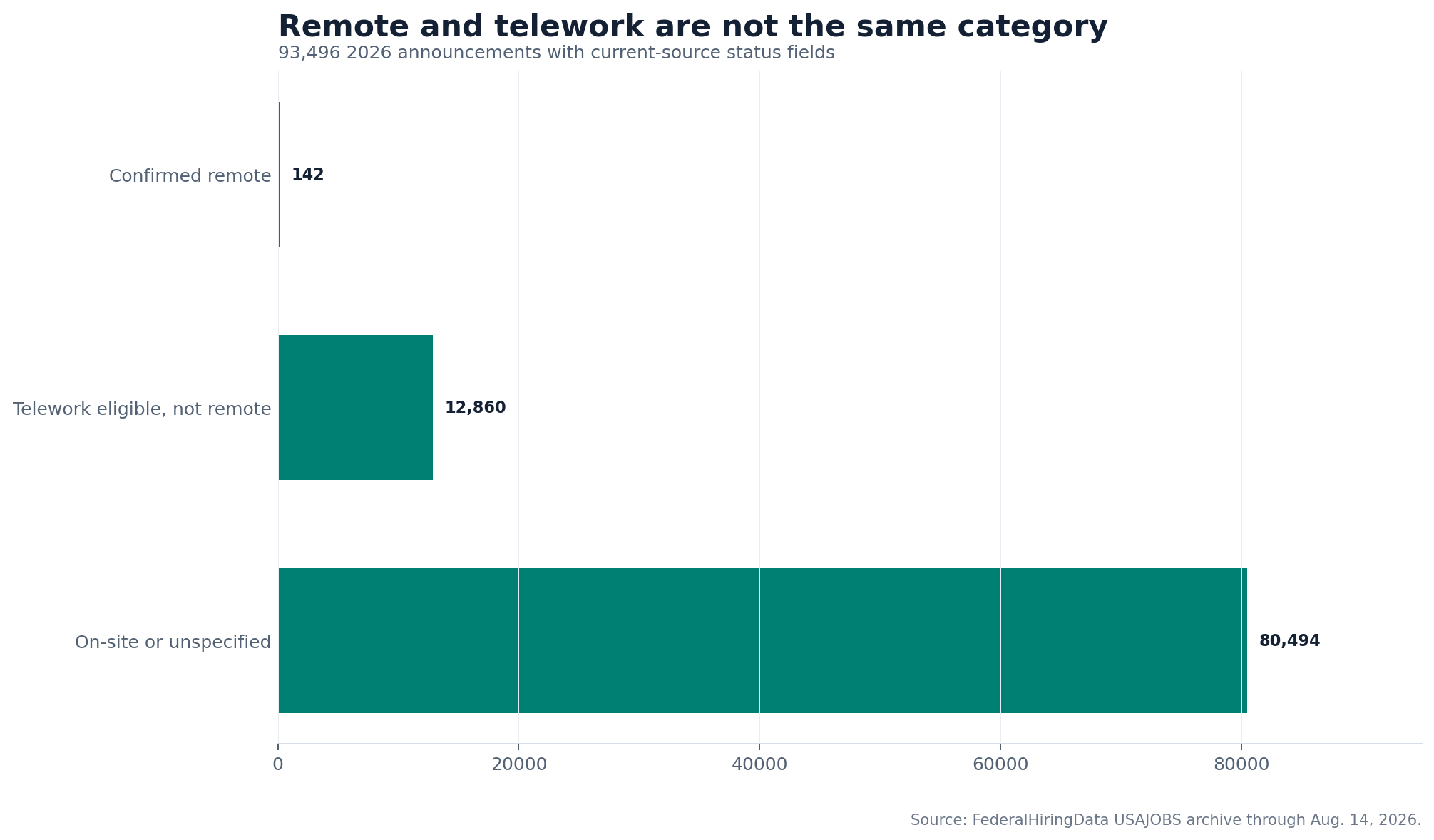
A federal job that permits telework is not automatically a remote job. In 93,496 2026 announcements with current-source remote fields, FederalHiringData found 142 confirmed remote announcements and 12,860 telework-eligible announcements that were not marked remote.
Confirmed remote represented 0.2% of this cohort. Telework-eligible but not remote represented 13.8%. The remaining 80,494 were on-site or did not carry a positive remote/telework signal.
OPM's definitions explain the difference
OPM defines telework as an arrangement in which an employee works from an approved alternative site on scheduled days and also regularly works at an agency site. Remote work is different: the employee is not expected to report to an agency worksite on a regular and recurring basis under the remote-work agreement.
That is why FederalHiringData keeps separate filters. Combining both categories and labeling the result "remote jobs" would inflate the number of positions that are actually advertised as fully remote.
The current snapshot is just as lopsided
Among 11,983 records in the warehouse that were still open on Aug. 17, only 29 were confirmed remote. 3,280 were telework eligible but not remote.
Those counts are a dated snapshot, not a promise that the same jobs remain open now. Readers should use the live remote and telework filters and check the announcement's location and telework sections before applying.
The agency pattern shows why one label can mislead
Veterans Health Administration accounted for 76 confirmed remote and 2,501 telework-eligible, non-remote announcements in the 2026 cohort. Veterans Benefits Administration followed with 23 remote and 291 telework-eligible announcements. Department of State's agency-wide label recorded 15 remote and 110 telework-eligible announcements.
The point is not that those agencies guarantee flexible work. It is that a search result count can be shaped by a few large organizations and recurring recruiting patterns. Applicants still need to check the duty station and workplace arrangement on the specific announcement. One agency may also apply different policies across occupations, offices and bargaining units.
Which occupations carried the telework signal
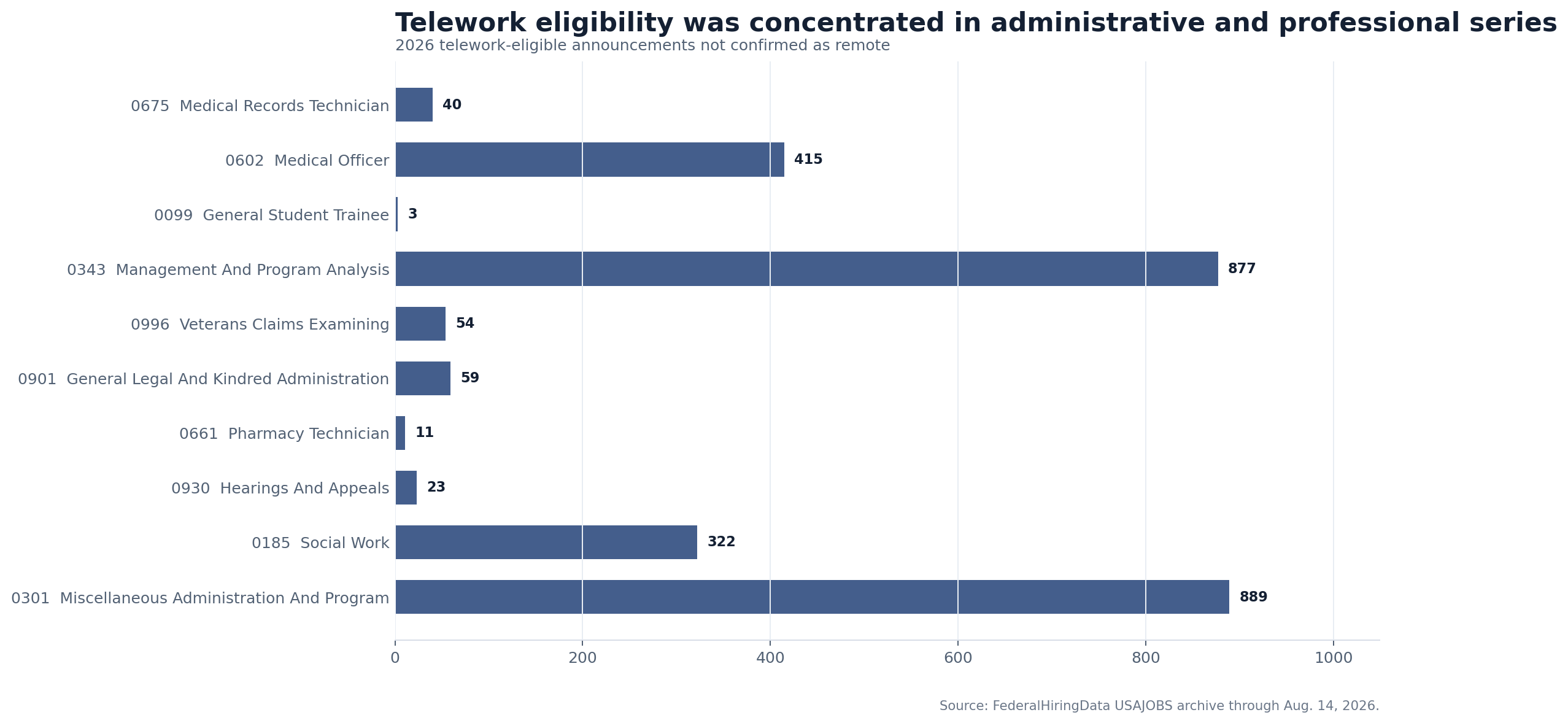
Management and Program Analysis (0343) recorded 877 telework-eligible, non-remote announcements in this ranked cohort. Miscellaneous Administration and Program (0301) recorded 889, and 2210 Information Technology Management recorded 840.
Confirmed remote was distributed differently. Medical Records Technician (0675) led this table with 33 confirmed remote announcements, followed by Medical Officer (0602) with 20 and General Student Trainee (0099) with 15. Small counts can move sharply when only a few announcements are added or closed.
The occupation mix also demonstrates why "remote federal work" is not synonymous with federal IT. Only one 2210 announcement in this 2026 cohort was confirmed remote, even though 840 were telework eligible. Clinical records, medical and trainee series supplied more of the confirmed-remote count. A keyword-only search for technology roles would miss that structure.
Why this is not a disappearance trend
FederalHiringData cannot honestly use the full 2017-2026 archive to chart remote-work disappearance. The complete historical archive preserves dates, titles, grades, pay and occupations, but its older source does not carry a consistently comparable remote indicator. Current-source remote fields are complete for 2026 and sparse before 2025.
The defensible result is a cross-section: remote was rare in the 2026 records with reliable status fields, and telework was much more common. A causal or long-run trend claim would require a consistently populated field across years.
How applicants should read an announcement
Check the overview's location, remote and telework fields together. Then read any agency-specific conditions. A telework-eligible label may still involve several days per pay period at a duty station. A remote label can still restrict the employee's approved worksite or geographic area. Neither arrangement is an entitlement, and the announcement remains the controlling source.
Methodology and limitations
FederalHiringData analyzed active and historical `Job` source records opened in 2026 through Aug. 14. Confirmed remote requires the normalized remote indicator to be true. Telework eligible excludes records already counted as remote. The active snapshot required a close date on or after Aug. 17. Counts are announcements, not hires or positions.
Older Abigail archive rows were excluded from the remote-rate denominator because their source does not preserve a comparable remote field. Forum claims about remote work established demand for this analysis but were not factual evidence.
Keep reading
Related federal hiring research
Article data window: FY2019-FY2025
Contract Spending and Federal Headcount Often Moved Independently
Across a bounded 28-agency sample, contract-obligation growth and covered headcount growth had only a 0.169 correlation; five agencies increased obligations while headcount fell.
Article data window: Jan. 1-14, 2026
Federal Healthcare Hiring Led Early January 2026 Job Announcements
Veterans Health Administration, nurse roles, medical officers, and other clinical and support occupations drove the strongest healthcare signal in the early January archive.
Article data window: Jan. 1-14, 2026
Federal Hiring Trends: Jan. 1-7 vs Jan. 8-14, 2026
Veterans Health Administration stayed dominant, nurse and medical roles strengthened, and remote-work signals remained too sparse for a public trend claim.
Federal Hiring Data Weekly
Subscribe to Federal Hiring Data Weekly.
Subscribe to Federal Hiring Data Weekly. Confirm your email after signing up to receive federal hiring trends, salary data, agency movements, and original research.