August 18, 2026
How Common Are Named Security-Clearance Levels in Federal Job Announcements?
Among 93,496 analyzed 2026 announcements, 21,360 named Confidential, Secret, Top Secret or Top Secret/SCI. Unknown values remain separate.
Published August 18, 2026Last edited August 18, 2026
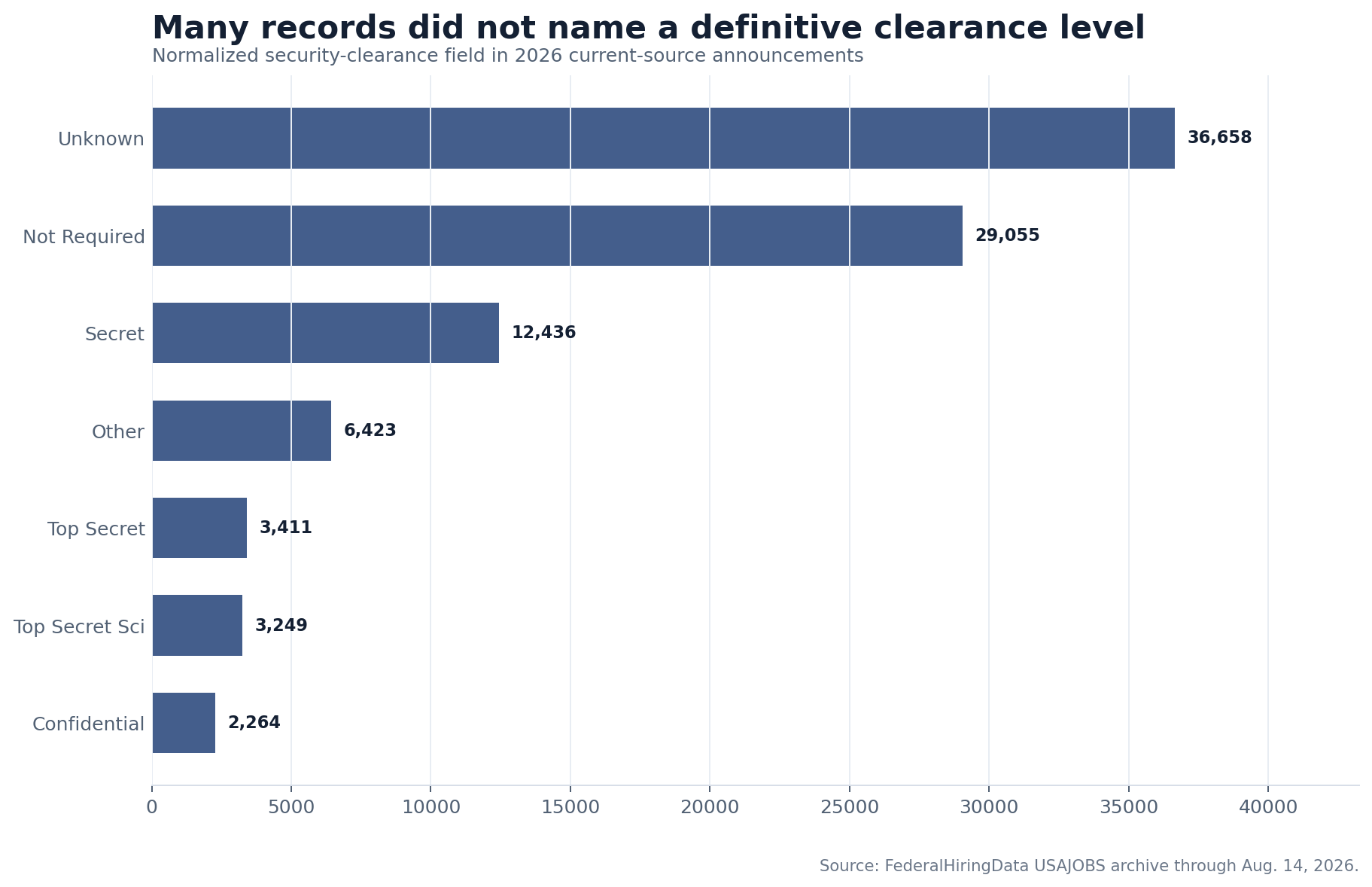
A security clearance is common in some federal career fields, but it is not a universal USAJOBS requirement. In 93,496 2026 current-source announcements, FederalHiringData found 21,360 that named a normalized Confidential, Secret, Top Secret or Top Secret/SCI level. That is 22.8% of the cohort.
Another 29,055 were explicitly normalized as not required. 43,081 carried an unknown, other or otherwise non-definitive value. Treating all of those ambiguous records as clearance jobs would be just as misleading as treating them all as no-clearance jobs.
What the levels mean
Defense Counterintelligence and Security Agency guidance identifies Confidential, Secret and Top Secret as the three primary eligibility levels for classified national-security information. A Top Secret/SCI signal adds access requirements for sensitive compartmented information; it should not be collapsed into ordinary Top Secret when an announcement names it separately.
Public trust and suitability determinations are different concepts. They should not be relabeled as security-clearance levels simply because a background investigation may be required.
The normalized table contained 12,436 Secret, 3,411 Top Secret, 3,249 Top Secret/SCI and 2,264 Confidential announcements. The largest category, however, was Unknown at 36,658. "Other" added 6,423. Those two categories are deliberately excluded from the named-level numerator because their labels do not prove a classified-access requirement at a specific level.
Which occupations carried the named-level signal
Miscellaneous Administration and Program (0301) led the 2026 table with 1,651 announcements naming a level. Information Technology Management (2210) followed with 1,440, Management and Program Analysis (0343) with 1,149, and General Engineering (0801) with 671.
| Series | Occupation | Announcements naming a level |
|---|---|---|
| 0301 | Miscellaneous Administration And Program | 1,651 |
| 2210 | Information Technology Management | 1,440 |
| 0343 | Management And Program Analysis | 1,149 |
| 0801 | General Engineering | 671 |
| 0080 | Security Administration | 651 |
| 0201 | Human Resources Management | 564 |
| 1801 | General Inspection, Investigation, Enforcement, And Compliance Series | 547 |
| 0340 | Program Management | 510 |
| 0501 | Financial Administration And Program | 507 |
| 0905 | Attorney | 498 |
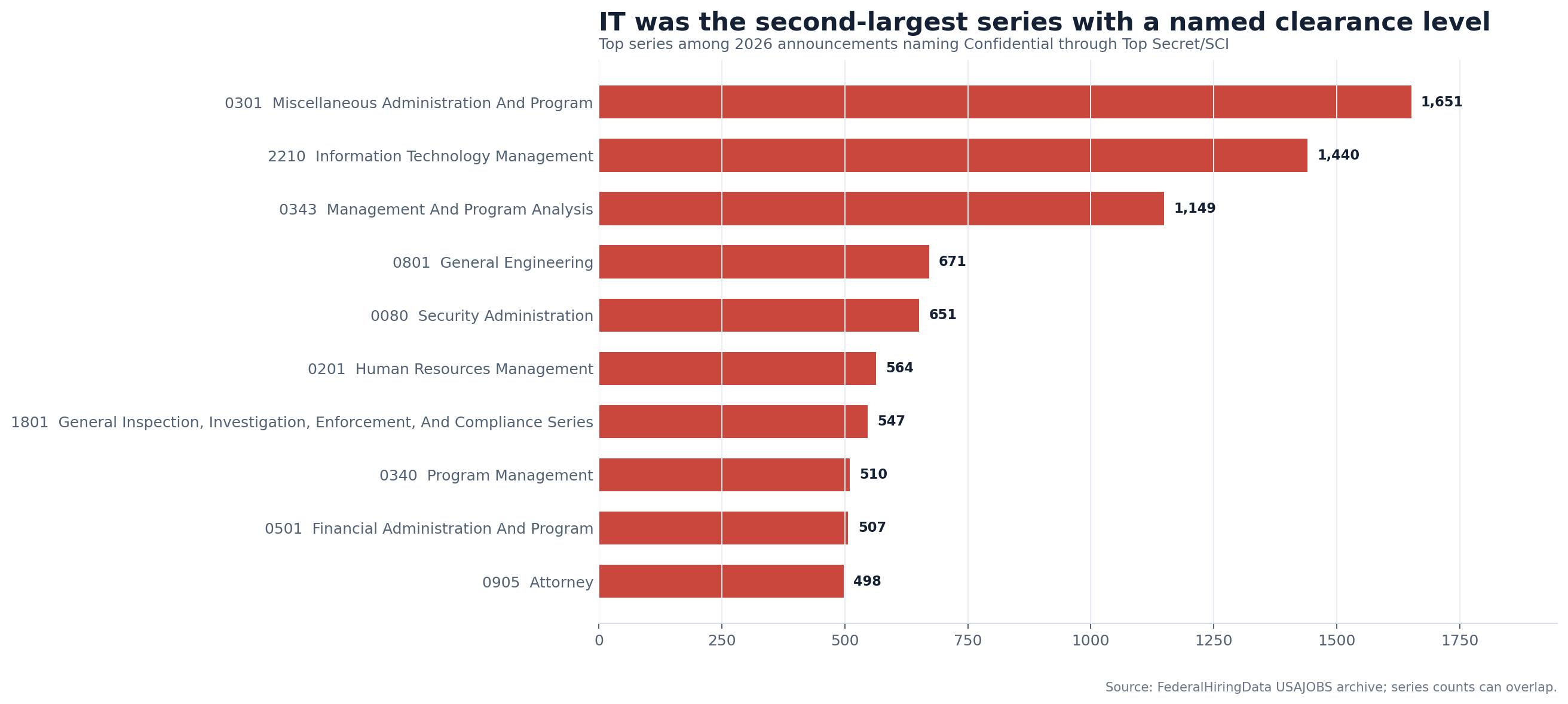
The table is broader than intelligence occupations. Human resources, attorneys, finance, engineering and program management can support classified missions even when the job title does not sound intelligence-specific.
Defense organizations dominate the agency ranking
Army National Guard Units led with 1,148 named-level announcements, followed by Commander, Navy Installations Command with 891 and Air National Guard Units with 784. Fleet, naval systems, Marine Corps, military health and logistics organizations fill much of the rest of the top group.
Agency counts describe announcement labels, not how many cleared employees an organization has or how many investigations DCSA completed.
This is especially important for broad administrative series. A 0301 program role at a defense organization can support classified work, while another 0301 at a civilian agency may not. The occupation code alone cannot determine clearance requirements. The announcement-level field and conditions of employment must be read together.
Clearance eligibility is not the same as immediate access
An announcement may require an applicant to be eligible for a clearance, able to obtain one, or already possess one. Those conditions are not interchangeable. The exact announcement controls. The public data also do not show adjudication outcomes or processing time.
Applicants should read conditions of employment, required documents and any drug-testing, polygraph, citizenship or sensitivity language. FederalHiringData's classification is a search and research aid, not an adjudication decision.
Why this analysis uses 2026 only
The older historical archive preserves millions of core announcement fields, but it does not carry a comparable security-clearance field. By contrast, the `Job` source records used here have a populated clearance value for all 93,496 analyzed rows. Publishing an apparent 2017-2026 trend would therefore measure source coverage rather than hiring requirements.
Methodology and limitations
FederalHiringData analyzed current-source active and historical announcements opened in 2026 through Aug. 14. A named level requires the normalized value Confidential, Secret, Top Secret or Top Secret/SCI. Unknown, Other and null-derived categories remain ambiguous. Occupation counts can overlap when one announcement names multiple series.
The analysis does not measure applicants, clearances granted, investigation duration, suitability, public trust or hires. Forum discussions identify the demand for this question; DCSA supplies the definitions and the USAJOBS archive supplies the announcement counts.
Keep reading
Related federal hiring research
Article data window: FY2019-FY2025
Contract Spending and Federal Headcount Often Moved Independently
Across a bounded 28-agency sample, contract-obligation growth and covered headcount growth had only a 0.169 correlation; five agencies increased obligations while headcount fell.
Article data window: Jan. 1-14, 2026
Federal Healthcare Hiring Led Early January 2026 Job Announcements
Veterans Health Administration, nurse roles, medical officers, and other clinical and support occupations drove the strongest healthcare signal in the early January archive.
Article data window: Jan. 1-14, 2026
Federal Hiring Trends: Jan. 1-7 vs Jan. 8-14, 2026
Veterans Health Administration stayed dominant, nurse and medical roles strengthened, and remote-work signals remained too sparse for a public trend claim.
Federal Hiring Data Weekly
Subscribe to Federal Hiring Data Weekly.
Subscribe to Federal Hiring Data Weekly. Confirm your email after signing up to receive federal hiring trends, salary data, agency movements, and original research.