August 18, 2026
The Korea Exercise Was Cut. The Civilian Workforce Behind the Alliance Was Not
The U.S. defense presence in South Korea includes 2,903 appropriated-fund civilians, while 12,428 archived job announcements reveal the year-round system behind the alliance.
By Evan Mercer
Published August 18, 2026Last edited August 19, 2026
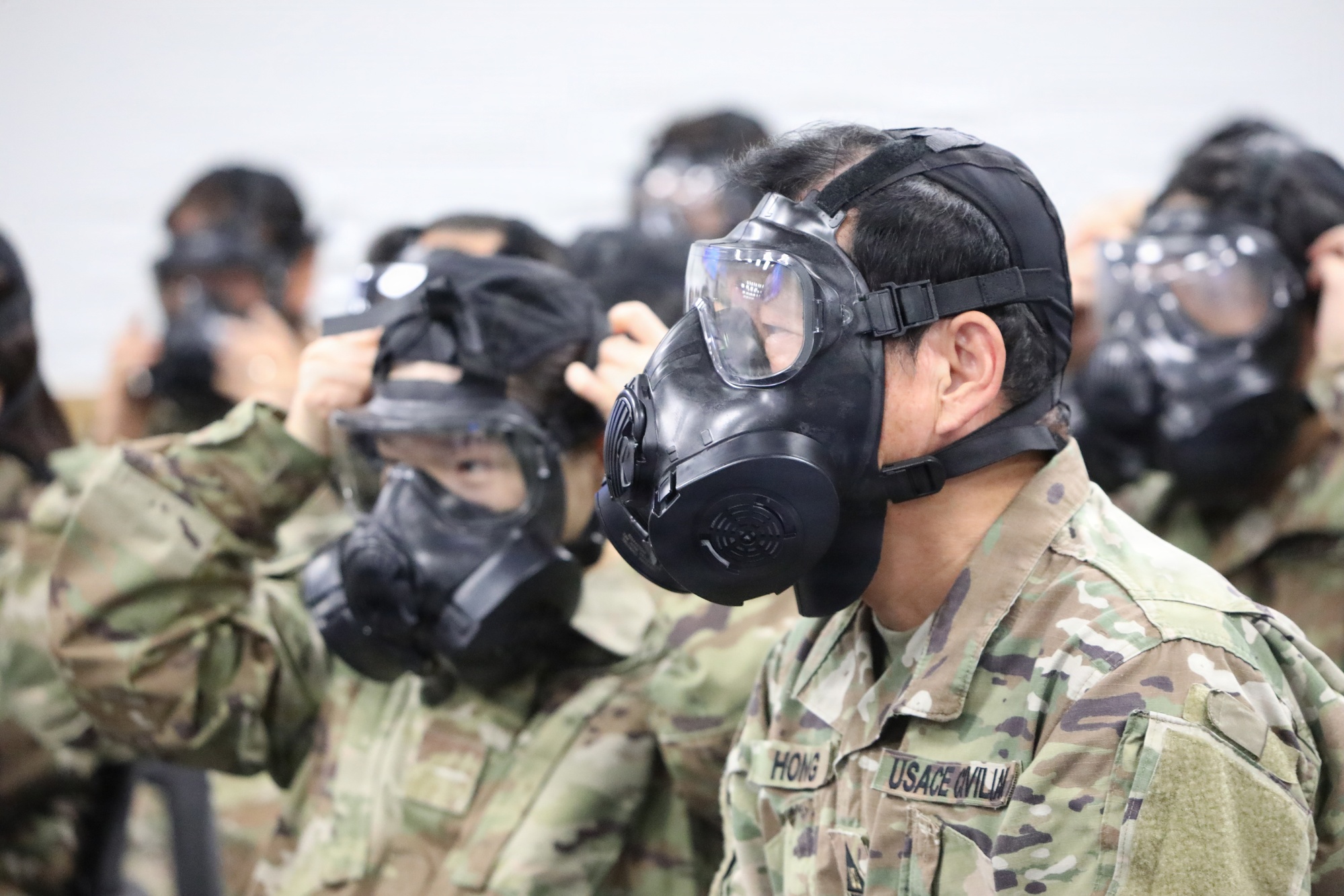
The first full day of this year's Ulchi Freedom Shield exercise unfolded under an unusual order: make it smaller.
President Donald Trump directed the United States and South Korea to scale back the 11-day exercise shortly before it began Aug. 17, the Associated Press reported. What was reduced, and by how much, was not immediately clear. The decision put attention on aircraft, field drills and the politics of the alliance.
The less visible part of that alliance did not disappear with the change in exercise plans. As of March 31, the Defense Manpower Data Center counted 2,903 U.S. appropriated-fund defense civilians assigned in South Korea, alongside 23,372 active-duty personnel and 314 reserve-component personnel. They are different workforces and should not be combined as if everyone serves in the same capacity. Together, however, they show why the U.S. presence on the peninsula cannot be understood from an exercise schedule alone.
FederalHiringData's USAJOBS archive makes the civilian system more concrete. It contains 12,428 public announcements tied to South Korea since March 2017, spanning installation management, medicine, information technology, education, logistics, engineering, security and everyday base services. A live production check on Aug. 18 found 40 active Korea-linked announcements.
The exercise may be episodic. The workforce behind it is not.
What remains when an exercise gets smaller?
Ulchi Freedom Shield is built to test the combined command structure that the United States and South Korea would use in a crisis. Last year's official Defense Department coverage described a mix of live, virtual and field training across military and government organizations. It also documented Army civilians participating alongside uniformed personnel.
This year's late change affects the training event, not the basic arithmetic of the U.S. footprint. DMDC's March report counted:
| Assigned U.S. defense population in South Korea | People |
|---|---|
| Active-duty personnel | 23,372 |
| Appropriated-fund DoD civilians | 2,903 |
| Reserve-component personnel | 314 |
| Report total | 26,589 |
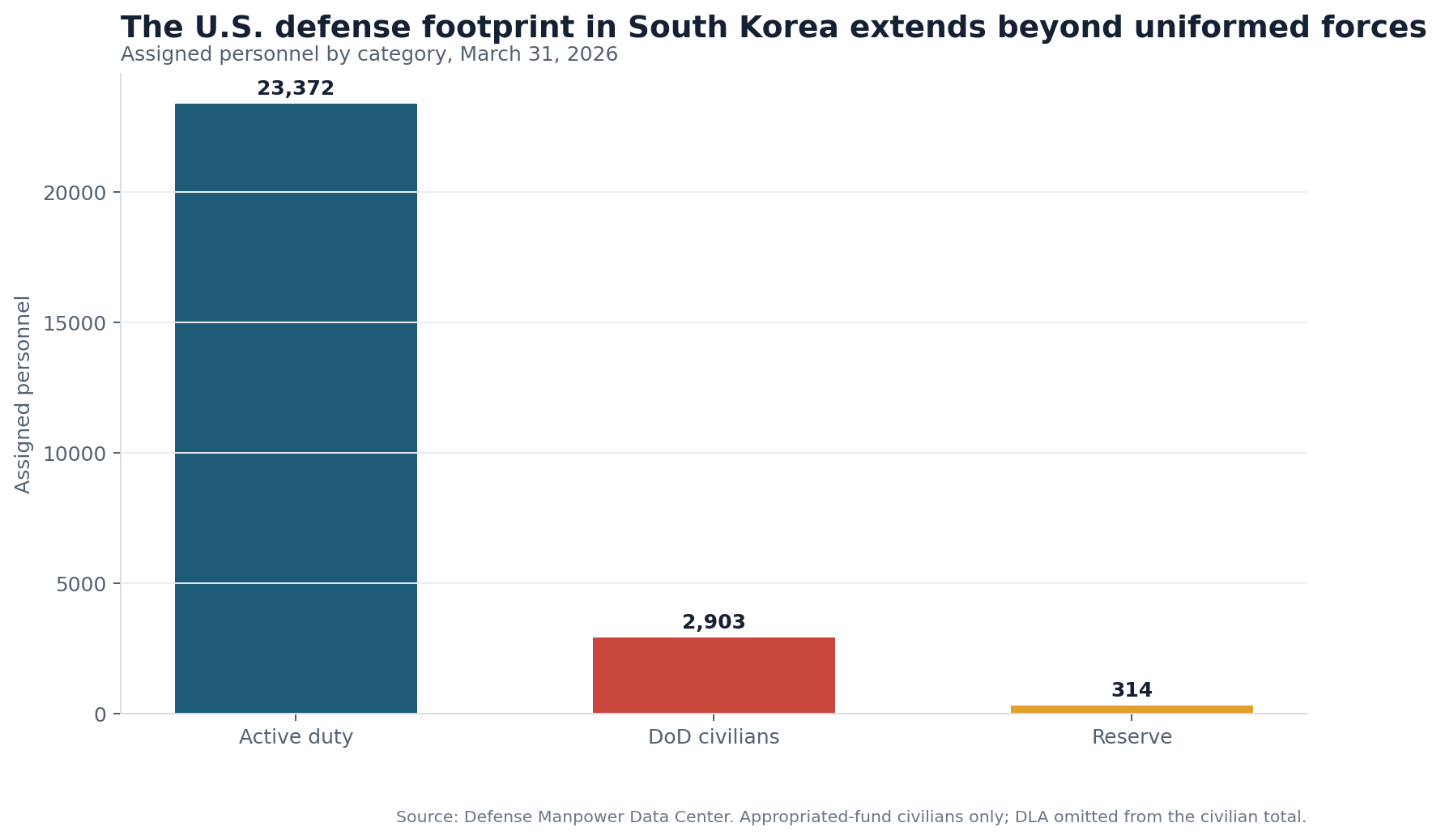
The active-duty count was concentrated in the Army, with 15,354 personnel, and the Air Force, with 7,384. The civilian count had a different composition: 1,289 Army civilians, 185 Air Force civilians, 44 Navy civilians, nine Marine Corps civilians and 1,376 people assigned to the defense agencies DMDC groups as the Fourth Estate.
That separation matters. Civilian employees are not troops, and an announcement is not a military billet. Civilians manage infrastructure, schools, hospitals, networks, procurement, family services and other functions that allow a large overseas presence to operate between major exercises.
The DMDC count is also narrower than every person who may support the mission. It covers assigned, unclassified personnel in the named categories. It does not count contractors as civilian employees, and the March civilian total excludes Defense Logistics Agency personnel because the agency did not submit data for that report. Temporary and contingency deployments may also fall outside the assigned-personnel count.
Where does the civilian system sit?
The job archive shows that the civilian footprint is organized around several major hubs rather than one headquarters.
| South Korea location label | Archived announcements since March 2017 |
|---|---|
| Pyong Taek | 4,097 |
| Camp Humphreys | 2,057 |
| Taegu | 1,853 |
| Osan | 1,698 |
| Seoul | 882 |
| Tongduchon | 654 |
| Kunsan | 478 |
| Chinhae | 415 |
| Waegwan | 411 |
| Yongsan | 356 |
These labels come from the announcements and preserve some of USAJOBS' inconsistent spelling. Pyong Taek and Camp Humphreys can describe overlapping geography, while Taegu is the older spelling commonly used in federal records for Daegu. The table should therefore be read as an announcement-location index, not a count of separate installations or people.
Even with that limitation, the clustering is informative. Camp Humphreys is the largest overseas U.S. military installation and a center of Army and combined-command activity. Osan and Kunsan anchor Air Force operations. Daegu supports Army logistics and headquarters work. Seoul and Yongsan retain diplomatic, command and administrative functions. Chinhae is tied to Navy activity.
The work follows those missions. A decision to trim one exercise does not close clinics, turn off networks, suspend school operations or erase the need to maintain facilities across those locations.
Which organizations keep the footprint operating?
The largest announcing organization in the archive was Army Installation Management Command, with 2,967 Korea-linked announcements. That is more than twice the total for any other organization.
| Announcing organization | Unique announcements |
|---|---|
| Army Installation Management Command | 2,967 |
| U.S. Army Medical Command | 1,345 |
| Pacific Air Forces | 1,342 |
| U.S. Army, Pacific | 1,068 |
| Department of Defense Education Activity | 729 |
| U.S. Army Corps of Engineers | 629 |
| U.S. Army Cyber Command | 542 |
| U.S. Army Sustainment Command | 534 |
| Defense Commissary Agency | 466 |
| Joint Activities | 442 |
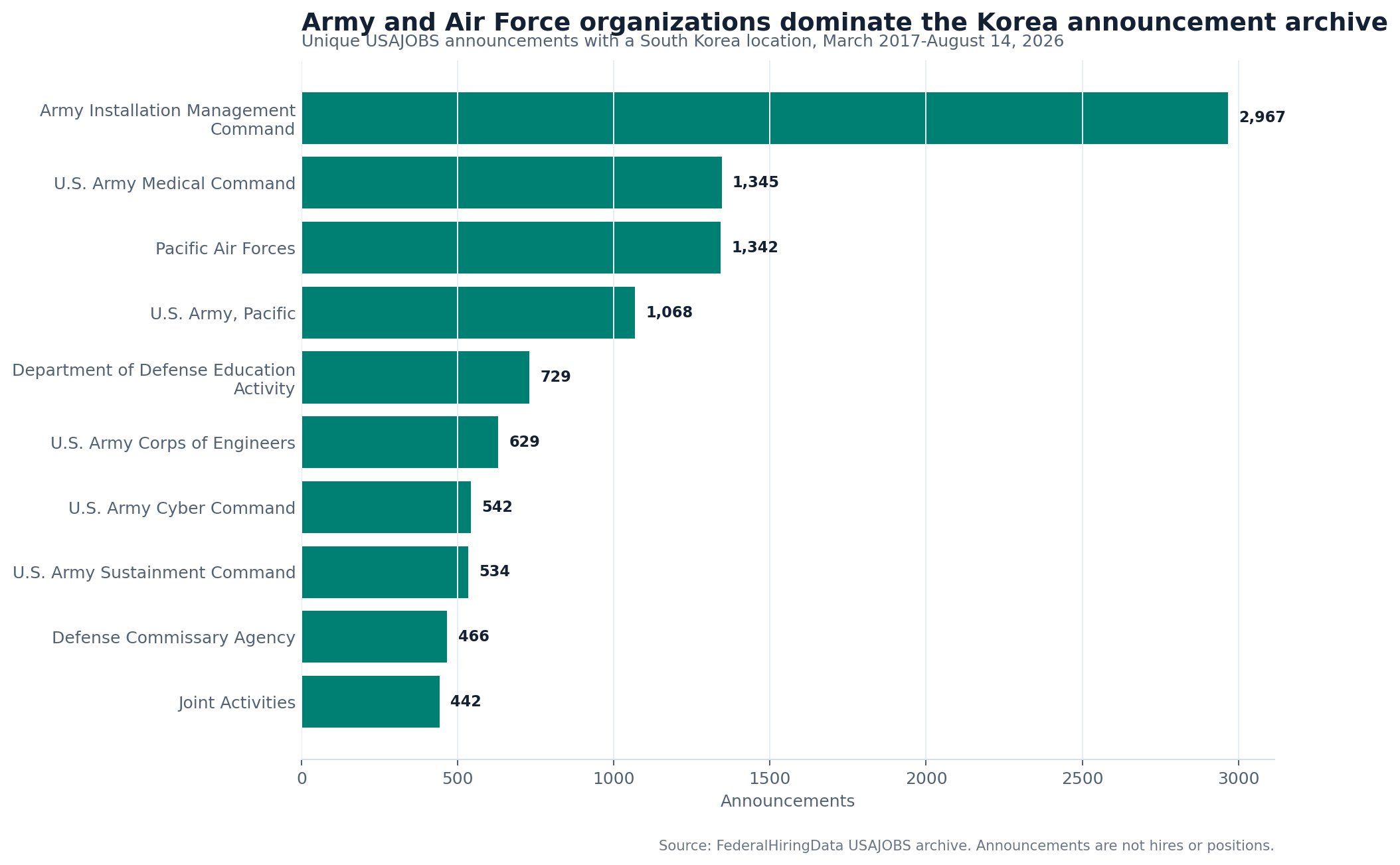
The list reads like an operating system for an overseas community. Installation Management runs garrisons and services. Medical Command and Defense Health Agency facilities provide care. DoDEA runs schools. The Corps of Engineers manages design, construction and infrastructure. Cyber Command and other technology organizations maintain communications and systems. The commissary agency supports daily life.
It would be a mistake to add the announcement counts and call the result a workforce. The same organization can publish repeatedly for recurring needs, and one announcement can cover multiple positions or locations. The value of the archive is in showing which institutions have repeatedly sought civilian labor in Korea over nearly a decade.
An older Office of Personnel Management series provides a useful cross-check. FedScope counted 2,916 covered federal civilians with South Korea duty stations in September 2024. That is close to DMDC's 2,903 appropriated-fund defense civilians in March 2026, but it is not a one-to-one comparison. The agencies, coverage rules and dates differ. The similarity supports the scale of the estimate; it does not prove the populations are identical or unchanged.
What work appears again and again?
The occupation mix is broader than the phrase “military support” suggests.
The most frequent series was 0301, Miscellaneous Administration and Program, with 1,164 announcements. Information Technology Management, series 2210, appeared in 896. Clerical and assistant work appeared in 541, education and training technician work in 452, logistics management in 434, and general education and training in 411.
Engineering, human resources, contracting, security administration, nursing, social science and recreation also appear among the recurring series. Some of those roles connect directly to operational readiness. Others sustain the schools, clinics, child-care programs, recreation centers and administrative offices used by service members and families.
That distinction is important for job seekers. A Korea assignment is not a single career track. The archive includes nurses and medical support assistants, engineers and IT specialists, teachers and education technicians, logisticians, contracting staff, human-resources specialists, housing staff, recreation workers and commissary employees.
It also shows how quickly opportunities can pass. Among Korea-linked announcements with usable dates, the median application window was nine days. Ninety percent were open for 20 days or fewer. Those are historical announcement durations, not a promise about future postings, but they make a practical point: an applicant waiting for an exercise or diplomatic event to signal hiring may already be late.
What can job seekers infer now?
The live count of 40 active Korea-linked announcements on Aug. 18 confirms that public recruiting continues. It does not mean there are exactly 40 vacancies. Some announcements list multiple jobs, while others create candidate rosters or cover more than one location. The count will change as listings open and close.
Applicants should read each announcement for overseas conditions that do not apply to most domestic federal jobs: transportation agreements, return rights, living-quarters allowances, family-member employment rules, medical clearance, tour length and limits on how long certain overseas appointments may be held. Eligibility can also differ for military spouses, family members, current federal employees and members of the public.
The historical pattern suggests a better search strategy than watching only for a single job title. Follow the organizations that repeatedly hire in the relevant location, save searches across adjacent occupational series, and keep application materials ready before the short window opens. Readers can browse current federal jobs, explore the location directory and compare broader federal workforce statistics.
The data does not show whether the 2026 exercise reduction will increase or decrease civilian hiring. It would be speculation to connect a last-minute training decision to an announcement published days or months later. Budgets, rotations, attrition, local labor, security requirements and agency-specific plans all shape recruiting.
Why the civilian count changes the alliance story
Coverage of Korea exercises naturally centers on troops and hardware. Those are the most visible parts of an event designed to test military readiness. But the public personnel and hiring records show an institutional presence built for continuity.
Nearly half of the defense civilians in DMDC's South Korea total were assigned to Fourth Estate agencies rather than a military department. Thousands of historical announcements came from installation, medical, education, engineering, cyber and sustainment organizations. The largest recruiting locations were communities where Americans live and work year-round.
That does not make every civilian an exercise participant. It means the alliance relies on a labor system whose duties continue before the opening ceremony and after the field training ends.
The political argument over Ulchi Freedom Shield concerns the size, cost and diplomatic signal of a specific exercise. The personnel data answers a different question: what must still function when the exercise gets smaller? The answer is a network of bases, schools, clinics, infrastructure, logistics and digital systems supported by almost 3,000 appropriated-fund defense civilians assigned on the peninsula.
Methodology and limitations
FederalHiringData used the Defense Manpower Data Center's *Military and DoD Civilian Personnel by State/Country* workbook for March 31, 2026. The report separates active duty, reserve components and appropriated-fund civilians. It covers assigned unclassified personnel, may exclude temporary or contingency deployments, and notes that Defense Logistics Agency civilian data was not submitted for the March release. The categories are reported separately throughout this article.
The USAJOBS analysis counts distinct control numbers with at least one source location identified as South Korea. It covers active and historical public announcements in the FederalHiringData research archive from March 2017 through Aug. 14, 2026. The live active count was checked after a successful production import on Aug. 18. Location labels are preserved from source data and can overlap geographically. Occupational-series counts can overlap when one announcement lists multiple series.
An announcement is not an application, selection, hire, vacancy or employee. FederalHiringData does not infer contractor headcount, local-national employment, military strength or exercise participation from USAJOBS records. The OPM FedScope comparison uses a different covered civilian population and a September 2024 snapshot.
The current exercise description is based on Associated Press reporting from Aug. 18. Exercise background comes from official 2025 Defense Department coverage. Personnel data comes from the DMDC workforce reports and historical OPM datasets.
Hero photo: Emergency Essential and Mission Essential civilians train at Camp Humphreys during Ulchi Freedom Shield 25. U.S. Army photo by Monique Freemon via DVIDS, public domain.
Keep reading
Related federal hiring research
Article data window: FY2019-FY2025
Contract Spending and Federal Headcount Often Moved Independently
Across a bounded 28-agency sample, contract-obligation growth and covered headcount growth had only a 0.169 correlation; five agencies increased obligations while headcount fell.
Article data window: Jan. 1-14, 2026
Federal Healthcare Hiring Led Early January 2026 Job Announcements
Veterans Health Administration, nurse roles, medical officers, and other clinical and support occupations drove the strongest healthcare signal in the early January archive.
Article data window: Jan. 1-14, 2026
Federal Hiring Trends: Jan. 1-7 vs Jan. 8-14, 2026
Veterans Health Administration stayed dominant, nurse and medical roles strengthened, and remote-work signals remained too sparse for a public trend claim.
Federal Hiring Data Weekly
Subscribe to Federal Hiring Data Weekly.
Subscribe to Federal Hiring Data Weekly. Confirm your email after signing up to receive federal hiring trends, salary data, agency movements, and original research.