August 18, 2026
The USS Abraham Lincoln Is Still at Sea. A $192.6 Million Maintenance Plan Is Waiting
The carrier's deployment has outlasted its published maintenance calendar. More than 25,000 archived Navy job announcements show the shore-side labor system around its homeport.
By Evan Mercer
Published August 18, 2026Last edited August 19, 2026

The Navy has started moving a replacement carrier toward the USS Abraham Lincoln. It has not announced when Lincoln will be home.
That gap matters because two clocks are now running at once. Sailors aboard the San Diego-based carrier have been deployed for more than 260 days, including more than 240 days without a port call, according to the Associated Press. Ashore, the Navy's public budget had already scheduled Lincoln for a $192.6 million maintenance availability in Bremerton, Washington, beginning Aug. 1.
The calendar and the ship are plainly no longer aligned. The USS George Washington is heading across the Pacific to relieve Lincoln, AP reported Aug. 15, but the Navy has not published a firm homecoming date. The budget schedule is a planning document, not a live itinerary, and the public record does not yet show how the extended deployment will change the timing or cost of the maintenance period.
What the records do show is the scale of the system waiting beyond the flight deck. FederalHiringData's archive contains 25,227 public Navy-linked job announcements around San Diego and Coronado since March 2017. They span information technology, engineering, program management, contracting, logistics, finance, facilities, aviation and family services. A live production check on Aug. 18 found 66 active announcements within that bounded definition.
The carrier's return is a story about a crew that has stayed at sea far longer than planned. It is also a story about the civilian and shore-side workforce that turns a homecoming into repair, recovery and another readiness cycle.
Why is Lincoln's return date still unsettled?
Lincoln left San Diego in November 2025 for an Indo-Pacific deployment, then was redirected to the Middle East. The original plan called for the carrier to return in May, according to AP. Instead, the deployment was extended as the ship supported operations in the U.S. 5th Fleet area.
The replacement movement is the clearest public sign that relief is approaching. USS George Washington, the forward-deployed carrier based in Japan, left to replace Lincoln following repairs from damage sustained during operations near Iran, AP reported. Replacement does not establish the date Lincoln will depart the region, transit home or enter maintenance.
Conditions aboard the ship have made that uncertainty more consequential. AP reported complaints involving food, clean water, mail, supplies and mental-health strain during the extended period at sea. The Navy said contested conditions disrupted normal supply hubs and forced it to prioritize food, hygiene products and mail. It also said the ship was again producing adequate clean water and serving healthy meals.
The Navy said it had not observed an increase in suicidal ideation or attempts aboard Lincoln, although it did not provide data to AP. Defense Secretary Pete Hegseth said reporting about conditions misrepresented the situation. One sailor who went overboard was recovered and transferred for additional care; the Navy did not publicly characterize the sailor's intent.
Those statements should be kept in their proper form. They are claims and responses in AP's reporting, not findings that can be independently resolved with staffing data. The personnel record can illuminate the length of the deployment and the labor system around the ship. It cannot diagnose conditions aboard it.
The concern has now reached Congress. In an Aug. 18 report about a separate destroyer breakdown, AP said Democratic lawmakers were also calling for investigations into conditions aboard Lincoln. That does not establish what an investigation would find. It does show that the uncertainty surrounding the deployment has moved beyond private family complaints and into formal oversight demands.
What was supposed to be waiting ashore?
The Navy's fiscal 2026 Operation and Maintenance budget book lists USS Abraham Lincoln, CVN-72, for a Planned Incremental Availability in Bremerton from Aug. 1, 2026, through Dec. 1, 2027. The listed fiscal 2026 amount is $192.591 million.
| Public maintenance plan | Budget-book entry |
|---|---|
| Ship | USS Abraham Lincoln (CVN-72) |
| Availability | Planned Incremental Availability |
| Planned location | Bremerton, Washington |
| Planned start | Aug. 1, 2026 |
| Planned end | Dec. 1, 2027 |
| FY2026 amount | $192.591 million |
A Planned Incremental Availability is a scheduled period for maintenance and modernization on a nuclear-powered aircraft carrier. It is not a single repair job or a direct payroll figure. The amount can support work distributed across the Navy, shipyard, contractor and supply systems under the rules of the appropriation.
The published start date had passed while Lincoln remained deployed. That is evidence of a schedule mismatch, not proof that the maintenance was canceled or that every dollar will be spent later. Public budget books are prepared before operations unfold. They can preserve the Navy's intended sequence without reflecting every subsequent operational change.
That distinction is the central finding. The extended mission does not end when the carrier crosses into San Diego Bay. It pushes against a long maintenance cycle that was already meant to be underway.
How large is the civilian system in California?
DMDC counted 28,698 appropriated-fund Navy civilians assigned in California as of March 31. Across all defense components, California had 57,196 appropriated-fund DoD civilians, 163,850 active-duty personnel and 54,211 reserve-component personnel.
Those are statewide figures. They include organizations and installations far beyond San Diego, and they cannot be attributed to Lincoln or its maintenance availability. They establish scale: the Navy operates inside a large California civilian labor market even before contractors, nonappropriated-fund workers and local private-sector employment are considered.
The San Diego and Coronado announcement archive supplies the more local view. It does not identify who has ever touched CVN-72. It shows the occupations and commands that repeatedly recruit around the carrier's homeport.
Commander, Navy Installations led the archive with 5,056 announcements. Naval Information Warfare Systems Command followed with 3,333, Naval Facilities Engineering Systems Command with 3,049, U.S. Pacific Fleet with 2,915 and Naval Air Systems Command with 2,390.
| San Diego/Coronado Navy organization | Unique announcements since March 2017 |
|---|---|
| Commander, Navy Installations | 5,056 |
| Naval Information Warfare Systems Command | 3,333 |
| Naval Facilities Engineering Systems Command | 3,049 |
| U.S. Pacific Fleet | 2,915 |
| Naval Air Systems Command | 2,390 |
| Naval Medical Command | 1,589 |
| U.S. Marine Corps | 1,587 |
| Naval Supply Systems Command | 992 |
| United States Fleet Forces Command | 813 |
| Naval Sea Systems Command | 746 |
The list is broader than ship maintenance. Installation services, communications, facilities, medicine, supply and fleet operations all appear because a carrier homeport is also a city-sized institutional network.
What does San Diego's Navy system hire for?
The archive's largest occupational series was Information Technology Management, 2210, with 1,423 announcements. Management and Program Analysis, 0343, had 1,237. General Engineering, 0801, had 1,027. Computer Science, 1550, had 771, while Contracting, 1102, had 694.
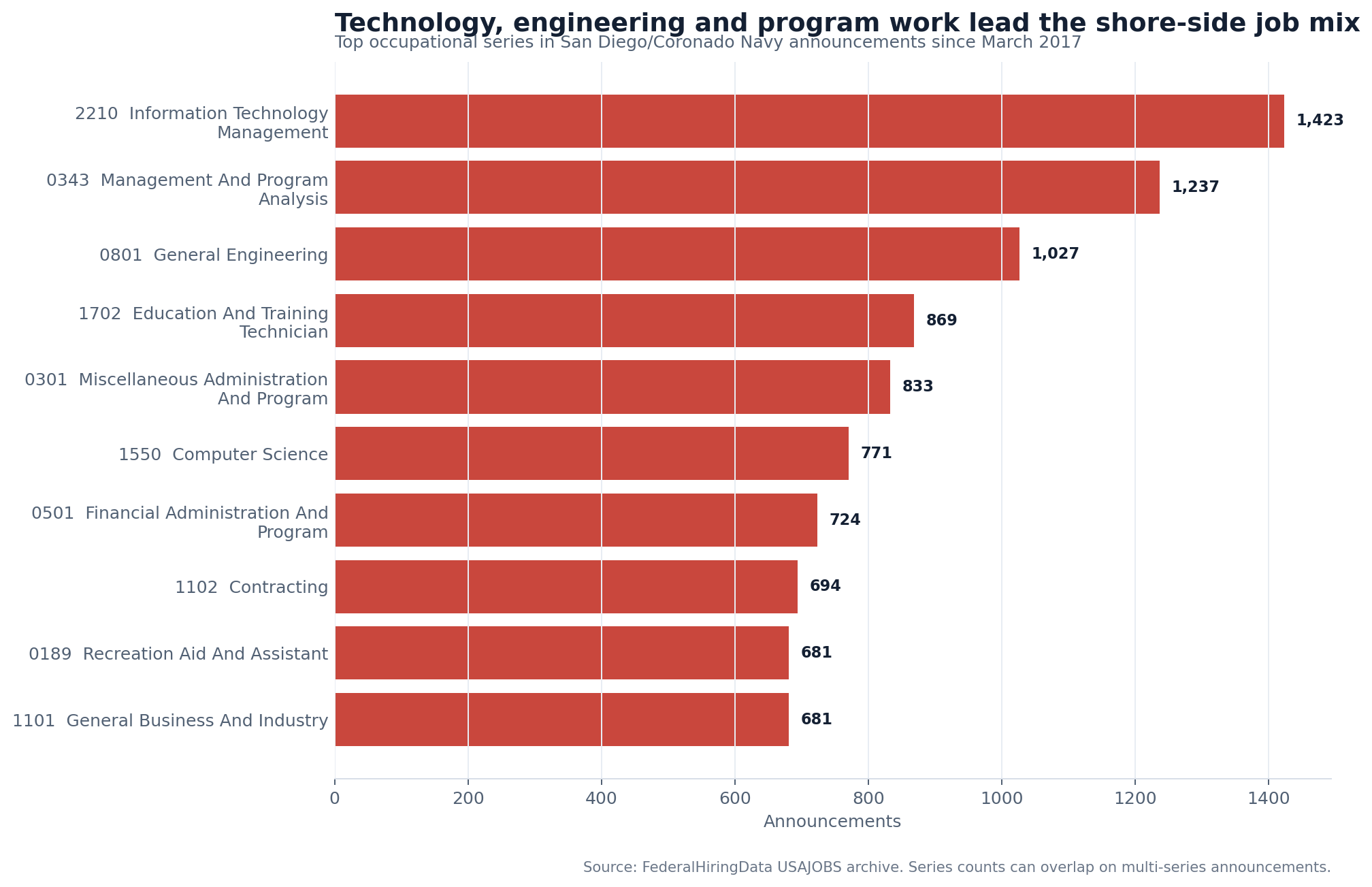
The mix answers a natural question: what is the shore-side counterpart to sailors maintaining a carrier at sea? It includes software and networks, engineering and technical review, acquisition and contracting, financial administration, logistics, facilities, child and youth programs, recreation and medical support.
Not all of those jobs support Lincoln. Some belong to laboratories, bases, hospitals, Marine Corps organizations, other ships or regional commands. The point is not to claim a direct assignment that USAJOBS does not provide. It is to show the durable labor market into which Lincoln's crew and maintenance demands return.
That market has been active across years rather than only when a carrier comes home.
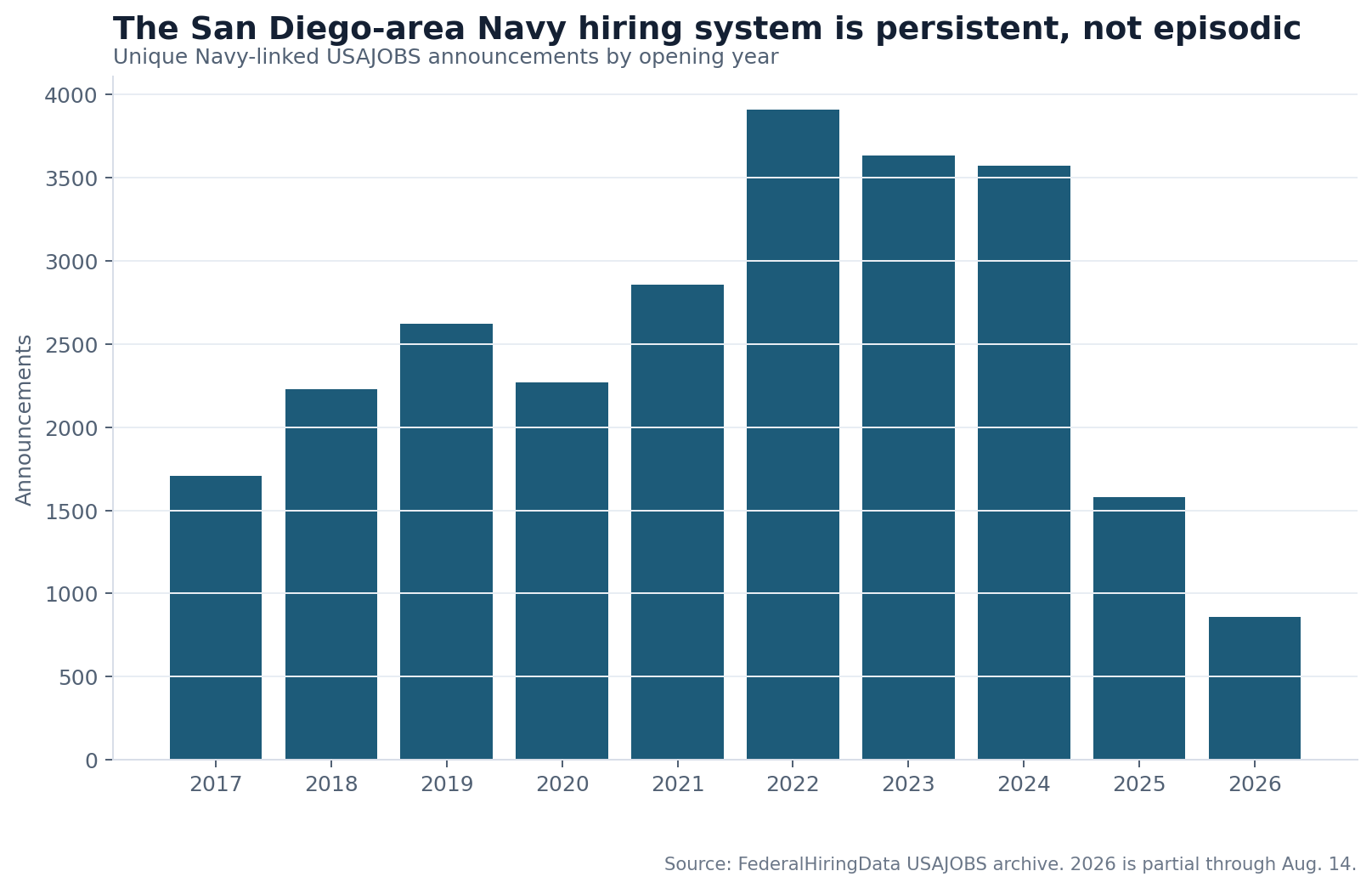
Public announcement volume rose from 1,705 in 2017 to 3,908 in 2022, then remained above 3,500 in both 2023 and 2024. It dropped to 1,580 in 2025. The archive contains 857 announcements opening in 2026 through Aug. 14.
That decline does not measure a decline of the same size in employment. One announcement can cover several vacancies, locations or grades; agencies can fill jobs through mechanisms not visible as conventional public announcements; and USAJOBS does not report selections. The series measures public recruiting activity, not workforce strength.
What changes when the carrier finally returns?
For the crew, homecoming begins a period of reunion and recovery after an unusually long deployment. It does not necessarily mean every sailor immediately starts a normal schedule. Carriers require inspections, maintenance, training resets, personnel movements and administrative work after deployment.
For the Navy, the delayed maintenance calendar creates sequencing questions. The budget planned a 16-month availability in Bremerton, away from Lincoln's San Diego homeport. The public record does not yet answer whether the start and end dates will move together, whether work packages have already been adjusted or whether operational commitments will change the scope.
For civilian employees and contractors, maintenance periods can shift workload across shipyards, engineering organizations, supply systems and program offices. But no responsible conclusion can be drawn about a specific hiring increase until the Navy publishes updated plans or announcements. A budget line is not a job count.
For families, schedule uncertainty itself has a cost. The public data cannot quantify missed milestones, child-care changes, household moves or stress. AP's reporting shows why a precise return date matters to people even when operational security and changing missions prevent the Navy from supplying one.
The bounded employment evidence offers one useful corrective. Lincoln is often described as a self-contained floating city. Operationally, it depends on a much larger shore network. That network includes tens of thousands of statewide Navy civilians and a San Diego-area recruiting system that has advertised more than 25,000 public jobs since 2017.
What should job seekers watch?
The 66 active San Diego/Coronado Navy announcements in the Aug. 18 production snapshot included only listings meeting the article's Navy department and location rules. The number will move as jobs open and close. It should not be read as Lincoln-specific hiring.
Applicants interested in carrier-adjacent work should search by both occupation and organization. A generic “Navy” query can hide the difference between base operations, information warfare, facilities engineering, aviation systems, fleet headquarters, medicine and ship systems. Readers can browse current federal jobs, review occupation data, explore locations and follow other federal workforce reporting.
They should also distinguish federal civilian positions from military assignments and contractor jobs. USAJOBS primarily covers federal civilian announcements. It does not provide a complete picture of private shipyard labor, suppliers or uniformed billets.
The strongest conclusion is therefore narrower than “the carrier is bringing jobs home.” Lincoln remains at sea, its replacement is moving, and a major maintenance availability was supposed to have begun. The shore-side labor system is visible and substantial, but the Navy has not yet published enough updated information to connect the deployment extension to a specific civilian hiring effect.
Methodology and limitations
FederalHiringData reviewed current Associated Press reporting, the Department of the Navy's fiscal 2026 Operation and Maintenance budget book, DMDC's March 31 personnel report and the FederalHiringData USAJOBS archive.
The archive analysis counts distinct public announcement control numbers whose source department includes Navy and whose source location identifies San Diego, Coronado or North Island, California. It includes active and historical announcements from March 2017 through Aug. 14, 2026. The live count was checked after a successful USAJOBS production import Aug. 18. Multi-series announcements can appear in more than one occupation count.
The 25,227-announcement figure is not a count of Lincoln jobs, employees, hires or vacancies. It describes the broader Navy-linked public recruiting system around the carrier's homeport. The DMDC figures are statewide assigned-personnel counts and cannot be reduced to San Diego or attributed to one ship. The maintenance amount is a fiscal 2026 budget-book entry, not a final contract value, total lifecycle cost or updated schedule.
Current deployment details and Navy responses come from Associated Press reporting on the replacement movement, conditions aboard Lincoln and congressional calls for investigations. The maintenance entry appears in the official FY2026 Navy budget book. Personnel context comes from DMDC workforce reports.
Hero photo: Sailors build a spindle for an MH-60S Sea Hawk aboard USS Abraham Lincoln on May 20, 2026. U.S. Navy photo via DVIDS, public domain.
Keep reading
Related federal hiring research
Article data window: FY2019-FY2025
Contract Spending and Federal Headcount Often Moved Independently
Across a bounded 28-agency sample, contract-obligation growth and covered headcount growth had only a 0.169 correlation; five agencies increased obligations while headcount fell.
Article data window: Jan. 1-14, 2026
Federal Healthcare Hiring Led Early January 2026 Job Announcements
Veterans Health Administration, nurse roles, medical officers, and other clinical and support occupations drove the strongest healthcare signal in the early January archive.
Article data window: Jan. 1-14, 2026
Federal Hiring Trends: Jan. 1-7 vs Jan. 8-14, 2026
Veterans Health Administration stayed dominant, nurse and medical roles strengthened, and remote-work signals remained too sparse for a public trend claim.
Federal Hiring Data Weekly
Subscribe to Federal Hiring Data Weekly.
Subscribe to Federal Hiring Data Weekly. Confirm your email after signing up to receive federal hiring trends, salary data, agency movements, and original research.