January 31, 2025
Veterans Health Administration Led January 2025 Federal Job Announcements
A FederalHiringData archive reconstruction found 24,256 USAJOBS announcements closing in January 2025, led by 4,193 Veterans Health Administration postings.
By Evan Mercer
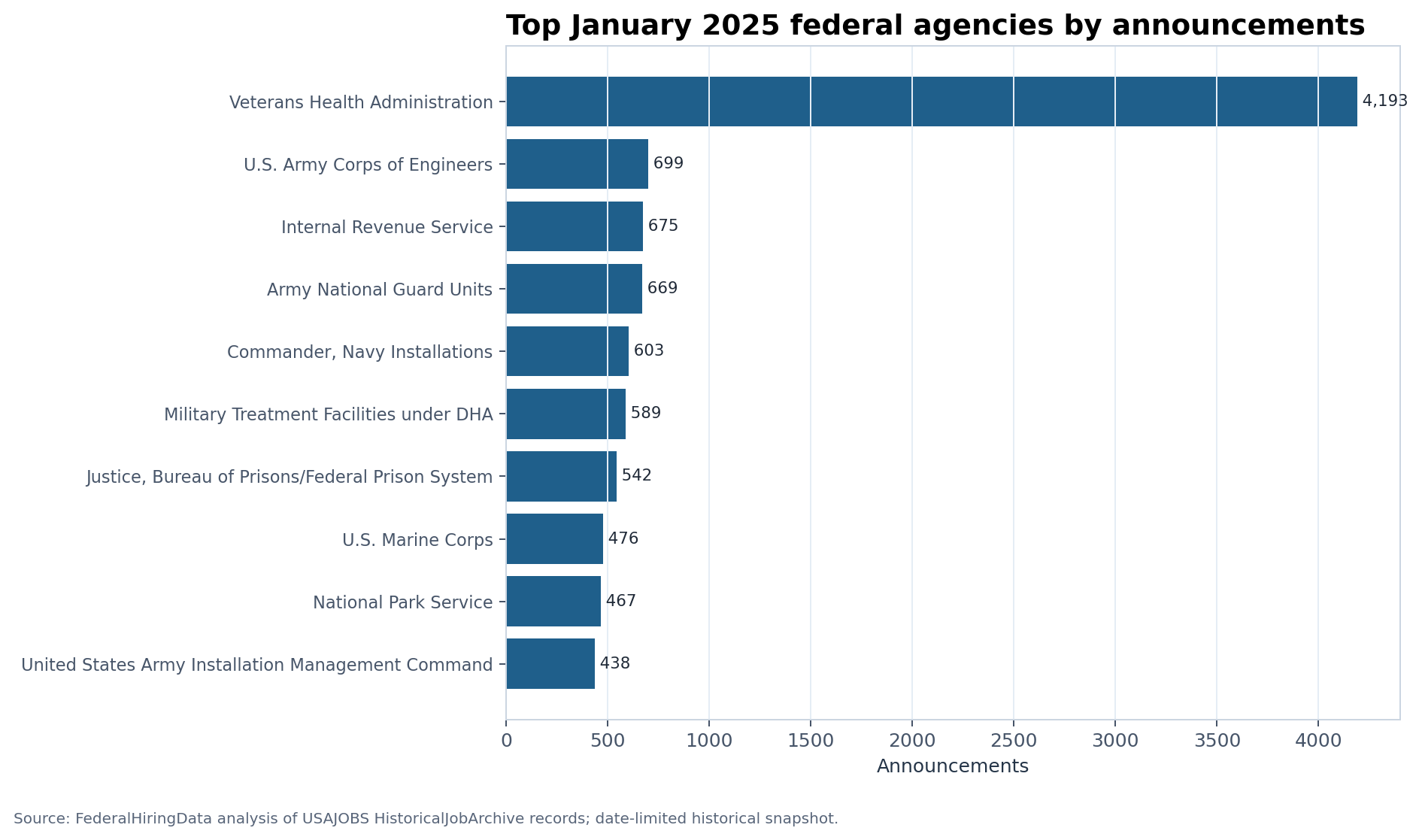
The Veterans Health Administration was the dominant federal advertiser in the January 2025 historical USAJOBS archive. FederalHiringData found 24,256 announcements with close dates in January 2025, and 4,193 of them were VHA announcements. That is about 17.3% of the month.
The gap between VHA and the next group of agencies was large. The U.S. Army Corps of Engineers had 699 January announcements, the Internal Revenue Service had 675, and Army National Guard Units had 669. None came close to the VHA total.
Top agencies
| Agency | Announcements | Share of Jan. total | Avg. max salary |
|---|---|---|---|
| Veterans Health Administration | 4,193 | 17.3% | $117,708 |
| U.S. Army Corps of Engineers | 699 | 2.9% | $105,141 |
| Internal Revenue Service | 675 | 2.8% | $132,381 |
| Army National Guard Units | 669 | 2.8% | $54,456 |
| Commander, Navy Installations | 603 | 2.5% | $40,700 |
| Military Treatment Facilities under DHA | 589 | 2.4% | $106,782 |
| Justice, Bureau of Prisons/Federal Prison System | 542 | 2.2% | $93,008 |
| U.S. Marine Corps | 476 | 2.0% | $54,081 |
| National Park Service | 467 | 1.9% | $49,956 |
| United States Army Installation Management Command | 438 | 1.8% | $88,095 |
What the ranking shows
The first lesson is that January 2025 federal job demand was not evenly distributed across agencies. VHA alone accounted for more announcements than the next five listed agencies combined. That does not mean VHA made that many hires in January, and it does not mean every announcement represented a separate job. It does mean that the public USAJOBS announcement archive showed a concentrated health-care-heavy recruiting footprint.
The second lesson is that several operational agencies were clustered just below the top line. U.S. Army Corps of Engineers, IRS, Army National Guard Units, Commander Navy Installations, Military Treatment Facilities under DHA, the Bureau of Prisons, the Marine Corps, and the National Park Service all posted hundreds of January-closing announcements. That mix spans health care, tax administration, corrections, defense support, installation operations, parks, engineering, and public-facing services.
Department view
Agency names are the most useful public-facing labels, but department totals help show broader mission clusters. The leading departments in the same January archive were:
| Department | Announcements | Share of Jan. total |
|---|---|---|
| Department of Veterans Affairs | 4,335 | 17.9% |
| Department of the Army | 4,185 | 17.3% |
| Department of the Navy | 2,599 | 10.7% |
| Department of the Air Force | 2,472 | 10.2% |
| Department of Defense | 1,869 | 7.7% |
| Department of Homeland Security | 1,310 | 5.4% |
| Department of the Interior | 1,215 | 5.0% |
| Other Agencies and Independent Organizations | 1,005 | 4.1% |
This department-level view reinforces the agency ranking without replacing it. Veterans Affairs led because VHA was unusually large in the announcement archive. Defense-related components also appear strongly because several separate military and defense-health organizations posted large numbers of announcements under their own names.
How January filled in over the month
FederalHiringData grouped January close dates by week. The first partial week was smaller, while the four full weeks each had more than five thousand announcements closing.
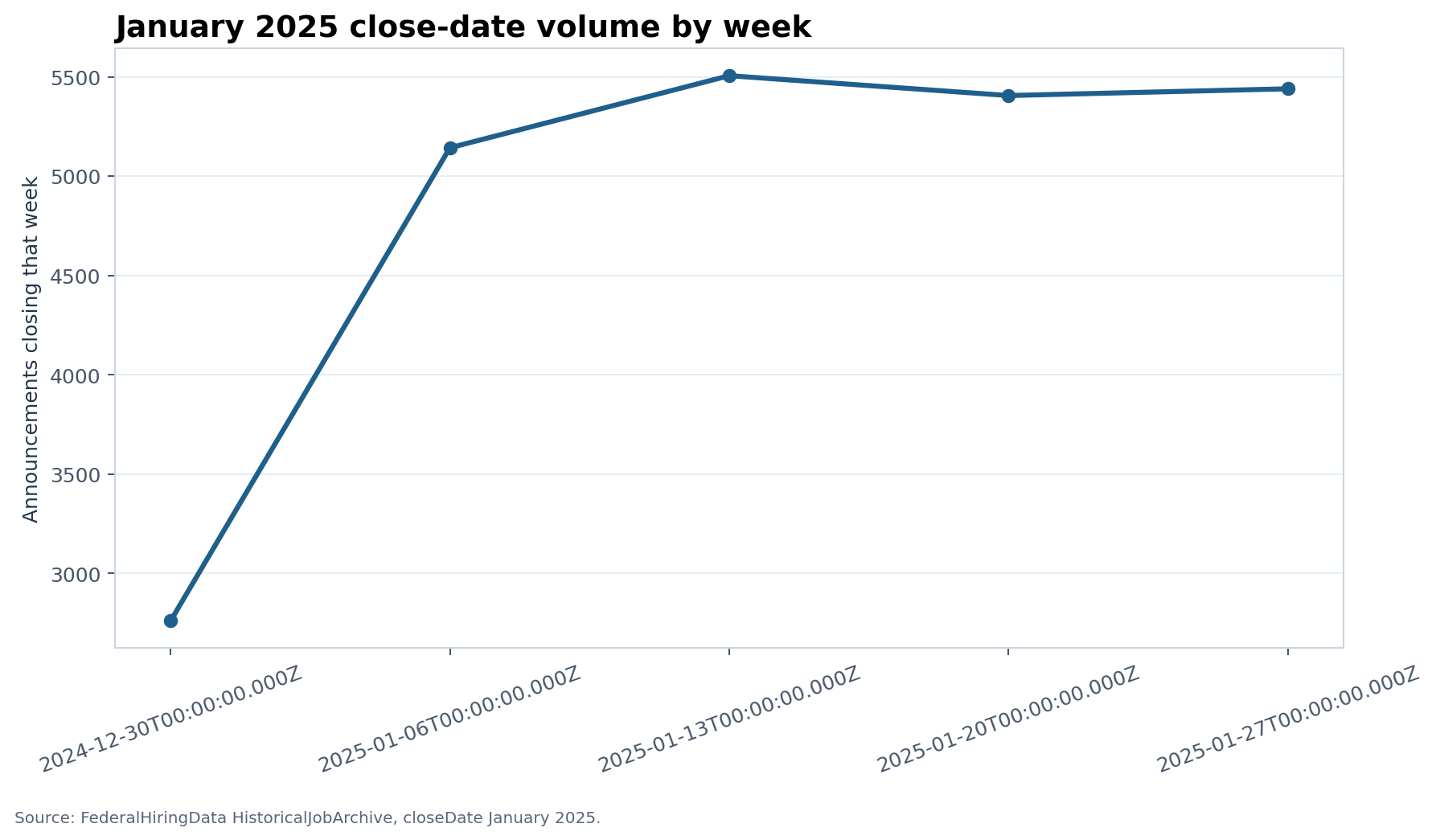
The pattern is important for readers who use job boards casually. A monthly snapshot can hide very fast turnover. Many federal announcements close in one or two weeks, so the set visible on any given day can differ sharply from the set visible a week later.
Why VHA stands out
VHA's count reflects the way federal health-care recruiting appears in public announcements. Medical systems often recruit across many occupations, pay systems, locations, and specialty tracks. In the January archive, that produced a much larger visible announcement footprint than a typical headquarters office or policy bureau.
Readers should not treat the count as a measure of agency size or final hiring. OPM workforce data would be needed for headcount, and personnel records would be needed for completed hiring actions. This article is narrower: it measures public announcements closing in January 2025.
The VHA finding is still useful because it describes the public applicant-facing market. A job seeker in January 2025 would have encountered many more VHA announcements than announcements from most other agencies. That visibility affects search results, saved-search emails, occupation filters, and the apparent shape of federal hiring even when the final hiring outcome is unknown.
What the second tier of agencies tells us
The agencies below VHA also matter. The Army Corps of Engineers and National Park Service show land, infrastructure, and seasonal operating needs. IRS announcements point to tax administration and business operations. Bureau of Prisons announcements reflect corrections and facility staffing. Commander Navy Installations and Army installation-management components point to base operations and local support work.
Together, that second tier makes the January archive look less like one centralized federal labor market and more like several overlapping markets: health care, defense installations, tax administration, corrections, parks, engineering, and general mission support. That is why FederalHiringData keeps agency pages, occupation pages, and location pages separate instead of treating a monthly total as the whole story.
Why this is not a hiring-total article
Announcement volume is a leading public signal, but it is not the same as accessions. Agencies can advertise for future vacancies, cancel announcements, hire multiple people from one announcement, make no selection, or reuse a certificate later. The correct interpretation is that these agencies had the largest public announcement footprints in the January historical archive.
That distinction protects the article from overclaiming while preserving the main value of the archive. USAJOBS is the public front door of federal recruiting. Measuring that front door helps readers understand what applicants could actually see.
What applicants could take from this snapshot
For job seekers looking back at January 2025, the data point to where public announcement volume was concentrated. Health care, defense support, tax administration, corrections, parks, and installation management were all visible in the top ranks. But the ranking should be used as a map of public opportunity signals, not as a promise that a specific vacancy existed later.
The safest reading is simple: if someone wanted to understand which federal agencies were most visibly advertising at the start of 2025, VHA was the clear outlier.
How this helps future archive work
This January 2025 article is also a baseline for later historical comparisons. Once more months are analyzed, FederalHiringData can compare whether VHA remained this dominant, whether IRS or land-management agencies rose seasonally, and whether defense-installation components became more or less visible after the January transition period.
The January baseline is especially useful because it sits near the start of the 2025 policy cycle. It does not answer what happened later by itself. It gives the archive a measured starting point: a month with more than twenty-four thousand closing announcements, a very large VHA footprint, a deep second tier of operational agencies, and weekly close-date volume above five thousand announcements in each full week of the month.
Those facts are modest, but they are sturdy. They can be tested against later months without depending on anecdotes or a single day's search results.
They also give readers a way to separate structure from noise. One agency leading a single day can be an accident of closing dates. One agency leading an entire month by thousands of announcements is a pattern worth preserving and revisiting as the archive expands. That baseline matters.
Methodology and limitations
This article is a FederalHiringData historical reconstruction. It uses USAJOBS HistoricalJobArchive records with announcement close dates on or before 2025-01-31. The analysis date shown to readers is 2025-01-31; the actual publication timestamp is preserved separately in the production Article row and in Article schema metadata.
The dataset counts job announcements, not hires, selections, applicants, certificates, or filled positions. A single announcement may represent one vacancy, many vacancies, or a continuing recruitment need. FederalHiringData normalizes fields such as agency, occupation series, salary range, location count, and open/close dates where the source data supports it, but the underlying announcement text remains the controlling source.
The article uses 24,256 archive records in its primary snapshot. Historical USAJOBS announcements can be amended, cancelled, or structured differently across agencies. Salary maximums are advertised maximums from normalized announcement data and should not be read as guaranteed pay for any applicant. Advertised locations are not the same as OPM duty-station employment counts.
The historical-as-of date is a reporting cutoff, not a claim that this web page existed on that date. FederalHiringData preserved the actual publication and edit timestamps in the article record and uses the January 2025 date to tell readers which archive slice the analysis reflects. Question Intelligence helped select the topic because people search for these answers, but forum posts are not used as evidence for the numerical claims.
Null or ambiguous source fields are not silently converted into confident labels. When the article describes agency, occupation, salary, duration, or location patterns, it is describing the normalized rows available for that specific cutoff. Later backfills can improve coverage, but this pilot avoids retroactively using later January or later-year data in articles assigned to earlier January cutoffs.
Sources: FederalHiringData HistoricalJobArchive; USAJOBS; USAJOBS API documentation. Photo: Benjamin Ashton via Unsplash, used under the Unsplash License.
Keep reading
Related federal hiring research
Article data window: FY2019-FY2025
Contract Spending and Federal Headcount Often Moved Independently
Across a bounded 28-agency sample, contract-obligation growth and covered headcount growth had only a 0.169 correlation; five agencies increased obligations while headcount fell.
Article data window: Jan. 1-14, 2026
Federal Healthcare Hiring Led Early January 2026 Job Announcements
Veterans Health Administration, nurse roles, medical officers, and other clinical and support occupations drove the strongest healthcare signal in the early January archive.
Article data window: Jan. 1-14, 2026
Federal Hiring Trends: Jan. 1-7 vs Jan. 8-14, 2026
Veterans Health Administration stayed dominant, nurse and medical roles strengthened, and remote-work signals remained too sparse for a public trend claim.
Federal Hiring Data Weekly
Subscribe to Federal Hiring Data Weekly.
Subscribe to Federal Hiring Data Weekly. Confirm your email after signing up to receive federal hiring trends, salary data, agency movements, and original research.