August 30, 2026
ATF's Breached System Was Isolated. Its IT Management Workforce Fell 25%.
ATF said a standalone system was breached while its core network stayed unaffected. FederalHiringData found the agency's 2210 IT-management workforce fell from 48 to 36 after September 2024.
By Evan Mercer
Published August 30, 2026Last edited August 30, 2026

The Bureau of Alcohol, Tobacco, Firearms and Explosives says a cyberattack reached a standalone system holding information related to targets of investigations. It also says the system was separated from the agency's enterprise network, that its connections were terminated and that core services such as case management and eForms were not affected.
Those two facts belong together. The incident was serious enough for senior Justice Department officials to designate it a major incident, yet ATF's first public account describes a technical boundary that limited the known reach of the compromise.
The breach also arrived during an unusually sharp contraction in the agency's civilian workforce. FederalHiringData's analysis of Office of Personnel Management records found that ATF's covered workforce fell from 5,298 employees in September 2024 to 4,504 in June 2026, a reduction of 794, or 15.0%. Its Information Technology Management workforce, occupational series 2210, fell from 48 to 36 over the same period, a 25.0% decline.
That is not evidence that staff losses caused the breach. The public record does not identify the intrusion method, the full data scope, the attacker or the affected system's staffing history. Series 2210 is an imperfect proxy for IT capacity, not a roster of cybersecurity specialists. Contractors and employees in other occupations also perform technical and security work.
It is evidence of a capacity question. ATF entered a major cyber response with a smaller directly employed IT-management cadre, no series 2210 USAJOBS announcements opened in 2026 through Aug. 30 in FederalHiringData's historical archive, and a technology environment supported in part by a large managed-services contract. Older Justice Department inspector general audits had already documented weaknesses in security controls and patch management, although those findings do not establish what happened in this incident.
The most defensible conclusion is narrower than a blame claim: the isolation described by ATF appears to have constrained the known blast radius, while the agency now has to investigate and recover with a thinner measurable federal IT workforce.
What ATF confirmed, and what remains unknown
ATF disclosed the incident on Aug. 26. Its official statement said a standalone system was affected and described that system as operating separately from the enterprise network. The agency said there was no indication its enterprise network, eForms or any other ATF system was affected.
ATF said it terminated connections to the environment, began forensic and incident-response work and coordinated with the Justice Department. It also said its mission was not affected. Senior DOJ officials designated the event a major incident and completed required notifications, according to the statement.
Reuters reported Aug. 27 that ATF spokesperson Tanya Roman said the system contained information about targets of investigations. The agency did not identify the culprit. The Cybersecurity and Infrastructure Security Agency referred questions to ATF.
A ransomware group claimed responsibility, but the public claim cited by Reuters did not include a description or samples of stolen material. ATF and DOJ had not publicly attributed the intrusion as of Aug. 30. FederalHiringData is therefore not treating the group's claim as confirmation of who carried out the attack, what was taken or whether ransomware was deployed.
| Question | Publicly supported answer as of Aug. 30 |
|---|---|
| Was an ATF system affected? | Yes. ATF confirmed a cybersecurity incident involving a standalone system. |
| What did it contain? | ATF told Reuters it contained information related to targets of investigations. |
| Was the enterprise network affected? | ATF said there was no indication that it, eForms or another ATF system was affected. |
| Was the incident contained? | ATF disconnected the environment and described it as separate. The investigation remains active, so the final scope is not public. |
| Who was responsible? | Unknown publicly. A group's claim is unverified. |
| How did the intrusion occur? | Not disclosed. |
| Did staffing contribute? | Unknown. No public evidence establishes that causal link. |
The federal definition of a major incident is consequential. Office of Management and Budget guidance ties the designation to incidents likely to result in demonstrable harm or that otherwise meet a significant threshold, with accelerated reporting obligations. The label does not mean the enterprise network was compromised, and it should not be used to fill in facts that ATF has not released.
No later public DOJ or CISA update located by FederalHiringData through Aug. 30 materially expanded the official scope. That absence is not proof that no additional effects will emerge. Incident findings can change as forensic work proceeds.
ATF's workforce fell 15% after September 2024
ATF became a Justice Department bureau in 2003 with 4,728 covered civilian employees in the September FedScope snapshot. Its headcount moved within a relatively narrow band for much of the next two decades, then reached 5,298 in September 2024, the highest September observation in this comparable series.
By September 2025, the count had fallen to 5,066. By June 2026, the latest OPM month available for this analysis, it was 4,504.

The 15.0% decline is an agencywide measure. It includes criminal investigators, inspectors, intelligence analysts, administrative employees and technical workers. It does not tell us how ATF distributed reductions among offices or whether every departure represented a vacant position at the time of the incident.
| ATF workforce observation | Covered employees | Change from September 2024 |
|---|---|---|
| September 2003 | 4,728 | — |
| September 2024 | 5,298 | — |
| September 2025 | 5,066 | -232 |
| June 2026 | 4,504 | -794 (-15.0%) |
The overall decline was not limited to technology work. Criminal Investigation, series 1811, fell from 2,563 employees in September 2024 to 2,312 in June 2026, a 9.8% reduction. Inspection, Investigation and Compliance, series 1801, fell 11.1%. Intelligence, series 0132, fell 14.2%. Investigative Analysis, series 1805, fell 37.5%.
Those mission occupations are analytically separate from the IT workforce. An ATF special agent is not a network defender simply because the agent uses investigative systems. A cybersecurity capacity analysis that folds thousands of agents into a technical denominator would be misleading.
The measurable IT-management cadre fell from 48 to 36
OPM's occupational series 2210 is called Information Technology Management. It covers federal work involving IT systems, applications, networks, policy and related functions. It is the best consistent public workforce proxy available for ATF's directly employed IT-management capacity, but it is not a synonym for “cybersecurity workforce.”
Some 2210 employees work in security. Others specialize in customer support, applications, systems administration, data, telecommunications or program management. Cyber responsibilities may also sit with contractors, security-administration employees, engineers, investigators or officials whose public occupation does not reveal their team assignment.
With that definition made explicit, the contraction is notable. ATF had 48 employees in series 2210 in September 2024 and 36 in June 2026. The series had also stood at 48 in January 2015. Monthly records show fluctuation between those endpoints, not a steady decade-long slide, but the latest level is below the start of the series and 25% below the September 2024 count.

Thirty-six employees should not be interpreted as the number of people defending every ATF system. It is the number of OPM-covered employees classified into one federal occupational series for the ATF subcomponent. The records do not expose contractors, detailees, vacancies, specific skills, shift coverage or the distribution of responsibilities among headquarters and field environments.
The adjacent occupational data do not reveal a hidden replacement pool large enough to erase the signal. Security Administration, series 0080, fell from 41 to 34 between September 2024 and June 2026. Telecommunications, series 0391, declined from 24 to 21. Those series are not interchangeable with 2210, and most employees in them should not automatically be called cyber staff. They do show that several measurable technical or security-adjacent groups were smaller at the latest observation.

Related research
Put this finding in context

CybersecurityAugust 29, 2026
QTFY Targeted Federal Networks for Years. Four Named Agencies Later Lost 1,503 IT Employees.
FederalHiringData found four QTFY-targeted agencies lost 1,503 broad IT-management employees as public cyber controls and recruiting diverged.

Data investigationsAugust 19, 2026
Social Security Has 85% More Beneficiaries per Worker Than in 2000
Social Security added 25 million beneficiaries while losing 9,600 full-time permanent workers. Recent service gains show what technology changed—and what a thinner workforce still risks.
| Occupational series | September 2024 | June 2026 | Change |
|---|---|---|---|
| 2210 Information Technology Management | 48 | 36 | -25.0% |
| 0080 Security Administration | 41 | 34 | -17.1% |
| 0391 Telecommunications | 24 | 21 | -12.5% |
| 0132 Intelligence | 332 | 285 | -14.2% |
| 1805 Investigative Analysis | 152 | 95 | -37.5% |
| 1811 Criminal Investigation | 2,563 | 2,312 | -9.8% |
The point is not that all six groups maintain systems. They do not. The table separates technical and mission occupations so the much larger agent workforce does not obscure the scale of the directly observable IT cadre.
Personnel actions show more 2210 departures than arrivals
OPM's monthly Dynamics files provide another view. They record personnel actions rather than a simple count of unique people hired or lost. Transfers can appear in both accessions and separations, and a person can generate more than one action. FederalHiringData therefore uses the terms accessions and separations, not hires and quits.
ATF recorded five series 2210 accessions and nine separations in calendar 2024. In 2025, it recorded three accessions and 11 separations. Across the two years, that is eight accessions and 20 separations, an action balance of negative 12.

| Calendar year | 2210 accessions | 2210 separations | Action balance |
|---|---|---|---|
| 2024 | 5 | 9 | -4 |
| 2025 | 3 | 11 | -8 |
| 2024–2025 | 8 | 20 | -12 |
No ATF 2210 action rows appear in the available January-through-June 2026 files. That is not enough to conclude that absolutely no personnel movement occurred. Aggregate action data and status headcounts can diverge because of reporting, coding and release timing. The headcount series is the stronger evidence for the endpoint; the actions explain part, but not necessarily all, of the movement.
Agencywide action flows were much larger. ATF recorded 304 accessions and 345 separations in 2024, followed by 128 accessions and 723 separations in 2025. In the first six months of 2026, the files contain 32 accessions and 116 separations. Those totals reinforce that the agency was moving through a broad workforce contraction, but they do not identify which positions were vacant when the incident occurred.
ATF's public IT recruiting trail goes quiet in 2026
FederalHiringData's historical USAJOBS archive contains 86 distinct ATF announcements linked to series 2210 from March 2017, when archive coverage begins, through Aug. 30, 2026.
The annual count ranged from eight to 16 in each full year from 2018 through 2024. It fell to four in 2025. The archive contains no ATF series 2210 announcement opened in 2026 through Aug. 30.

| Open year | Distinct 2210 announcements |
|---|---|
| 2017, March–December | 2 |
| 2018 | 11 |
| 2019 | 9 |
| 2020 | 8 |
| 2021 | 10 |
| 2022 | 11 |
| 2023 | 16 |
| 2024 | 15 |
| 2025 | 4 |
| 2026 through Aug. 30 | 0 |
An announcement is not a vacancy, application, selection or hire. One announcement can advertise multiple positions, cover several locations or create a standing register. An agency can also recruit through shared certificates, internal actions or channels not visible as a public ATF announcement. Conversely, an announcement may yield no hire.
The archive therefore cannot establish an unfilled-position count. It can establish that the public recruiting signal weakened at the same time the 2210 headcount declined. Readers looking for currently open federal positions can search FederalHiringData's active jobs; the historical count here is used to study past recruiting behavior, not to imply that an old announcement remains open.
Contractors support an environment larger than the federal headcount
Federal headcount is only one layer of ATF's technology capacity. The bureau uses a major Enterprise Standard Architecture task order, known as ESA V, for managed services. A 2023 DOJ inspector general audit described the vehicle as a nine-year task order awarded in May 2020 with an initial value of $492.7 million.
The contract covered IT services, network and data-center support, service-desk work and related technology functions for ATF and participating federal components. That breadth matters: neither the ceiling nor a year's obligations can be treated as spending exclusively consumed by ATF staff or systems.
FederalHiringData analyzed ATF-awarded transactions in broad IT and telecommunications product-service-code families from the local USAspending comparison layer. Those transactions carried $138.9 million in obligations in fiscal 2019 and $111.8 million in fiscal 2025.

These are two comparison years, not a continuous annual trend. Fiscal 2025 obligations were concentrated in broad IT and telecommunications services, including managed services under the ESA V environment. USAspending transactions can be modified, deobligated or recorded in ways that do not equal annual program cost.
Federal Hiring Data Weekly
Get the biggest federal workforce changes in your inbox.
Subscribe to Federal Hiring Data Weekly for federal hiring trends, salary data, agency movements, and original investigations, with email confirmation before delivery.
Most important, contract dollars are not contractor workers. FederalHiringData did not divide obligations by an assumed salary or labor rate. The public records do not reveal the number of contractor personnel assigned to ATF security, their experience, or the balance between labor, software, cloud services, equipment and other costs.
| Contract measure | Fiscal 2019 | Fiscal 2025 |
|---|---|---|
| Broad ATF-awarded IT/telecom obligations | $138.9 million | $111.8 million |
| Interpretation | Comparison-layer total | Comparison-layer total |
| Not measured | Contractor headcount | Contractor headcount |
The evidence supports a mixed capacity picture. Directly employed 2210 headcount was smaller, while the agency continued to operate within a sizable outsourced service environment. That can provide specialized skills and scale. It can also increase the importance of federal oversight, contract management, access controls and clear responsibility across organizational boundaries.
It does not show whether a contractor operated the affected system. ATF has not publicly connected ESA V, any vendor or any old audit finding to this breach.
Older audits found weaknesses, but not the cause of this breach
The DOJ Office of Inspector General's fiscal 2023 FISMA audit of ATF identified weaknesses in four of nine security-program domains and one of eight areas assessed under a congressional reporting requirement. The audit made 12 recommendations, and ATF concurred with them.
FISMA audits evaluate whether an agency's information-security program and practices meet government standards. They do not predict a specific intrusion. The public report predates the 2026 incident, and its sensitive details are appropriately limited. FederalHiringData is not reproducing operational findings that could create security risk.
The 2023 ESA V contract audit provides one historical example of why oversight matters. The inspector general found ATF generally justified the contract and administered it appropriately. It also reported that costs had increased 85% from the initial award and that 20 of 51 performance indicators lacked disincentives.
In a patch-management example from 2021 and 2022, the audit said security patches were not always applied promptly. The record cited 980 devices with unaddressed vulnerabilities in November 2021, falling to 118 by January 2022. The issue was closed in February 2022.
The reduction from 980 to 118 is counterevidence to a simple failure narrative: the agency and contractor took corrective action, and the inspector general closed that item. The example is also more than four years older than the current incident. It cannot be presented as the vulnerability that was exploited, and the audit does not identify the standalone system ATF says was affected in 2026.
What the audits establish is institutional context. ATF managed a large, complex technology environment with known control and contract-oversight challenges before the breach. What they do not establish is a causal chain from those challenges, the later workforce decline or a vendor action to the incident.
Isolation is evidence that a security control worked
The phrase “standalone system” could be read as an incidental detail. It should instead be treated as one of the most important facts ATF has disclosed.
Separating a sensitive environment from the enterprise network can reduce how far an attacker moves and what other services are exposed. ATF's statement that eForms, case-management functions and the enterprise network showed no indication of impact is not proof that the affected data were unimportant. Information about investigation targets is sensitive. It is evidence that the known incident boundary was narrower than an enterprise-wide compromise.
ATF also said it terminated the system's connections and began forensic work. Those actions are consistent with containment and investigation. The final assessment may change, but it would be inaccurate to describe the public record as showing that all ATF systems were penetrated.
This counterevidence matters when interpreting the workforce data. A smaller IT staff can create concerns about workload, monitoring, patching, recovery and vendor oversight. It does not mean every control failed. In the agency's initial account, segmentation appears to have limited exposure.
The central management question is therefore not “Did staffing cuts cause the breach?” The evidence cannot answer that. It is whether ATF can sustain incident response, remediation, modernization and routine operations with 36 employees in the measurable 2210 series, other federal specialists whose roles are not fully observable, and contractor support whose staffing is also undisclosed.
What to watch next
Three future disclosures would materially improve the public understanding of this incident.
First is scope. ATF or DOJ could identify the categories of records involved, the number of affected people and whether notification or identity-protection steps are required, without disclosing operational details that create new risk.
Second is cause and control. A final review could explain whether the intrusion involved credentials, software, a vendor, configuration or another vector at a level suitable for public accountability. Until then, claims about the entry method remain speculation.
Third is capacity. Budget documents, OPM workforce releases and future USAJOBS announcements will show whether the 2210 cadre stabilizes or rebuilds. ATF's fiscal 2027 budget exhibits report 5,107 direct full-time equivalents in fiscal 2025, 4,660 enacted for fiscal 2026 and 4,769 requested for fiscal 2027. Those budget FTE figures are not interchangeable with OPM's covered headcount, but both sources describe a smaller near-term workforce than the 2024 OPM peak.
The same caution applies to a future increase. More announcements would show recruiting activity, not successful hiring. More contract obligations would show spending actions, not technical staff. Responsible oversight needs the measures kept separate.
Methodology and limitations
FederalHiringData combined four public-data layers.
Long-run headcount uses September observations from OPM's legacy FedScope Status files for ATF subcomponent code DJ15 from 2003 through 2024, then OPM Enterprise Human Resources Integration Status files for September 2025 and June 2026. ATF's move from the Treasury Department to DOJ in 2003 is the starting organizational boundary. The latest 2026 observation is June, not a full-year average.
Occupation counts use the same ATF subcomponent and OPM's published series codes. Series 2210 is presented as an IT-management proxy. Series 0080, 0391 and the mission occupations are shown separately rather than combined into an invented “cyber workforce.” OPM's files do not reveal team assignment or contractor labor.
Personnel-action counts use OPM Dynamics accessions and separations. They are aggregate actions that can include transfers, not unique people. Historical recruiting counts use distinct ATF announcements linked to series 2210 in the FederalHiringData historical USAJOBS archive. Coverage begins in March 2017. Announcements are not openings, applicants, selections or hires.
Contract analysis uses federal action obligations in broad IT and telecommunications product-service-code families for ATF awarding subagency code 1560. The local comparison layer currently contains fiscal 2019 and fiscal 2025 transactions for this analysis, so the chart does not imply a continuous trend. Dollar totals cannot be converted to contractor headcount.
Primary context comes from ATF, DOJ OIG, OMB, OPM, USAspending and DOJ budget exhibits. Reuters supplied the spokesperson's description of the affected data and the context of the unverified claim. No source reviewed by FederalHiringData established the actor, intrusion method, full loss, staff workload or a causal role for workforce reductions.
OPM aggregate files can be revised, and occupational classifications do not capture every skill. The June 2026 endpoint is partial-year context. Contract and budget records follow different definitions and periods. These limitations are why the article reports a capacity signal rather than a cause.
A contained breach can still expose a capacity problem
ATF's first account presents neither an insignificant event nor an enterprise collapse. A system holding sensitive investigative information was compromised. The agency also says isolation prevented the known incident from reaching core systems.
That containment deserves weight. So does the workforce record.
ATF's covered headcount was 15% below its September 2024 level by June 2026. Its small 2210 IT-management series was down 25%, with more separation than accession actions in 2024 and 2025. The public USAJOBS trail shows no new ATF 2210 announcement opened in 2026 through Aug. 30. Contractor support expands the technology workforce beyond what OPM captures, but its scale and deployment are not publicly measurable in people.
None of those numbers explains how the attacker entered. Together, they define the environment in which ATF must respond: sensitive systems, a large managed-services structure, older documented control challenges and fewer directly employed IT managers available in the latest public count.
The breach investigation should determine cause. The workforce evidence poses a separate question that does not require guessing: whether the agency has enough durable federal technical capacity to oversee its systems, contractors and recovery after the immediate incident is contained.
FederalHiringData will continue tracking ATF workforce and recruiting changes through our statistics, job archive and future research articles.
Related research
More from FederalHiringData
Occupation guidesAugust 17, 2026
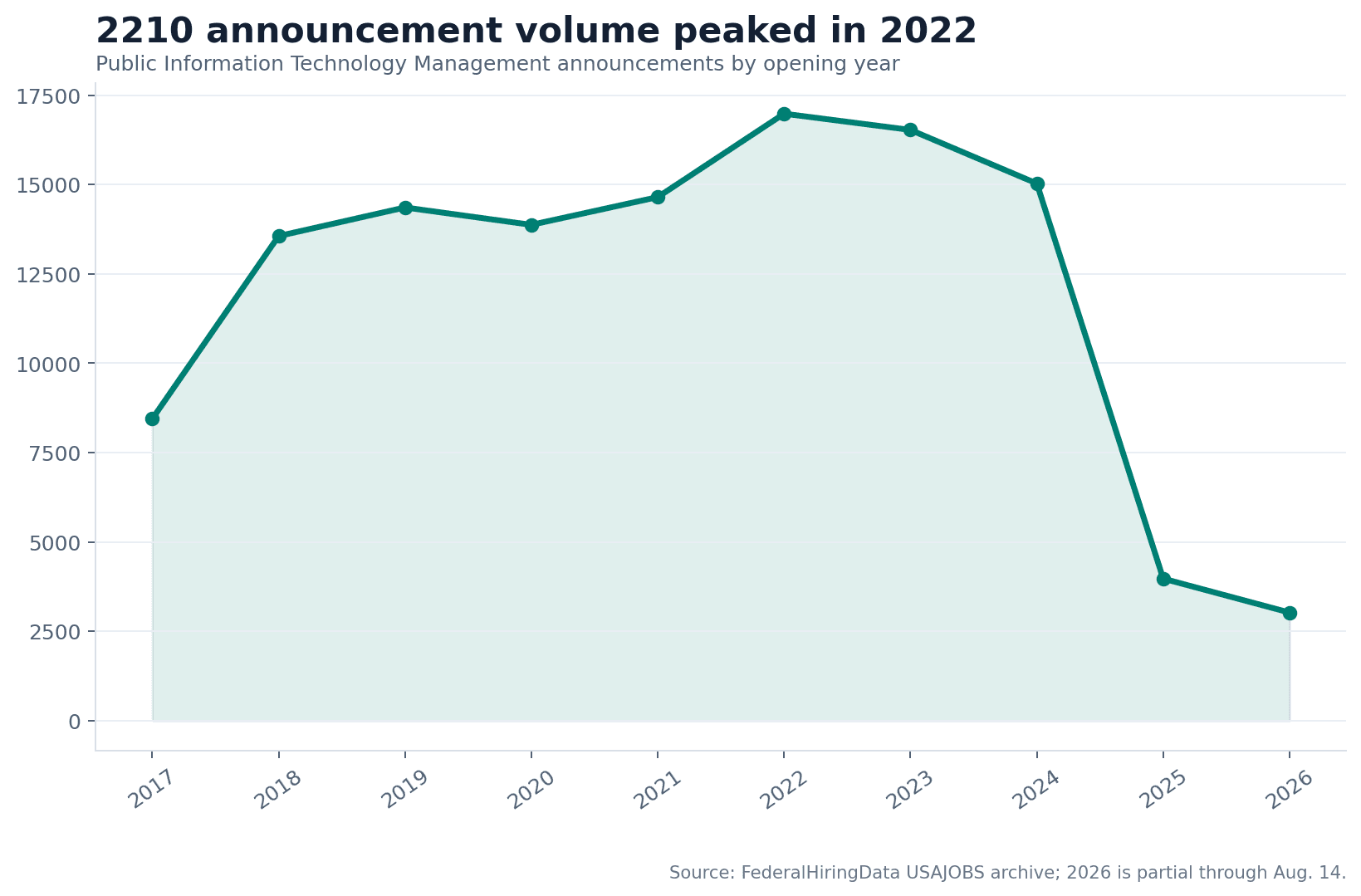
Federal 2210 Jobs by the Numbers: 120,410 IT Announcements Since 2017
The archive contains 120,410 Information Technology Management announcements, with a $122,683 median advertised annual maximum among valid salary ranges.
Data investigationsAugust 24, 2026
TSA Has More Than 1,300 Aviation Inspectors. Its Cybersecurity Role Map Is Outdated.
TSA added aviation cybersecurity requirements as its broad inspection and compliance workforce contracted and its public cyber role map remained outdated.

Cybersecurity and infrastructureAugust 30, 2026
DOE Has 120 Days to Write the Foreign Grid Technology Rules. CESER's Budget Funds 66 FTE.
Executive Order 14420 gives DOE 120 days to write foreign grid technology rules. CESER's FY2026 request funds 66 FTE, while DOE and FERC entered 2026 with smaller covered workforces.
Federal Hiring Data Weekly
Get the biggest federal workforce changes in your inbox.
Subscribe to Federal Hiring Data Weekly for federal hiring trends, salary data, agency movements, and original investigations, with email confirmation before delivery.