August 18, 2026
FEMA's Public Workforce Count Fell 22% as GAO Warned of Readiness Risks
FEMA had 5,793 fewer covered civilian employees in June 2026 than in January 2025. GAO says the agency cut staff without the workforce planning needed to assess mission capacity.
By Evan Mercer
Published August 18, 2026Last edited August 18, 2026
The Federal Emergency Management Agency's public workforce count fell by more than one-fifth over 17 months, a contraction that helps put a new government watchdog warning into scale.
FEMA had 20,262 covered civilian employees in June 2026, according to the latest Office of Personnel Management data available for this analysis. That was 5,793 fewer than in January 2025, a 22.2% decline.
The finding does not prove FEMA is unable to respond to a disaster. It does show that the agency entered the 2026 hurricane season with substantially fewer employees visible in OPM's public data, after a period when departures repeatedly outnumbered arrivals.
That is the data context behind an Aug. 4 Government Accountability Office report warning that staff reductions and a lack of workforce planning may affect FEMA's mission readiness. GAO found that FEMA made workforce decisions without an analysis of the people and skills it would need. The Department of Homeland Security agreed with GAO's recommendations.
What GAO found
GAO's report, *FEMA Workforce: Staff Reductions and Lack of Planning May Impact Mission Readiness*, describes both a sharp rise in departures and a planning failure.
| GAO workforce measure | Personnel employed | New hires | Separations |
|---|---|---|---|
| Fiscal year 2023 average | 22,855 | 3,952 | 2,767 |
| Fiscal year 2024 average | 23,863 | 4,275 | 2,791 |
| Fiscal year 2025 average | 25,134 | 2,907 | 4,321 |
| Oct. 1, 2025-May 16, 2026 | 21,742 | 134 | 2,545 |
GAO reported that FEMA's 4,321 separations in fiscal 2025 were 55% higher than in fiscal 2024. FEMA officials told the watchdog that those departures cost the agency experienced personnel and institutional knowledge.
The concern was not simply that fewer people worked at FEMA. GAO said the agency rescinded its 2022-2026 strategic plan in May 2025 and had no overall strategic direction on which to base workforce planning. It also found that FEMA did not use a workforce analysis when making its 2025 and 2026 reduction decisions or considering future workforce actions.
GAO made three recommendations, including that FEMA issue a strategic plan with clear goals and establish a workforce-planning process that includes an analysis of current staffing and future needs. DHS agreed.
Public workforce data shows a 22% decline
FederalHiringData independently analyzed OPM's monthly Federal Workforce Data files. The public series shows FEMA's covered civilian headcount declining from 26,055 in January 2025 to 20,262 in June 2026.
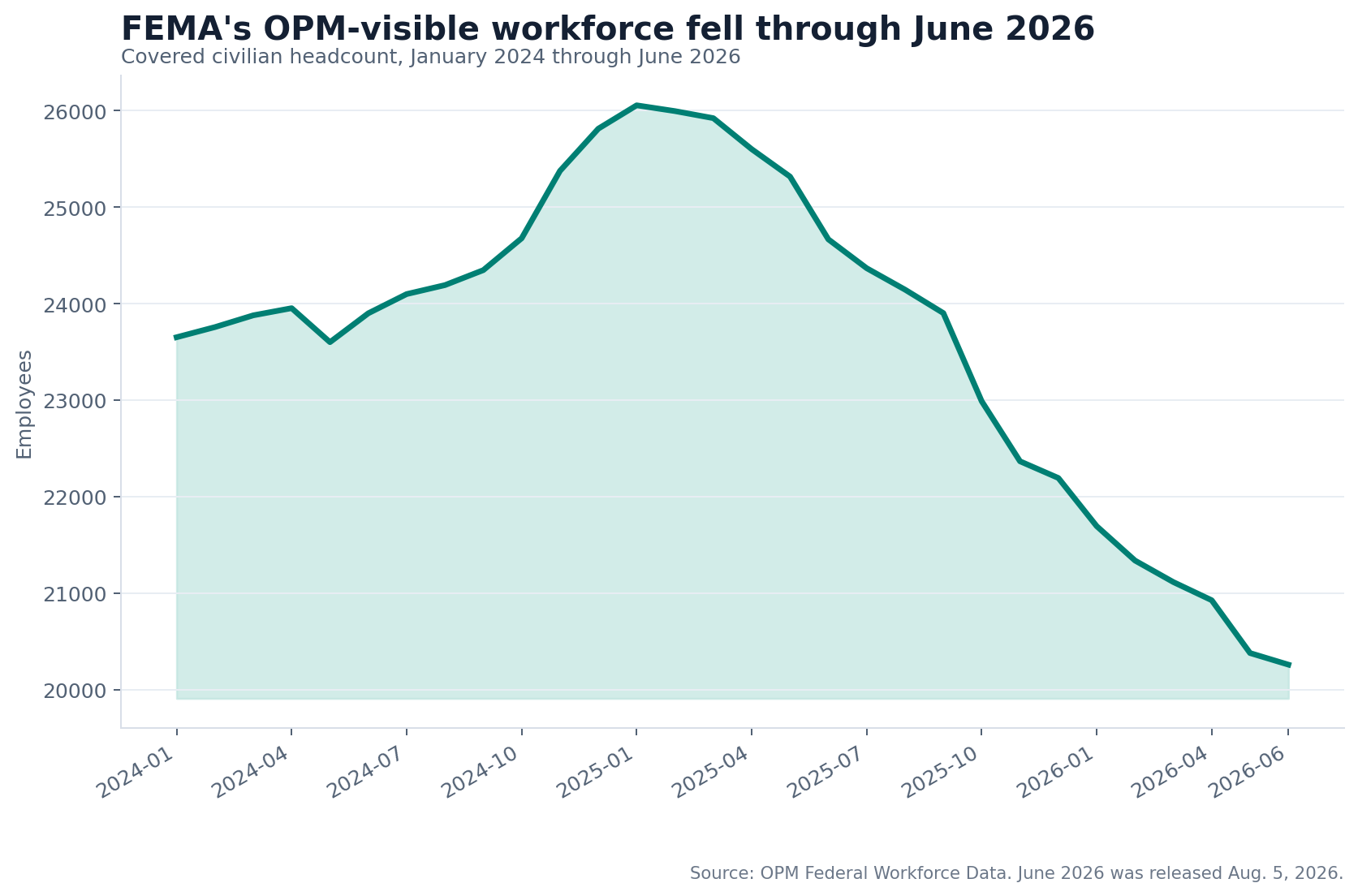
The OPM pattern is consistent with GAO's conclusion even though the two sources use different definitions and time periods. GAO used FEMA records and reported annual or partial-year averages over pay periods. OPM's employment file is a snapshot of covered civilian employees at the end of each month.
Those figures should not be treated as interchangeable point estimates. Their value is that two independent public views point in the same direction: FEMA lost thousands of employees while separations substantially exceeded hiring.
FederalHiringData's OPM analysis found:
| Calendar period | Accessions | Separations | Net |
|---|---|---|---|
| 2025 | 1,075 | 5,033 | -3,958 |
| January-June 2026 | 150 | 1,889 | -1,739 |
Accessions include people entering the covered workforce through new hires, transfers and rehires. Separations include resignations, retirements, terminations and other exits. They are personnel actions, not a count of job announcements.
On that basis, accessions trailed separations in 16 of the 18 months from January 2025 through June 2026. The imbalance was sustained rather than confined to one unusual month.
Why staffing capacity matters at FEMA
FEMA is not organized like an agency with a stable, uniform daily workload. Its workforce must expand and deploy when disasters occur, while also managing recovery work that can continue for years.
GAO reported that FEMA had response and recovery operations tied to 1,079 open disaster declarations as of June 2, 2026. It also described how Hurricanes Helene and Milton stretched capacity in 2024. FEMA deployed 13,500 employees after the two storms, the largest deployment in agency history, according to agency officials. By November 2024, only 4% of its incident-management workforce remained available to deploy.
The watchdog identified a second pressure point outside FEMA itself. DHS's Surge Capacity Force draws employees from other federal organizations when FEMA needs extra help. FEMA officials expected about 240 employees to be available for surge support during the 2026 hurricane season, down from 600 in 2025, GAO reported.
None of those facts establishes that FEMA will fail in a future emergency. Disaster demands vary, employees can be reassigned, and staffing totals alone do not measure readiness. They do explain why GAO focused on whether FEMA knows which capabilities it must retain before reducing the workforce further.
Emergency management specialists make up nearly half the public count
The June 2026 OPM file also shows what kinds of work are concentrated inside FEMA. Emergency Management Specialist, occupational series 0089, accounted for 9,782 employees, or about 48% of the agency's OPM-visible workforce.
| Occupational series | Public occupation | Employees in June 2026 |
|---|---|---|
| 0089 | Emergency Management Specialist | 9,782 |
| 0343 | Management and Program Analysis | 2,143 |
| 0301 | Miscellaneous Administration and Program | 1,161 |
| 2210 | Information Technology Management | 1,130 |
| 2003 | Supply Program Management | 704 |
| 0028 | Environmental Protection Specialist | 619 |
| 0501 | Financial Administration and Program | 399 |
| 0346 | Logistics Management | 390 |
| 0201 | Human Resources Management | 352 |
| 1109 | Grants Management | 300 |
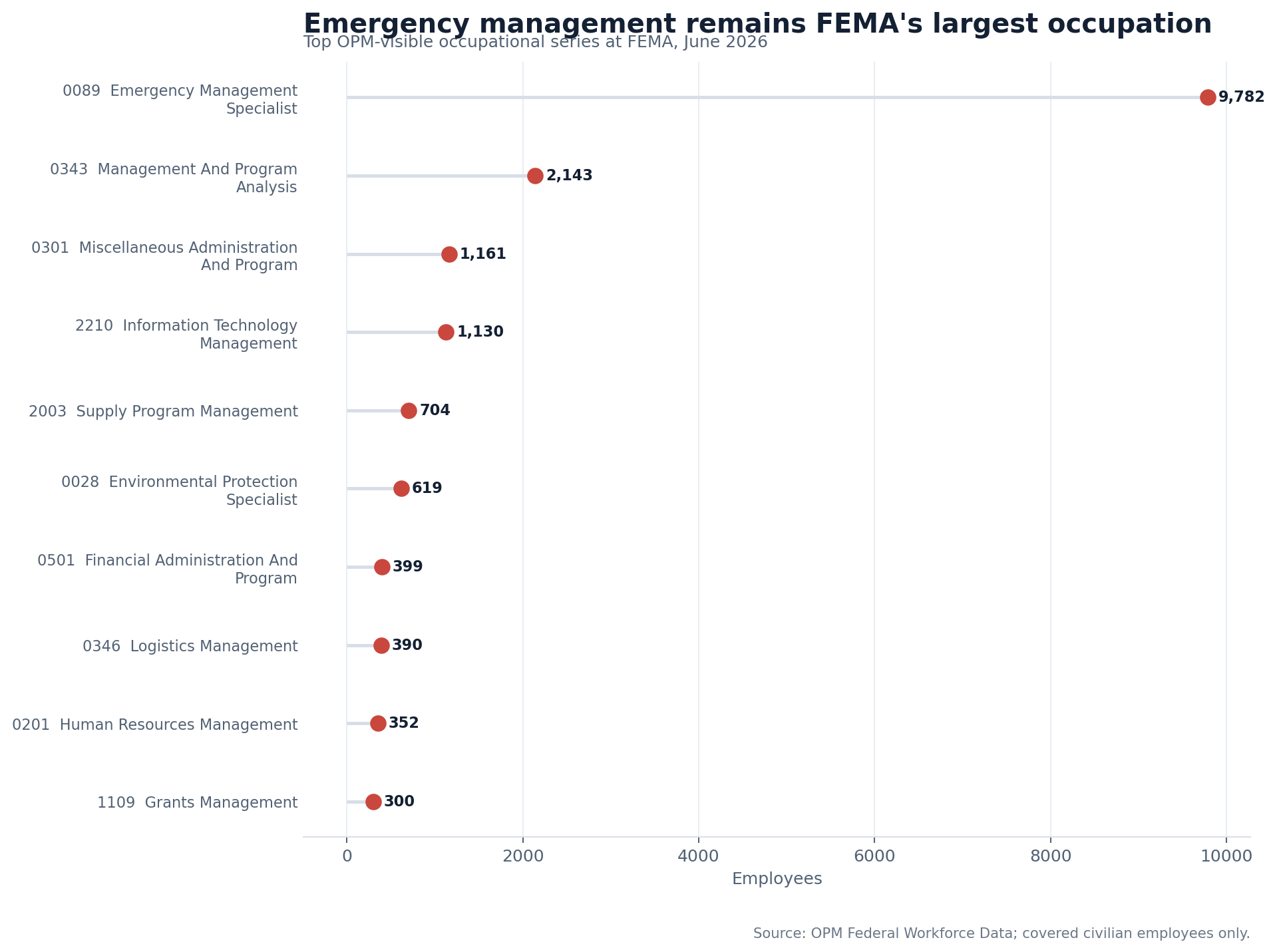
That mix makes the workforce issue more concrete. FEMA's capacity depends not only on field disaster specialists but also on information technology, logistics, grants, financial administration, environmental review and human-resources staff.
It is not possible from public aggregate files to identify which specific teams absorbed every departure or whether each lost capability was replaced through another staffing arrangement. GAO's central criticism is precisely that FEMA had not done the workforce analysis needed to connect reduction decisions to mission requirements.
The workforce is geographically distributed
FEMA's public workforce data is not concentrated solely at headquarters. In June 2026, OPM recorded 2,994 covered employees with District of Columbia duty stations, 2,672 in Texas, 1,908 in Virginia, 1,251 in Georgia and 1,221 in Florida. California and Maryland each had 913.
Another 2,010 FEMA records used OPM's no-data-reported state code. Because those employees cannot be assigned to a state from the public file, the geographic counts are useful indicators rather than a complete regional roster.
The distribution matters because FEMA combines national coordination, regional offices, logistics facilities and disaster operations. A governmentwide headcount number cannot show whether the agency has the right skill in the right location when an incident begins.
Current USAJOBS recruiting has not stopped
Workforce contraction does not mean FEMA has stopped advertising jobs.
At 7:13 a.m. UTC on Aug. 18, FederalHiringData contained 41 active FEMA announcements from the latest successful USAJOBS import. Eleven had opened since Aug. 17. Recent titles included Emergency Management Specialist, Management and Program Analyst, Supervisory Firefighter, Human Resources Specialist, Grants Management Specialist and utility-systems positions.
Readers can browse current federal job announcements and use the agency filter to see the latest FEMA listings. The active count will change as announcements open and close.
These are announcements, not necessarily 41 positions or 41 eventual hires. One announcement may cover multiple vacancies or locations, and USAJOBS does not disclose selections or onboarding outcomes.
The historical recruiting pattern is still stark. FederalHiringData's complete public archive contains 4,466 FEMA announcements that opened in 2024 and 1,195 that opened in 2025, a 73.2% decline. The archive has 126 opening in 2026 through the local research snapshot used for this article.
Announcement volume is not a workforce count, and it cannot explain every staffing change. It does show that the public recruiting pipeline became much smaller at the same time the OPM workforce series was falling.
What this means for federal job seekers and employees
For applicants, the immediate message is nuanced. FEMA continues to recruit, including for core emergency-management, mitigation, preparedness, grants, technology and support work. But a job seeker should not read the 41 active announcements as evidence that hiring has returned to its earlier scale.
For current employees, GAO's findings raise questions about workload, deployable capacity, training and institutional knowledge. The report does not quantify workload per remaining employee or establish that every office is understaffed. It says FEMA lacks the strategic and workforce-planning foundation needed to demonstrate that its staffing choices match its mission.
For Congress and DHS, the issue is measurability. A smaller workforce may be an intentional policy choice. The public record does not show that FEMA first identified the people and skills required to perform its statutory responsibilities and then designed reductions around those requirements.
That is what turns this from a story about one personnel number into a readiness question.
Methodology and limitations
FederalHiringData queried monthly OPM Employment, Accessions and Separations files using the exact FEMA agency-subelement code HSCB. The headcount comparison uses January 2025 and June 2026 month-end Employment snapshots. Calendar-year action totals sum the monthly Accessions and Separations files. June 2026 is the latest OPM observation in the local research warehouse and was released Aug. 5, 2026.
The USAJOBS analysis uses unique announcement control numbers assigned to the Federal Emergency Management Agency. Historical annual counts use announcement opening year. The active count was checked against production after the successful USAJOBS import completed at 6:29 a.m. UTC on Aug. 18. USAJOBS announcements do not measure applications, selections, hires, employees or vacancies unless a posting explicitly supplies a reliable vacancy count.
GAO's figures come from FEMA records and use fiscal years, pay periods and an agency-reported April 18 point-in-time count. They are presented with GAO's definitions and are not merged with OPM snapshots. Differences between the two sources can reflect timing, coverage and measurement rules.
The analysis cannot determine current readiness, workload, training level, contractor support, individual deployments or the operational consequence of a future disaster. It does not forecast disaster performance. It shows the scale, composition and persistence of a documented workforce reduction while preserving GAO's narrower conclusion that the reductions and lack of planning may affect mission readiness.
Primary sources: GAO-26-108427, the accessible full GAO report, and OPM Federal Workforce Data. Related FederalHiringData coverage: the federal workforce decline through May 2026, current job search, workforce statistics, and the historical announcement archive.
Hero photo: G. Edward Johnson via Wikimedia Commons, licensed under CC BY 4.0.
Keep reading
Related federal hiring research
Article data window: FY2019-FY2025
Contract Spending and Federal Headcount Often Moved Independently
Across a bounded 28-agency sample, contract-obligation growth and covered headcount growth had only a 0.169 correlation; five agencies increased obligations while headcount fell.
Article data window: Jan. 1-14, 2026
Federal Healthcare Hiring Led Early January 2026 Job Announcements
Veterans Health Administration, nurse roles, medical officers, and other clinical and support occupations drove the strongest healthcare signal in the early January archive.
Article data window: Jan. 1-14, 2026
Federal Hiring Trends: Jan. 1-7 vs Jan. 8-14, 2026
Veterans Health Administration stayed dominant, nurse and medical roles strengthened, and remote-work signals remained too sparse for a public trend claim.
Federal Hiring Data Weekly
Subscribe to Federal Hiring Data Weekly.
Subscribe to Federal Hiring Data Weekly. Confirm your email after signing up to receive federal hiring trends, salary data, agency movements, and original research.