August 17, 2026
Trump Threatens Oman as U.S. Federal Personnel Face Elevated Security Risks
Some non-emergency U.S. personnel had already been relocated. A 2025 inspection documented 108 authorized U.S. direct-hire positions, while current public personnel data captures only a fraction.
By Evan Mercer
Published August 17, 2026Last edited August 18, 2026
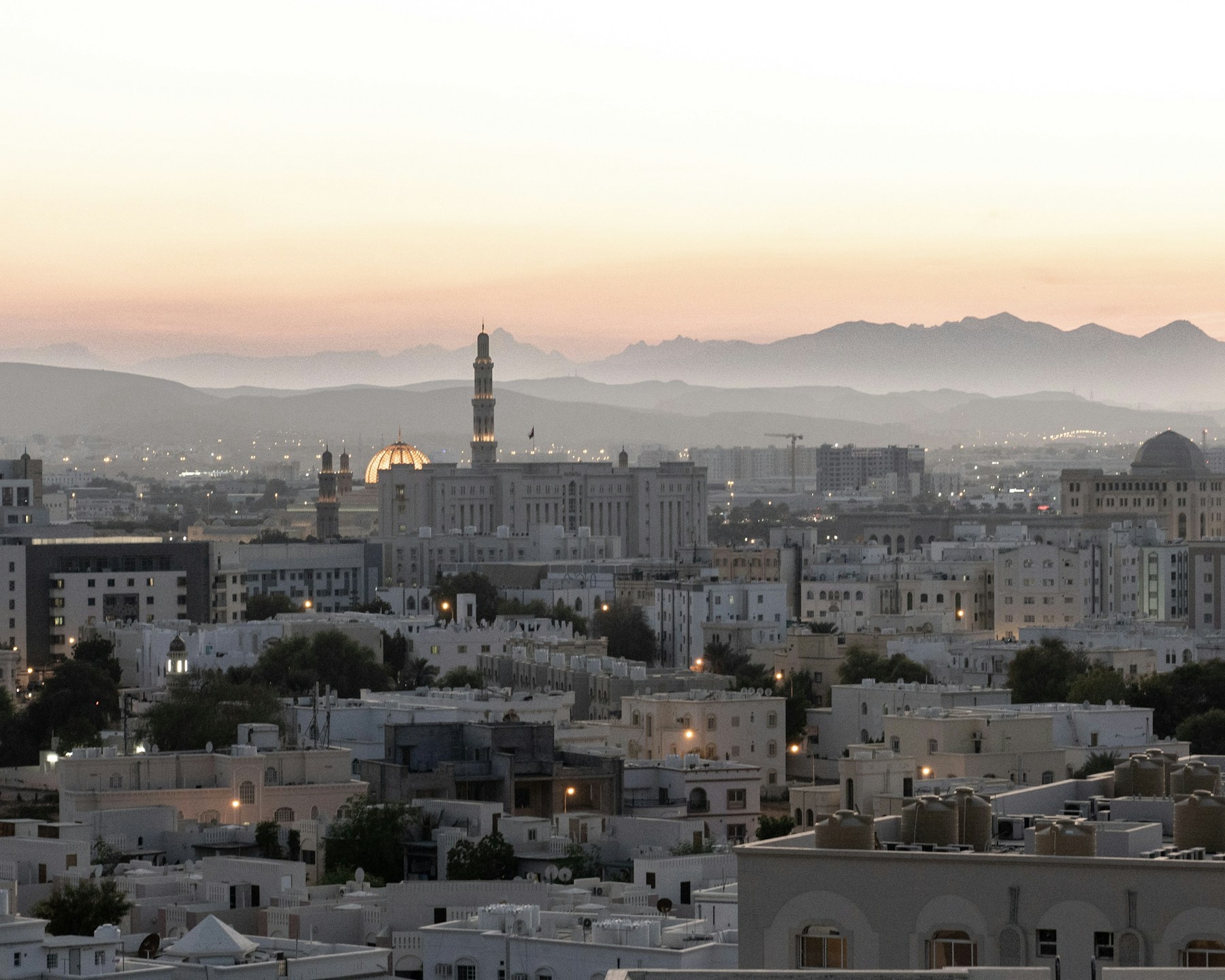
President Donald Trump threatened military action against Oman on Aug. 17 while U.S. federal personnel remained assigned there and some non-emergency U.S. personnel had already been relocated outside the country because of the regional security environment.
The Associated Press reported on Aug. 17 that Trump told Fox News reporter Trey Yingst the United States would bomb Oman if it "gets in the way" of U.S. objectives involving Iran and the Strait of Hormuz. Reuters also reported the remark. Fox did not provide audio of the interview. The remark was a threat, not a publicly announced strike order or operational plan.
The personnel risk predates Trump's remark. The State Department rates Oman Level 3: Reconsider Travel because of terrorism and armed conflict. It authorized non-emergency U.S. government employees and employee family members to leave on June 27. By Aug. 1, the U.S. Embassy in Muscat said some non-emergency personnel had been relocated outside the country. Official warnings also cite missile and drone risks, possible escalation, commercial-flight cancellations and periodic airspace closures.
Trump therefore threatened the same country where a U.S. embassy and interagency workforce continue to operate. That does not establish that an attack is imminent or that U.S. personnel are currently under attack. It does make the safety, staffing and continuity of the American mission part of the story.
What public records show about U.S. staffing in Oman
Three public numbers describe three different things. They should never be added together or treated as competing estimates of the same workforce.
| Public measure | Source, meaning and limit |
|---|---|
| 108 authorized U.S. direct-hire positions | State Department OIG: the authorized structure in the 2025 inspection was 65 State Department positions and 43 positions in other U.S. government agencies. This is not a verified Aug. 17, 2026 physical headcount or proof that every position was filled. |
| 4 OPM-visible employees | June 2026 OPM data: four covered CDC/HHS civilian records had an Oman duty station, all in Muscat. This is not the total workforce because Foreign Service personnel and several other systems are excluded. |
| 224 historical USAJOBS announcements | FederalHiringData archive: public recruiting announcements linked to Oman from March 2017 through July 2026. This is not 224 employees, current workers, hires or currently open vacancies. |
The State OIG benchmark gives the broadest recent public view of Embassy Muscat's authorized American staffing structure. OPM provides a narrow, more recent slice of covered civilian employment. USAJOBS shows what agencies recruited for over time. None provides a current physical roster.
Why the personnel risk is central
The State Department's Oman Travel Advisory, issued June 27 and still live on Aug. 17, says Americans should reconsider travel to Oman because of terrorism and armed conflict.
| Current public status | What the official record says |
|---|---|
| Travel advisory | Level 3: Reconsider Travel |
| U.S. government staffing | Non-emergency employees and employee family members were authorized to depart on June 27 because of safety risks |
| Change from earlier status | Authorized departure replaced the previous ordered departure |
| Regional conflict | State cites ongoing threats of Iranian drone and missile attacks after U.S.-Iran hostilities began Feb. 28 |
| Transportation | State cites significant commercial-flight disruption |
| Terrorism | Attacks can occur with little or no warning; possible targets include government facilities and places visited by Americans |
An Aug. 1 security alert from Embassy Muscat said the post remained on authorized-departure status and that some non-emergency U.S. government personnel had been relocated outside Oman. The alert also warned of possible escalation, flight cancellations and periodic airspace closures.
That sequence matters. The State Department had already concluded that the regional environment justified allowing non-emergency personnel and families to leave, and the embassy later confirmed that some personnel had moved. Trump's subsequent threat introduced another point of diplomatic and security uncertainty around the country where the remaining mission operates.
What each dataset can see
| Source | What it sees | What it does not tell us |
|---|---|---|
| State Department OIG | The embassy's authorized staffing structure during the inspection | Whether every position is filled or how many people are physically in Oman today |
| OPM public workforce data | Covered civilian employees reported through OPM's public personnel system | Foreign Service personnel and several other excluded personnel systems |
| USAJOBS archive | Public recruiting announcements and the work agencies advertised | Employees, applicants, selections, hires or a current personnel roster |
The broad staffing benchmark: 108 authorized positions
The responsible answer is a benchmark, not a precise current headcount.
The State Department Office of Inspector General inspected Embassy Muscat from September 2024 through January 2025. Its unclassified report recorded the mission's authorized staffing structure at the time:
| Embassy staffing structure | Authorized positions |
|---|---|
| U.S. direct-hire positions | 108 |
| State Department positions within that total | 65 |
| Other U.S. government agency positions within that total | 43 |
The 108 is the strongest recent public measure of the intended American direct-hire presence at Embassy Muscat. It is not a confirmed Aug. 17, 2026 headcount. Authorized positions can be vacant, staffing can change, the inspection predates the current crisis, and authorized departure has since moved some non-emergency personnel outside Oman.
The OIG separately reported 20 eligible-family-member positions and 191 locally employed staff positions. Those categories should not be added to 108 and relabeled as U.S. federal employees. They describe other parts of the mission's staffing structure.
In short: public records establish the scale and types of the federal presence, but not today's exact number on the ground.
Who does the U.S. government have in Oman?
The OIG report identifies a diplomatic mission with multiple agencies and functions. USAJOBS history adds evidence about the work those agencies have recruited for over time.
| Function | Publicly documented work or components | What the evidence establishes |
|---|---|---|
| Diplomacy | Political and economic work, consular services, public diplomacy and embassy administration | State Department functions within the mission structure documented by OIG |
| Public health | CDC health science, epidemiology and public-health programs | CDC/HHS presence documented by OIG; four covered CDC employees visible in June 2026 OPM data |
| Defense and security cooperation | Defense-related personnel, logistics, programs and cooperation | Department of Defense presence documented by OIG; recruiting history adds examples of functions |
| Law enforcement and homeland security | FBI, Homeland Security Investigations and Customs and Border Protection | Justice and Homeland Security components documented by OIG |
| Engineering and infrastructure | Civil, mechanical and electrical engineering, architecture, construction and project oversight | Oman-linked Army Corps recruiting history; not proof every advertised role is occupied today |
| Technology and operations | Information technology, logistics, airfield and program management, and administrative support | Recurring USAJOBS recruiting history; not a current roster |
In plain English, the public record describes diplomats and consular staff, defense personnel, public-health scientists, federal investigators, border-security personnel, engineers, and administrative and technology support. It does not identify every person or prove that every historically advertised role is filled today.
What OPM can see: four CDC employees
June 2026 is the newest month in FederalHiringData's local OPM Federal Workforce Data warehouse. An exact Oman duty-station query found four covered civilian employees, all in Muscat and all with the Centers for Disease Control and Prevention.
| Public OPM occupation | Grade | Employees visible |
|---|---|---|
| General Health Science | GS-14 | 1 |
| General Health Science | GS-15 | 1 |
| Miscellaneous Administration and Program | GS-15 | 1 |
| Public Health Program Specialist | GS-14 | 1 |
Four is not the total U.S. government workforce in Oman. It is a narrow observable subset.
OPM says its personnel system covers about 96% of non-Postal executive-branch civilian employment, but its published coverage list excludes State Department Foreign Service personnel, foreign nationals employed overseas, the CIA and several intelligence agencies. Military personnel and contractors are outside this civilian count as well.
The OPM result is useful because it shows the kind of public-health work visible in a recent civilian workforce file. It cannot be used to shrink a 108-position interagency embassy structure to four people.
What USAJOBS shows: recruiting history, not people
FederalHiringData's complete archive contains 224 unique public USAJOBS announcements linked to Oman that opened from March 2017 through July 2026.
That number measures announcements. It does not measure employees, current positions, selections or hires. A single announcement can advertise multiple occupations or vacancies, and similar work can be advertised repeatedly.
| Hiring agency | Unique Oman-linked announcements |
|---|---|
| Centers for Disease Control and Prevention | 130 |
| U.S. Army Corps of Engineers | 58 |
| Customs and Border Protection | 10 |
| Immigration and Customs Enforcement | 9 |
| U.S. Air Forces in Europe | 7 |
| Air Force Elements, U.S. Central Command | 5 |
| Defense Logistics Agency | 5 |
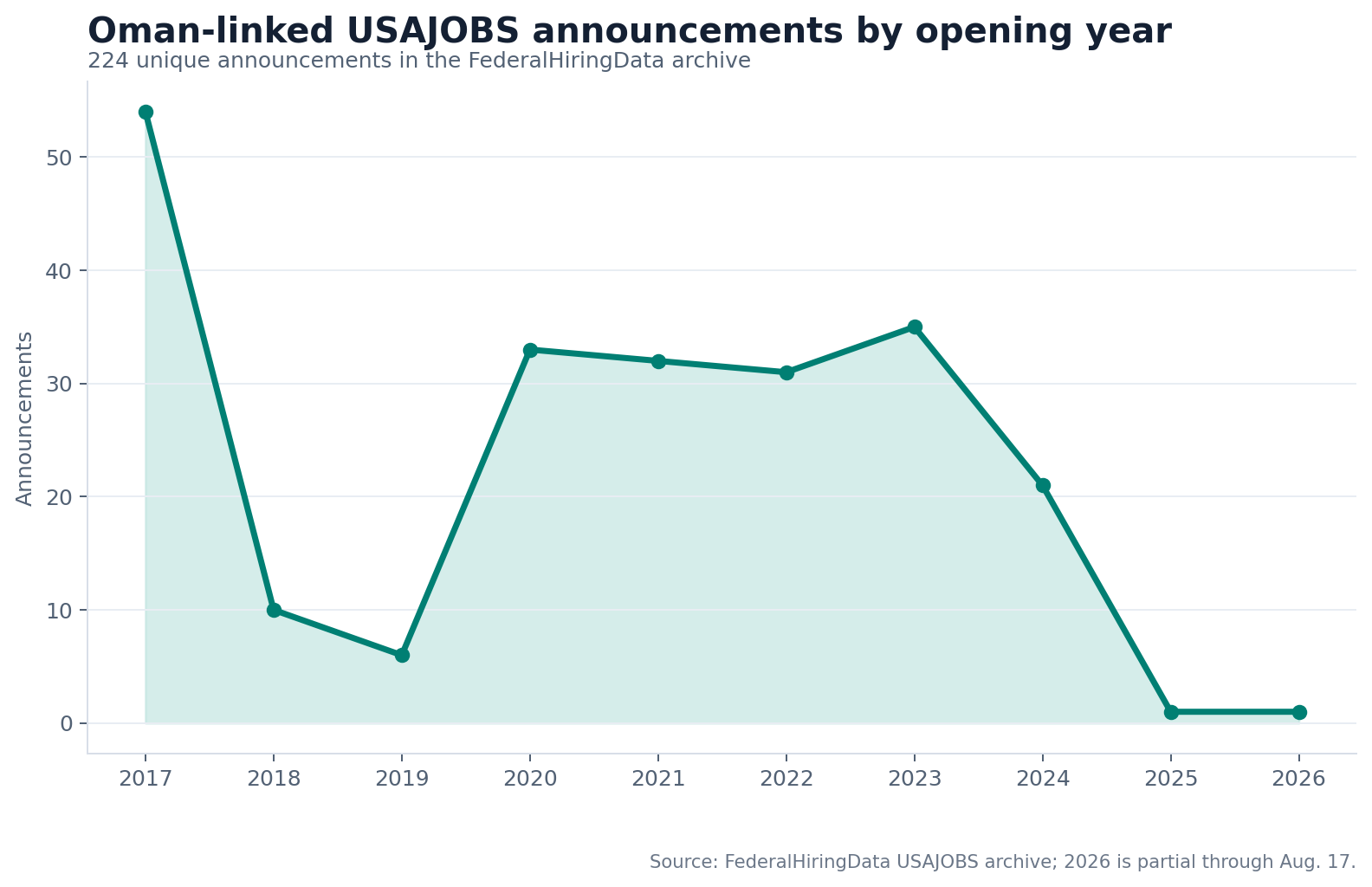
The history makes the work more concrete. CDC repeatedly advertised public-health advisor, physician, health scientist and epidemiologist roles. Army Corps announcements included civil, mechanical and electrical engineers, architects, geologists, construction-control staff and project specialists. Homeland Security announcements included border and investigative work. Defense components advertised logistics, program, information-technology, administrative-support and airfield-management roles.
Those announcements show what the U.S. government has recruited people to do in Oman. They are not a roster of who is there now.
What risk do U.S. federal employees in Oman face now?
The public record supports three broad risk categories. It does not support claims about a specific threat to an individual employee or an imminent attack on Embassy Muscat.
Regional military escalation
The State Department says U.S.-Iran hostilities that began Feb. 28 created an ongoing threat of drone and missile attacks from Iran. It also cites significant disruption to commercial flights. Embassy Muscat's Aug. 1 alert described a complex environment with potential for unforeseen escalation and advised Americans to prepare for flight cancellations, airspace closures and travel disruption.
Those are official assessments, not projections by FederalHiringData. Authorized departure is itself evidence that the government had moved beyond routine caution: non-emergency employees and families were permitted to leave, and the embassy later said some personnel had been relocated.
Terrorism
The travel advisory says terrorist violence is a risk in Oman and that attacks can occur with little or no warning. Its list of possible targets includes government facilities, transportation hubs, large gatherings and places frequented by U.S. citizens and other foreigners.
That warning should not be stretched into a claim that Embassy Muscat faces a known attack plan. No such evidence is presented here. It establishes the threat category State is asking travelers and personnel to consider.
Diplomatic deterioration
A direct U.S. threat against the government hosting American diplomats can complicate the environment in which those diplomats and other federal employees operate. The confirmed event is Trump's public threat. The confirmed security measures are the Level 3 advisory, authorized departure and relocation of some non-emergency personnel.
Other outcomes remain possibilities, not reported facts. Further deterioration could lead to demonstrations, diplomatic restrictions, a heightened security posture, additional personnel reductions, suspension of nonessential operations or new departure decisions. This article does not claim any of those outcomes has occurred because of Trump's Aug. 17 statement.
The risk discussion is deliberately workforce-level. FederalHiringData does not publish embassy security vulnerabilities, defensive arrangements, evacuation routes, employee travel patterns or other operational details.
Why Benghazi is relevant - and why Oman is not Benghazi
The attacks on U.S. facilities in Benghazi, Libya, on Sept. 11-12, 2012 killed four Americans: Ambassador J. Christopher Stevens, Sean Smith, Tyrone Woods and Glen Doherty. The Justice Department identifies all four in its case record.
The independent State Department Accountability Review Board later found that the security posture at the Special Mission compound was inadequate for Benghazi's threat environment and grossly inadequate for the attack that occurred. Its official public briefing emphasized the need for clear-eyed risk assessment, sufficient resources and continuing attention to changing conditions.
That history helps answer why the security status of an overseas federal workforce matters. Political and security conditions can change quickly. Decisions about staffing, authorized departure, mission continuity and risk mitigation can have life-or-death consequences for Americans serving abroad.
Oman in August 2026 is not Benghazi in September 2012. Oman has a functioning central government. The security environment is different. Benghazi involved an armed terrorist assault on U.S. facilities. There is no evidence presented here of an imminent assault on Embassy Muscat, and the State Department has already reduced exposure by authorizing non-emergency personnel and families to depart.
The comparison is about risk management for U.S. personnel abroad, not a prediction that Oman will experience the same event.
What public records cannot tell us
No public source reviewed for this article gives a precise Aug. 17 roster of U.S. federal employees physically in Oman. The OIG report supplies a 2025 authorized-position benchmark. The embassy alert confirms that some non-emergency personnel later relocated. OPM sees only a subset. USAJOBS records recruiting activity rather than employment.
Public data also do not enumerate all Foreign Service personnel, military members, contractors, temporary-duty staff, locally employed workers in a comparable personnel system or personnel systems excluded from OPM reporting. FederalHiringData makes no numerical estimate of clandestine or intelligence personnel and does not infer identities or assignments from gaps in public data.
The sound conclusion is narrower and stronger: the United States maintained a sizable diplomatic and interagency structure in Oman; official records document what many of those employees do; and the State Department had already taken steps to reduce personnel exposure before the president's latest threat.
Methodology and sources
FederalHiringData queried the June 2026 OPM Employment file using the exact duty-station country value OMAN. It queried active and historical announcement-location tables using the exact normalized country value Oman, then deduplicated by USAJOBS control number. That produced 224 unique announcements opening from March 2017 through July 2026. Agency, title and occupation counts come from those matched controls.
The broad staffing benchmark comes from the State Department OIG's May 2025 unclassified inspection of Embassy Muscat. Current security findings come from the State Department's June 27 Oman Travel Advisory and Embassy Muscat's Aug. 1 security alert. Trump's Aug. 17 statement is attributed to AP and Reuters reporting. Benghazi facts come from the Justice Department and the State Department Accountability Review Board's public briefing.
Analysis date: Aug. 17, 2026. The canonical URL and original publication date are unchanged.
Related FederalHiringData research: Where Overseas Federal Job Announcements Were Concentrated in 2025, What Federal Hiring Data Shows About the Strait of Hormuz War's Effect on USAJOBS, and the searchable historical announcement archive.
Keep reading
Related federal hiring research
Article data window: FY2019-FY2025
Contract Spending and Federal Headcount Often Moved Independently
Across a bounded 28-agency sample, contract-obligation growth and covered headcount growth had only a 0.169 correlation; five agencies increased obligations while headcount fell.
Article data window: Jan. 1-14, 2026
Federal Healthcare Hiring Led Early January 2026 Job Announcements
Veterans Health Administration, nurse roles, medical officers, and other clinical and support occupations drove the strongest healthcare signal in the early January archive.
Article data window: Jan. 1-14, 2026
Federal Hiring Trends: Jan. 1-7 vs Jan. 8-14, 2026
Veterans Health Administration stayed dominant, nurse and medical roles strengthened, and remote-work signals remained too sparse for a public trend claim.
Federal Hiring Data Weekly
Subscribe to Federal Hiring Data Weekly.
Subscribe to Federal Hiring Data Weekly. Confirm your email after signing up to receive federal hiring trends, salary data, agency movements, and original research.