August 22, 2026
The Patent Backlog Started Falling. USPTO Is Trying to Hire 1,500 Examiners.
The unexamined patent inventory fell by 60,933 applications as USPTO reached about half of its fiscal 2026 patent-examiner hiring goal.
By Evan Mercer
Published August 22, 2026Last edited August 22, 2026
The U.S. Patent and Trademark Office entered 2025 with 837,928 unexamined utility, plant and reissue applications. By April 6, 2026, that inventory had fallen to 776,995, a reduction of 60,933 applications.
For the first time in nearly a decade, USPTO said its fiscal-year output of first office actions was running ahead of new filings. The office also said it was about halfway toward an aggressive goal of hiring 1,500 patent examiners in fiscal 2026.
Those milestones point in the same direction, but they do not prove a one-variable explanation. A backlog falls when examination output exceeds new work entering the queue. Hiring can raise future output, but newly hired examiners need training and supervision. Workflow changes, overtime, application volume and search tools can affect the balance sooner.
The useful story is therefore a turnaround with an unresolved attribution question. USPTO had begun reducing the inventory. It had not yet shown how much of the change came from more examiners, higher production by the existing corps, changing filings or new tools, or whether the improvement would persist after the hiring surge.
The inventory fell by 60,933 applications
USPTO's April 10 announcement reported an unexamined inventory of 776,995 utility, plant and reissue applications. The January 2025 peak was 837,928. The difference is a 7.3% reduction.

This measure does not include every item in the patent system. Design applications follow a different examination process and should not be folded into a utility/plant/reissue series without a consistent definition. Total inventory can include work beyond the unexamined queue. First-action pendency measures time to an examiner's first substantive action, while total pendency extends to disposal. Each answers a different question.
The 60,933 decline is not the number of patents granted. A first office action may allow claims, reject them or require continued exchange with the applicant. Moving an application out of the unexamined inventory begins substantive examination; it does not complete the case.
Still, the threshold matters. If first actions continue to exceed incoming applications, the queue can shrink. If filings regain the lead, it grows again.
The backlog had been building for years
USPTO said the unexamined inventory had risen from 576,103 in 2020 to 837,928 in January 2025, an increase of 261,825 applications, while annual filings declined by more than 8,000 over the same broad period. That history suggests the queue was not simply a product of surging demand.
Production capacity, attrition, training and workflow all matter. Patent examination is specialized knowledge work. Examiners search prior art, interpret claims, apply legal standards and communicate findings. Technical fields move at different speeds and carry different application volumes. A national total can conceal substantial variation among technology centers.
The office's April statement said it was nearing its fiscal-year goal of virtually eliminating applications that otherwise would exceed 36 months without a first action. Reducing the oldest work is different from lowering the average. A queue can improve at the tail while other applications continue accumulating, or improve broadly while a difficult specialty remains behind.
A complete performance view would publish unexamined inventory, first actions, disposals and both pendency measures by technology center. USPTO's Patents Dashboard provides much of that operating detail; a single headline count should not replace it.
Hiring 1,500 examiners is a pipeline, not instant output
USPTO's fiscal 2025 financial report set goals of 1,100 new patent examiners in 2025 and another 1,500 in 2026. The April release said the agency was about halfway to the 2026 goal, without giving an exact on-board count in the announcement.
The target itself had changed from earlier budget planning. A fiscal 2025 congressional submission projected 850 hires in 2025 and 700 to 900 per year after that, with about 400 annual attritions offsetting gross hiring. The later plan was substantially more aggressive.
Gross hiring should not be confused with net workforce growth. New employees replace separations before they expand the corps. They also begin with a training burden. Experienced primary examiners and supervisors must review work and teach procedures, so a large entering class may use some capacity before it adds its full production.
USPTO streamlined recruiting, added candidate support and used online interviewing. Most utility patent examiners enter at GS-7 or GS-9 and receive a special pay rate. The technical requirement is broad: applicants need qualifying STEM education, and the office recruits by engineering and scientific discipline.
The best measure of the program is not offers made. It is trained examiners retained and producing quality-compliant work after one, two and three years.
Agency headcount fell during the hiring drive
FederalHiringData's calculation from OPM monthly employment files shows covered USPTO employment at 14,349 in December 2024 and 13,529 in June 2026, a decline of 820 employees, or 5.7%.

This is an agency-wide count, not the patent-examiner corps. USPTO also employs trademark examiners, attorneys, IT specialists, analysts and support staff. The series cannot show whether examiner hiring offset larger reductions elsewhere or whether specific technical centers grew.
It does establish a useful constraint. The backlog began falling during a period when overall covered employment did not expand. That makes a simple "more total employees caused the turnaround" claim untenable.
Federal Hiring Data Weekly
Get the biggest federal workforce changes in your inbox.
Subscribe to Federal Hiring Data Weekly for federal hiring trends, salary data, agency movements, and original investigations, with email confirmation before delivery.
Examiner-level staffing data are needed to resolve the issue. USPTO's own dashboards and reports can show corps size and hiring, while OPM series identify covered occupational groups. The measures should be reconciled by date and universe rather than spliced together.
Recruiting data reflect a technical, centralized workforce
The FederalHiringData historical USAJOBS archive contains 3,942 distinct announcements matched to USPTO from May 2017 through Aug. 12, 2026. The archive includes patent examining and patent administration series, alongside IT, management analysis, attorneys and program staff.

Agency-wide announcements rose from 183 in partial 2017 coverage to 753 in 2024. The archive contains 88 in 2025 and 51 in partial 2026 coverage through Aug. 12. Those control-number counts do not equal hires. A single multi-discipline or standing announcement may support many selections, and recruiting architecture can change between years.
The archive is more useful at the announcement level: fields sought, grade, pay, application windows and location. Examiner campaigns recruit for specialties such as computer engineering, mechanical engineering, chemistry and physics. A broad national hiring target must be filled across those technical markets, not from one interchangeable pool.
Remote and telework policy also affect recruiting and retention, but the presence of a telework field does not mean a position is fully remote. Any trend analysis must use confirmed workplace language and preserve policy dates.
Production tools may help, but attribution is not public yet
USPTO has introduced AI-assisted search and other workflow pilots. Its April release credited examiner work and noted the steady release of robust AI tools. That is evidence the tools were part of the operating strategy, not evidence of a measured causal effect on the 60,933-application decline.
A search tool can surface prior art faster, reduce repetitive work or improve consistency. It can also require validation, training and careful quality controls. Examination output that rises while statutory quality measures remain on target is encouraging, but quality metrics do not isolate which tool produced the result.
The same caution applies to overtime and production credits. Higher output may reflect more paid hours, changed crediting, workflow triage or a shifting application mix. Without a decomposition by examiner tenure, technology center, hours and tool use, assigning a percentage of the backlog decline to AI would be speculation.
USPTO can make that attribution testable by comparing participating and nonparticipating work under a documented design, publishing the period and sample, and reporting quality as well as speed.
The next checkpoints will decide whether this was a turn
Related research
Put this finding in context
Data investigationsAugust 19, 2026
106,533 Applications, 2,610 Academy Graduates: Why the FAA Still Has a Controller Shortage
FAA has abundant applicant interest, but its audited funnel reaches only 2,610 Academy graduates before years of facility training. The binding constraint is certification capacity.

Data investigationsAugust 20, 2026
634 Applications, Eight Completed Rotations: Why the Federal Cyber Exchange Stalled
Employees showed interest in the federal cyber rotation program. Home-agency approval, unreimbursed staffing costs and senior qualification demands narrowed the path.
The April milestone is a real reduction from a clearly dated peak. The next questions are whether fiscal 2026 finishes with first actions still ahead of filings, whether first-action and total pendency improve, and whether the oldest inventory stays low.
Hiring progress should be reported as applications, offers, entries on duty, training completion, attrition and net examiner change. Technology-center totals would show whether capacity matches the application fields where the queue is concentrated.
Quality remains a hard condition. A faster first action is not useful if rework, appeal or error increases. USPTO said it exceeded its statutory patent-quality compliance targets while the inventory fell. Continued reporting will show whether that balance holds.
For prospective examiners, the role combines technical education with legal and analytical work. Historical postings are not current openings. Readers can browse current federal jobs, review occupation pages and explore agency hiring.
The patent backlog did begin moving down. Calling the turnaround complete would be premature. The office now has to turn one favorable fiscal-year balance into a sustained reduction while converting a large hiring class into experienced examiners.
The backlog equation can be tested without guessing
For the unexamined queue, the basic accounting is beginning inventory plus incoming applications minus applications receiving a first action, with adjustments for transfers, corrections and definition changes. USPTO's statement that cumulative first actions exceeded cumulative filings identifies the direction of that balance during fiscal 2026. The 60,933 decline gives the net change from a separate January 2025 peak date.
Those two comparisons are related but not identical. One is fiscal-year flow; the other spans roughly 15 months. A mathematical decomposition should use monthly dashboard values under one stable definition and reconcile any adjustment terms. It should not subtract a fiscal-year filing total from a differently dated inventory change.
Technology-center detail would reveal whether the turnaround is broad. Chemistry, software, communications, mechanical technologies and biotechnology can receive different application volumes and require different search expertise. A national decline can coexist with a growing queue in one center.
Training cohorts should be aligned to those same centers. If new examiners are concentrated in fields where the backlog is largest, future capacity may improve even before the national workforce total grows. If attrition removes senior examiners from another center, mentoring and production can remain constrained.
The necessary data exist in operational systems. Publishing a stable monthly extract of filings, first actions, disposals, inventory and examiner staffing by center would let the public evaluate the turnaround without assigning credit by assertion.
The same extract should preserve revisions and exact as-of dates. That would prevent a later dashboard update from silently changing the apparent size of the turnaround and would keep partial fiscal-year performance separate from completed-year results.
Methodology and limitations
Inventory, first-action and hiring-progress statements come from USPTO's April 10, 2026 release. Hiring goals and recruiting changes come from the fiscal 2025 Agency Financial Report. Earlier hiring projections come from USPTO's fiscal 2025 congressional submission and are presented as an earlier plan, not a simultaneous target.
FederalHiringData calculated monthly covered USPTO employment from OPM Federal Workforce Data from January 2015 through June 2026. That series is not an examiner count. We counted distinct historical USAJOBS control numbers matched to USPTO from May 23, 2017 through Aug. 12, 2026. Announcements do not equal positions, hires or trained examiners, and 2026 coverage is partial.
Utility, plant and reissue inventory is kept separate from design-patent measures where definitions differ. This article does not estimate an AI effect or attribute the backlog decline to hiring alone. Readers can consult the USPTO Patents Dashboard, browse current jobs and read more workforce investigations.
Continue reading
More from FederalHiringData
Data investigationsAugust 22, 2026
FDA's Inspection Mission Grew. Its Experienced Investigator Pipeline Did Not.
Drug-investigator vacancies doubled from 25 to 51 as FDA struggled to recruit, retain and train staff for domestic and foreign inspections.

Hiring processAugust 17, 2026
What Direct Hire Means on USAJOBS, and What 16,320 Labeled Announcements Reveal
Engineering, IT and contracting led a conservative cohort of USAJOBS announcements with Direct Hire in the title. A 14-day median application window still does not measure selection speed.
Hiring processAugust 17, 2026
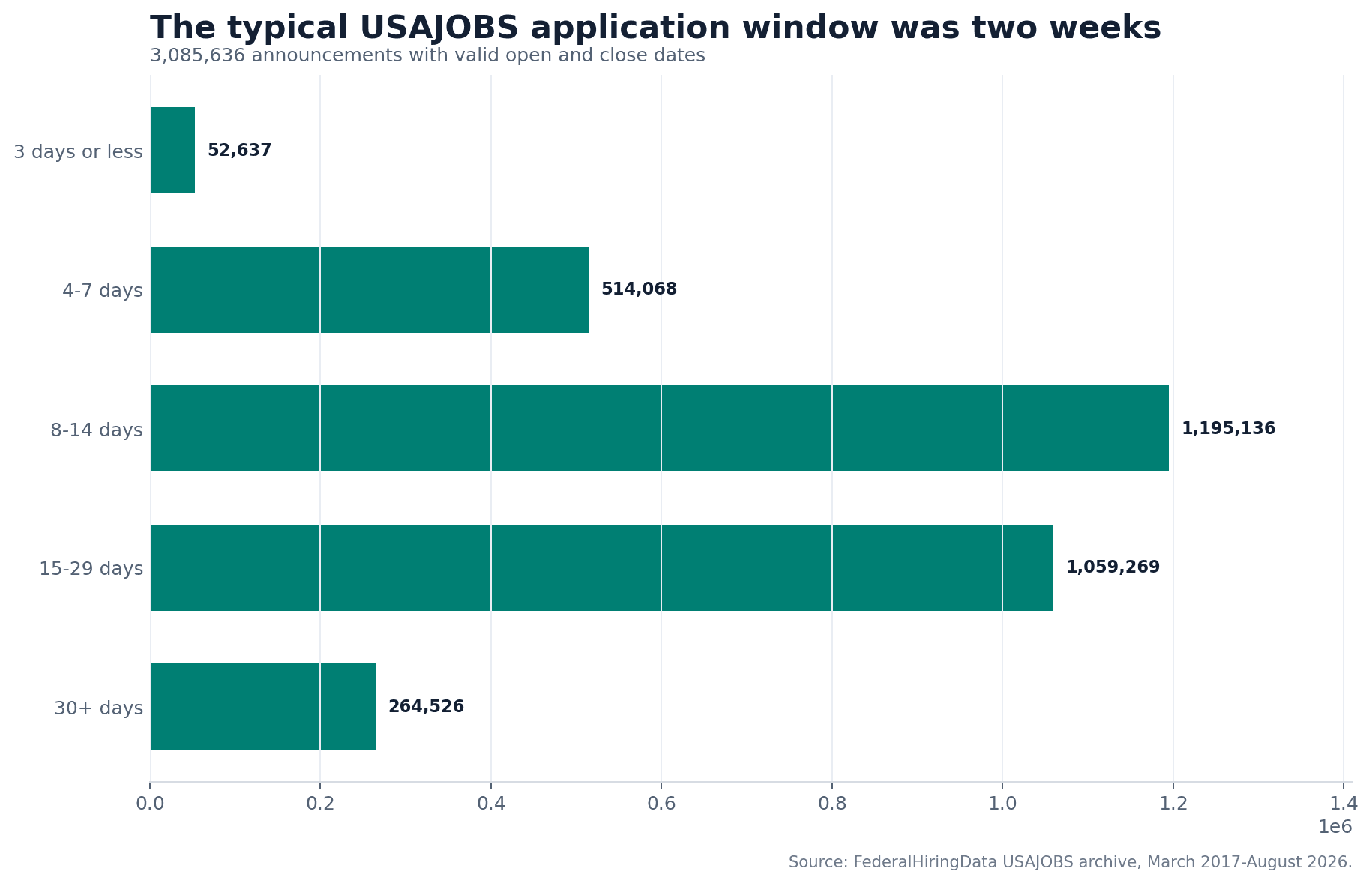
How Long USAJOBS Announcements Stay Open: 3.09 Million Records
Across 3,085,636 announcements, the median application window was 14 days and 566,705 closed within a week.
Federal Hiring Data Weekly
Get the biggest federal workforce changes in your inbox.
Subscribe to Federal Hiring Data Weekly for federal hiring trends, salary data, agency movements, and original investigations, with email confirmation before delivery.