August 28, 2026
The FBI Ordered a 260-Person Analytical Surge. Its Intelligence Series Had Fallen by 305.
The FBI ordered a 260-person analytical surge after its 0132 workforce fell by 305. Public records show the scale but not the opportunity cost.
By Evan Mercer
Published August 28, 2026Last edited August 28, 2026
An FBI memo sent to field offices in early July did more than declare a priority. It attached a national staffing number and a deadline.
The bureau wanted 260 investigative analysts and staff operations specialists to support an investigation involving Georgia's 2020 election, according to reporting by the Associated Press and CBS News, both of which reviewed the internal directive. Each participant was assigned an estimated 708 records checks by July 17. Multiplied together, those planning figures imply as many as 184,080 checks. They do not prove that 184,080 checks were completed.
The number raises an operational question separate from the politics and legal merits of the underlying investigation: how large is a 260-person analytical assignment inside the FBI?
FederalHiringData's answer is that it was large enough to be visible against the bureau's workforce, but the public data do not support the simple percentage circulating in public discussion. The latest Office of Personnel Management file counted 35,334 covered FBI employees in June 2026, including 2,896 in the 0132 Intelligence series. The reported assignment equaled 0.74% of the entire covered bureau workforce and, as a scale comparison only, 9.0% of the 0132 series.
But the memo did not say it was assigning 260 series-0132 employees. It combined investigative analysts with staff operations specialists, job families that do not map cleanly into one public OPM category. Calling the surge "9% of FBI analysts" would turn an illustrative denominator into a false one.
The public record has a second gap. As of Aug. 28, neither the FBI nor the Justice Department had published an accounting showing whether the July 17 target was completed, how long the assignments lasted, which offices supplied each employee or what other work was delayed. The FBI has defended its authority to investigate credible allegations involving federal elections. It has not publicly supplied the resource details needed to calculate opportunity cost.
That leaves a narrower but still important finding: the bureau ordered a mixed group of 260 analytical personnel into one national priority after its identifiable 0132 workforce had already fallen by 305 employees from September 2024.
A 260-person directive needs more than one denominator
An FBI workforce number can refer to employees onboard, positions funded in a budget, special agents, intelligence analysts or a wider set of professional staff. Those counts answer different questions.
FederalHiringData queried OPM's monthly employee stock for FBI subelement DJ02. The latest local release, June 2026, contains the following covered headcount:
| Public workforce category | June 2026 count | What it can tell us |
|---|---|---|
| All covered FBI employees | 35,334 | Scale of the bureau in OPM's public file |
| Criminal Investigation, 1811 | 12,792 | Special-agent-heavy investigative series, not the reported analyst group |
| Intelligence, 0132 | 2,896 | Broad intelligence-series stock, not identical to the mixed surge |
| Misc. Administration and Program, 0301 | 3,784 | Broad series that may contain some support roles but cannot stand in for staff operations specialists |
| Investigative Analysis, 1805 | 1 | Released OPM series count, plainly not a complete FBI investigative-analyst roster |
| Reported analytical surge | 260 | AP-reported mix of investigative analysts and staff operations specialists |
The 260 figure is therefore 0.74% of all covered FBI employees. That is the cleanest public ratio. It says that, if the full directive was filled, roughly one out of every 136 people in the covered bureau workforce was assigned to the effort. It does not say they were all removed from unrelated cases full time, all traveled to Atlanta or all remained assigned after July 17.

The second comparison is useful only if its limits remain attached. A group of 260 is close to 9.0% of the 2,896-person 0132 series. That shows why the directive attracted attention: it is not a rounding error beside the bureau's most visible analyst series. But it does not identify the share of 0132 employees assigned, because the numerator includes other job families and no public roster links the participants to OPM series.
Three analytical roles are not interchangeable
The FBI describes intelligence analysts, investigative analysts and staff operations specialists as related parts of investigative support, not synonyms.
On FBIJobs, intelligence analysts consolidate information into strategic and analytic intelligence, identify gaps and threats, prepare products and support partners. The same page says investigative analysts provide tactical analysis to operational personnel, working alongside intelligence analysts and special agents on cases. The OPM classification standard places Investigative Analysis in series 1805.
Staff operations specialists have appeared in FBI oversight records as another operational-support category. A 2005 Justice Department inspector general audit examined intelligence analysts, operations specialists and related support positions separately. The audit found operations specialists divided time among analytical, administrative and program-management work, with the mix varying between headquarters and field offices.
The modern public workforce file does not provide a title-level flag for staff operations specialists. Series 0301 is too broad: its 3,784 employees include many miscellaneous administration and program jobs unrelated to this assignment. Series 1805 is also unusable as a complete investigative-analyst count; only 1 FBI employee appears there in June.
That mismatch is not evidence that the FBI has one investigative analyst. It is evidence that a public occupational-series extract cannot reconstruct the memo's combined staffing pool. The responsible denominator is unknown.
The identifiable intelligence series had been shrinking
FBI covered headcount expanded substantially after 2000. Legacy FedScope counted 27,362 employees in September 2000. The comparable September stock reached 37,414 in 2024 before falling to 35,334 by June 2026.

The latest endpoint is 2,080 lower than September 2024, a 5.6% decline. From January 2025, the decrease was 1,773. Series 1811 Criminal Investigation fell by 619 from January 2025 to June 2026.
The 0132 series contracted faster. It declined from 3,201 in September 2024 to 2,896 in June 2026, a loss of 305, or 9.5%.

The timing matters, but it does not prove causation. The decline preceded the July directive; the OPM series does not identify who received the assignment. It cannot show that the surge caused resignations, that falling headcount caused the surge or that every departed 0132 employee had the same skills as the people selected.
It does establish the operating backdrop. Leadership was drawing on analytical capacity after a measurable reduction in both the total bureau workforce and its most clearly identifiable intelligence series.
Separations exceeded accessions in the public action files
OPM's Dynamics files offer another view of the contraction. In series 0132, the FBI recorded 81 accession actions and 125 separation actions during 2024. In 2025 it recorded 51 accessions and 217 separations. From January through June 2026, the released extract contains 0 accession actions and 89 separation actions.

Those are actions, not unique people. A transfer, conversion or other personnel movement can appear differently from a new hire or a departure from government. The action totals also do not mechanically equal the change between two monthly headcount stocks. Redactions, timing and movements within government prevent that shortcut.
Still, the direction is consistent with the stock series. The bureau was not replacing visible 0132 separation actions one for one during the period reviewed. The 2025 gap was especially wide: 217 separations versus 51 accessions.
The Justice Department's FY2027 FBI budget summary points toward rebuilding. It lists 2,880 intelligence-analyst positions at the FY2026 enacted level and requests 3,016 for FY2027, an increase of 136 positions. It also requests growth in special-agent positions from 12,902 to 14,190.
Those are budget positions, not the covered employees in OPM's monthly stock. The close numerical relationship between 2,880 budgeted analyst positions and 2,896 covered 0132 employees should not be forced into a reconciliation the source documents do not make.
A historical 260 shows why the current number stands out
The number 260 has an unusual precedent in the bureau's analyst history.
In a 2007 follow-up audit of FBI intelligence analysts, the Justice Department inspector general reported that the FBI received an FY2006 budget enhancement of 260 intelligence-analyst positions. The bureau filled 51 requested positions at headquarters and overseas offices, then allocated the remaining 209 to field offices using threat and risk criteria.
Federal Hiring Data Weekly
Get the biggest federal workforce changes in your inbox.
Subscribe to Federal Hiring Data Weekly for federal hiring trends, salary data, agency movements, and original investigations, with email confirmation before delivery.
That historical enhancement was not the 2026 assignment. It concerned funded positions, not a short-term mixed-role surge. But it gives the current number institutional scale: two decades ago, 260 was large enough to constitute an entire annual analyst-position enhancement.
The same audit counted 2,119 intelligence analysts in April 2006, including 1,043 in field offices, 899 in headquarters operational divisions and 177 elsewhere. About half worked in the field. The inspector general said allocation should be based on threat, risk and workload across headquarters and field offices, and warned that the FBI could not otherwise know whether analysts were distributed appropriately.
That does not dictate how a 2026 director should prioritize a case. It does show what a complete public explanation would need: criteria, duration, the offices affected and the workload tradeoffs.
CBS reported that every field office was asked to contribute, with larger offices assigned eight people and small or medium offices assigned three to five. Some reporting indicated work could be performed remotely. A distributed surge can process a national workload without physically moving 260 people to one building. It still occupies hours that must be managed against local and national responsibilities.
The public data cannot map the field-office effect
The directive's field-office reach makes geography an obvious analytical question. The current personnel release cannot answer it.
Every one of the 2,896 FBI series-0132 employees in June 2026 has redacted duty-station geography in the public OPM file. FederalHiringData did not substitute headquarters addresses, infer an office from job titles or spread the workforce across the map by population.
Historical oversight offers only old context. The 2007 inspector general audit found about half of intelligence analysts in field offices and half across headquarters and other entities. It also documented variation among offices and recommended a formal allocation method. Nearly 20 years later, that audit cannot establish the 2026 distribution.
The current memo reportedly asked offices nationwide to contribute. Public records do not name the participating employees, their occupational series, hours, home offices or the length of their detail. A credible office-level opportunity-cost estimate is therefore impossible from open data.
The workforce is concentrated in experienced grades
Series 0132 is not primarily an entry-level workforce. In June 2026, 1,174 covered employees were GS-13 and 917 were GS-14. Together they accounted for most of the GS-coded 0132 stock.

That grade concentration suggests the public 0132 count represents a mature professional workforce. It does not tell us the grades selected for the Georgia work. Nor does grade reveal case expertise, database access, clearance, performance or the number of checks one person can complete accurately.
The reported target of 708 checks per person is a workload assignment, not a productivity metric. Without the complexity of each check, quality controls, overtime used or actual completion data, dividing records by days cannot measure analyst performance.
The word "check" also conceals variation. CBS described tactical support that can include open-source research, database queries, phone analysis, subpoena preparation and review of returns. Those activities draw on different systems and levels of judgment. A straightforward identity query and a review that requires resolving aliases, travel, business ties or conflicting records may both be counted as one check while consuming very different amounts of time.
That is why the implied 184,080-check total should not be converted into work hours or a cost estimate. The memo's deadline and per-person target establish managerial scale. They do not disclose the starting date for every participant, whether the work was batched or quality-reviewed, how overtime was authorized, or whether a check could be closed with no result. No public record located for this analysis supplies a completion rate or error rate.
The distinction matters for accountability in both directions. A high record count does not prove that analysts were overloaded, and it does not prove that the assignment was routine. A defensible evaluation would need the work definition, actual hours, rework, supervisory review and outcomes. None of those fields appears in OPM staffing data or the public reports describing the memo.
USAJOBS shows only a narrow slice of recruiting
FederalHiringData's historical USAJOBS archive found 318 FBI announcements under agency codes DJ02 or DJ from 2020 through partial 2026. Eight carried series 0132: two in 2023, five in 2024 and one in 2025. None carried series 1805.

Related research
Put this finding in context
Data investigationsAugust 26, 2026
Apprenticeship Grants Exceeded $1.2 Billion. Labor's Employment and Training Workforce Fell to 894.
Apprenticeship USA obligations exceeded $1.2 billion as an audit exposed oversight gaps and ETA's covered workforce fell to 894.

Data investigationsAugust 24, 2026
FAA Received 23 Electric-Propulsion Projects. Its Certification Skill-Gap Review Is on Hold.
FAA says current electric-aircraft projects remain supported, but two certification branches reported an eight-position specialty gap as a selected technical workforce fell 7.3%.
The thin public posting trail should not be read as eight vacancies or eight hires. One announcement can cover multiple openings, and FBI recruiting does not live solely inside the ordinary USAJOBS archive. The FBIJobs site currently displays an internal 0132 opening and separately describes investigative-analyst careers. Internal and bureau-specific channels can operate outside the archive used here.
The archive is most useful as a visibility measure. It shows how little of the FBI's analyst staffing pipeline can be reconstructed from ordinary public announcements. It cannot prove that the bureau stopped recruiting, quantify vacancies or connect a posting to the July assignment.
What the FBI has said, and what remains unanswered
When CBS first reported the surge, the FBI declined comment. In later reporting, an FBI spokesperson said the bureau would always investigate credible allegations involving federal elections. That is a defense of mission authority, not a staffing accounting.
The Justice Department had previously said it was investigating irregularities connected to Fulton County's 2020 election. This article does not evaluate the factual predicate, legal merits or investigative decisions in that case. Georgia's certified result and recount history are relevant political context, but they do not answer the workforce question.
On July 9, Sen. Mark Warner, the ranking Democrat on the Senate Intelligence Committee, requested a briefing. His letter asked for the criteria behind the 260-person figure, the offices involved, assignment duration, cost and any investigations paused or reassigned.
Those requests identify the missing variables. They do not prove that a particular investigation was harmed. FederalHiringData found no public FBI or DOJ response resolving them and no official completion report for the July 17 target as of publication.
The status must therefore remain unknown. The memo described a planned deadline. It did not establish publicly that every check was finished, that the surge ended on that date or that the same staffing level continued.
What a 260-person surge means operationally
The strongest defensible conclusion is not that the FBI devoted 9% of all analysts to one case. The public data cannot identify that denominator.
It is that a national 260-person assignment was equivalent to 0.74% of the entire covered FBI workforce and close to 9.0% of the bureau's visible 0132 series as a scale reference. It came after total covered headcount had fallen 2,080 from September 2024 and series 0132 had fallen 305.
Historical oversight shows that analytical allocation has always been a management problem: headquarters and field offices need different capabilities, investigative support differs from strategic intelligence, and priority cases can demand personnel quickly. The FBI's authority to redirect staff is not in doubt. The transparency of the tradeoff is.
Without the occupational mix, hours, assignment duration, office distribution and displaced-case record, no outsider can calculate the true opportunity cost. Claims that the surge consumed a known share of analyst capacity go beyond the data. Claims that it had no effect on other work are equally unsupported.
The measurable fact is the scale. The accountability question is why that scale was chosen and what it displaced. The public record, one month after the reported deadline, still answers the first only partially and the second not at all.
Methodology and limitations
FederalHiringData queried the current OPM/Federal Workforce Data monthly Status records for FBI agency subelement DJ02 through June 2026. Counts are sums of OPM's released count field. Long-run total headcount joins observed September FedScope agency records for 2000-2014 with comparable September Federal Workforce Data stocks for 2015-2024; June 2026 is shown as a separate latest endpoint.
The occupational analysis uses OPM series 0132, 1805, 0301 and 1811. Series 0132 is not treated as identical to every intelligence or investigative function. Series 0301 is not used as a staff-operations-specialist denominator. The public file's single series-1805 employee is reported as a data-mapping limitation, not a complete workforce count.
That limitation is consequential. Staff operations specialists may be coded in a broad administrative series that includes many unrelated jobs, while employees doing investigative analysis may appear under series other than 1805. Adding 0132, 1805 and 0301 would therefore mix unlike work and overstate the relevant pool. Using 0132 alone would omit personnel whose titles appeared in the reported directive. The analysis instead presents the known bureau total and 0132 series as separate scale references, without claiming that either is the directive's true denominator.
Personnel-action counts come from OPM Dynamics accession and separation files for 2024 through June 2026. They are actions, not unique people. Geography is omitted because the current 0132 duty-station fields are fully redacted.
The USAJOBS analysis covers FBI-coded announcements visible in the FederalHiringData historical archive. The broader archive begins in 2017; the current FBI-matched records begin in 2020. FBIJobs and internal channels make the announcement data incomplete. Announcements are not vacancies, applications, selections or hires.
The 260-person and 708-check figures come from AP and CBS reviews of the internal memo. The implied 184,080 total is a multiplication of reported planning figures, not verified completed work. No classified staffing or investigative activity is inferred.
Primary sources include the FBI's intelligence-analyst career description, historical account of its analytical mission and integrated analyst-agent training; OPM's 1805 standard; DOJ's FY2027 budget summary; and the Justice Department inspector general's 2005 and 2007 analyst audits.
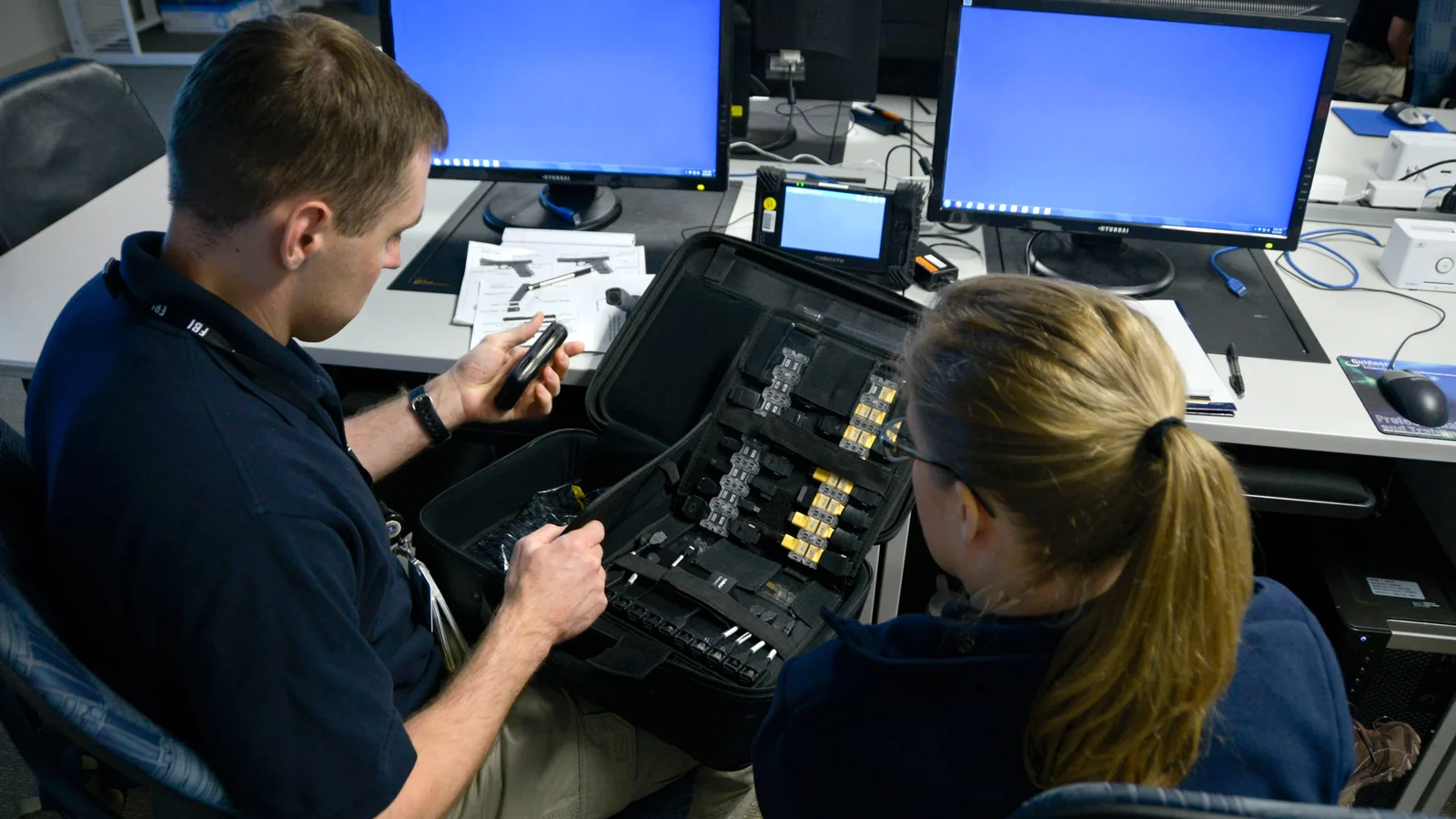
The underlying monthly workforce series is available in the downloadable data file. The hero photograph shows special-agent and intelligence-analyst trainees working together during the FBI Academy's Basic Field Training Course. It is an official FBI image from the bureau's public website.
Continue reading
More from FederalHiringData

Data investigationsAugust 23, 2026
ICE Received 150,000 Applications. Its Workforce Grew by About 9,600 at the Peak.
OPM recorded 10,030 new-hire actions during ICE's surge, but tentative offers were not final hires and covered employment had receded by June.
Data investigationsAugust 25, 2026
The Nuclear Regulatory Commission Recorded 215 Engineering Separations in 2025. It Recorded 17 Accessions.
NRC's two largest engineering series recorded 215 separations and 17 accessions in 2025 as advanced-reactor applications and engagements expanded.

Data investigationsAugust 23, 2026
The Secret Service Added 451 Employees. GAO Still Wants Proof Its Agents Can Train Enough.
Secret Service headcount grew 5.6% after June 2024, but the current protective-training rate and revised staffing requirement remain undisclosed.
Federal Hiring Data Weekly
Get the biggest federal workforce changes in your inbox.
Subscribe to Federal Hiring Data Weekly for federal hiring trends, salary data, agency movements, and original investigations, with email confirmation before delivery.