August 23, 2026
ICE Got 150,000 Applications. Its Workforce Grew by About 9,600 at the Peak.
OPM recorded 10,030 new-hire actions during ICE's surge, but tentative offers were not final hires and covered employment had receded by June.
By Evan Mercer
Published August 23, 2026Last edited August 23, 2026

In September 2025, the Department of Homeland Security put two enormous numbers behind its push to expand Immigration and Customs Enforcement: more than 150,000 applications for law-enforcement jobs and more than 18,000 tentative offers.
Neither number answered the harder question. A tentative offer is not a final offer, an academy graduation or an employee on the payroll.
The closest public measure of what actually reached the federal workforce comes from the Office of Personnel Management. ICE had 20,848 covered federal employees in August 2025. Five months later, in January 2026, it had 30,461. That was a net increase of 9,613 employees, or 46.1%, in one of the fastest agency expansions visible in the monthly data.
OPM's personnel-action files provide another view. From September through January, ICE recorded 10,030 new-hire actions and 43 transfers in. Those figures show that the recruiting campaign produced far more than applications and press-release offers. They still do not reveal a person-level conversion rate: OPM's new hires cannot be matched to the applicants or tentative offers DHS announced.
The expansion also did not hold at its peak. By June, covered employment had declined to 29,065, down 1,396 from January. ICE remained 8,217 employees larger than it had been in August, but separations exceeded accessions in every reported month from February through June.
That is the central finding of FederalHiringData's review of OPM workforce records, ICE operational data, USAJOBS announcements, USAspending contracts and enacted funding: ICE built a much larger federal workforce unusually quickly. The public record does not support saying that 18,000 tentative offers became 18,000 hires, and it shows that the first surge was already receding while detention, removal, legal and contracting demands remained elevated.
The best public answer is about 9,600 at the peak
DHS's September 16 announcement said ICE had received more than 150,000 law-enforcement applications and extended more than 18,000 tentative offers. It did not publish final offers, entry-on-duty dates, academy starts, academy completions or attrition.
OPM's monthly data fill part of that gap. They count covered federal employees actually reported within ICE, not people who clicked Apply or cleared an early selection stage.
| Workforce measure | Count | Period |
|---|---|---|
| Covered ICE employees before the surge | 20,848 | August 2025 |
| Covered ICE employees at the peak | 30,461 | January 2026 |
| Net increase to peak | 9,613 | August 2025-January 2026 |
| OPM new-hire actions | 10,030 | September 2025-January 2026 |
| Transfers in | 43 | September 2025-January 2026 |
| Covered ICE employees, latest month | 29,065 | June 2026 |
The 10,030 new-hire actions included 8,960 competitive-service appointments, 1,065 excepted-service appointments and five Senior Executive Service appointments. They were not all law-enforcement officers. ICE also hired attorneys, nurses, analysts, human-resources specialists, contracting staff and other mission-support employees.
The 9,613 net increase is smaller than gross hiring because employees were also leaving. It is the clearest answer to how much larger ICE's onboard federal workforce became during the initial push. It should not be treated as an exact count of September applicants who ultimately reported for duty: some hires may have applied earlier, and the datasets have no shared applicant identifier.
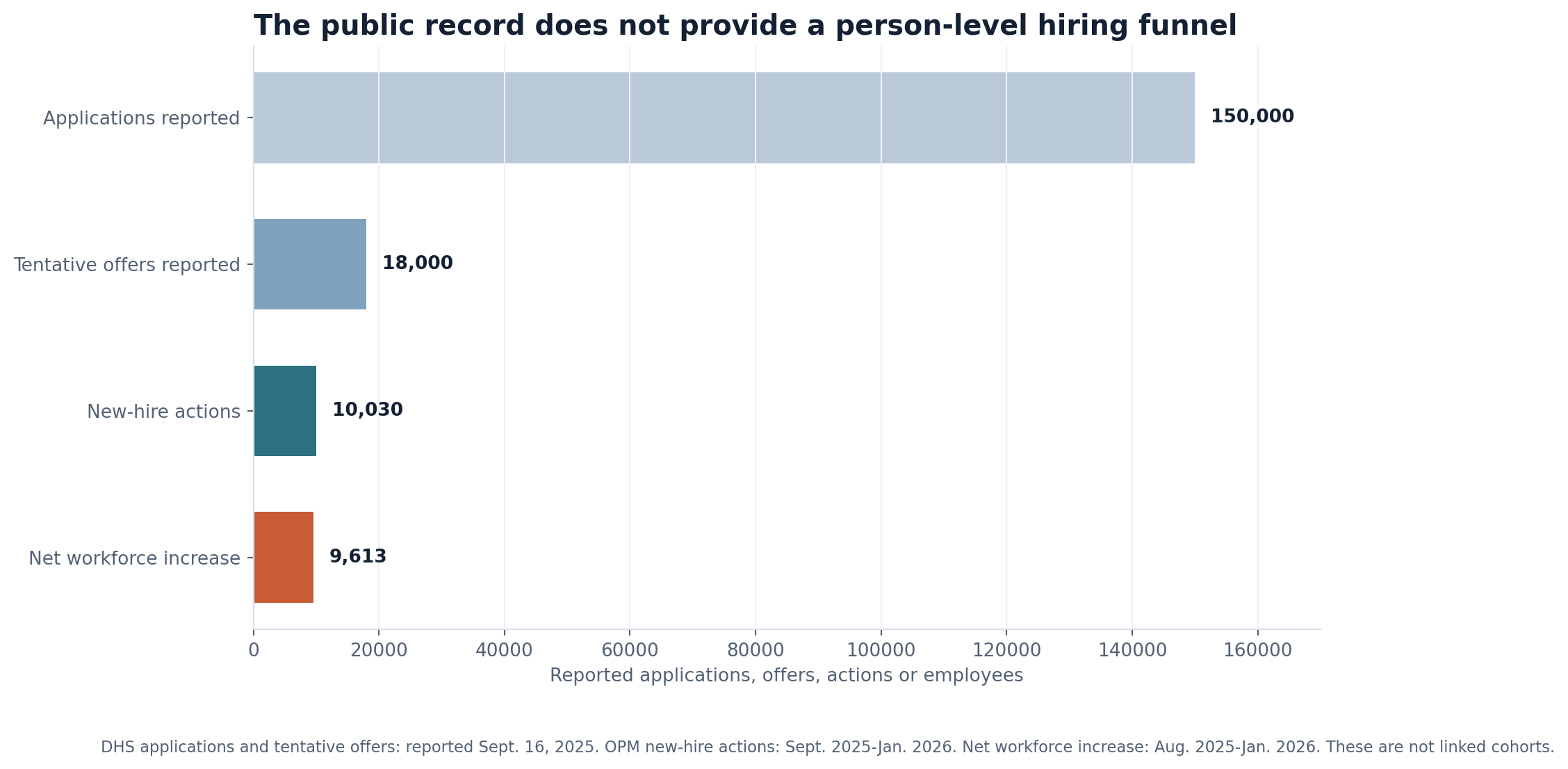
The distinction matters because ICE's own hiring guide describes multiple gates. Requirements vary by job, but law-enforcement applicants can face structured assessments, medical and drug testing, fitness requirements, background investigation and academy training. A tentative selection can still end before a final offer or entry on duty.
Current USAJOBS notices make the same sequence explicit. Applicants may receive a tentative offer, then must satisfy pre-employment conditions before a final offer. The process is not a single administrative handoff.
A two-decade plateau, then a near-vertical rise
ICE's workforce had grown before 2025, but not like this. FederalHiringData combined OPM's legacy FedScope series with monthly Federal Workforce Data to build a consistent annual record from 2004 through June 2026.
ICE had 16,141 covered employees in September 2004. It reached 20,057 in 2009, then spent most of the next 15 years between roughly 19,000 and 21,000. September 2024 stood at 20,606. September 2025, after the surge began, was 22,799. By June 2026 the workforce was 29,065.
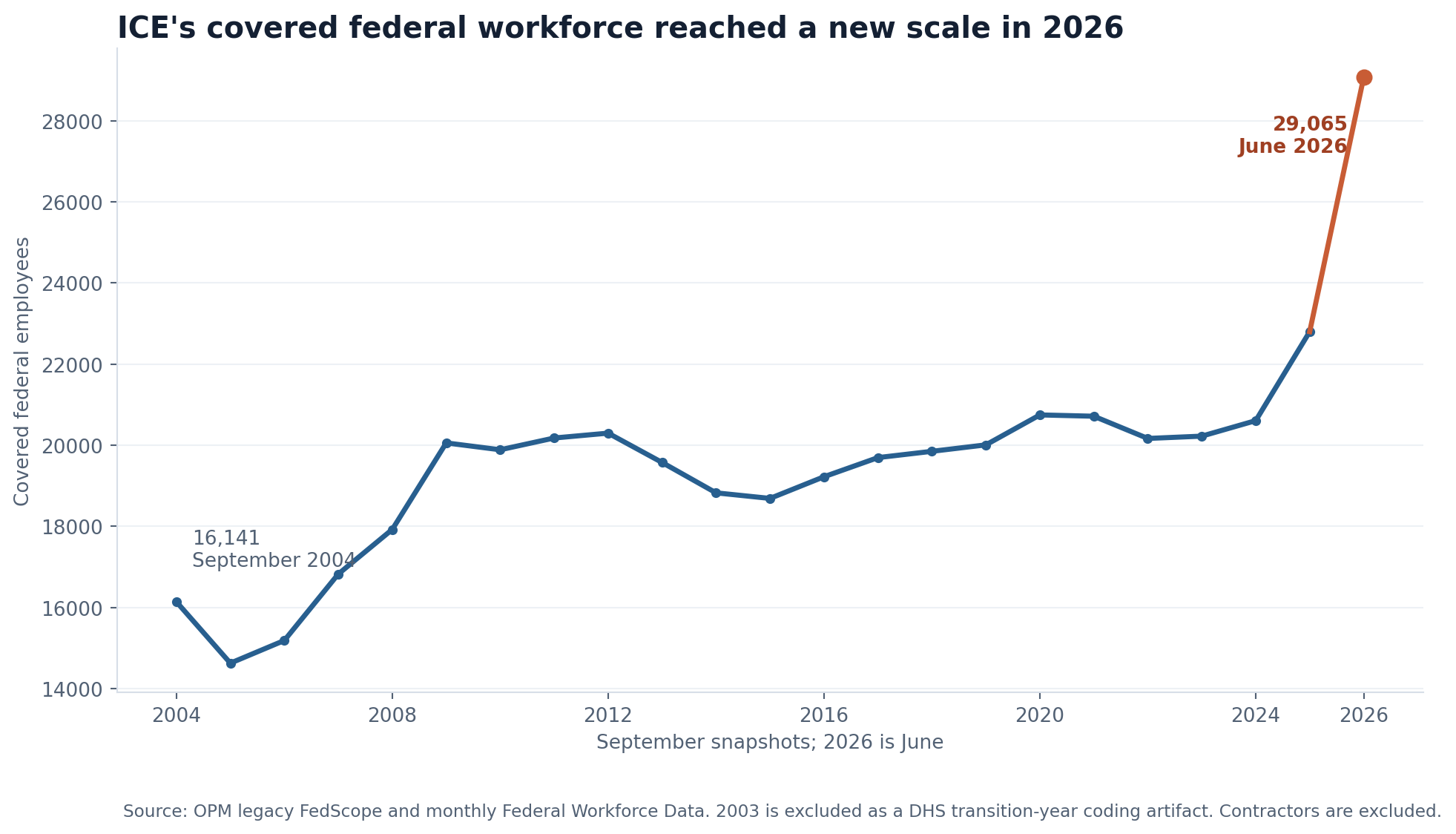
The 2003 OPM record is not shown. ICE was created in March of that year, and the legacy file assigns 39,808 employees to its subelement code that September, more than twice the 2004 count. That discontinuity reflects the department's transition and coding, not a defensible ICE workforce baseline.
Monthly records show how compressed the expansion was. Headcount moved from 20,848 in August 2025 to 22,799 in September, 24,593 in October, 26,827 in November, 28,272 in December and 30,461 in January.
Personnel actions rose even faster. ICE recorded 2,808 accessions in September, 1,588 in October, 1,741 in November, 3,228 in December and 708 in January. It recorded 1,623 separations over those same five months.
After January, the direction reversed. Accessions fell to 229 in February, 170 in March, 119 in April, 164 in May and 81 in June. Separations were 469, 447, 310, 346 and 223, respectively.
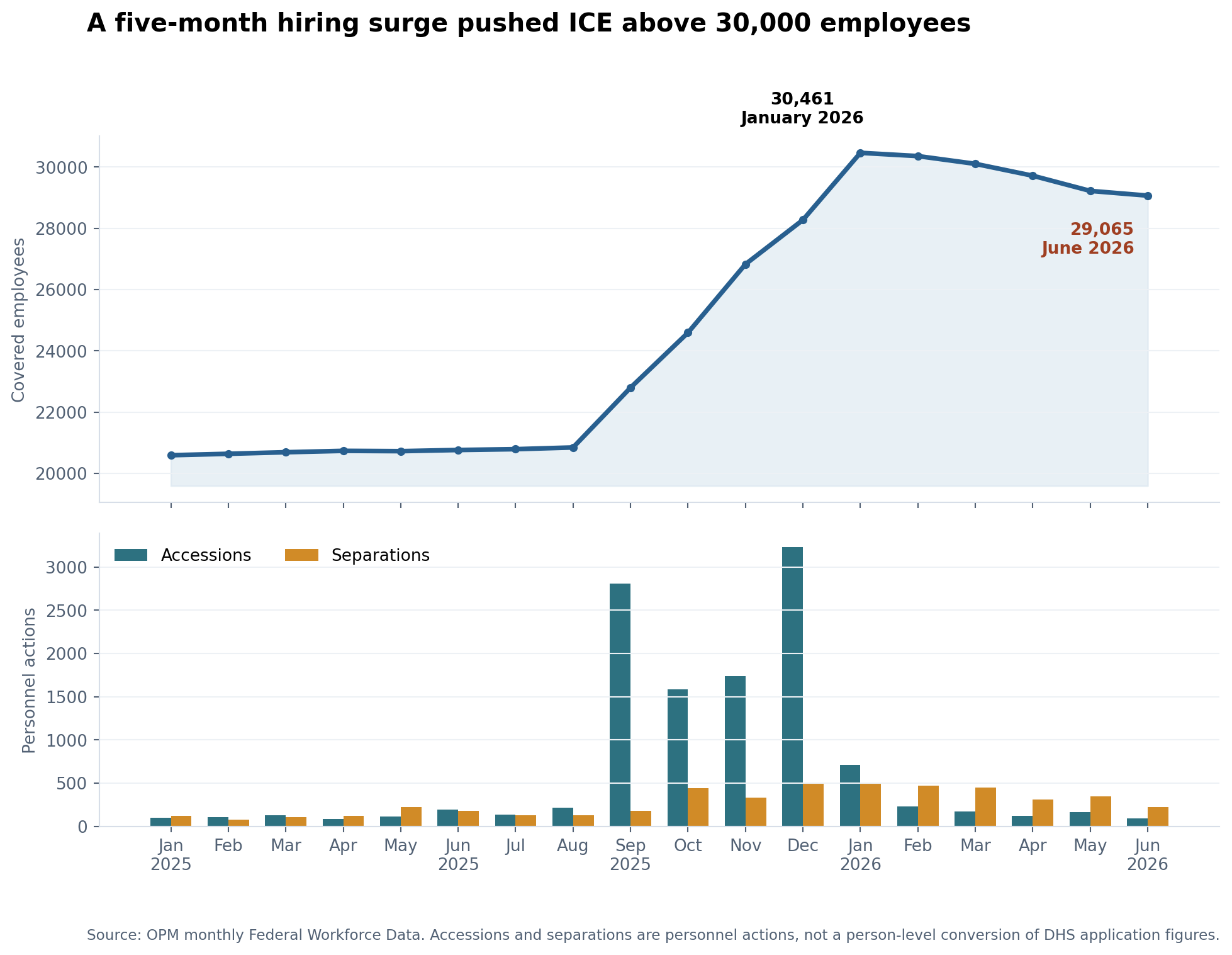
The files establish the net change and the categories of personnel actions. They do not explain every departure or prove why the pace slowed. From September through June, OPM recorded 2,058 quits, 681 voluntary retirements, 627 expired appointments or other terminations, 203 transfers out and 173 other retirement or separation actions. An action count is not an employee interview, and the public data do not say whether a particular hire completed training or remained in the same role.
The expansion landed in enforcement, investigations and law
ICE is not one interchangeable corps of officers. Enforcement and Removal Operations carries out civil immigration enforcement, detention and removals. Homeland Security Investigations conducts criminal investigations under hundreds of federal statutes. The Office of the Principal Legal Advisor represents DHS in removal proceedings and advises the agency. Management and Administration and the ICE Health Service Corps support finance, technology, acquisition, facilities, human capital and detention health care.
ICE's fiscal 2024 annual report provides the last detailed pre-surge component snapshot. ERO had 7,696 personnel, including 6,050 law-enforcement personnel. HSI had approximately 8,800 employees, including 6,950 special agents. OPLA had more than 1,700 attorneys and 260 support personnel. ICE described its total workforce as more than 20,000.
OPM does not publish those component rosters each month. Occupational series offer a careful proxy for where the 2025-26 growth went.
| OPM occupation series | January 2025 | January 2026 | June 2026 | Jan. 2025-Jan. 2026 change |
|---|---|---|---|---|
| 1801, inspection and enforcement | 6,838 | 13,108 | 11,873 | +6,270 |
| 1811, criminal investigation | 6,076 | 8,635 | 8,543 | +2,559 |
| 0905, attorneys | 1,777 | 2,772 | 2,635 | +995 |
| 0301, administration and program | 1,163 | 1,129 | 1,145 | -34 |
| 0343, management analysis | 1,031 | 985 | 971 | -46 |
| 1805, investigative analysis | 770 | 835 | 825 | +65 |
| 1802, compliance support | 644 | 578 | 684 | -66 |
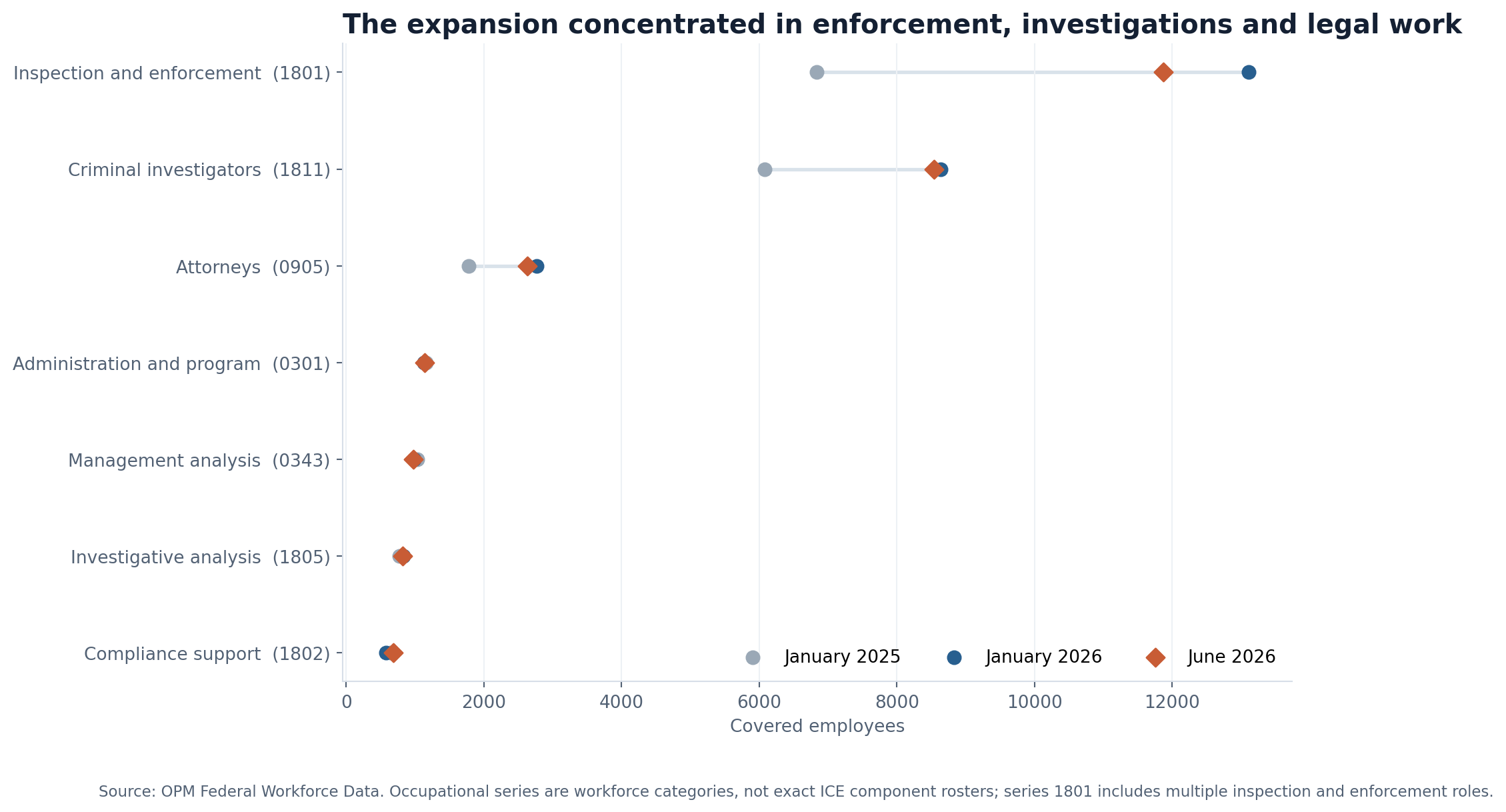
Series 1801 nearly doubled in one year, accounting for most of the increase. It includes general inspection, investigation, enforcement and compliance work. At ICE, that makes it the best public monthly proxy for deportation and related civil-enforcement staffing, but it is broader than the title "deportation officer." Series 1811 is the government's criminal-investigator classification and is closely associated with HSI, but it is not a perfect component roster. The attorney series similarly approximates OPLA's legal workforce without proving that every 0905 employee sat in that office.
The June data also show where the post-peak decline concentrated. Series 1801 fell by 1,235 from January to June. Criminal investigators declined by 92 and attorneys by 137. That does not establish whether the employees resigned, transferred, retired, moved between classifications or left after temporary appointments. It does show that the initial peak was not simply maintained across the largest growth occupations.
Operational capacity expanded on more than one payroll
ICE's workload was also moving. In fiscal 2024, ERO reported 271,484 removals, an average detained population of about 37,700 and a non-detained docket above 7.6 million. OPLA said it participated in more than 1.8 million removal hearings and supported the completion of more than 582,860 immigration-court cases.
The latest ICE detention workbook, released July 20, reports much larger fiscal 2026 operating counts through July 11. Average daily detained population was 64,508 for the fiscal year to date. ICE reported 65,765 people detained on July 11, 353,948 initial book-ins and 356,389 removals.
Federal Hiring Data Weekly
Get the biggest federal workforce changes in your inbox.
Subscribe to Federal Hiring Data Weekly for federal hiring trends, salary data, agency movements, and original investigations, with email confirmation before delivery.
Those are not full-year comparisons to fiscal 2024, and they do not measure officer productivity. They establish the scale and exact period of the system the enlarged workforce was supporting.
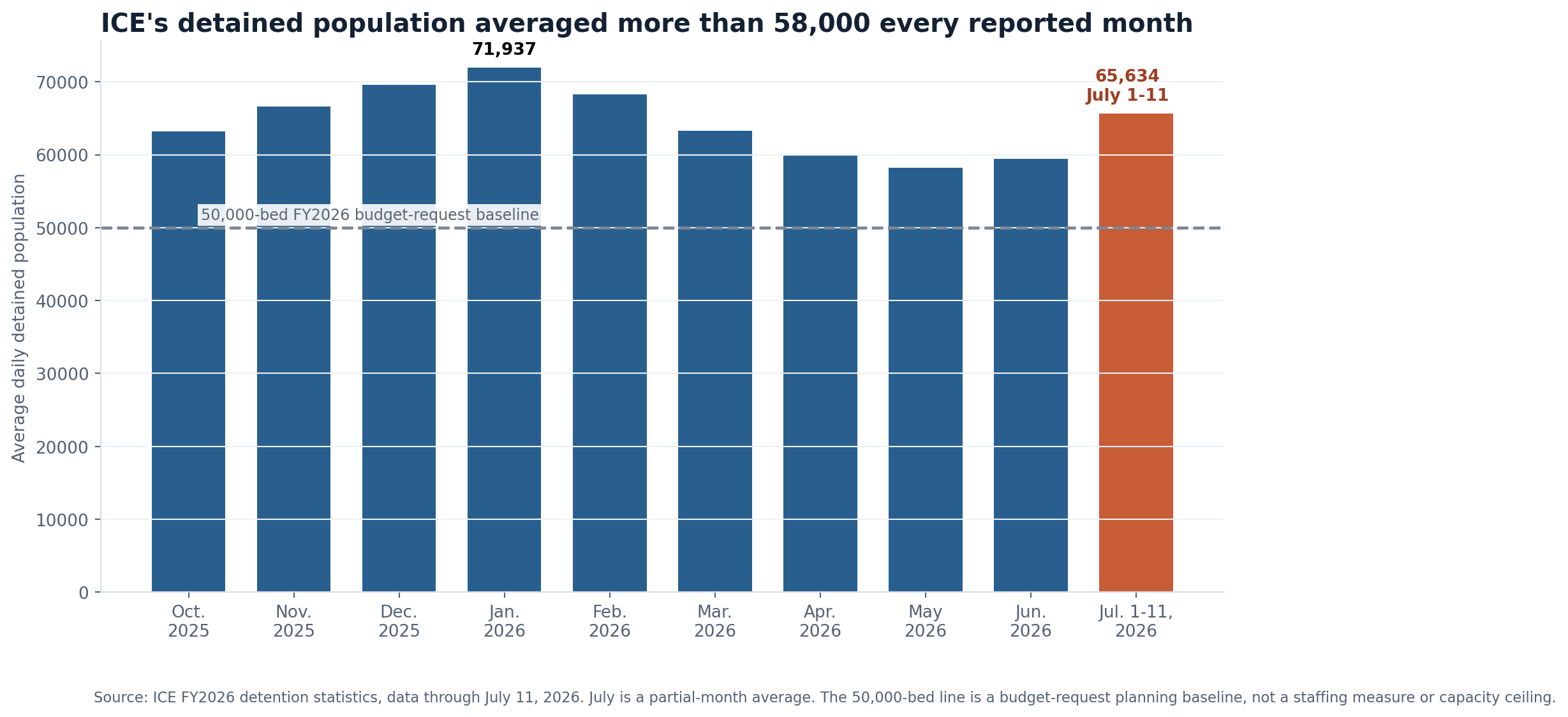
ICE's fiscal 2026 budget request had proposed $501 million to sustain 50,000 detention beds and $205 million more for transportation and removal operations. The operational series later ran above that planning baseline every reported month, peaking at an average 71,937 in January. July's 65,634 is a partial-month average through July 11, not a full July measure.
Congress subsequently provided a much larger multiyear pool. Public Law 119-21, enacted July 4, 2025, appropriated $29.85 billion to ICE through September 2029 for a broad list of purposes: hiring and training, signing and retention bonuses, recruiting and onboarding, detention and removal operations, facilities, transportation, information technology, vehicles, OPLA and 287(g), among others.
It would be wrong to call the whole $29.85 billion a hiring appropriation. It funds a much wider operating system.
One part of that system sits with state and local agencies. DHS reported on September 2, 2025 that ICE's 287(g) partnerships had expanded from 135 agreements to 958 in 40 states, with 8,501 trained task-force officers and more than 2,000 additional officers in training. DHS also announced reimbursement opportunities beginning October 1.
Those officers are not ICE federal employees. They operate under agreements between ICE and participating state or local agencies. Adding them to OPM headcount would inflate the federal workforce and erase a crucial distinction between direct federal hiring and delegated or partnered enforcement capacity.
Contracts grew faster than federal headcount
Contractors form another separate layer. ICE uses contracts for guard services, detention operations, air transportation, medical care, information technology, call centers, facilities and professional support. USAspending captures money obligated on awards; it does not count contractor employees.
FederalHiringData queried transaction-level contract obligations where ICE was the awarding subagency. Obligations rose from $2.53 billion in fiscal 2021 to $3.99 billion in fiscal 2025. Fiscal 2026 reached $6.77 billion through August 23, already 70% above the previous full-year total.
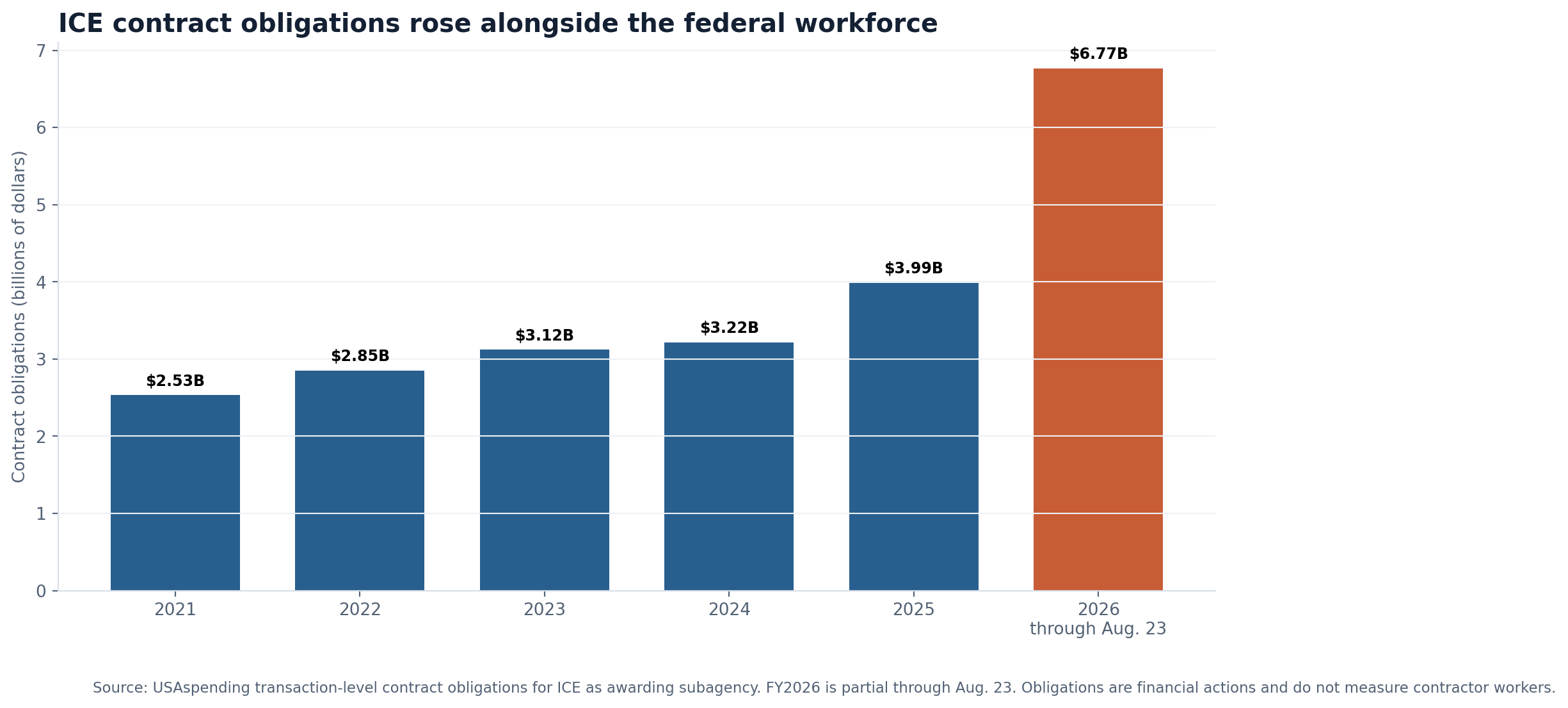
The fiscal 2025 service categories show where large pieces went. USAspending recorded $1.65 billion under guard services, $676.8 million under air-passenger transportation, $305.5 million under program management and support, $189.6 million under application-development support and $101.0 million under managed health care.
| Selected FY2025 contract category | ICE obligations |
|---|---|
| Guard services | $1.65 billion |
| Air-passenger transportation | $676.8 million |
| Program management and support | $305.5 million |
| Application-development support | $189.6 million |
| Managed health care | $101.0 million |
These categories do not map neatly to ICE components, and a dollar obligated is not necessarily a dollar spent in the same period. Modifications and deobligations can change award totals. Most important, no defensible public conversion turns $6.77 billion into a contractor headcount.
The contract record nevertheless changes how the workforce story should be read. The federal payroll expanded by thousands, but ICE's operational capacity was not built with federal employees alone. Transportation, detention security, health care and IT also expanded through purchased services, while 287(g) added state and local personnel under federal agreements.
Recruiting volume alone does not explain the surge
The FederalHiringData historical USAJOBS archive contains 7,304 distinct ICE announcements opened from March 1, 2017 through August 14, 2026. It recorded 1,012 in 2018, 1,019 in 2019, 872 in 2022, 583 in 2024, 440 in 2025 and 296 in 2026 through August 14.
That pattern looks counterintuitive beside the headcount surge. The reason is that an announcement is not a vacancy or a hire. A nationwide or open-continuous notice can support many selections across many duty stations. One announcement can also close without a selection.
Related research
Put this finding in context

Data investigationsAugust 20, 2026
634 Applications, Eight Completed Rotations: Why the Federal Cyber Exchange Stalled
Employees showed interest in the federal cyber rotation program. Home-agency approval, unreimbursed staffing costs and senior qualification demands narrowed the path.

Data investigationsAugust 22, 2026
IHS Launched Its Largest Hiring Push. Its Covered Workforce Fell 458 by June.
IHS launched against severe provider vacancies, but covered employment fell 458 from January through June and the campaign still lacks a public numeric target.
The archive shows a change in recruiting form. Median ICE announcement duration was 14 days in 2025 and 12 days in partial 2026, but 79 announcements opened in 2025 and 23 in partial 2026 stayed open at least 90 days. Current deportation-officer notices have advertised many vacancies, multiple locations or a location to be determined after selection.
Among 2025-26 announcements, inspection and enforcement series 1801 was the most frequent occupation, followed by nurses, attorneys, program management, administration and physician assistants. The archive also contains medical and support hiring for the ICE Health Service Corps and other offices. That is another reason the campaign cannot be reduced to a count of badge-carrying officers.
DHS advertised unusually strong incentives. Its archived careers expo page says new ICE recruits may be eligible for a signing bonus of up to $50,000, paid over five years. Public Law 119-21 authorized discretionary signing bonuses for qualifying agents, officers and attorneys hired after enactment with a five-year service commitment.
The qualifiers are essential. The sources do not say that every recruit received $50,000, how many bonuses were approved or the average amount actually paid.
Training is another unresolved part of the pipeline. The Federal Law Enforcement Training Centers' Criminal Investigator Training Program, used across agencies, lasts 59 training days. ICE ERO also has an agency-specific Basic Immigration and Enforcement Training Program. FLETC says sponsoring agencies select trainees and set recruitment standards before sending them to training.
Public Law 119-21 supplied $750 million to FLETC, including at least $285 million for training new DHS and state/local law-enforcement personnel. But neither ICE nor FLETC publishes a complete 2025-26 ledger of ICE-specific seats requested, classes begun, graduates, failures or wait times. Training is a required stage and a plausible capacity constraint; the available evidence cannot quantify how many tentative offers stopped there.
What the 150,000 figure can and cannot tell us
The recruitment release was a measure of interest. The 18,000 figure was a measure of tentative selection. OPM's data are the first public evidence of people reaching covered employment.
At the January peak, the federal workforce was about 9,600 larger than it had been before the surge. OPM recorded just over 10,000 new-hire actions during the five expansion months. Those two independent measures are close enough to show that the campaign produced a real, extraordinary hiring outcome.
They are not close enough to manufacture a conversion rate. The application figure was "more than" 150,000. The tentative-offer figure was "more than" 18,000. The populations and dates do not align precisely with OPM. New-hire actions cover all occupations and can include applicants recruited before the announcement. Net headcount reflects both hiring and departures.
The same caution applies to whether staffing kept pace. Detention and removal counts rose sharply, but they are not units of equal work and cannot be divided by total employees to create a productivity score. HSI's criminal-investigation mission is different from ERO's civil-enforcement mission. OPLA's litigation work moves with the immigration-court docket. Contractors and 287(g) officers add capacity outside federal headcount.
What the data establish is narrower and more useful. ICE did not merely collect applications. It added thousands of employees, with the largest gains in inspection and enforcement, criminal investigation and legal work. It also expanded contracts and state/local partnerships. By June, however, covered employment was below its January high even as detention remained above the earlier 50,000-bed planning baseline.
That makes the next question measurable: whether ICE stabilizes the 2026 workforce, how many of the new employees remain, and whether the agency begins publishing final-offer, entry-on-duty and academy-completion counts rather than stopping at tentative offers.
Readers can search current ICE announcements, explore federal workforce statistics, compare agency hiring records and read more FederalHiringData investigations.
Methodology and limitations
Federal workforce: FederalHiringData queried OPM legacy FedScope and monthly Federal Workforce Data for agency subelement HSBB. The long series uses September observations from 2004 through 2025 and June 2026 as the latest endpoint. The 2003 observation is excluded as a DHS transition-year coding artifact. OPM headcount covers federal employees, excludes contractors and is not budget FTE.
Personnel actions and occupations: Accessions and separations are OPM actions, not a linked cohort of DHS applicants. Monthly headcount does not reconcile perfectly to actions because transfers, effective dates, corrections and coverage differ. Occupational series are broad classifications, not exact ICE component rosters. Series 1801 is not synonymous with deportation officers, series 1811 is not a complete HSI roster and series 0905 is not a complete OPLA roster.
Applications and hiring stages: Application and tentative-offer counts come from DHS's September 16, 2025 announcement. Hiring requirements come from official ICE guidance and USAJOBS notices. ICE and FLETC did not publish a complete person-level conversion, academy-throughput or attrition series reviewed for this article.
Operations: FY2024 measures come from ICE's annual report. FY2026 detention, book-in and removal data come from the July 20 workbook and run through July 11. Partial fiscal 2026 figures are not presented as full-year comparisons. Operational counts do not measure employee productivity or staffing adequacy.
Recruiting archive: FederalHiringData counted distinct ICE USAJOBS controls with agency code HSBB or the exact ICE agency name. Coverage begins March 1, 2017 and runs through August 14, 2026. Announcements are not applications, vacancies filled or hires; one announcement can span many positions and locations.
Contracts and partnerships: USAspending values are transaction-level contract obligations for ICE as the awarding subagency. Fiscal 2026 is partial through August 23. Obligations are financial actions, not contractor workers. The 287(g) count is DHS's dated September 2, 2025 figure; state/local officers are not included in federal ICE headcount.
The hero photograph shows Matthew Elliston, ICE acting director of Law Enforcement Systems and Analysis, speaking during the 2025 ICE Hiring Expo in Dallas on August 26, 2025. It is a public-domain photograph from U.S. Immigration and Customs Enforcement.
Continue reading
More from FederalHiringData
Data investigationsAugust 18, 2026
FEMA's Public Workforce Count Fell 22% as GAO Warned of Readiness Risks
FEMA had 5,793 fewer covered civilian employees in June 2026 than in January 2025. GAO says the agency cut staff without the workforce planning needed to assess mission capacity.

Data investigationsAugust 18, 2026
IRS Workforce Fell 29% as GAO Warned of Filing-Season Risks
The IRS had 29,663 fewer covered civilian employees in June 2026 than in January 2025. GAO says workforce-planning gaps and post-filing pressures pose risks to future operations.
Data investigationsAugust 23, 2026
USCIS Had 12.1 Million Cases Pending. Its Formal Backlog Was 7 Million.
Receipts exceeded completions by 929,000 in the first half of fiscal 2026 as covered employment remained 11% below its January 2025 peak.
Federal Hiring Data Weekly
Get the biggest federal workforce changes in your inbox.
Subscribe to Federal Hiring Data Weekly for federal hiring trends, salary data, agency movements, and original investigations, with email confirmation before delivery.