August 23, 2026
The Secret Service Added 451 Employees. GAO Still Wants Proof Its Agents Can Train Enough.
Secret Service headcount grew 5.6% after June 2024, but the current protective-training rate and revised staffing requirement remain undisclosed.
By Evan Mercer
Published August 23, 2026Last edited August 23, 2026
The U.S. Secret Service is larger than it was when a gunman opened fire at a presidential campaign rally in Butler, Pennsylvania, in July 2024.
Federal workforce data shows 8,465 Secret Service employees in June 2026, up 451 from June 2024. The criminal-investigator workforce grew even faster: series 1811 increased by 412 employees, or 10.9%, over those two years. Police-series employment, the closest public occupation proxy for the Uniformed Division, rose by 50.
Those additions are consequential. They are also not the same as proof that the agency has enough people in the right assignments, or enough protected time and facilities, to meet its own training plans.
That distinction remains unresolved in the public record. The Government Accountability Office has tracked Secret Service protective training since 2019. As of June 2026, GAO still classified its core staffing-and-training recommendation as open and partially addressed. The agency had revised its staffing requirements after the 2024 assassination attempt and a new federal law, but GAO said it had not yet received the evidence needed to determine whether the revised approach lets agents meet the training target.
The fairest reading is neither that the Secret Service failed to respond nor that its capacity problem is solved. The workforce expanded. The fiscal 2026 budget sought hundreds of additional positions and more support for recruit classes and training facilities. But the most important public outcome measure - how much time protective-detail agents now spend training - remains unavailable.
The workforce grew, especially among investigators
Secret Service employment has moved through several cycles. Office of Personnel Management data shows 5,546 employees in September 2000. The agency reached more than 7,000 by 2011, fell to 6,338 in September 2014 and then resumed a sustained expansion. By September 2025, it had 8,269 employees. The latest public workforce observation in the FederalHiringData research warehouse, June 2026, puts the total at 8,465.

The two-year change around the 2024 attack is more revealing than the long arc alone.
| OPM workforce measure | June 2024 | June 2026 | Change |
|---|---|---|---|
| All Secret Service employees | 8,014 | 8,465 | +451 (+5.6%) |
| Criminal investigators, series 1811 | 3,782 | 4,194 | +412 (+10.9%) |
| Police officers, series 0083 | 1,565 | 1,615 | +50 (+3.2%) |
The investigator increase accounts for most of the agency-wide gain, but these lines should not be mistaken for an organization chart. OPM occupation series identify the kind of work employees perform. They do not disclose whether a particular investigator served on a permanent protective detail, in a field office, in protective intelligence, at headquarters or in another assignment. Series 0083 is similarly useful for tracking police employment, but it is not a published Uniformed Division roster.

The chart therefore shows added occupational capacity, not the staffing level of a specific protectee's detail. That is an important boundary in a mission where the public should not expect operational deployment data.
Hiring accelerated, but the pipeline also had heavy turnover
OPM personnel-action data adds another dimension. The Secret Service recorded 1,043 accessions and 688 separations during calendar 2024. In 2025, it recorded 1,093 accessions and 942 separations. From January through June 2026, it recorded 661 accessions and 342 separations.
| Period | Accessions | Separations | Net actions |
|---|---|---|---|
| Calendar 2024 | 1,043 | 688 | +355 |
| Calendar 2025 | 1,093 | 942 | +151 |
| January-June 2026 | 661 | 342 | +319 |
Personnel actions are events, not a guaranteed count of unique workers. They can include different appointment and separation categories, and the simple difference does not always equal the change between two headcount snapshots. Still, the flows show an organization hiring at substantial scale while replacing a large number of departing employees.
The recruiting signal on USAJOBS is narrower. The FederalHiringData historical USAJOBS archive contains 600 Secret Service announcements opened in 2024, 342 in 2025 and 165 from Jan. 1 through Aug. 14, 2026. The partial 2026 total includes 16 announcements in series 1811 and 12 in series 0083.
Those counts are not a hiring funnel. One announcement can cover several vacancies or locations, and a closed announcement does not prove that anyone applied, was selected, entered training or joined the onboard workforce. They do show that public recruiting continued while OPM recorded workforce growth. Readers can separately browse current Secret Service openings and active criminal-investigator jobs; the historical records analyzed here should not be assumed to remain open.
The training measure is the harder test
GAO's recommendation began with a blunt finding: agents on the two principal protective details were spending far less time training than the agency planned.
In fiscal 2014, Presidential Protective Division agents spent 3.3% of their regular work hours training, while Vice Presidential Protective Division agents spent 1.9%. By fiscal 2018, the shares had increased to 5.9% and 2.9%. They remained far below the original 25% target.
The Secret Service later changed the target. Its August 2021 human-capital plan called for approximately 12% of work hours to be available for training. The lower target reflected a new plan, not a retroactive benchmark for 2014 or 2018. It is shown below only to put the documented actuals in the context of the standard the agency later adopted.

GAO said results reported in May 2022, March 2023 and August 2024 were still far below 12%. The watchdog's concern was not simply that a percentage had been missed. Agents assigned to protection could be pulled away from training by operational demands, leaving the agency without a durable way to preserve readiness while meeting the daily mission.
The public record does not provide a current percentage. That absence matters. A growing workforce can create room for training, but headcount does not show whether supervisors actually schedule agents for it, whether operational demands interrupt it, whether facilities can absorb more classes or whether required courses are completed.
The same problem appears in GAO's separate review of Uniformed Division training data. The agency issued a policy in January 2025, but GAO said the policy did not yet explain how the Secret Service would collect and use completion data. That recommendation also remained open in the latest public update.
The staffing requirement moved after July 2024
Federal Hiring Data Weekly
Get the biggest federal workforce changes in your inbox.
Subscribe to Federal Hiring Data Weekly for federal hiring trends, salary data, agency movements, and original investigations, with email confirmation before delivery.
The Secret Service has revised staffing models before. A 2020 GAO review found that a new model raised the fiscal 2020 special-agent requirement from 3,708 under the old approach to 5,256. The revised model accounted for workload the earlier version missed, including the effect of agents reaching annual compensation limits.
An earlier workforce plan aimed for 9,595 Secret Service employees by fiscal 2025, including 4,807 special agents and 1,797 Uniformed Division officers. OPM's September 2025 agency headcount was 8,269. That gap is relevant context, but it is not an apples-to-apples verdict: the plan used Secret Service workforce categories and a future target, while OPM reports observed civilian headcount by public classifications.
Then the governing standard changed again. The Enhanced Presidential Security Act of 2024 requires the Secret Service to use the same standards when determining how many agents are needed to protect the President, Vice President and major presidential and vice-presidential candidates. It also required a comprehensive review. The law does not publish a minimum agent count.
In February 2025, the Secret Service told GAO that it was revising staffing requirements in response to the assassination attempt and the new law. In its July 2025 public progress report, the agency said it had implemented 21 of 46 congressional recommendations, with 16 in progress. Periodic protective-operations training, defined training curricula and timelines, and a review of staffing models were among the actions still in progress.
As of June 2026, GAO had not published the revised numerical requirement or evidence that it had been met. That makes older targets useful history, but not a substitute for the missing current benchmark.
The fiscal 2026 request paired hiring with training capacity
The Secret Service's fiscal 2026 congressional budget justification requested 8,826 positions and 8,607 full-time equivalents. Compared with the fiscal 2025 full-year continuing-resolution level, that was an increase of 444 positions and 304 FTE.
Three hiring proposals were especially relevant to the capacity question.
| Fiscal 2026 program change | Requested positions | Requested FTE | Requested funding |
|---|---|---|---|
| Special-agent hiring | 260 | 130 | $62.9 million |
| Uniformed Division hiring | 128 | 64 | $25.7 million |
| Technical law-enforcement hiring | 25 | 13 | $3.4 million |

Positions and FTE answer different budget questions. A position is an authorized staffing slot in the request. FTE measures the work-years expected during the fiscal year, so a newly hired employee who starts partway through the year contributes only part of an FTE. Neither measure proves that Congress funded the request, that recruiting succeeded, or that a recruit completed training and joined the workforce.
The budget also requested $18.2 million in added operational support for the James J. Rowley Training Center because the agency planned additional recruit classes, plus $12 million for facility renovations. A separate $6 million increase was requested for earned overtime on protective missions above the annual pay cap. Congress has extended the special protective-services overtime authority through 2028.
Those pay and training lines reveal a real constraint: adding positions can increase academy demand before it increases field capacity, while a high operational tempo can consume the time of experienced personnel and generate compensation beyond ordinary limits.
The request also included $24.6 million for broad World Cup and America250 support, largely for travel, overtime, equipment and related costs, with five positions and five FTE. That is evidence of a planned workload, not a basis for estimating security staffing at any event. This analysis does not infer protective gaps from public schedules or discuss deployment details.
Related research
Put this finding in context

Data investigationsAugust 23, 2026
ICE Got 150,000 Applications. Its Workforce Grew by About 9,600 at the Peak.
OPM recorded 10,030 new-hire actions during ICE's surge, but tentative offers were not final hires and covered employment had receded by June.
Data investigationsAugust 20, 2026
634 Applications, Eight Completed Rotations: Why the Federal Cyber Exchange Stalled
Employees showed interest in the federal cyber rotation program. Home-agency approval, unreimbursed staffing costs and senior qualification demands narrowed the path.
More people alone cannot close the recommendation
The independent panel that reviewed the July 2024 attack made the central caution explicit. Its October 2024 report described a culture of "doing more with less," inadequate commitment of time to training and training facilities that needed improvement. It called for training to become a top-tier priority and said operational schedules should not routinely pull agents away from it.
But the panel also said the failures it examined were not primarily a question of resource quantity. In its judgment, simply adding personnel and money would not resolve problems involving organization, leadership, accountability, risk assessment and training quality. It recommended more personnel alongside a more rational allocation of agents and broader changes in how the agency operates.
That is why the OPM increase is important but incomplete evidence. The agency had 412 more criminal investigators in June 2026 than two years earlier. Public data cannot show whether those employees were allocated where the revised model required, whether experienced agents could attend recurring training, or whether added recruit classes produced enough graduates to offset attrition and new demands.
The Secret Service's 2025 strategic plan makes human capital and training central pillars. It commits to recruitment, retention and continuous career development. It does not publish the protective-detail training rate that would let an outside reader test the result.
What would demonstrate that capacity caught up
The available evidence supports a measurable interim conclusion. The Secret Service added employees after July 2024, and the growth was concentrated in the criminal-investigator series. It asked for more special agents, Uniformed Division officers, training support, facilities work and overtime funding. Its own public tracker records substantial implementation activity.
What remains unknown is the answer to the agency's harder readiness test.
A complete public accounting would identify the revised staffing requirement without disclosing operational assignments; report the share of regular work hours spent in required protective training; show completion rates for special-agent and Uniformed Division courses; reconcile academy entrants and graduates with attrition; and explain whether training is still routinely displaced by mission demands.
Until those measures are available, the public can verify growth but not sufficiency. The Secret Service is larger. GAO's open recommendation shows why size alone is not yet the same as demonstrated training capacity.
Methodology and limitations
FederalHiringData analyzed OPM FedScope September employment files for 2000-2014 and OPM Federal Workforce Data for 2015 through June 2026. The continuous historical chart uses September observations through 2025 and labels June 2026 separately. Agency codes account for the Secret Service's move from Treasury to Homeland Security.
Occupation comparisons use OPM series 1811 and 0083. They are public workforce proxies, not internal rosters for protective details or the Uniformed Division. Personnel actions count events rather than verified unique workers. Calendar 2026 action data covers January through June.
The training history and recommendation status come from GAO-19-415. Fiscal 2014 and 2018 are the documented actuals. The approximately 12% target was adopted in 2021 and is shown as later context, not a retroactive standard. The current training share and revised post-2024 staffing requirement are not public in the cited record.
Budget figures are requests, not enacted spending or proof of filled positions. The USAJOBS analysis covers announcements opened through Aug. 14, 2026. The FederalHiringData historical USAJOBS archive begins approximately March 2017. Announcements do not equal vacancies, applications, selections, academy graduates or hires.
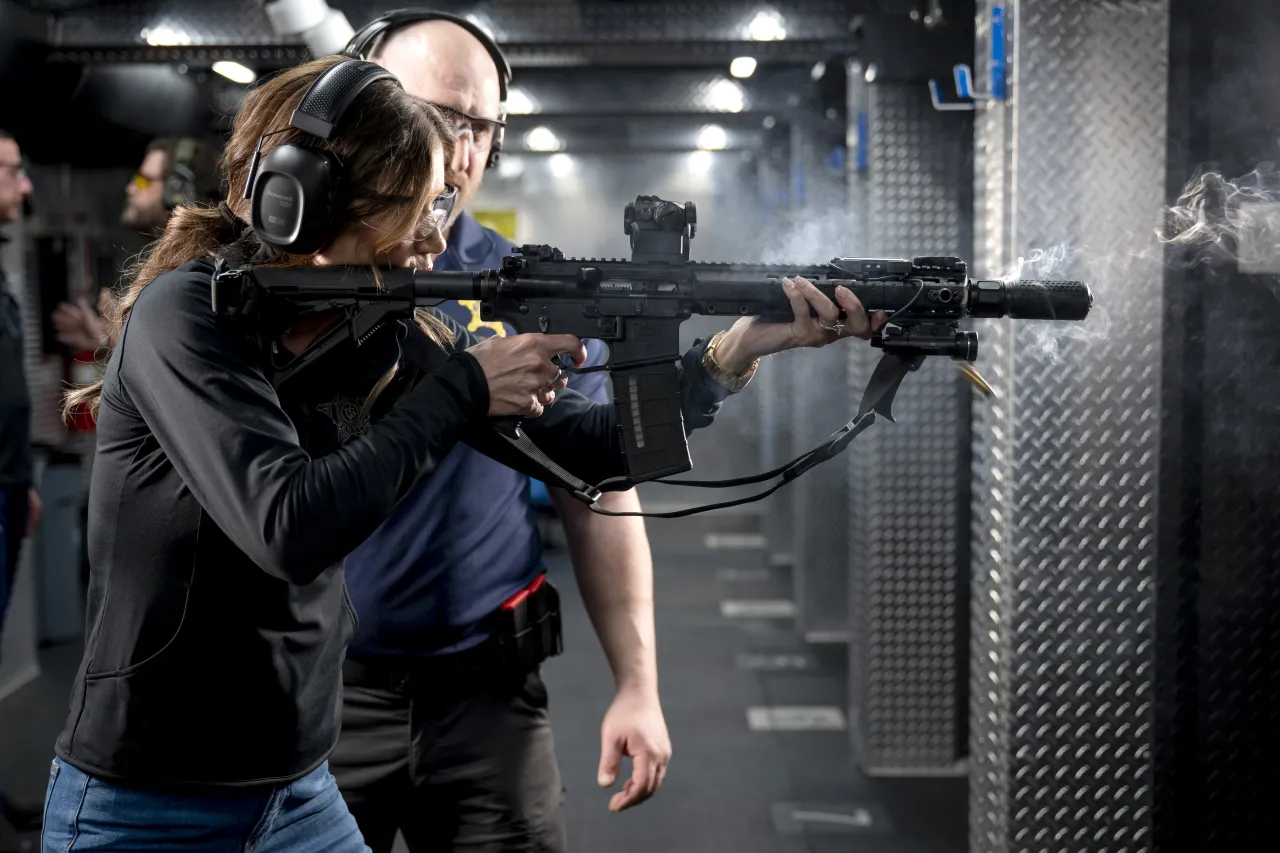
The hero image documents a March 19, 2025 live-fire demonstration at the Rowley Training Center. It was released through the DHS media library and photographed by Tia Dufour. It illustrates the training environment; it is not evidence of training frequency or outcomes.
For broader context, explore federal workforce statistics, the federal jobs archive and more FederalHiringData investigations.
Continue reading
More from FederalHiringData

Data investigationsAugust 23, 2026
NASA Cut Its Civil-Service Workforce 22%. Now It Wants Core Technical Work Back In-House.
NASA lost more than 4,000 civil servants before directing its centers to restore in-house engineering, operations and science capability.
Data investigationsAugust 23, 2026
The Forest Service Set a 4-Billion-Board-Foot Timber Goal. Key Staff Fell 22%.
Timber sales rose 29% through June, but nine occupations needed to plan, contract and oversee forest projects had 1,445 fewer employees than in 2024.
Data investigationsAugust 18, 2026
FEMA's Public Workforce Count Fell 22% as GAO Warned of Readiness Risks
FEMA had 5,793 fewer covered civilian employees in June 2026 than in January 2025. GAO says the agency cut staff without the workforce planning needed to assess mission capacity.
Federal Hiring Data Weekly
Get the biggest federal workforce changes in your inbox.
Subscribe to Federal Hiring Data Weekly for federal hiring trends, salary data, agency movements, and original investigations, with email confirmation before delivery.