August 23, 2026
The Forest Service Set a 4-Billion-Board-Foot Timber Goal. Key Staff Fell 22%.
Timber sales rose 29% through June, but nine occupations needed to plan, contract and oversee forest projects had 1,445 fewer employees than in 2024.
By Evan Mercer
Published August 23, 2026Last edited August 23, 2026
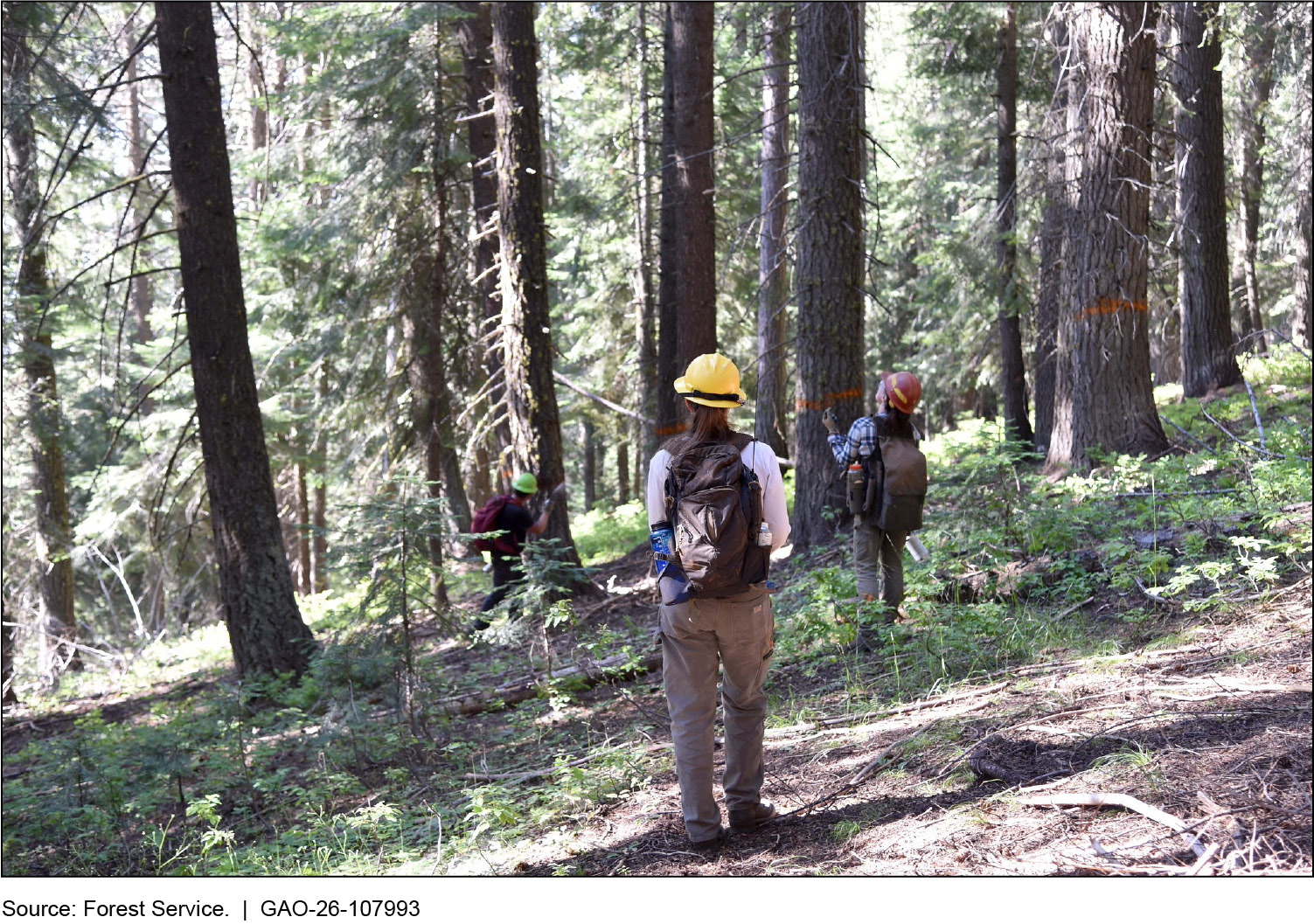
The Forest Service entered fiscal 2026 with a larger timber goal and a smaller workforce expected to deliver it.
The agency's May 2025 forest-management strategy set a goal of selling 4 billion board feet of timber. Through June 30, 2026, official reports show it had sold 2.10 billion. That was 29% more than during the same nine months of fiscal 2025.
At the same time, nine occupations involved in planning, reviewing, contracting, engineering and overseeing forest projects had 5,029 Forest Service employees in June 2026. They had 6,474 two years earlier. That is a decline of 1,445 employees, or 22.3%, in a deliberately narrow workforce measure assembled from Office of Personnel Management data.
The sales increase matters because it rules out a simple story in which fewer workers immediately produced less timber. The Forest Service moved more volume through the first three quarters than it did a year earlier. But the final quarter would have needed to deliver nearly 1.90 billion board feet to reach the strategy goal, 44% more than the agency sold in the final quarter of fiscal 2025.
The resulting question is not whether the agency did any work with fewer people. It plainly did. The question is whether a smaller federal workforce can repeatedly prepare, review and administer enough projects to sustain a higher level after existing contracts and ready-to-sell projects are used.
A larger goal after a smaller workforce
A March 2025 executive order on timber production directed agencies to increase domestic timber production and streamline approvals. The Forest Service followed in May with a National Active Forest Management Strategy. It called for increasing annual timber volume offered by 25% over the fiscal 2020-2024 average and set the 4-billion-board-foot sales goal.
That goal sits above every annual total in the Forest Service's Cut and Sold series since 2000. The highest in that period was about 3.27 billion board feet in fiscal 2019. Fiscal 2025 ended at 2.95 billion.

The goal arrived during a major workforce contraction. The Government Accountability Office reported that about 5,860 of the Forest Service's roughly 35,500 employees departed between Jan. 12 and June 14, 2025. Nearly 1,000 more left between then and September. GAO characterized the overall reduction as approximately 20%.
Longer-run OPM data shows the agency employed 39,568 people in September 2000 and more than 44,000 at its early-2000s peak. It had 35,854 in September 2025. The June 2026 count was 33,576, although June is not seasonally identical to September for an agency with a large seasonal workforce.

That broad total includes firefighters, administrators, recreation staff and many employees outside timber programs. It establishes the agency-wide contraction, not the exact number of people available for timber sales.
The work before a sale is also timber work
A sale does not begin when a logging crew arrives. Federal employees may identify a project, evaluate forest conditions, conduct wildlife and cultural-resource surveys, complete environmental analysis, design roads, appraise timber, prepare a contract and oversee performance after award.
GAO asked all nine Forest Service regions about their ability to do that work. Every region said staffing constrained its capacity to plan, prepare or implement forest-management projects. They named shortages in forestry, engineering and contracting, as well as specialists needed for surveys and reviews under environmental, endangered-species and historic-preservation laws.
FederalHiringData built a conservative workforce measure around nine OPM occupational series that map to those functions. It excludes wildland-fire series 0456 and forestry-technician series 0462 from the headline calculation. Series 0462 has historically mixed timber and fire positions, while many firefighters have moved into the new 0456 series, making a timber-only comparison unreliable without employee-level program data.
| Selected Forest Service occupation | June 2024 | June 2026 | Change |
|---|---|---|---|
| Natural resources management | 2,482 | 1,799 | -28% |
| Forestry | 1,332 | 1,195 | -10% |
| Civil engineering | 623 | 486 | -22% |
| Wildlife biology | 564 | 466 | -17% |
| Archaeology | 536 | 428 | -20% |
| Contracting | 437 | 270 | -38% |
| Engineering technical | 370 | 300 | -19% |
| General engineering | 99 | 61 | -38% |
| Environmental protection | 31 | 24 | -23% |
| Selected total | 6,474 | 5,029 | -22.3% |

This is not an official timber-program roster. General natural-resources employees and engineers can support many programs, while timber employees can appear in other series. The measure is useful because its scope is stated and reproducible: it tracks a set of skills the official audit identified as part of the delivery bottleneck.
GAO's forest-level examples show what the percentages can mean in practice. At one forest, 18 of 44 timber positions were vacant, including 14 of 22 forestry-technician positions. Another forest reported a 41% timber vacancy rate and expected to produce about 20% less timber volume as a result. Several forests reported vacancy rates above 40% in at least part of their timber workforce.
Those examples should not be generalized into a national vacancy rate. They do show that the national headcount change was not merely a reshuffling on an organization chart.
Fiscal 2026 accelerated through June
The strongest counterpoint is the agency's own sales record. Forest Service Cut and Sold reports show 1.63 billion board feet sold through the third quarter of fiscal 2025. Through the same point in fiscal 2026, the agency reported 2.10 billion, an increase of about 474 million board feet.
The Southern, Eastern and Pacific Northwest regions each reported more than 400 million board feet through June 2026. Together they accounted for 63% of the servicewide total.
| Forest Service region | Timber sold through June 30, 2026 |
|---|---|
| Southern | 454.9 million board feet |
| Eastern | 450.5 million |
| Pacific Northwest | 428.3 million |
| Pacific Southwest | 280.4 million |
| Northern | 220.5 million |
| Rocky Mountain | 100.0 million |
| Southwestern | 83.2 million |
| Intermountain | 81.7 million |
| Alaska | 5.1 million |
| Servicewide | 2.10 billion board feet |
This is not a productivity ranking. Regions differ in forest acreage, timber type, project inventory, mill access, market conditions and the amount of sale-ready work carried into the year.
Nor did being ahead through June make the 4-billion goal automatic. Fiscal 2025 sold 1.32 billion board feet in its final quarter and finished at 2.95 billion. Fiscal 2026 needed 1.90 billion in its final quarter to reach four billion.
Federal Hiring Data Weekly
Get the biggest federal workforce changes in your inbox.
Subscribe to Federal Hiring Data Weekly for federal hiring trends, salary data, agency movements, and original investigations, with email confirmation before delivery.

That hatched final segment is arithmetic, not a projection. Final fiscal 2026 results were not publicly available when this analysis was completed. The Forest Service also warns that its Cut and Sold reports are accurate but less precise than its official Periodic Timber Sale Accomplishment Report, or PTSAR, for target reporting. FederalHiringData did not locate a public fiscal 2026 PTSAR target table and does not treat the strategy goal as a verified PTSAR target.
Fiscal 2025 had a runway fiscal 2026 might not
The Forest Service exceeded its internal 2.8-billion-board-foot target in fiscal 2025, selling 2.95 billion. GAO found that the result depended partly on conditions that could be difficult to repeat.
Officials used contracts and agreements supported by supplemental funding, including money provided after wildfires and other disasters. The agency also drew from a stock of projects that had already completed much of the planning and preparation needed before sale. Officials told GAO that the same shelf stock would not be available at comparable scale for fiscal 2026.
That distinction is easy to miss in a quarterly total. Timber sold this quarter can reflect surveying, environmental analysis, engineering and contracting work performed months or years earlier. A workforce reduction can therefore affect the pipeline before it affects the sales total.
This lag is why the 29% increase and 22% workforce decline can both be true. One measures completed transactions through June. The other measures a selected set of people who help create and oversee the next transactions.
Contractors can add capacity, but not replace every federal role
The agency is not limited to work performed entirely by federal employees. States, tribes, counties, contractors and other partners can prepare or carry out projects through Good Neighbor Authority, stewardship agreements and related tools.
The Forest Service's fiscal 2026 budget justification reported 258 million board feet sold under Good Neighbor Authority in fiscal 2024 and 894 million through stewardship contracts and agreements. It also said 7.2 billion board feet was under contract. Volume under contract is not the same as timber newly sold during a fiscal year, but it shows the scale of work already in the system.
GAO found that these arrangements can expand capacity. It also found limits. Contractors may lack the local knowledge or specialized skill needed for a particular forest. Agency employees sometimes had to redo marking or other work that did not meet requirements. Federal staff still have to define projects, make governmental decisions, ensure legal compliance, award contracts and check performance.
Stable, multiyear funding matters too. A partner cannot reliably build a forestry or engineering team around work that appears one year and disappears the next. Contracting can move labor outside the federal headcount, but it does not make the underlying capability free or instantaneous.
The public recruiting signal is thin
The FederalHiringData historical USAJOBS archive for the Forest Service begins in March 2017. From Jan. 1 through Aug. 14, 2026, it contains 331 Forest Service announcements. Forty-eight were in forestry-technician series 0462, and none were in professional forestry series 0460.
Related research
Put this finding in context
Data investigationsAugust 18, 2026
FEMA's Public Workforce Count Fell 22% as GAO Warned of Readiness Risks
FEMA had 5,793 fewer covered civilian employees in June 2026 than in January 2025. GAO says the agency cut staff without the workforce planning needed to assess mission capacity.

Data investigationsAugust 21, 2026
DOE Has an $8 Billion Cleanup Mission. Its Federal Oversight Workforce Fell to 856.
DOE's nuclear-cleanup office lost one-third of its federal staff in two years while engineering, contracting and safety-related vacancies widened.
Only eight 2026 announcements had titles explicitly mentioning timber, silviculture, forest products or sale administration. That compares with 23 in the same calendar period of 2024 and more than 100 in each comparable period from 2017 through 2023.
Those numbers are a signal, not a hiring scorecard. A single announcement can cover multiple vacancies or locations. Relevant jobs can use general titles that the explicit title filter misses. A closed announcement does not prove anyone was hired. And the archive's partial 2017 coverage makes that year's count less comparable.
The personnel-action data is sharper but still incomplete. Across the nine selected occupations, OPM recorded 1,083 separations and one accession during calendar 2025. It recorded 126 separations and six accessions from January through June 2026. Actions are events rather than a count of unique workers, and they do not identify which employees worked on timber projects. They nevertheless align with the lower June headcount.
Readers looking for current openings can browse active Forest Service jobs, forestry-series jobs and the broader federal jobs search. The records analyzed here are historical announcements and should not be assumed to remain open.
What the evidence does and does not prove
The evidence supports three conclusions.
First, the Forest Service's timber ambition increased. Four billion board feet is above every annual sales total in the agency's 2000-2025 Cut and Sold series.
Second, the workforce available to deliver forest projects became smaller. GAO documented a roughly 20% agency-wide reduction and staffing constraints in every region. OPM data shows a 22.3% decline in nine selected occupations between June 2024 and June 2026.
Third, the agency still accelerated sales through the first three quarters of fiscal 2026. Any account that ignores that result would be incomplete.
What the evidence cannot yet establish is durability. A strong nine-month pace can come from projects prepared under earlier staffing, supplemental resources and an existing contract pipeline. It does not show how many new projects entered that pipeline, whether regional vacancies were filled or whether the final quarter reached the strategy goal.
Staffing is also not the only constraint. Environmental review, consultation, litigation, roads, mill capacity, timber markets and the physical characteristics of each forest can change how much volume is offered, sold or harvested. Those are different measures and should not be substituted for one another.
The next useful public accounting would connect the pieces: final fiscal 2026 PTSAR results, the volume of newly prepared sale inventory, regional vacancy rates by function, contractor and partner capacity, and a fiscal 2027 project pipeline. Without those measures, the public can see the higher goal and the smaller workforce, but not whether the underlying delivery system is being rebuilt.
Methodology and limitations
FederalHiringData reviewed GAO-26-107993, the March 2025 timber executive order, the Forest Service's May 2025 strategy, its fiscal 2026 budget justification, and national and regional Cut and Sold reports. Regional fiscal 2026 third-quarter reports reconcile exactly to the 2,104,481.06 MBF servicewide total.
Workforce counts use OPM FedScope September snapshots for 2000-2014 and OPM Federal Workforce Data for 2015-June 2026. The nine-series cohort covers environmental protection, archaeology, general natural-resources management, forestry, wildlife biology, general engineering, engineering technical, civil engineering and contracting. It is an analytical proxy, not an official timber-program definition.
The USAJOBS title analysis covers announcements opened from Jan. 1 through Aug. 14 in each year. FederalHiringData's historical archive starts in March 2017. Announcements do not equal vacancies, applications, selections or hires.
The hero image shows a Forest Service timber-marking crew at work and appears in the GAO report with Forest Service credit. For related context, read the separate investigation of the wildland-fire workforce, explore federal workforce statistics, or browse more FederalHiringData investigations.
Continue reading
More from FederalHiringData

Data investigationsAugust 18, 2026
IRS Workforce Fell 29% as GAO Warned of Filing-Season Risks
The IRS had 29,663 fewer covered civilian employees in June 2026 than in January 2025. GAO says workforce-planning gaps and post-filing pressures pose risks to future operations.
Data investigationsAugust 23, 2026
Passport Waits Fell. State's Plan for the Next Surge Is Still Unfinished.
State rebuilt passport staffing and processed record demand after the 2023 crisis, but key measures of durable surge capacity remain unpublished.

Data investigationsAugust 23, 2026
The Secret Service Added 451 Employees. GAO Still Wants Proof Its Agents Can Train Enough.
Secret Service headcount grew 5.6% after June 2024, but the current protective-training rate and revised staffing requirement remain undisclosed.
Federal Hiring Data Weekly
Get the biggest federal workforce changes in your inbox.
Subscribe to Federal Hiring Data Weekly for federal hiring trends, salary data, agency movements, and original investigations, with email confirmation before delivery.