August 20, 2026
Federal Fire Staffing Rebounded in 2026. All of the Net Gain Came From Nonpermanent Appointments.
Interior built a new wildland fire service, but the Forest Service has not joined it. Federal records show the 2026 staffing rebound came entirely from nonpermanent appointments.
By Evan Mercer
Published August 20, 2026Last edited August 20, 2026
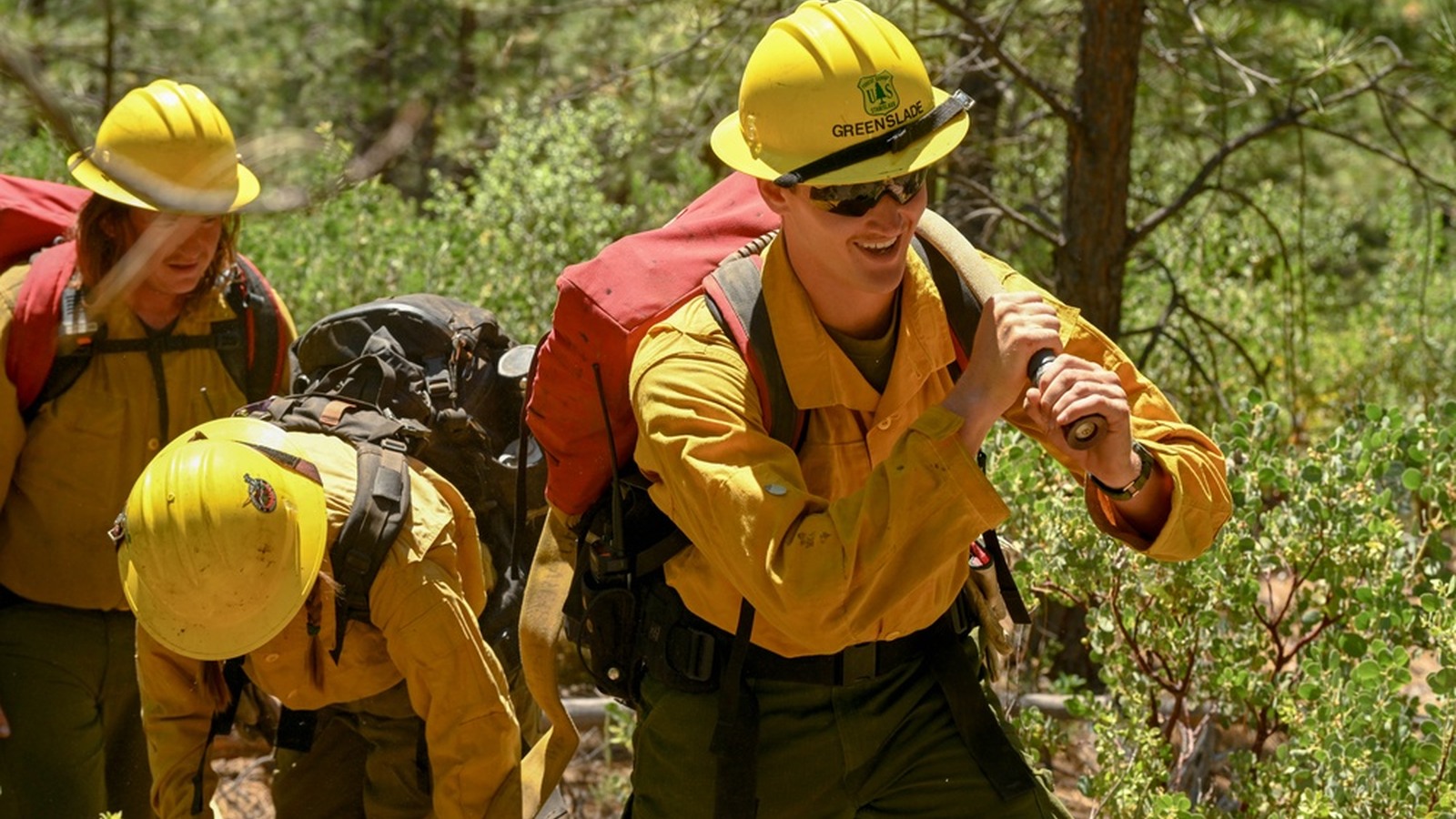
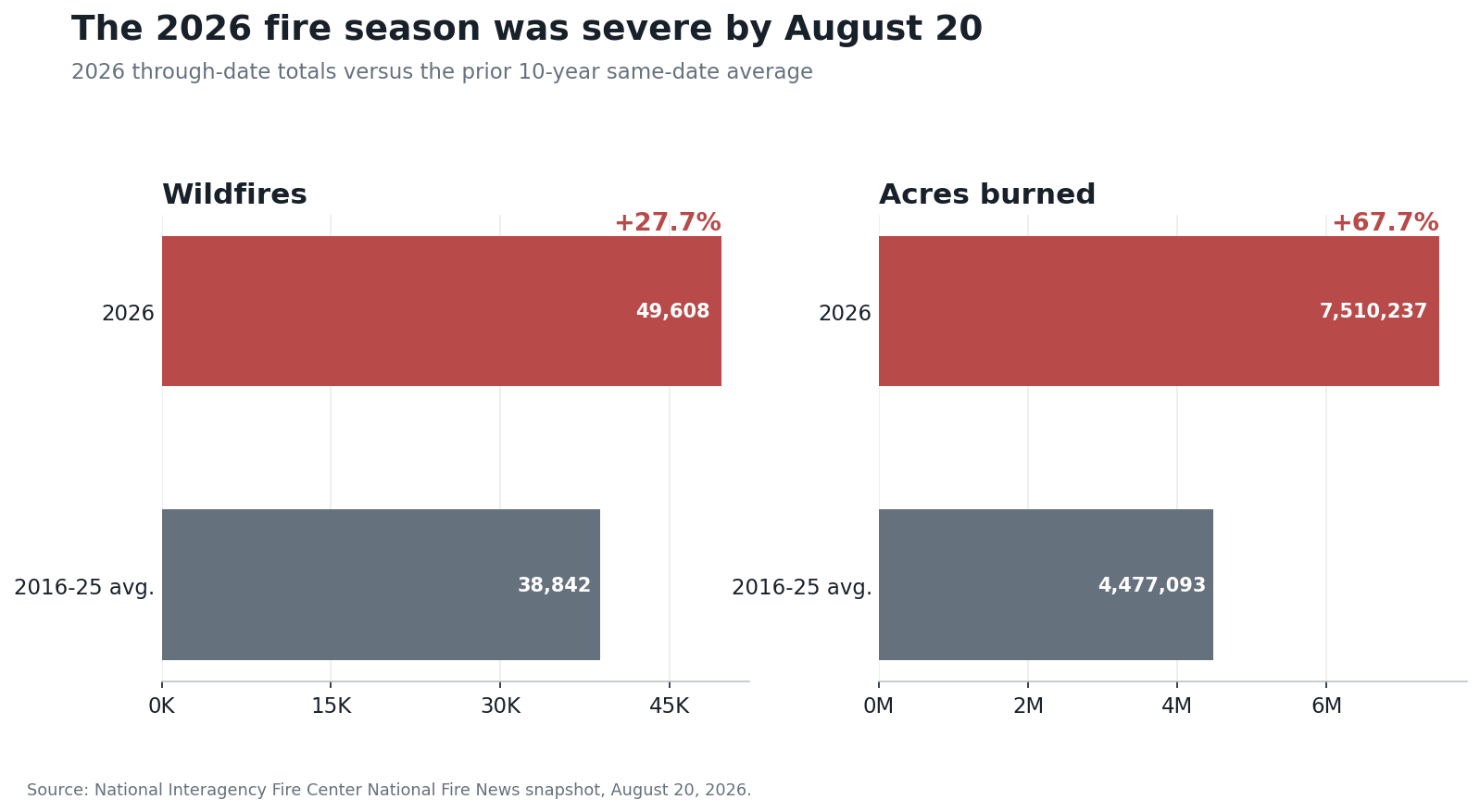
By August 20, the United States had recorded 49,608 wildfires that burned 7.5 million acres. Both measures were well above the average for the same date over the previous 10 years. Seventy-two large fires were active, and 25,248 people from the interagency fire system were assigned to incidents, according to a National Interagency Fire Center snapshot.
That is the setting in which the federal government is trying to remake its wildland-fire institutions. The Department of the Interior launched a U.S. Wildland Fire Service in January. The administration also wants to move the Forest Service's fire program from Agriculture into the new service. Those are not the same event.
The Interior consolidation is operational. The Forest Service transfer is still a proposal that would require Congress to act. Neither step, by itself, creates another engine captain, dispatcher, smokejumper or fuels specialist.
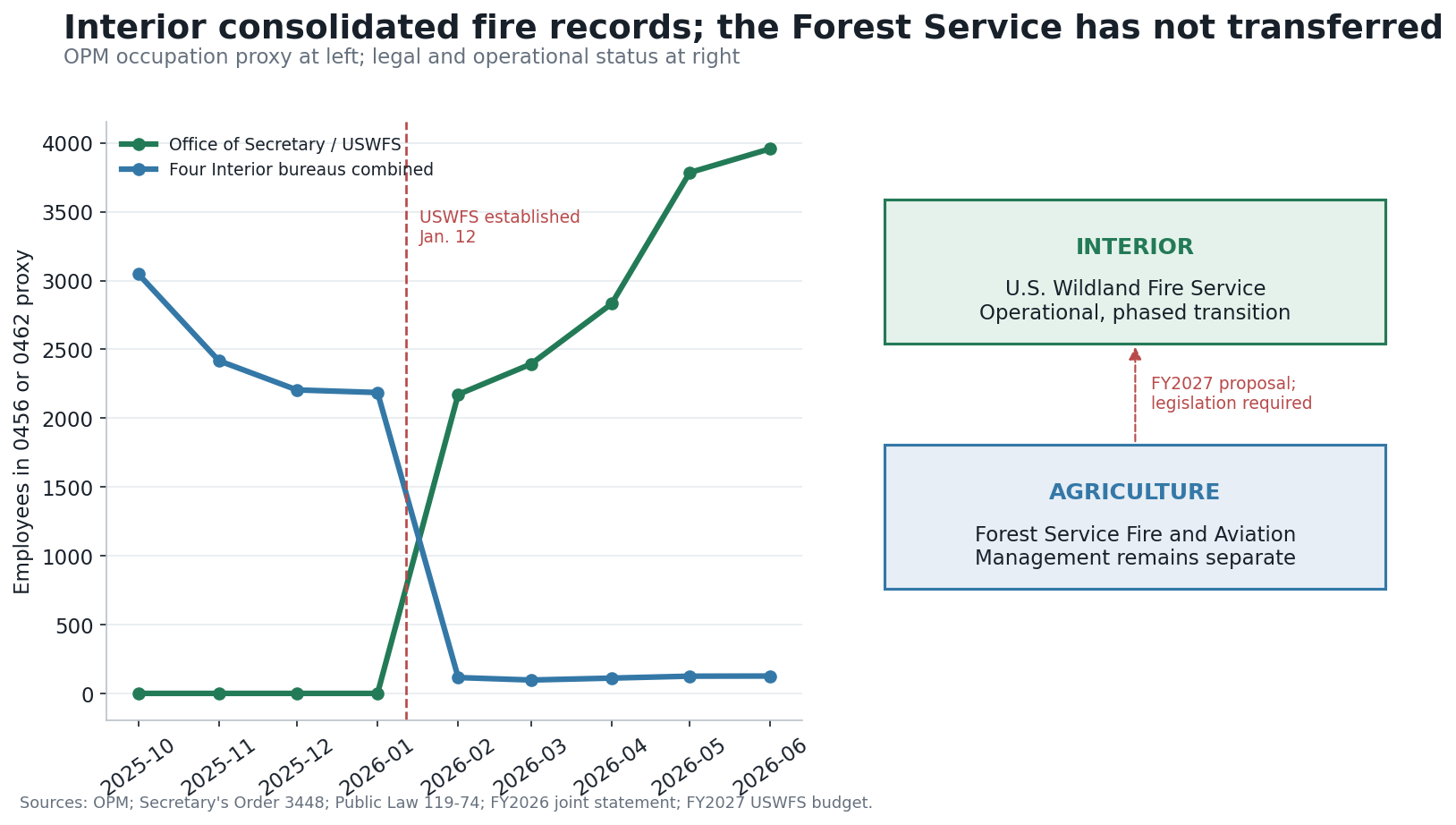
A FederalHiringData analysis of Office of Personnel Management records found 20,695 employees in a core fire-workforce occupation proxy in June 2026, the highest June total in the available 2015-2026 series and 8 percent above June 2025. But nonpermanent appointments increased by 1,813 while permanent appointments fell by 274. All of the net gain, and then some, came from temporary and other nonpermanent appointments.
The finding does not prove that the government lacks enough firefighters. There is no single federal series that captures every operational firefighter and support employee across time. It does show the distinction the reorganization cannot settle: moving authority can change who manages the workforce, while the harder measure of capacity is who is available, qualified and experienced when a crew or prescribed burn needs them.
A new service inside Interior
On January 12, Interior Secretary Doug Burgum signed Secretary's Order 3448, establishing the U.S. Wildland Fire Service in the Office of the Secretary. The order gives the service responsibility for Interior's fire operations and activities and describes a phased unification of programs from the Bureau of Indian Affairs, Bureau of Land Management, National Park Service, Fish and Wildlife Service, Office of Wildland Fire and Office of Aviation Services.
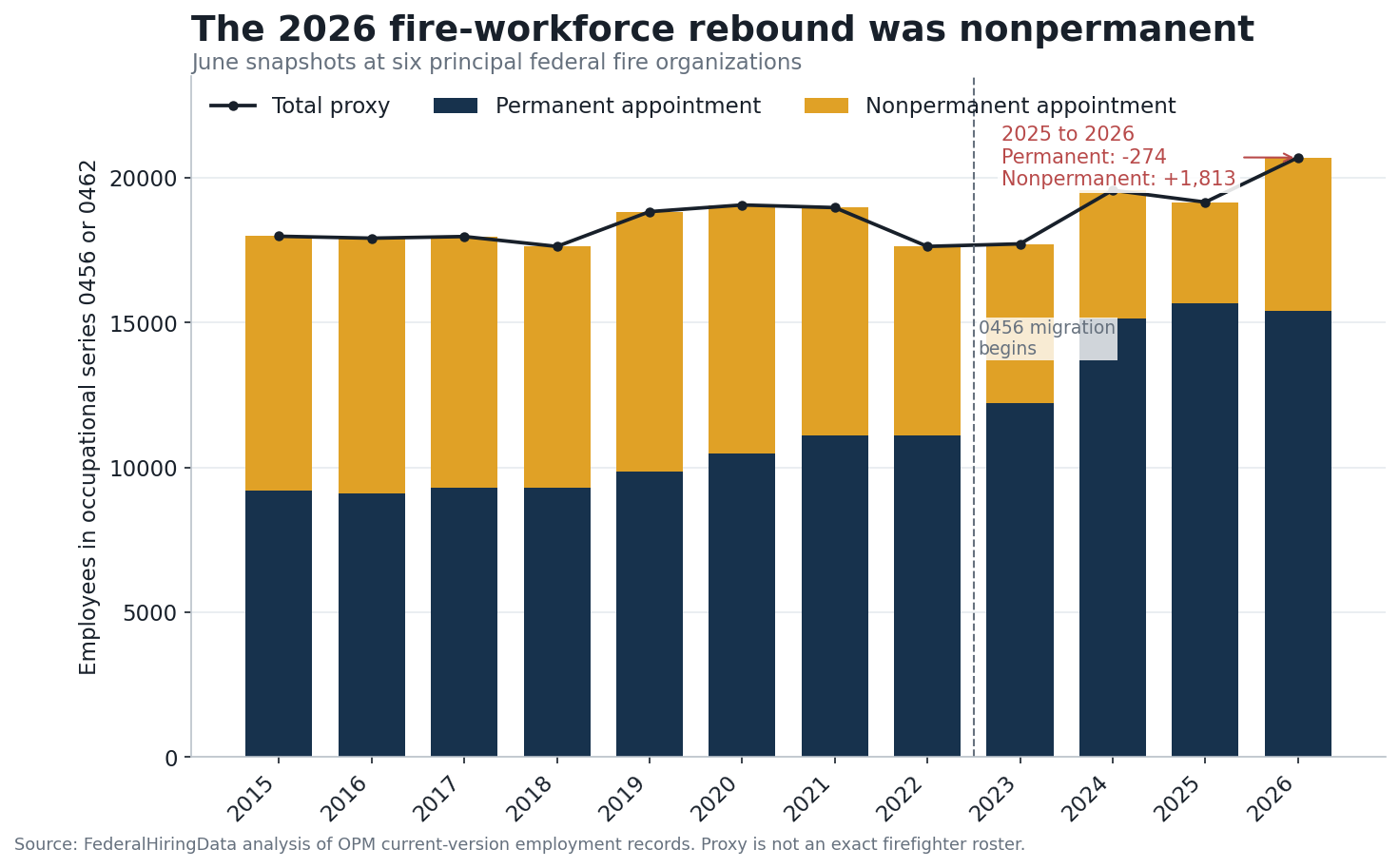
The personnel records show that the Interior move was more than a new name. In January, OPM's Office of the Secretary code contained just three employees in occupational series 0456 and 0462. It contained 2,173 in February and 3,957 in June. Over the same months, the combined count at the four Interior land bureaus fell from 2,187 to 129. That is clear administrative evidence of a large within-Interior realignment, even though an occupation proxy cannot account for every employee affected by the order.
The Forest Service has not moved
Forest Service Fire and Aviation Management remains in the Department of Agriculture. The agency was still advertising 2026 Forest Service fire jobs, and OPM counted 16,609 proxy employees under the Forest Service agency code in June. Interior's own current description says the new service collaborates with the USDA Forest Service as a partner. Readers looking for current openings can search FederalHiringData's broader /jobs index.
The legal trail matters because proposals changed as they moved through Congress. The Senate's July 2025 Interior appropriations bill would have explicitly barred the transfer of Forest Service functions, people, resources and hazardous-fuels work to Interior. Those prohibitions did not appear in the final Public Law 119-74, enacted in January 2026.
The final law retained separate Interior and Forest Service wildland-fire accounts. Its joint explanatory statement directed Agriculture, in consultation with Interior, to commission an independent, nonpartisan feasibility study. Congress told the study to examine hazardous-fuels cohesion, the red-card-qualified workforce, NIFC's existing coordinating role, timber targets, states, localities and tribes. It also asked for funding estimates, staffing plans and the legislative proposal needed to complete a transfer.
The administration's fiscal 2027 USWFS budget again proposes bringing the Forest Service program into Interior. Its requested transfer language is explicit: the move is contingent on enactment of consolidation legislation.
Two workforce measures, neither a perfect roster
The government publishes workforce totals that sound comparable but measure different things.
For 2021, the Government Accountability Office reported an approximate federal fire workforce of 18,700: about 12,800 Forest Service employees and 5,900 at Interior. That estimate included firefighters as well as fire-management and support positions. Interior's fiscal 2027 budget book later listed 17,587 preparedness-and-suppression personnel for fiscal 2025 actual and fiscal 2026 planned levels: 11,870 at the Forest Service and 5,717 at Interior.
The later roster is about 6 percent lower. But it would be wrong to call that a precise workforce loss. GAO's rounded agency estimate and the budget's operational headcount have different definitions and dates. The budget table also counts permanent, seasonal and temporary personnel and warns that it is headcount, not full-time equivalents.
FederalHiringData built a second measure from OPM records to compare the same occupations and agencies each June. It combines the new 0456 Wildland Fire Management series with the older 0462 Forestry Technician series at the Forest Service and five Interior organizations. More federal workforce context is available in the site's /statistics section.
That crosswalk is necessary because OPM created 0456 only in June 2022. Interior's employee election guide says historic fire jobs also appeared under broad series including 0301, 0401, 0455 and 0462. By June 2026, 9,664 employees in the proxy were coded 0456 and 11,031 remained in 0462.
The 2026 gain was nonpermanent
Used consistently, the proxy reveals the workforce's changing employment structure. The June total rose from 17,979 in 2015 to 20,695 in 2026, an increase of 15.1 percent. Permanent appointments rose 67.1 percent, from 9,208 to 15,390. Nonpermanent appointments fell 39.5 percent, from 8,771 to 5,305.
That decade-long move toward permanence is substantial counterevidence to the idea that federal fire staffing never adapted to longer demands. But the latest annual change went the other way. From June 2025 to June 2026, permanent appointments slipped 1.7 percent while nonpermanent appointments jumped 51.9 percent.
Work schedules are not a shortcut around the change. OPM coded 5,262 nonpermanent employees as full-time in June 2026 and only five as seasonal schedules. A temporary firefighter working full-time hours during an appointment is still temporary. Appointment type, not the schedule label, captures the 2026 surge.
The age profile supplies little evidence of a sudden broad aging crisis. Employees 45 and older were 20.5 percent of the proxy in June 2015 and 21.5 percent in June 2026. The more revealing experience evidence appears in who left.
Pay changed, then personnel flows reversed
Federal firefighter pay reform arrived in stages. Agencies raised the minimum rate to $15 an hour in 2021. The Infrastructure Investment and Jobs Act then funded a temporary supplement equal to the lesser of $20,000 a year or 50 percent of basic pay for eligible firefighters. Payments began in 2022 and were retroactive to October 1, 2021, but the supplement did not count as basic pay for retirement.
Congress made a new structure permanent in March 2025 through Public Law 119-4. The law created General Wildland Firefighter, or GW, rates with the largest percentage additions at lower grades. It also created incident-response premium pay for qualifying extended deployments, up to $9,000 a year. Unlike the temporary supplement, the new scheduled rate counts in locality, retirement and other basic-pay calculations. OPM now publishes annual GW salary tables.
The change is visible in OPM data. The count-weighted adjusted basic pay in the occupation proxy rose 28.3 percent from June 2024 to June 2025. That is not an individual raise estimate: thousands of people were moving between occupation and pay-plan codes, and grade mix changed too. It also excludes overtime, hazard pay and incident-response premium pay.
Accessions exceeded separations in every year from 2015 through 2020, narrowly missed in 2021, then surged ahead again in 2022 through 2024. The ratio reached 128.8 accessions per 100 separations in 2024. In 2025, the direction reversed. The proxy recorded 5,418 accessions and 6,064 separations, or 89.3 accessions per 100 separations. Quits rose to 2,557 from 2,129 in 2024. Retirements rose to 263 from 144.
The two kinds of departures removed different experience. People recorded as quitting in 2025 averaged 2.31 years of federal service; only 3.5 percent had at least 10 years. Retirees averaged 25.19 years, and 95.8 percent had at least a decade. The larger retention leak was near the beginning of a federal career, while the smaller retirement stream carried far more tenure per departure.
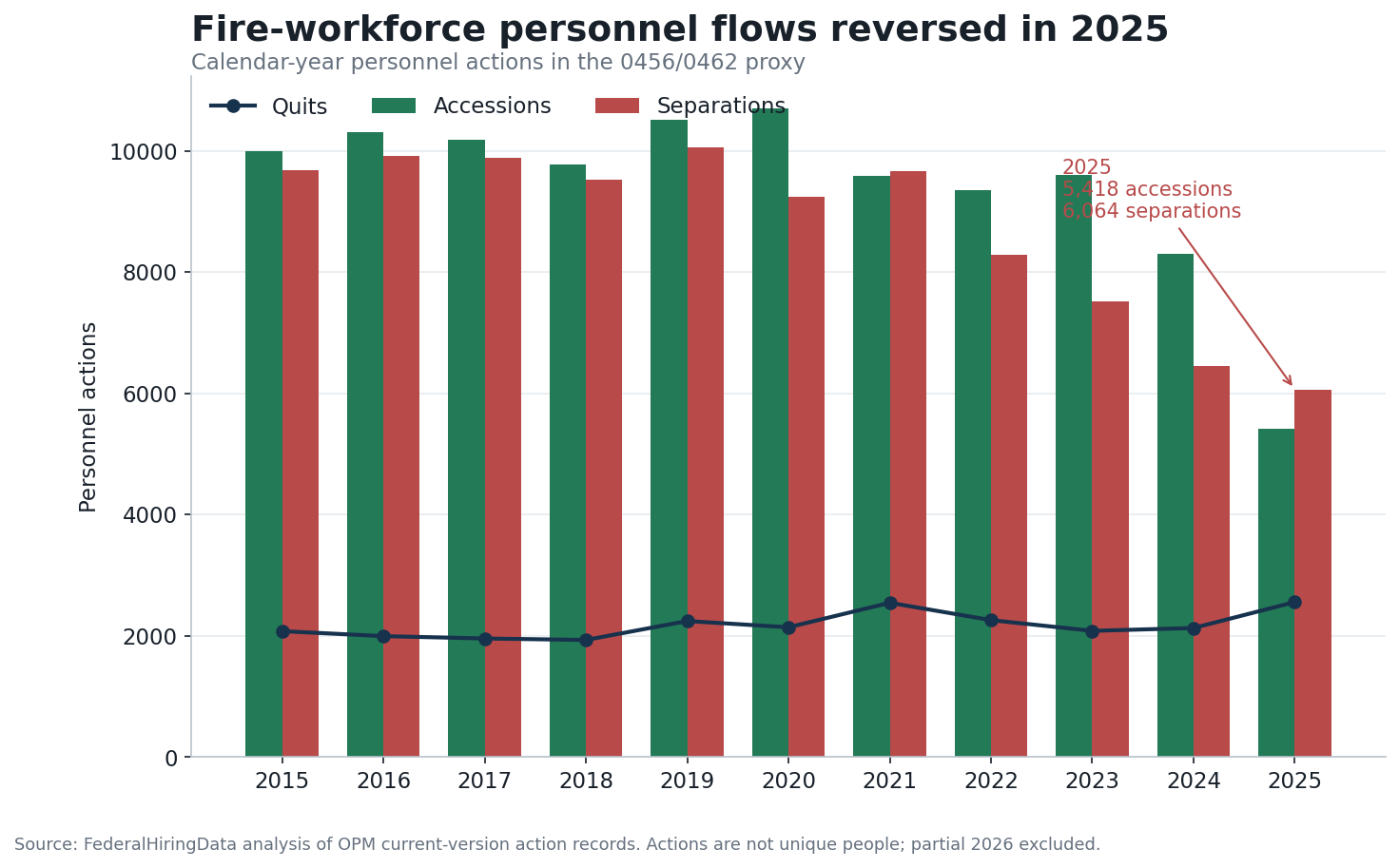
That one-year reversal does not establish that permanent pay reform failed. The law took effect during the year being measured. The records cannot separate pay from hiring restrictions, occupational conversion, seasonal timing or reorganization. They also cannot show how many more employees might have left without the permanent rates.
Recruiting narrowed in 2026
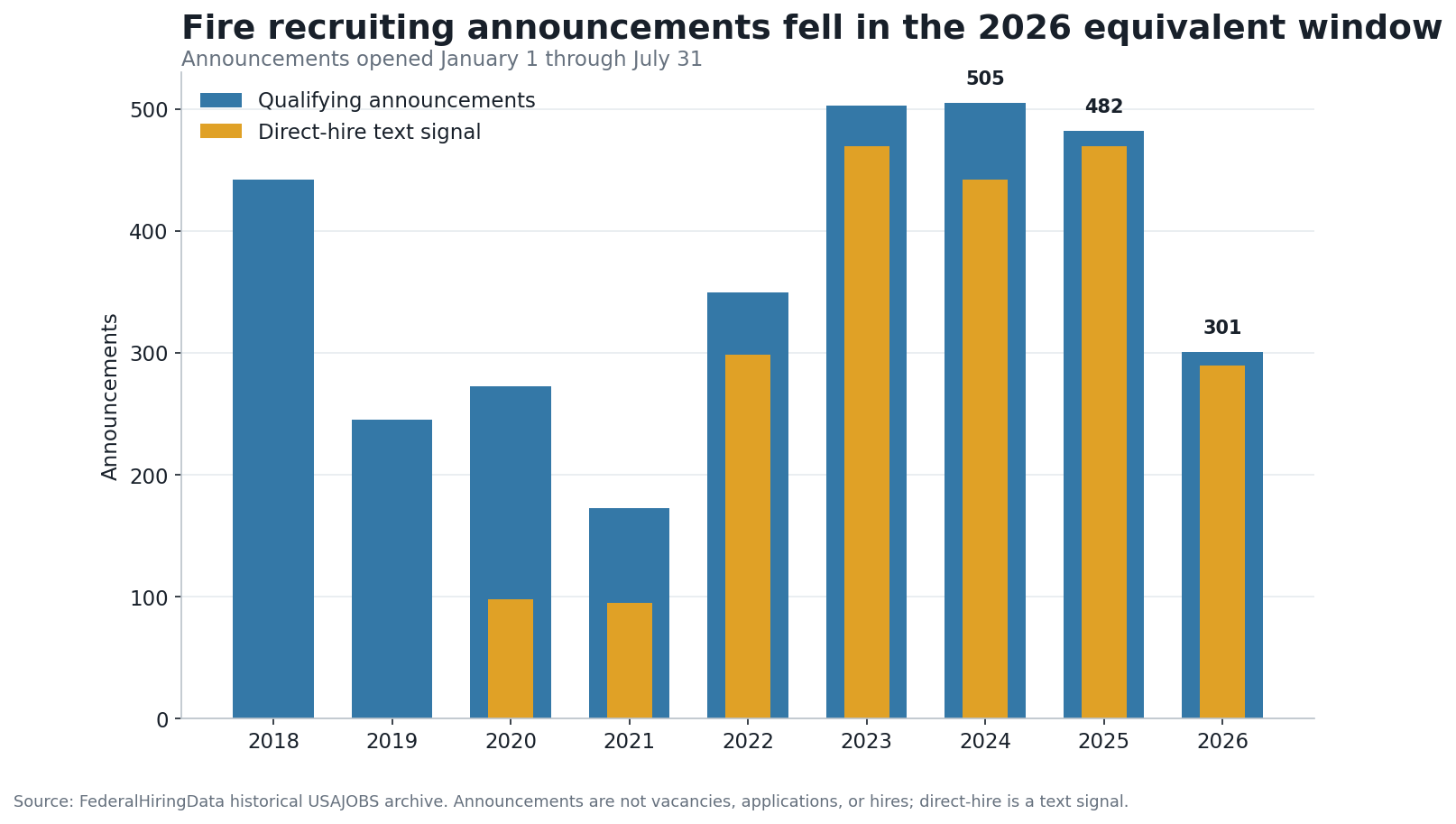
The FederalHiringData historical USAJOBS archive contains 301 qualifying fire announcements opened from January 1 through July 31, 2026, down from 482 in the equivalent 2025 period and 505 in 2024. Of the 2026 announcements, 290 carried a direct-hire signal in the title or announcement number. The median posting was open 13 days.
Those are announcements, not vacancies or people hired. One announcement can span many grades and locations. Historical appointment metadata are too incomplete to compare permanent and temporary postings across the full archive. What the records show is a smaller 2026 announcement footprint in the equivalent window, alongside broad use of direct-hire language and a large nonpermanent employment rebound by June. Related federal workforce reporting is collected on the /articles page.
The workforce is needed twice
The 2026 season is severe by the date. FederalHiringData calculated that fires through August 20 were 27.7 percent above the prior 10-year same-date average, while acres were 67.7 percent higher.
Long-run NIFC data complicate any claim that the country simply has more fires every year. Annual fires averaged 78,549 in 2000-2009 and 63,405 in 2016-2025, a 19.3 percent decline. Average acres moved from 6.93 million to 7.05 million, an increase of 1.8 percent. The recent period produced fewer reported fires but slightly more burned acreage.
Nominal federal suppression spending doubled across roughly comparable 10-year windows, from an average $1.30 billion in 2000-2009 to $2.67 billion in 2014-2023. That 104.7 percent increase is not adjusted for inflation and should not be read as a real-cost measure.
Emergency response is only half the capacity question. The same qualified workforce is expected to reduce hazardous fuels and conduct prescribed fire when weather, smoke rules and local conditions create a burn window.
GAO found that the Forest Service uses the same staff and equipment for suppression and prescribed burning. Officials told auditors that suppression assignments and fatigue could make managers reluctant to release people for planned fire. GAO recommended a strategic workforce plan that identifies prescribed-fire staffing needs. That recommendation remained open as of September 2025.
A peer-reviewed Forest Service study offers limited empirical evidence of the tradeoff. On the Okanogan-Wenatchee National Forest, firefighter unavailability was associated with lower odds of conducting a prescribed burn during the fall after researchers controlled for weather. The result did not translate into the same finding for spring, and one national forest cannot establish a national capacity gap.
Overtime evidence is older but points to the same strain. GAO reported that nearly half of Interior fire personnel worked between 501 and 1,903 overtime hours in fiscal 2021. Standard deployments last 14 days and can extend to 30. Interior's 2023 workforce assessment said employees identified excessive overtime as a major contributor to burnout and called rising overtime a symptom of a workforce-capacity problem.
Methodology and limitations
FederalHiringData analyzed OPM employment and personnel-action records through June 2026 and the FederalHiringData historical USAJOBS archive through July 31, 2026. The workforce proxy combines occupational series 0456 and 0462 at the Forest Service, Office of the Secretary/USWFS, BLM, Indian Affairs, NPS and FWS. OPM's current-version warehouse views prevent overlapping source releases from being counted twice. Personnel-action totals are events, not longitudinal person records.
The proxy errs in both directions. Series 0462 includes forestry technicians whose primary work is not fire. Series 0456 misses some dispatchers, aviation employees, incident managers and support personnel in other occupations. Migration into the new series changes composition, so the analysis does not splice the broader all-agency 2000-2024 occupation extract into an exact workforce line.
NIFC supplied official fire and cost data. The August comparison uses August 20 for every year; NIFC's assigned-personnel total includes federal, state, tribal, local and contracted resources. Suppression costs are nominal. USAJOBS announcements are not vacancies, applications, offers or hires, and the direct-hire measure is a title or announcement-number signal.
No comparable federal overtime series for 2022 through 2026 was found. Nor is there a current national dataset that connects qualified staffing to prescribed-fire and hazardous-fuels output. The records also cannot establish the causal effect of temporary or permanent pay reform. Those are unknowns, not numbers filled with estimates.
What the reorganization has changed
The public evidence does not support a clean yes or no on whether the government has enough people. A core occupation proxy is larger than it was in 2021 and the long-run workforce is far more permanent than it was a decade ago. Permanent pay reform corrected a serious compensation structure, and Interior completed a consequential consolidation.
But the official operational roster does not show obvious growth, separations overtook accessions in 2025, the latest staffing rebound relied on nonpermanent appointments, and documented fatigue and prevention constraints remain unresolved. The Forest Service has not joined the new service, and the administration's plan to move it still depends on Congress.
The reorganization may eventually improve coordination. As of August 20, it has changed the organization chart more clearly than it has changed the public evidence of federal fire capacity.
Continue reading
More from FederalHiringData

Data investigationsAugust 18, 2026
The Korea Exercise Was Cut. The Civilian Workforce Behind the Alliance Was Not
The U.S. defense presence in South Korea includes 2,903 appropriated-fund civilians, while 12,428 archived job announcements reveal the year-round system behind the alliance.
Data investigationsAugust 18, 2026
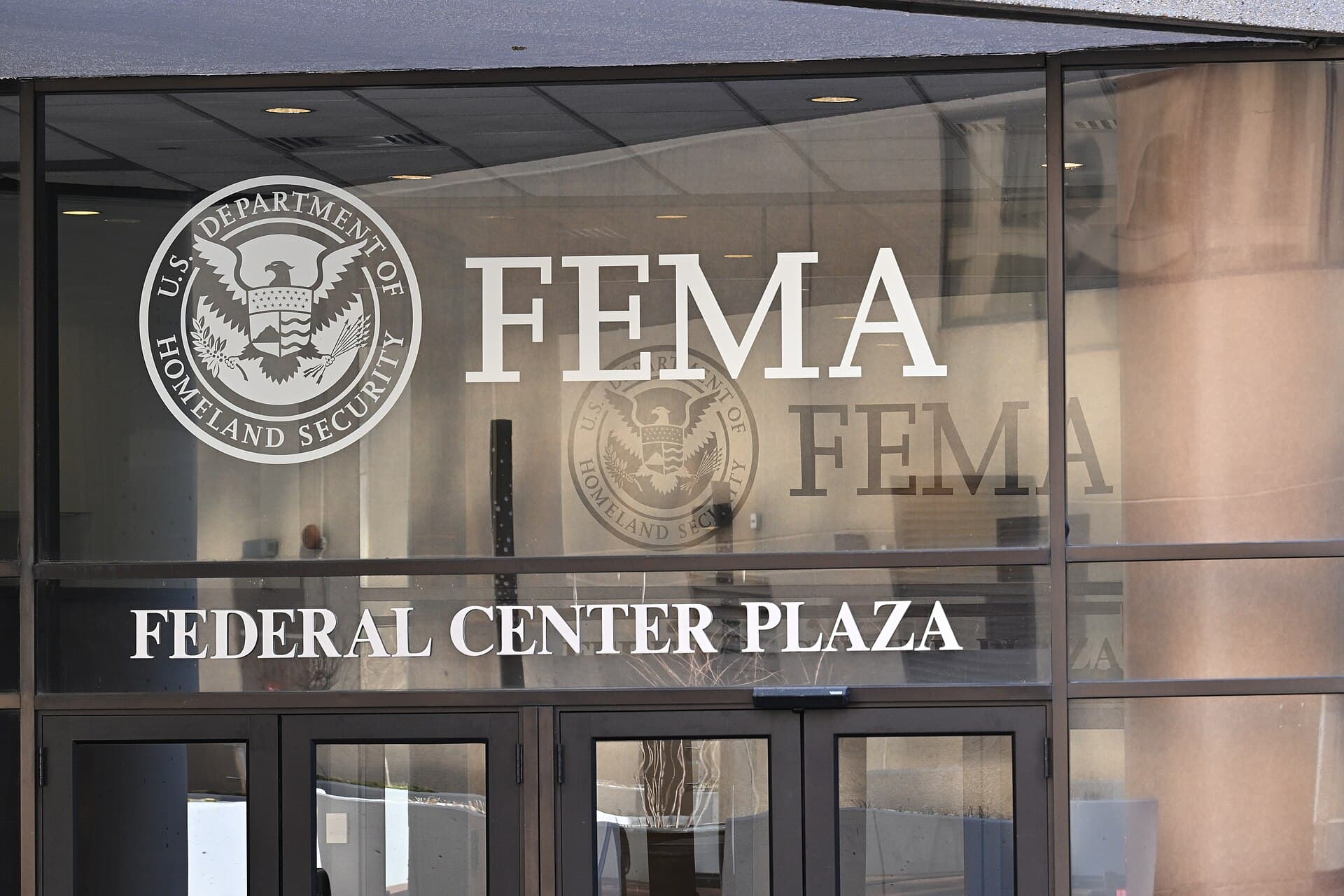
FEMA's Public Workforce Count Fell 22% as GAO Warned of Readiness Risks
FEMA had 5,793 fewer covered civilian employees in June 2026 than in January 2025. GAO says the agency cut staff without the workforce planning needed to assess mission capacity.

Data investigationsAugust 19, 2026
Social Security Has 85% More Beneficiaries per Worker Than in 2000
Social Security added 25 million beneficiaries while losing 9,600 full-time permanent workers. Recent service gains show what technology changed—and what a thinner workforce still risks.
Federal Hiring Data Weekly
Subscribe to Federal Hiring Data Weekly.
Subscribe to Federal Hiring Data Weekly. Confirm your email after signing up to receive federal hiring trends, salary data, agency movements, and original research.