August 21, 2026
DOE Has an $8 Billion Cleanup Mission. Its Federal Oversight Workforce Fell to 856.
DOE's nuclear-cleanup office lost one-third of its federal staff in two years while engineering, contracting and safety-related vacancies widened.
By Evan Mercer
Published August 21, 2026Last edited August 21, 2026
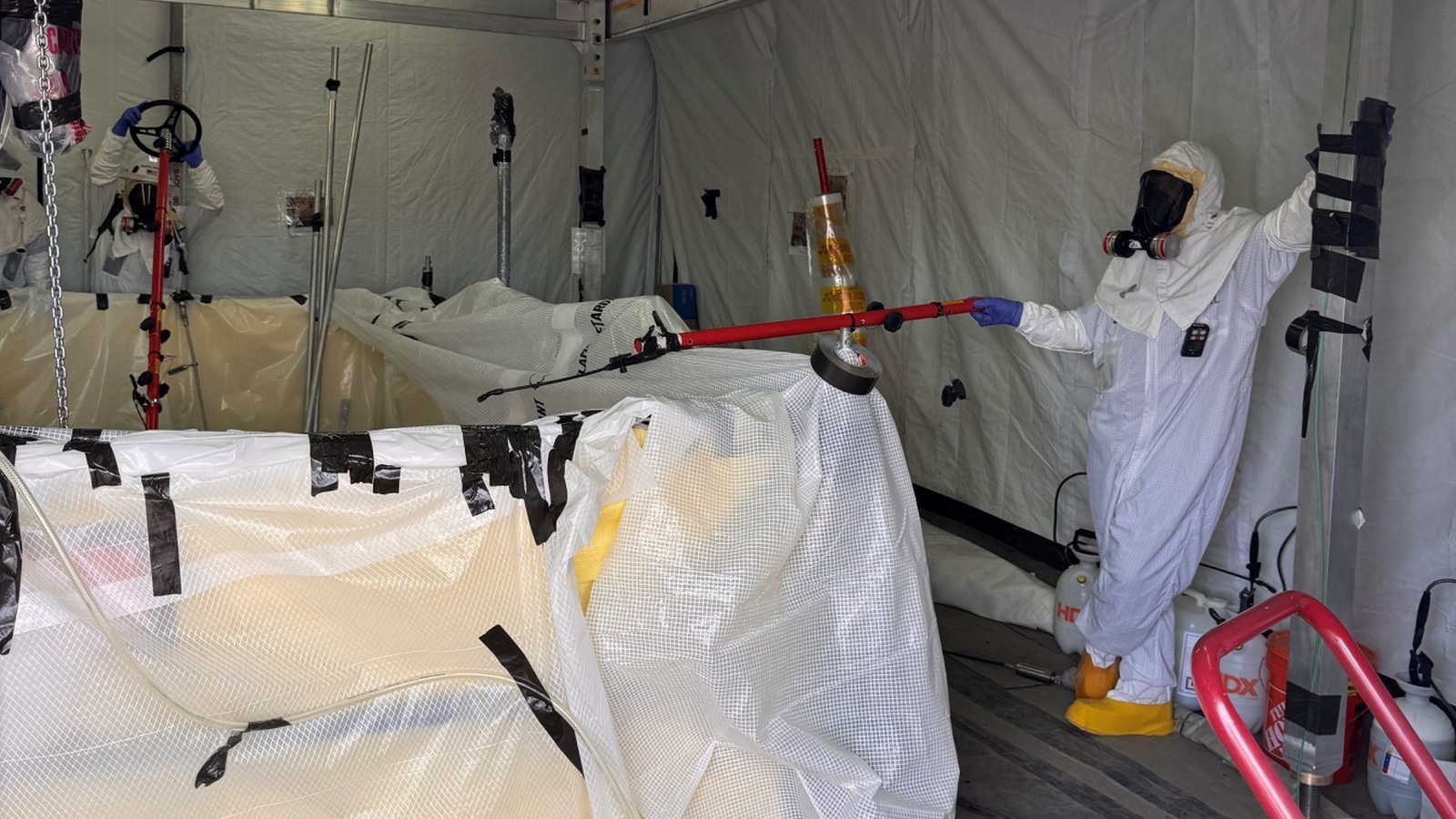
The federal organization responsible for cleaning up some of the most hazardous remnants of the nuclear-weapons complex entered fiscal 2026 with 856 employees. Its annual budget was $8.56 billion. Most of that money was set to move through contracts.
That combination is central to the Department of Energy's Office of Environmental Management, or EM. Contractors carry out much of the field work. Federal engineers, scientists, contracting officers, project directors, safety specialists and other employees remain responsible for setting requirements, awarding and administering contracts, checking performance and protecting the government's interests.
The federal side of that system became markedly smaller in 2025. The Government Accountability Office reported that EM had 1,272 federal employees at the end of fiscal 2023 and 856 at the end of fiscal 2025, a loss of 416 employees, or 32.7%, in two years. The 2025 staffing level was below the count for every fiscal year in GAO's 2014-to-2024 comparison.
The loss did not create a documented shutdown. As of December 2025, EM officials told GAO that no work stoppage had occurred because of vacancies. But the same officials described growing workloads, thinning experience and gaps in positions they considered especially important to safety. In six mission-critical occupational groups, EM reported 442 people onboard and 348 vacancies against a 790-position base inherited from its fiscal 2023 staffing assessment.
This is not a story about an $8 billion agency literally running with only 856 people. DOE said in 2022 that the wider cleanup enterprise included roughly 33,000 federal and contractor workers. It is a story about the much smaller federal workforce responsible for directing and overseeing that contractor-heavy enterprise, and how slowly some of its most specialized capacity can be rebuilt.
The federal workforce fell below its recent historical range
GAO's comparable annual series counted 1,469 active EM employees during fiscal 2014 and reached 1,539 in 2015. It then declined, unevenly, to 1,282 in 2019. The workforce recovered modestly in 2020 and 2021, reached 1,366 in 2023 and stood at 1,279 during fiscal 2024.
The 856 figure is a different kind of observation: an end-of-fiscal-year staffing stock for 2025, which GAO also described as EM's workforce entering fiscal 2026. It should not be joined to the earlier line as though the definitions were identical. GAO nevertheless made the comparison directly and concluded that 856 was below every annual count from 2014 through 2024.
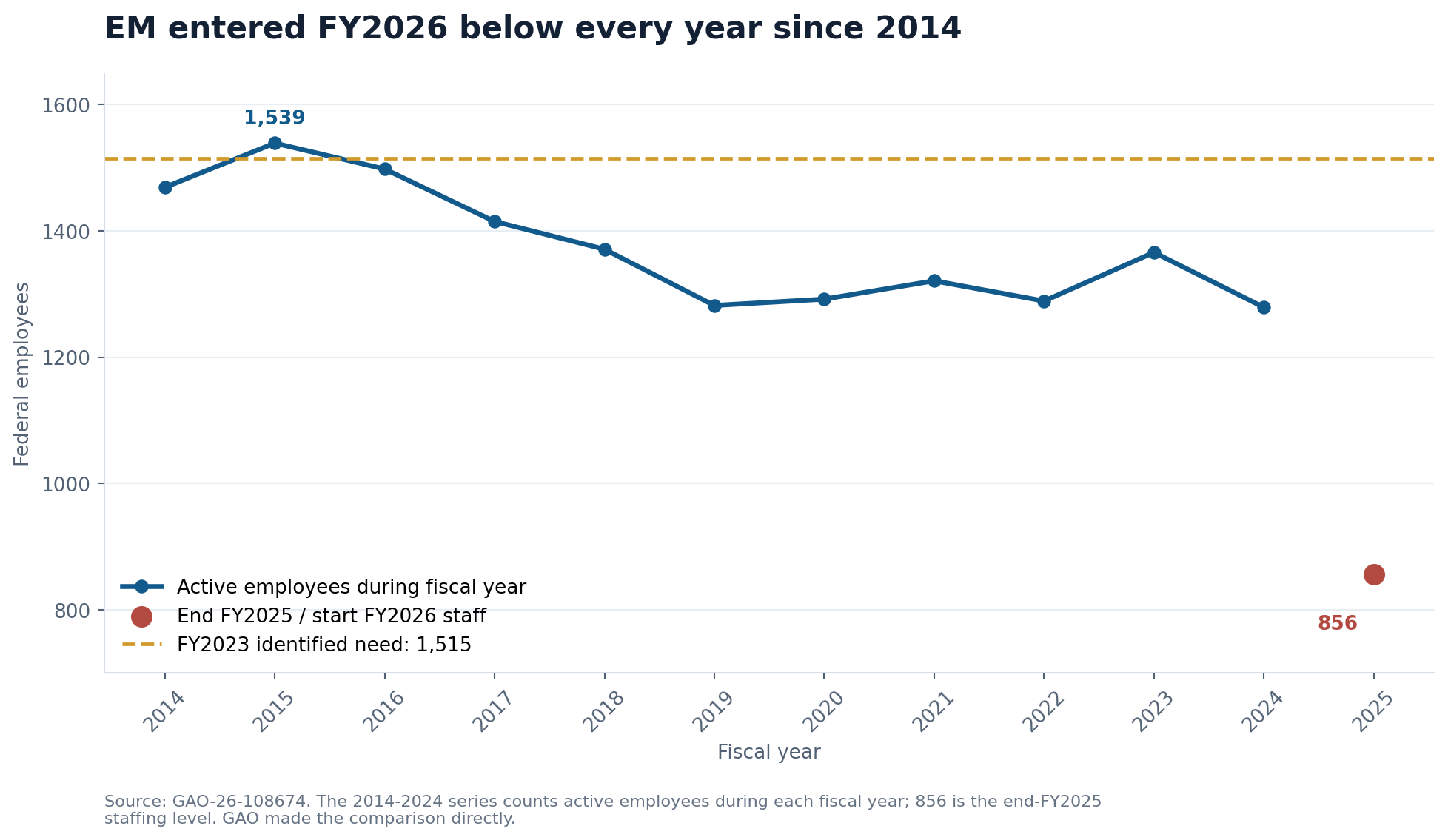
| Workforce checkpoint | Federal staff | Definition |
|---|---|---|
| During fiscal 2015 | 1,539 | Highest annual active-employee count in GAO's 2014-2024 series |
| End of fiscal 2023 | 1,272 | Onboard staff at year end |
| During fiscal 2024 | 1,279 | Annual active-employee count |
| End of fiscal 2025 | 856 | Onboard staff entering fiscal 2026 |
| Fiscal 2023 identified need | 1,515 | Permanent full-time position need, not onboard staff |
| Proposed fiscal 2026 staffing | 950 | Planning level, not an observed result |
The sharpest part of the decline was concentrated in one year and one policy. EM recorded 409 separations in fiscal 2025. Of those, 312 were associated with the Deferred Resignation Program, or 76.3%. That matters because it distinguishes the 2025 reduction from a slow, steady 11-year slide. It was a rapid exit wave landing on a workforce that had already remained below its 2015 level.
It also complicates any simple vacancy percentage. EM's fiscal 2023 workforce plan identified a need for 1,515 permanent full-time positions. Against that older base, 856 onboard staff left 689 vacancies, about 45%. But EM was reassessing its needs after the workforce reductions and proposed a fiscal 2026 staffing level of 950, with 174 planned hires. A smaller official requirement could lower the reported vacancy rate even if the number of people available to perform the work did not rise.
For that reason, every vacancy rate in this analysis keeps the denominator visible. It is a gap against the need EM identified in 2023, not proof that Congress authorized or funded 689 unfilled jobs in 2025, and not a forecast of the organization EM will ultimately adopt.
Five of six critical vacancy rates worsened
GAO examined six occupational series that EM designated as mission-critical across the complex. At the end of fiscal 2025, their combined position base was 790: 442 employees plus 348 vacancies. That produced an approximate vacancy rate of 44%, up from about 20% for the same six groups in fiscal 2023.
Five of the six vacancy rates increased. Nuclear engineering had the highest percentage, 23 vacancies against 42 positions, or about 55%. General engineering had the largest number of gaps, with 179 vacancies against 353 positions. Contracting had 77 vacancies against 178 positions.
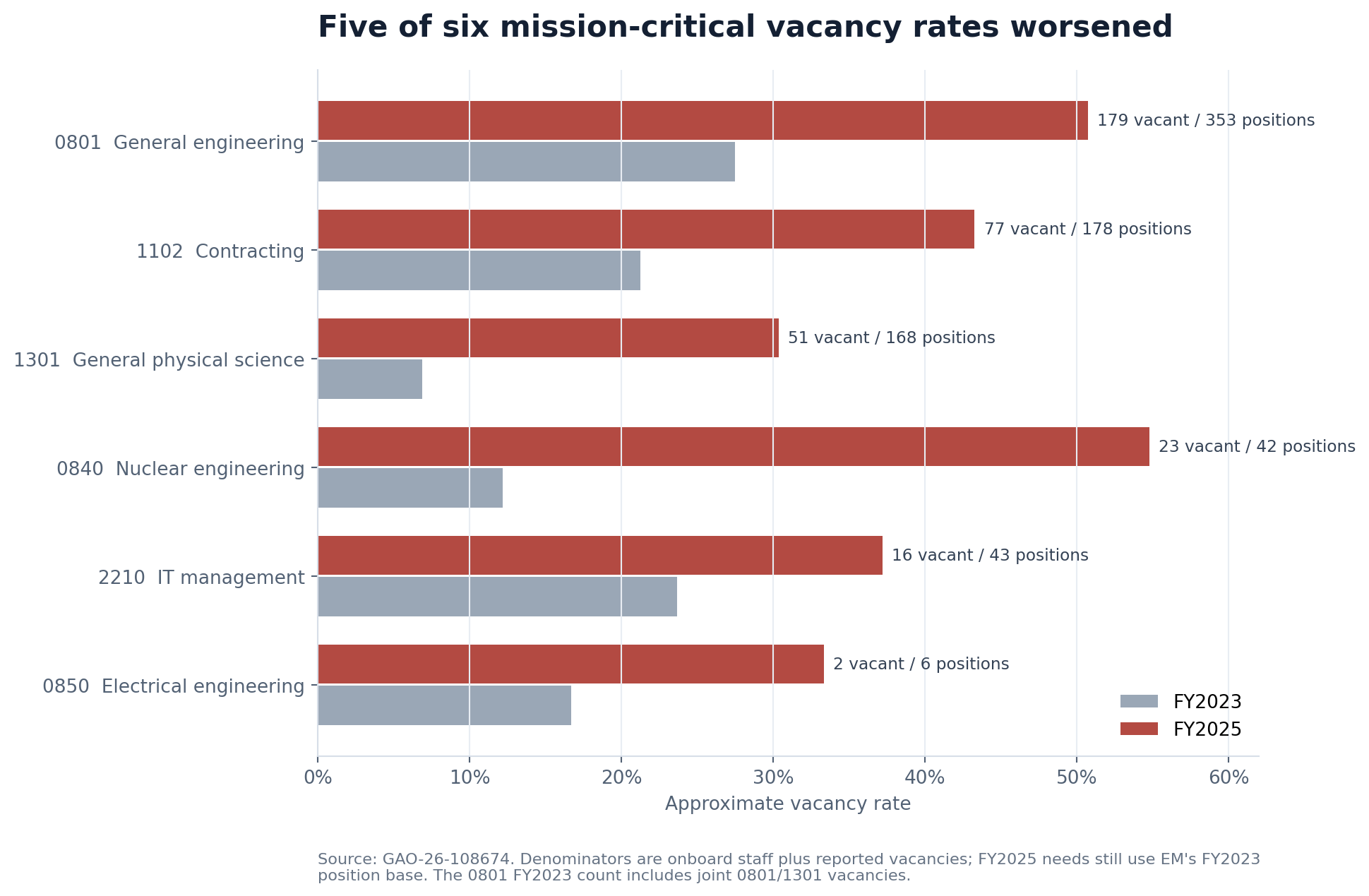
| Occupational series | End-FY2025 staff | Vacancies | Staff plus vacancies | Approximate vacancy rate |
|---|---|---|---|---|
| 0840 Nuclear engineering | 19 | 23 | 42 | 55% |
| 0801 General engineering | 174 | 179 | 353 | 51% |
| 1102 Contracting | 101 | 77 | 178 | 43% |
| 2210 IT management | 27 | 16 | 43 | 37% |
| 0850 Electrical engineering | 4 | 2 | 6 | 33% |
| 1301 General physical science | 117 | 51 | 168 | 30% |
| Six-series total | 442 | 348 | 790 | 44% |
The engineering and physical-science figures require another distinction. GAO combined the 0801 and 1301 series when discussing the pipeline for facility representatives and related oversight work. Together, those two series had 230 vacancies and an approximate 44% vacancy rate. That does not mean EM lacked 230 facility representatives. The series also include federal project directors, safety-system oversight engineers and people doing other engineering and scientific work.
The same caution applies to safety. EM identified 59 vacant positions as especially important to safety. The count establishes that safety-relevant gaps existed. It does not establish that 59 discrete safety checks went undone, nor does it support predicting an accident. GAO reported concern about workloads and coverage while also documenting that work had continued.
Departures took experience; qualification takes time
The 409 people who left in fiscal 2025 included 180 employees from the six mission-critical groups. General engineering lost 69 people, general physical science lost 55 and contracting lost 36. Those separations are people who departed during the year, while the 856 workforce figure is a year-end stock. They answer different questions and should not be subtracted again.
The succession issue extends beyond that exit wave. GAO found that 299 of the 856 remaining employees, or 35%, would be eligible to retire by 2030. Among the six critical occupational groups, 131 of 442 employees, or 30%, would be eligible. Retirement eligibility is not a prediction that all 299 will leave. It measures how much additional experience could become mobile during the next several years.
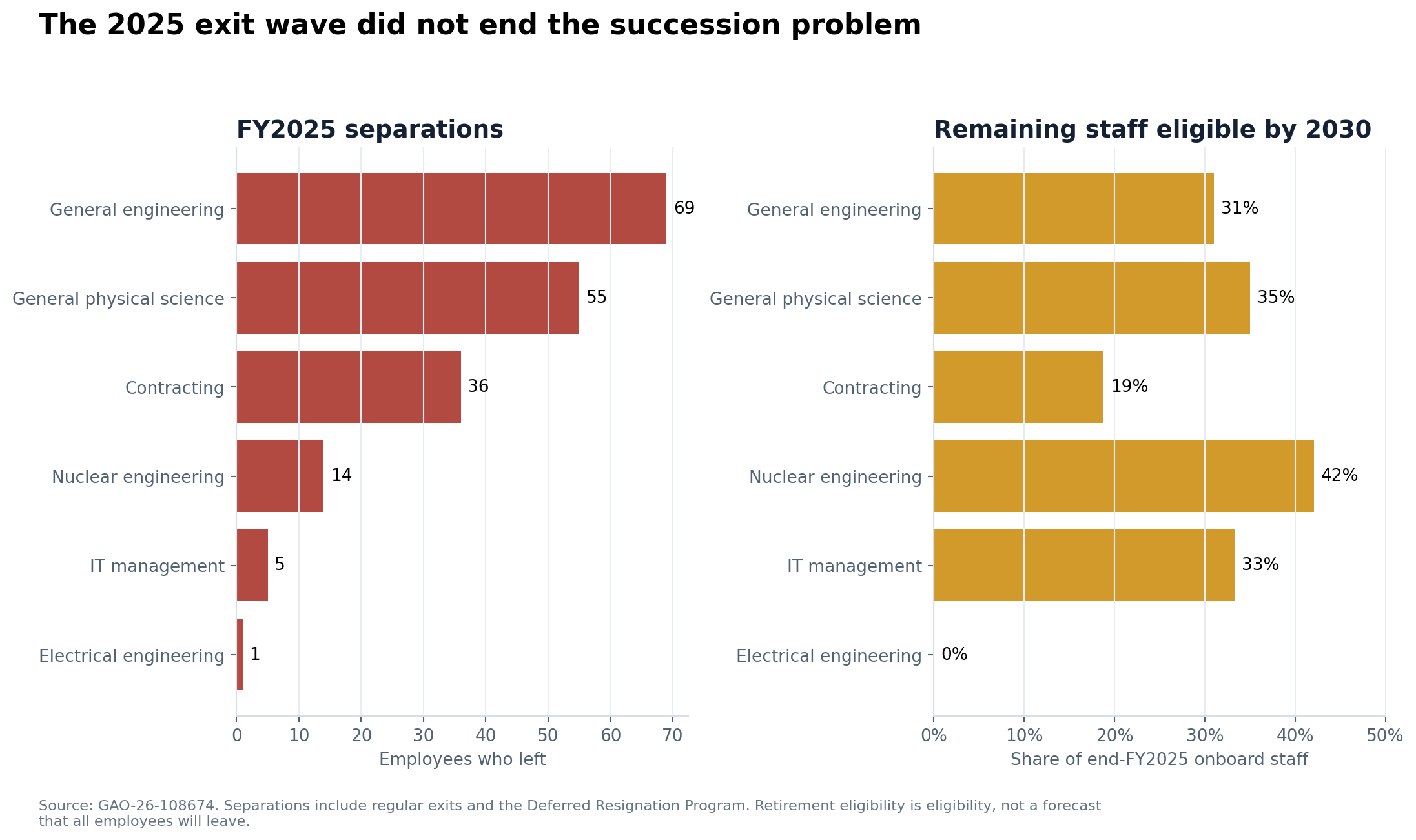
Replacing a departed employee is not always the same as restoring the departed capacity. GAO reported that many EM positions require at least a year of training. Facility representatives can need 18 months or more to qualify. At Hanford, some federal project directors may require as long as 10 years to become fully qualified for particular capital projects.
Those timelines reflect the specificity of the work. A person overseeing a hazardous-waste facility or a complex construction project must understand the site, contractor, technical baseline, safety authorization and DOE requirements. Hiring fills a seat. Qualification and experience determine how quickly the person can independently exercise the full authority attached to it.
That is why the entry pipeline matters. DOE said in a 2022 workforce discussion that only 15 of roughly 1,200 federal EM employees were under age 30. GAO then reported that, as of December 2025, EM was not hiring entry-level people and officials were concerned about losing knowledge as employees retired or resigned. These are two separate snapshots, not a continuous age series, but both point to a narrow route for growing the next cohort from inside the organization.
The pressure was distributed across the cleanup complex
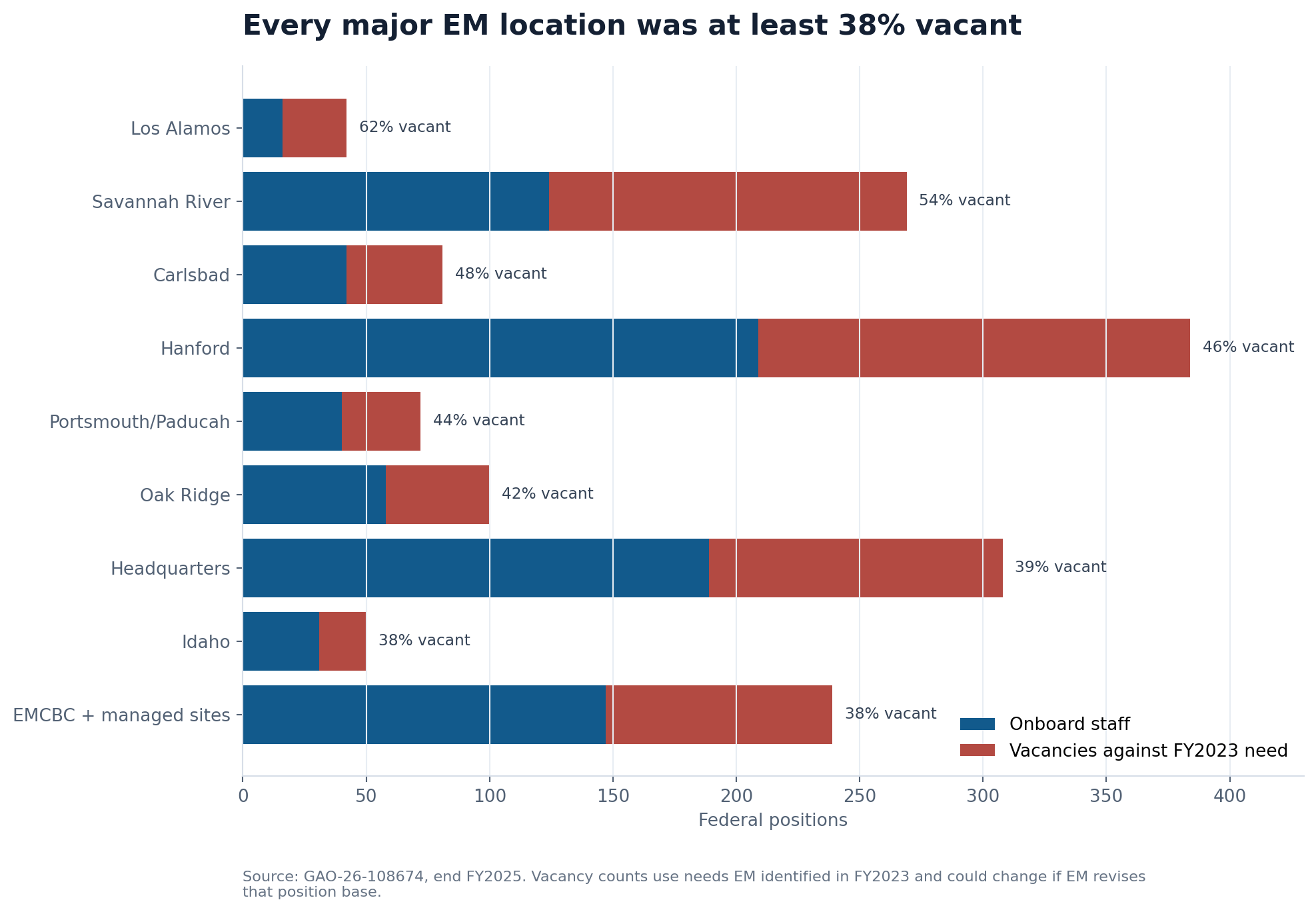
The vacancies were not confined to headquarters. Every location in GAO's end-of-fiscal-2025 table was at least 38% vacant against the older fiscal 2023 need. Los Alamos had the highest rate at 62%, though it was also the smallest listed office, with 16 staff and 26 vacancies. Savannah River had 124 staff and 145 vacancies, a 54% rate. Hanford, the largest field-office workforce in the table, had 209 staff and 175 vacancies, or 46%.
Federal Hiring Data Weekly
Get the biggest federal workforce changes in your inbox.
Subscribe to Federal Hiring Data Weekly for federal hiring trends, salary data, agency movements, and original investigations, with email confirmation before delivery.
| EM location | Staff | Vacancies | Vacancy rate | FY2025 separations |
|---|---|---|---|---|
| Hanford | 209 | 175 | 46% | 96 |
| Savannah River | 124 | 145 | 54% | 84 |
| Headquarters | 189 | 119 | 39% | 73 |
| EMCBC and managed sites | 147 | 92 | 38% | 65 |
| Carlsbad | 42 | 39 | 48% | 22 |
| Portsmouth/Paducah | 40 | 32 | 44% | 20 |
| Oak Ridge | 58 | 42 | 42% | 24 |
| Los Alamos | 16 | 26 | 62% | 12 |
| Idaho | 31 | 19 | 38% | 13 |
These locations are not interchangeable. DOE describes a cleanup mission spread across 15 remaining sites and about 2 million acres, with projects ranging from facility demolition to contaminated-soil work, tank-waste treatment and long-term stewardship. Hanford's staffing and qualification needs cannot simply be moved on paper to Los Alamos or Savannah River.
The site numbers also show why the issue is about resilience, not merely an organization-wide average. A small office can have a very high percentage gap; a large office can lose many more people in absolute terms. Both can matter, but in different ways. The public data does not show how supervisors prioritized individual tasks or how much qualified coverage remained on every shift, so the table cannot identify a specific unsafe facility.
Contractors kept work moving, but the federal role did not disappear
EM is designed around contracted execution. DOE's acquisition office says more than 90% of the program's annual budget is contracted to industry. Site contractors employ the people who operate treatment systems, demolish facilities, package waste and perform other cleanup work. Support-service and technical-assistance contractors perform a different set of functions alongside federal offices.
GAO reported more than 700 general support and technical-assistance contractor personnel in fiscal 2023, but it also found that EM did not have one reliable total. That group should not be added casually to the 856 federal employees. It is neither a complete count of all cleanup contractor workers nor a substitute count for federal personnel.
When federal positions were vacant, officials said some work was shifted to support or technical-assistance contractors and some to site contractors. That helped avoid stoppages. It did not transfer the government's ultimate responsibility for contract decisions, safety oversight, project approval and stewardship of public funds. The available evidence does not establish that EM improperly outsourced inherently governmental work, and this analysis does not make that claim.
The contracting workforce illustrates both the pressure and the importance of reading organization charts carefully. EM had 101 onboard contract specialists and 77 vacancies at the end of fiscal 2025. In March 2026, DOE realigned about 90 onboard contract specialists from EM to its Office of Management. GAO said EM would continue funding those employees while they worked on EM contracts. A later personnel report could therefore show a collapse in EM-coded 1102 employment even though the people and the EM-funded work moved organizationally rather than vanished.
That reorganization may change management, career paths and reporting lines. It is not evidence by itself that EM lost 90 additional contracting specialists.
An $8 billion mission with a much longer liability
DOE's fiscal 2027 budget justification shows $8.482 billion enacted for EM in fiscal 2025, $8.562 billion enacted in fiscal 2026 and an $8.176 billion request for fiscal 2027. GAO, citing DOE's fiscal 2025 financial report, said the remaining environmental liability exceeded $500 billion.
The annual budget is not a measure of completed cleanup, and the liability is not a bill due in one year. Together they show the scale and duration of the portfolio that federal staff must oversee.
USAspending offers a second, narrower view. FederalHiringData summed contract obligations recorded under eight named EM field procurement offices from fiscal 2017 through August 21, 2026. The selected offices recorded $6.71 billion in fiscal 2025 obligations, up from $4.41 billion in fiscal 2017. The series is intentionally conservative: it is not all EM contract spending, and obligations routed through other DOE offices are excluded. Obligations can also include negative adjustments or deobligations.
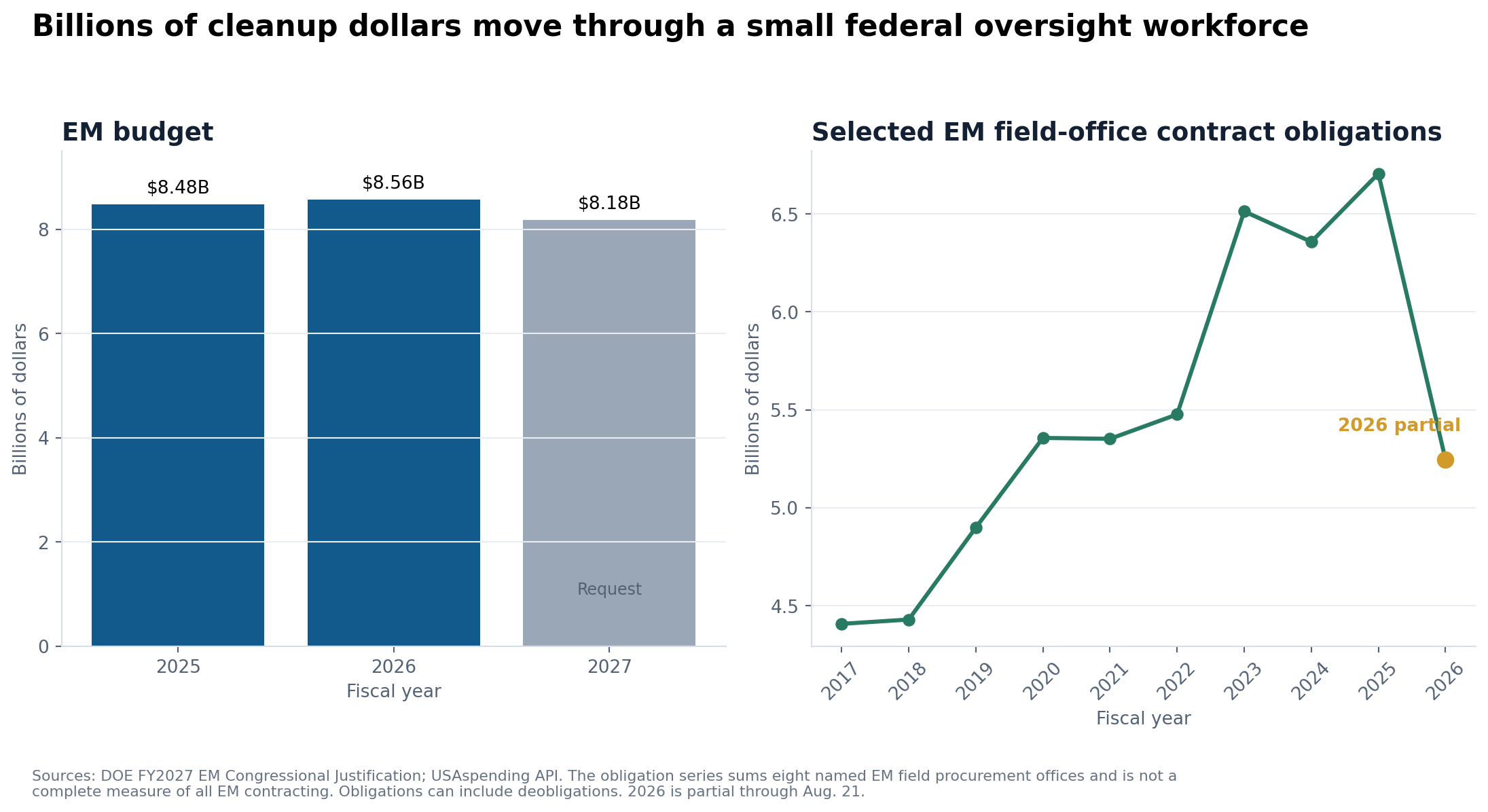
It would be tempting to divide those dollars by 856 employees and call the result productivity or workload. That would be misleading. Budget authority, contract obligations, contractor labor and federal headcount measure different things. The valid conclusion is more modest: billions of dollars and a multi-decade hazardous-cleanup portfolio move through an oversight structure whose federal staffing capacity fell sharply.
Related research
Put this finding in context
Data investigationsAugust 18, 2026
FEMA's Public Workforce Count Fell 22% as GAO Warned of Readiness Risks
FEMA had 5,793 fewer covered civilian employees in June 2026 than in January 2025. GAO says the agency cut staff without the workforce planning needed to assess mission capacity.

Data investigationsAugust 21, 2026
VHA's Federal Workforce Fell by 28,342. Its Care Forecast Kept Rising.
VA's health workforce contracted after late 2024 even as patient, visit and community-care demands remained large. The losses reached clinical and coordinating roles.
Recruiting records show a thin public pipeline, with limits
The FederalHiringData historical USAJOBS archive provides a recruiting context from March 2017 through August 14, 2026. Across Department of Energy announcements containing general engineering, nuclear engineering, contracting or general physical science, the archive contains 2,958 distinct announcements. Only 304 began at GS-9 or below, and 36 carried an explicit early-career signal such as a recent-graduate or student pathway.
Those counts are DOE-wide, not EM-specific. Older source records frequently identify the department or a broad office rather than preserving a stable Environmental Management suborganization. Only 10 archived announcements used an agency name that explicitly identified EM, and just one of those 10 named the public as an eligible hiring path. That does not mean EM publicly advertised only one job. It means the source taxonomy is too incomplete to produce a credible EM total.
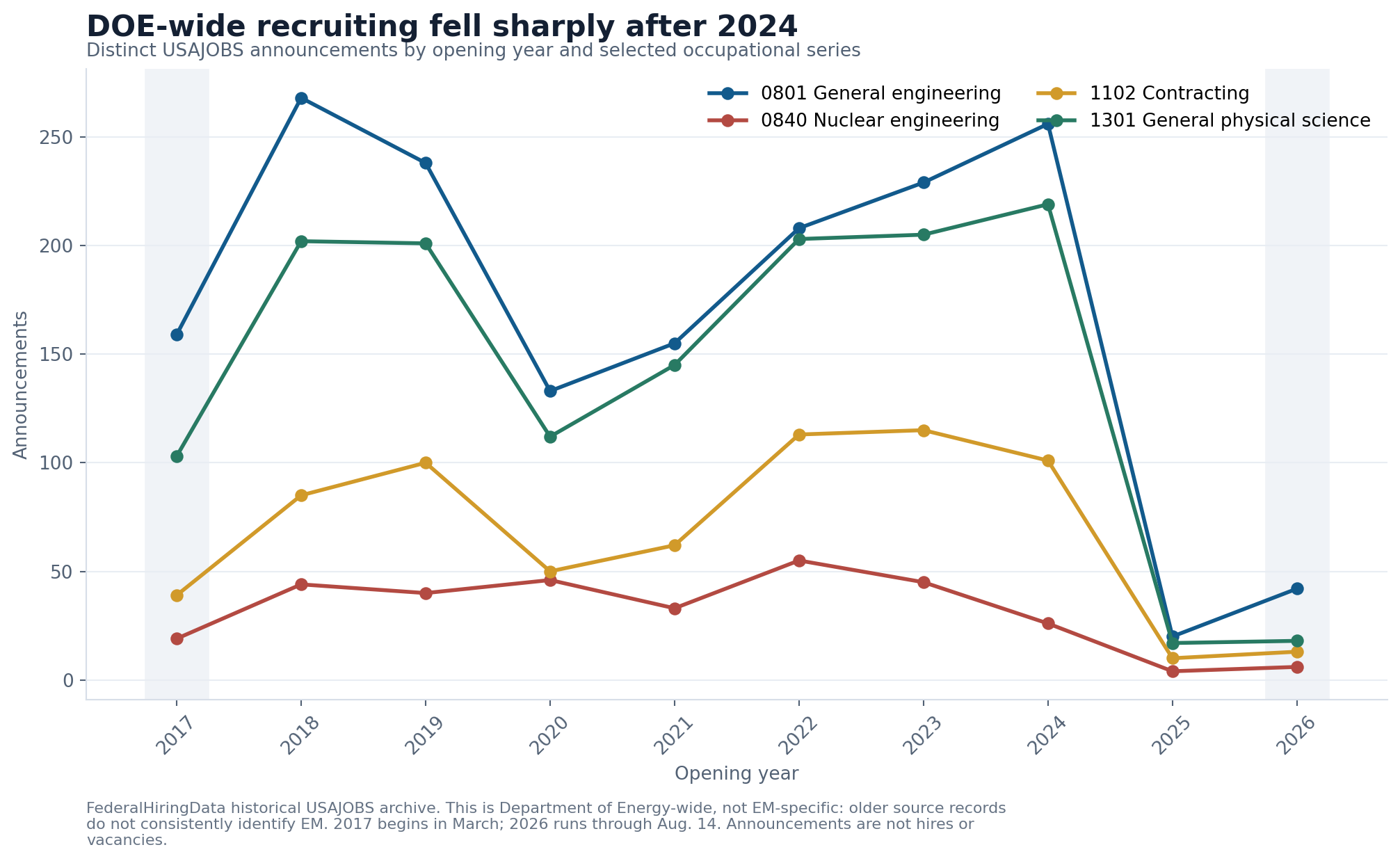
The DOE-wide series fell sharply after 2024 across all four occupations. The 2026 observation is partial, and 2017 begins in March. An announcement can cover multiple grades, locations or positions, while some announcements recruit for more than one occupational series. Announcements are not vacancies, applications, selections or hires.
Even with those limits, the records reinforce the pipeline problem in one useful way: explicit early-career recruiting was a small minority of the selected technical and contracting announcements in the archive. They cannot tell us how many people EM ultimately hired, but they show how little of the visible recruiting inventory was clearly designed as a long runway into these occupations.
What the evidence says about oversight risk
The evidence supports three conclusions.
First, the federal oversight workforce shrank abruptly. The end-fiscal-2025 level was one-third below the end-fiscal-2023 count and below GAO's annual observations back to 2014. This was not simply a vacancy denominator changing on a spreadsheet.
Second, the losses landed in jobs that were already difficult to fill and slow to develop. Engineering, physical science and contracting accounted for 307 of the 348 vacancies in the six critical series. Training and qualification can take from a year to many years, depending on the role. A planned hiring number does not translate immediately into independently qualified oversight.
Third, contractors can absorb tasks and keep projects moving, but that mitigation has limits that the public records do not fully measure. GAO could not establish one reliable count of support and technical-assistance contractors, and the available data does not show the quality or timeliness of every oversight decision. The system may remain operational while becoming less able to absorb another retirement, a project problem or an unexpected safety demand.
The counterevidence matters just as much. EM hired more than 300 federal staff in fiscal 2023, demonstrating that a hiring surge was possible, though GAO reported in 2024 that leaders did not expect that pace to continue. EM planned 174 hires for fiscal 2026. Work had not stopped because of vacancies as of December 2025. The public evidence does not show that a particular cleanup milestone slipped or a safety event occurred because a named position was empty.
The risk visible here is institutional: less federal depth, more work shifted around vacancies, and a long qualification cycle at the same time a large share of the remaining workforce can become retirement-eligible. For an organization directing an $8 billion annual program and a cleanup liability measured in hundreds of billions, that is a capacity problem worth tracking even before it produces a crisis.
Methodology and limitations
Federal workforce counts, vacancies, separations, retirement eligibility, qualification timelines and contractor-mitigation findings come from GAO-26-108674. Earlier vacancy and hiring context comes from GAO-24-106479. GAO analyzed DOE's internal DOEInfo human-capital data and EM staffing records. Public OPM files identify DOE and the Federal Energy Regulatory Commission as subelements but do not expose EM as a stable subelement, so this analysis does not manufacture an EM-specific OPM trend.
The 2014-2024 workforce series counts active employees during each fiscal year. The 856 figure is end-fiscal-2025 onboard staff. Vacancy rates divide reported vacancies by onboard staff plus vacancies, retaining the position need EM identified in fiscal 2023. Staff, vacancies, FTE plans, federal employees, support contractors and site contractors remain separate throughout.
Budget figures come from DOE's fiscal 2027 EM Congressional Justification. Contract obligations come from the USAspending agency API and include eight selected EM field procurement office codes. That series is not complete EM contracting, and fiscal 2026 is partial through August 21. The USAJOBS analysis uses distinct archived announcements, not job openings or hires, and is DOE-wide because historical EM identity is incomplete.
The hero photograph is a July 2026 Department of Energy image of Hanford crews using long-reach tools during high-risk cleanup. It illustrates the field environment; the pictured workers are not identified here as federal employees. Data and text were researched and written without OpenAI API calls.
Continue reading
More from FederalHiringData
Data investigationsAugust 18, 2026
IRS Workforce Fell 29% as GAO Warned of Filing-Season Risks
The IRS had 29,663 fewer covered civilian employees in June 2026 than in January 2025. GAO says workforce-planning gaps and post-filing pressures pose risks to future operations.
Data investigationsAugust 19, 2026
The Federal Workforce Shrunk by 286,000. DOGE's Savings Are Harder to Prove
FederalHiringData finds a 12.4% workforce contraction and an estimated $22.8 billion decline in annualized basic-pay cost, while the public savings ledger remains incomplete.

Data investigationsAugust 21, 2026
National Park Visits Rose 13%. September Staffing Fell 17%.
The park system still builds a summer workforce, but same-month OPM data show a thinner permanent base beneath 323 million annual visits.
Federal Hiring Data Weekly
Get the biggest federal workforce changes in your inbox.
Subscribe to Federal Hiring Data Weekly for federal hiring trends, salary data, agency movements, and original investigations, with email confirmation before delivery.