August 23, 2026
Passport Waits Fell. State's Plan for the Next Surge Is Still Unfinished.
State rebuilt passport staffing and processed record demand after the 2023 crisis, but key measures of durable surge capacity remain unpublished.
By Evan Mercer
Published August 23, 2026Last edited August 23, 2026
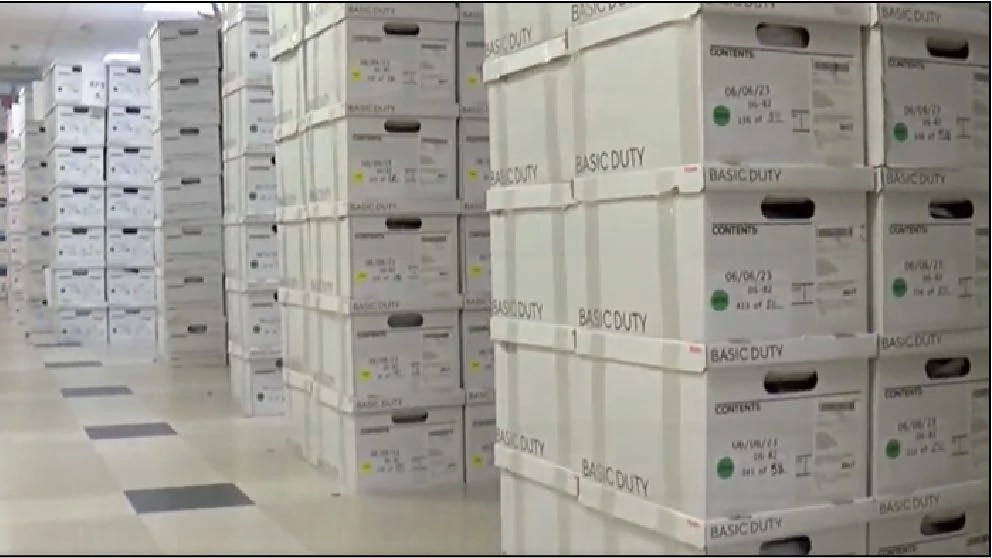
In 2023, passport applications filled rows of file boxes at the National Passport Center in Portsmouth, New Hampshire. The State Department began that fiscal year with 1.3 million applications already pending, staffed for 16.5 million new applications and expecting 19.9 million. It received 21.6 million.
By the summer, routine applications were taking an average of 10.5 weeks. About 1,200 passport specialists worked more than 250,000 hours of overtime during the year. Mandatory overtime averaged 12 to 24 hours a month, and one site reported an average of 24 hours a week.
Three years later, the visible crisis has receded. State hired hundreds of specialists, expanded customer-service staffing, launched online renewal and recorded much faster processing in fiscal 2024. It then accepted a record 23.3 million applications in fiscal 2025. The department's current public commitment is four to six weeks for routine service and two to three weeks for expedited service, excluding mailing time.
The recovery was real. The harder question is whether it is durable.
The latest public evidence does not yet answer that question. The most recent exact Passport Services specialist count is from July 2024. Six new passport agencies remain planned rather than listed as open. And the Government Accountability Office still classifies two recommendations about State's 83-project transformation roadmap as open.
State built substantially more capacity after the 2023 breakdown. But the public record still cannot show whether that system could absorb another surprise surge without returning to extraordinary overtime.
The crisis was years in the making
Passport demand has more than tripled since 2000. State received 7.37 million applications that year and 23.31 million in fiscal 2025. The long rise was not smooth: renewal cycles, travel disruptions and seasonal demand produced sharp peaks and valleys.

The 2023 backlog was not caused by demand alone. In its 2025 review of passport services, GAO traced part of the staffing shortfall to the federal hiring freeze imposed in 2017 and to workforce losses that continued afterward.
State had 1,296 passport specialists at the beginning of fiscal 2017. The count was nearly unchanged in 2018, then fell to 1,238 in 2019 and 1,170 in 2020. It remained below the 2017 level at the beginning of every fiscal year through 2023.

That erosion mattered because a new specialist cannot immediately carry a full caseload. State told GAO that it can take about 16 months for a new employee to become fully productive. Experienced workers must train new hires and audit their work, temporarily drawing capacity away from ordinary adjudication.
The system had also relied on overtime during an earlier demand cycle. GAO reported about 163,000 adjudicative overtime hours across eight consecutive months in fiscal 2017. When demand surged again in 2023, overtime became the release valve on a much larger scale.
The same-season comparison shows how far performance slipped.
| Service | May-July 2019 average | May-July 2023 average |
|---|---|---|
| Routine processing | 5.2 weeks | 10.5 weeks |
| Expedited processing | 2.4 weeks | 6.1 weeks |
These are actual average processing times for the same months, not advertised service commitments. The comparison is important because passport demand is seasonal; State says its busiest period generally runs from late winter through summer.
Overtime helped State move the backlog, but it carried a cost. GAO found attrition above 20% in 2023, the highest rate in nearly a decade. Officials said overtime was essential to meeting demand and also contributed to employees leaving. A system that depends on experienced specialists to train replacements can be weakened twice when those specialists are overextended.
Hiring and processing both recovered
State did not simply wait for volume to fall. It obtained direct-hire authority from the Office of Personnel Management in November 2023 and pushed specialist staffing toward a goal of 1,600. By July 2024, the exact count had reached 1,540, an increase of 328 from the beginning of fiscal 2023.
Processing improved even more visibly. State's fiscal 2024 performance report put average routine processing at 2.8 weeks and expedited processing at 1.2 weeks. The monthly peaks were 5.9 and 3.2 weeks, respectively. That was a dramatic reversal from fiscal 2023, when the annual averages were 8.7 weeks for routine service and 5.0 weeks for expedited service.

The department then handled record application volume. It received 23,308,976 applications in fiscal 2025, about 8% more than in fiscal 2023. It issued 27,348,416 passport books and cards. Those figures are not directly interchangeable: one application can result in both a book and a card, and production can cross fiscal-year boundaries.
The record volume is strong counterevidence to any claim that the recovery was cosmetic. State processed more demand after the crisis while maintaining a much shorter public service commitment. It also expanded the National Passport Information Center from just over 500 call agents in fiscal 2020 to more than 1,600 in fiscal 2024, reducing a separate customer-service bottleneck.
But the latest exact staffing number remains July 2024. Public federal workforce data can extend the story into 2026 only with a broader category: OPM occupational series 0967, Passport and Visa Examining. That series includes visa examiners and therefore cannot be treated as the Passport Services specialist roster.
The broader workforce reached 2,073 employees in September 2025 and measured 2,009 in June 2026, a 3.1% decrease. The change is worth watching, but it does not establish that passport specialist staffing declined.

The age profile does not show a workforce concentrated near retirement, but it does show why retention matters. In June 2026, 671 of the broader 2,009 examiners were under 40, while 1,040 were age 45 or older. Public data do not identify which age groups worked on passports rather than visas or how many held the experience needed to train new specialists.
Personnel actions show a burst of rebuilding followed by a slower year. Series 0967 recorded 379 accessions and 128 separations in calendar 2023, then 345 accessions and 137 separations in 2024. In 2025, it recorded 106 accessions and 126 separations. These are personnel-action events, not verified counts of unique employees, and their simple difference should not be read as a precise change in passport staffing.
Federal Hiring Data Weekly
Get the biggest federal workforce changes in your inbox.
Subscribe to Federal Hiring Data Weekly for federal hiring trends, salary data, agency movements, and original investigations, with email confirmation before delivery.
Recruiting slowed after the emergency push
The FederalHiringData historical USAJOBS archive provides another signal. It contains 135 State Department announcements with passport-related titles opened in 2023, 78 in 2024, 36 in 2025 and 31 from Jan. 1 through Aug. 14, 2026.

The archive also contains 53 announcements using the exact title "Passport Specialist - Direct Hire Authority" from 2023 through Aug. 14, 2026. That includes 12 in 2023, 18 in 2024, 15 in 2025 and eight in the partial 2026 period.
Announcement counts are not vacancy or hiring counts. A single announcement can cover multiple locations or positions, and a closed posting does not prove that anyone was selected or entered training. The archive begins approximately in March 2017, so the earlier years are incomplete. Still, the pattern is consistent with an urgent 2023-24 recruiting campaign that became less intensive after staffing recovered.
Readers can browse current State Department jobs separately. The historical announcements analyzed here should not be assumed to remain open.
Modernization added capacity, but it also created work
State's online passport renewal program is the clearest public-facing change. The department fully launched it in September 2024, and more than one million applications had been submitted online by late 2024.
It would be tempting to turn adoption into a claim about labor savings. The evidence does not support that shortcut.
GAO found that the 2023 pilot initially made specialists far less productive. Employees processing online renewals handled about eight applications a day, compared with about 200 paper applications, and State dedicated roughly 30% to 44% of its specialist workforce to the pilot during the period GAO reviewed. The department said the system was fully operational and working well by October 2024, after the pilot problems were addressed.
That history does not mean online renewal is failing today. It shows that modernization can consume scarce staff before it releases capacity. State has not publicly quantified the current specialist hours saved per online application, so adoption alone cannot answer whether the digital channel made the workforce more resilient.
The broader transformation plan has the same unfinished quality. State created an 83-project roadmap covering staffing, technology, facilities and operations. In the latest detailed GAO review, 24 projects designated as critical path had defined milestones. The other 59 did not. The critical-path projects were expected to be completed by the end of fiscal 2027, while the full roadmap extended to 2030.
GAO recommended that State add measurable milestones to the rest of the roadmap and fully assess the staff and funding required to deliver it. Both recommendations remained open when FederalHiringData checked their public status on Aug. 23, 2026.
Six new agencies remain part of the future capacity plan
Related research
Put this finding in context
Data investigationsAugust 23, 2026
The Forest Service Set a 4-Billion-Board-Foot Timber Goal. Key Staff Fell 22%.
Timber sales rose 29% through June, but nine occupations needed to plan, contract and oversee forest projects had 1,445 fewer employees than in 2024.
Data investigationsAugust 23, 2026
FAA's Aviation-Weather Network Was Designed for 90 Meteorologists. Staffing Fell to 69.
The last verified federal count found 69 meteorologists in a 90-position aviation-weather design. Public records show recruiting in 2026, but not a verified recovery.
State has also announced six new passport agencies in Salt Lake City, Kansas City, Orlando, Charlotte, San Antonio and Cincinnati. The expansion would bring in-person urgent service closer to millions of residents, but it should not yet be counted as operating capacity.
| Planned passport agency | Latest public timing found |
|---|---|
| Cincinnati, Ohio | Tentatively fall 2026 |
| Kansas City, Missouri | Tentatively fall 2026 |
| Charlotte, North Carolina | No later than 2028 |
| Orlando, Florida | No later than 2028 |
| Salt Lake City, Utah | No later than 2028 |
| San Antonio, Texas | No later than 2028 |
The Congressional Research Service reported that schedule in January 2026. State's public directory still listed 27 open passport agencies and centers when checked Aug. 23; the six planned sites were not listed as open. Public documents reviewed for this article did not disclose current onboard staffing for each planned location.
Facilities can improve access without necessarily increasing national adjudication capacity by the same amount. The effect depends on staffing, how work is routed and whether the new sites add trained specialists or redistribute existing ones. Those details are not yet public.
What would prove the system is ready for the next surge
State's current passport processing page advertises four to six weeks for routine service and two to three weeks for expedited service. Those are service commitments, not a published series of actual 2026 completion times. Mailing can add time at both ends.
The distinction matters because the question is no longer whether State escaped the 2023 backlog. It did. The question is whether the underlying capacity can withstand another demand error like the one that year, when applications exceeded staffing assumptions by 5.1 million.
A convincing public answer would include five measures: an updated exact Passport Services specialist count; actual average and peak processing times on a consistent basis; current overtime and attrition rates; project-level progress for all 83 roadmap initiatives; and staffing and opening dates for the six new agencies.
Those measures would separate permanent capacity from temporary effort. They would also show whether online renewal and other technology reduced workload after their costly implementation period.
The evidence available now supports a narrower conclusion. State rebuilt specialist staffing, processed a record application volume and sharply reduced waits. That recovery deserves to be recognized. But the department's own transformation extends through 2030, critical details remain unpublished, and GAO's recommendations remain open.
Passport processing recovered. The proof that the next surge would be absorbed without another overtime emergency is still unfinished.
Methodology and limitations
FederalHiringData combined Department of State passport application and issuance statistics, State annual performance reports, GAO reviews, the January 2026 Congressional Research Service summary, OPM FedScope and Federal Workforce Data, and the FederalHiringData historical USAJOBS archive.
The long-run workforce series uses September observations for 2000 through 2025 and labels June 2026 separately. OPM series 0967 combines passport and visa examining and is not the same as GAO's exact Passport Services specialist count. Personnel actions are events rather than verified unique workers.
USAJOBS counts cover passport-title announcements opened through Aug. 14, 2026. The archive begins approximately in March 2017. Announcements do not equal positions, applications, selections or hires.
Fiscal 2025 applications and products issued are reported separately because they are not one-to-one measures. Current processing figures are State's service commitments and exclude mailing time; this analysis does not present them as actual average completion times. Exact 2026 specialist staffing, current overtime, fiscal 2025 actual average processing time, staffing at the six planned agencies and labor savings from online renewal were not available in the official sources reviewed.
The hero image is a Department of State photograph reproduced in GAO-25-107164. It shows passport application boxes at the National Passport Center in Portsmouth during the fiscal 2023 backlog.
Explore more federal workforce statistics, search the historical federal jobs archive, browse current federal jobs and read more FederalHiringData investigations.
Continue reading
More from FederalHiringData

Data investigationsAugust 21, 2026
VHA's Federal Workforce Fell by 28,342. Its Care Forecast Kept Rising.
VA's health workforce contracted after late 2024 even as patient, visit and community-care demands remained large. The losses reached clinical and coordinating roles.

Data investigationsAugust 21, 2026
National Park Visits Rose 13%. September Staffing Fell 17%.
The park system still builds a summer workforce, but same-month OPM data show a thinner permanent base beneath 323 million annual visits.
Data investigationsAugust 18, 2026
FEMA's Public Workforce Count Fell 22% as GAO Warned of Readiness Risks
FEMA had 5,793 fewer covered civilian employees in June 2026 than in January 2025. GAO says the agency cut staff without the workforce planning needed to assess mission capacity.
Federal Hiring Data Weekly
Get the biggest federal workforce changes in your inbox.
Subscribe to Federal Hiring Data Weekly for federal hiring trends, salary data, agency movements, and original investigations, with email confirmation before delivery.