August 28, 2026
Federal Bargaining-Unit Coverage Fell by 579,903. Most of That Was Not Job Loss.
Federal represented bargaining-unit coding fell by 579,903 through May 2026. Defense drove 45% of the change, but the count is not job loss or union membership.
By Evan Mercer
Published August 28, 2026Last edited August 28, 2026
In January 2025, federal personnel records counted 1,294,304 employees in positions represented by bargaining units. By May 2026, that count was 714,401.
The difference was 579,903 employees.
That number is real. Its most obvious interpretation is wrong.
The federal workforce did shrink over those 16 months, but not by 579,903. Total covered headcount in the same Office of Personnel Management records fell by 278,592, from 2,304,585 to 2,025,993. The much larger change in bargaining-unit coverage reflects a second event layered on top of those departures: hundreds of thousands of positions were recoded after the administration excluded agencies from the federal labor-relations statute and instructed agencies to mark affected employees ineligible for bargaining-unit representation.
Defense shows the distinction most clearly. Its represented count fell by 262,899, from 390,240 to 127,341. Defense headcount fell by 89,668 over the same endpoints. A person can therefore disappear from the represented column without disappearing from the payroll count.
FederalHiringData's analysis finds that Defense supplied 45.3% of the clean governmentwide coverage decline. It also finds signs of the policy's stated exceptions: Defense fire-protection and police occupations retained far more represented coding than information technology, contracting or program-analysis positions.
The findings do not measure dues-paying union membership. They do not count every collective bargaining agreement that was terminated. And they do not show that a loss of agreement coverage caused an employee to lose a job. They show how the legal exclusions were translated into the monthly personnel record, alongside a separate and substantial workforce reduction.
A bargaining-unit code is not a union membership roll
The basic distinction begins with Block 37 of the federal SF-50 personnel form.
OPM's Guide to Processing Personnel Actions says a four-digit Bargaining Unit Status code identifies whether the position occupied by an employee is represented. A specific unit receives a specific code after the Federal Labor Relations Authority certifies it and OPM records it in the Federal Labor Management Information System, or FLIS.
Two universal codes handle employees outside an active unit:
| BUS code | OPM meaning | What it does not mean |
|---|---|---|
| 7777 | Eligible for representation, but not included in a bargaining unit | Not proof that the employee rejected membership |
| 8888 | Ineligible for inclusion in a bargaining unit | Not proof that the employee left federal service |
| Specific four-digit code | Position is included in the certified unit associated with that code | Not proof that the employee pays union dues |
OPM's 2023 bargaining-unit review memo is explicit: the code follows the position, and a specific unit code does not indicate whether the employee is a union member. OPM's union-membership guidance separately explains that membership is voluntary and involves becoming a dues-paying member. An exclusive representative must represent the interests of everyone in the unit without regard to membership.
That is why "represented employee" is the right label for this analysis. "Union member" is not.
The distinction also separates two official databases that are easy to blur together. FLRA determines the appropriate unit and certifies its representative. OPM's FLIS stores the recognition profile, description and unit code. OPM's monthly EHRI Status data then count employees whose positions carry those codes. A unit profile is a legal and organizational record. The monthly headcount is a personnel snapshot. They are related, but they are not identical measures.
A stable series broke after the exclusions
For a decade before 2025, OPM's represented count moved gradually. It was 1,176,730 in January 2015, 1,201,906 in January 2019, 1,235,735 in January 2021 and 1,276,384 in January 2024. It reached 1,294,304 in January 2025.
Then the status mix changed.

President Donald Trump issued Executive Order 14251 on March 27, 2025. The order invoked statutory authority to exclude listed agencies and subdivisions from Chapter 71 of Title 5 after determining that they had primary intelligence, counterintelligence, investigative or national-security functions and that the labor statute could not be applied consistently with national-security requirements. It included nearly all of Defense and many other departments or subdivisions. A later order expanded the list.
The monthly represented count was still 1,265,695 in June 2025. It fell to 839,795 by September and 783,501 by December. It reached 735,175 in March 2026, rose to 886,115 in April and fell to 714,401 in May.
Those reversals are not a plausible series of mass union joins and resignations. They track policy implementation, court orders and HR coding.
OPM said in its June 2026 release notes that an April increase came from a court order requiring Veterans Affairs to restore a union contract for more than 300,000 employees. OPM's February 2026 implementation FAQ instructed agencies to change affected employees' status to 8888. The code shift visible in the data is therefore part of the implementation itself.
The indexed comparison makes the scale clearer. By May 2026, total covered headcount stood at 87.9% of its January 2025 level. Represented coding stood at 55.2%.

This does not make the headcount decline unimportant. A reduction of 278,592 covered employees is substantial. It means the same period contains both fewer employees and fewer statutory bargaining relationships. The error is to assign the whole 579,903 coverage change to only one of those processes.
Defense drove 45% of the clean decline
No department contributed more to the represented-code change than Defense.
| Department | Represented, Jan. 2025 | Represented, May 2026 | Coverage-code change | Total headcount change |
|---|---|---|---|---|
| Defense | 390,240 | 127,341 | -262,899 | -89,668 |
| Veterans Affairs | 374,566 | 272,673 | -101,893 | -33,343 |
| Treasury | 84,905 | 4,741 | -80,164 | -32,407 |
| Homeland Security | 122,350 | 93,968 | -28,382 | -6,217 |
| Health and Human Services | 39,380 | 16,820 | -22,560 | -20,211 |
| Commerce | 20,911 | 5,480 | -15,431 | -7,974 |
| Environmental Protection Agency | 12,036 | 322 | -11,714 | -4,374 |
| NASA | 9,732 | 7 | -9,725 | -4,116 |

The paired columns should not be read as a simple subtraction that reveals exactly how many employees were "only recoded." Aggregate monthly files do not link a January employee to a May record. People were hired, separated, transferred and reorganized. Some records were redacted or corrected. But the size mismatch is decisive: Defense cannot have lost 262,899 represented employees through a total workforce decline of 89,668 alone.
The same problem appears in percentage terms. Defense had 774,572 covered civilians in January 2025, and 390,240, or 50.4%, carried represented unit codes. In May 2026, it had 684,904 civilians, and 127,341, or 18.6%, carried those codes.

The turning point was April and May 2026. On April 9, the Defense secretary issued a termination memorandum. Defense followed on April 22 with 17 pages of implementation instructions. Components were directed to terminate applicable agreements, revise position records and notify affected employees, subject to exemptions and court orders.
The public EHRI series follows that schedule. Defense represented coding was 353,049 in March, 294,314 in April and 127,341 in May. At the same time, the not-eligible category rose from 202,775 in March to 296,365 in April and 529,514 in May.
That is an administrative signature of implementation. It is not an independently verified count of terminated agreements.
The services did not move uniformly
Defense is not one personnel system in practice. The Navy, Army, Air Force and department-wide agencies entered the change with different unit structures, occupations and court-order exposure.
| Defense organization | Jan. 2025 represented | May 2026 represented | Jan. share of headcount | May share |
|---|---|---|---|---|
| Navy | 102,042 | 51,780 | 46.1% | 25.8% |
| Army | 108,968 | 13,756 | 49.3% | 7.3% |
| Air Force | 86,462 | 44,382 | 49.9% | 29.3% |
| Defense agencies | 92,768 | 17,423 | 58.4% | 12.0% |

Federal Hiring Data Weekly
Get the biggest federal workforce changes in your inbox.
Subscribe to Federal Hiring Data Weekly for federal hiring trends, salary data, agency movements, and original investigations, with email confirmation before delivery.
The Army had the largest absolute decline, down 95,212 represented-coded employees. The department-wide Defense category fell by 75,345, the Air Force by 42,080 and the Navy by 50,262.
These are organizational totals, not a list of which local contracts ended. A service can contain units exempted by occupation, units covered by a court order, certified wage-system subdivisions and non-exempt populations. The surviving represented count should not be interpreted as one uniform policy decision.
OPM's separate fiscal 2024 union-time report illustrates another denominator problem. It listed 459,602 Defense bargaining-unit employees for that agency-reported program measure. Monthly EHRI Status counted 394,799 represented Defense employees in September 2024. The 64,803 difference does not prove either source is wrong. The report and monthly file use different reporting processes, timing and coverage. FederalHiringData does not force them into one series.
The OPM labor-unions dashboard likewise combines FLIS unit profiles with EHRI employee counts. Visible May 2026 EHRI examples include code 2457 for a Social Security Administration national unit with 34,895 employees, code 2009 for a Forest Service unit with 19,857, and code 0061 for a National Air Traffic Controllers Association unit at the Federal Aviation Administration with 14,757. Those codes show how certification records map into personnel data. They do not provide a clean public roster of every Defense agreement affected in 2026, because much of Defense's unit detail is redacted or replaced by 8888.
The occupation pattern matches the stated exceptions
Defense's instructions did not apply identically to every occupation. They said police officers, firefighters, security guards and employees in their immediate local employing offices remained covered by the statute. They also preserved specified federal wage-system employees at four certified subdivisions and told components to exempt units protected by active court orders.
The occupation data line up with that design.
| Defense occupation | Represented, Jan. 2025 | Represented, May 2026 | May as share of Jan. |
|---|---|---|---|
| Fire protection and prevention (0081) | 7,071 | 6,561 | 92.8% |
| Police (0083) | 4,788 | 4,156 | 86.8% |
| Sheet metal mechanic (3806) | 5,355 | 3,932 | 73.4% |
| General education and training (1701) | 5,875 | 4,193 | 71.4% |
| General business and industry (1101) | 9,217 | 5,396 | 58.5% |
| Engineering technical (0802) | 9,330 | 3,926 | 42.1% |
| Contracting (1102) | 16,219 | 3,668 | 22.6% |
| Management and program analysis (0343) | 12,142 | 2,443 | 20.1% |
| Information technology (2210) | 18,369 | 2,921 | 15.9% |
| Nurse (0610) | 7,119 | 111 | 1.6% |

Fire and police were the two clearest high-retention occupations among the large series reviewed. That is consistent with the written exception. It does not establish that every employee in those series was covered, or that every remaining code comes from the occupational exception. Unit composition and court orders can also matter.
The decline also crossed the middle of the grade distribution. Represented coding fell by 49,317 at reported grade 11 and 53,124 at grade 12. Grade 9 fell by 32,662 and grade 13 by 24,628. Grade labels span multiple pay plans in the released file; they should not all be read as General Schedule grades.

Geography would have added another important dimension, but the current public release redacts Defense duty-station geography in the relevant records. FederalHiringData did not substitute an old geography, infer locations from installation names or present a national map with fabricated precision. The missing geography is a limitation, not a blank to fill with assumptions.
Workforce cuts happened too, but they are a different count
The policy change occurred during an actual Defense workforce contraction.
Defense fell from 774,572 covered civilians in January 2025 to 684,904 in May 2026. The dynamics files recorded 116,179 Defense separation actions and 33,910 accession actions during calendar 2025. Of those, 56,095 separations and 17,794 accessions carried represented status at the time of the action.
Those numbers show that employees in represented positions were part of the workforce reduction. They do not support a person-level estimate of how many employees affected by the bargaining exclusions were separated.
There are three reasons. First, an accession or separation is a personnel action, not necessarily a unique person entering or leaving the entire federal government. Transfers and conversions can affect the action files. Second, the status is recorded at the time of the action; after agencies changed codes to 8888, an employee from a formerly represented position could appear in the not-eligible category. Third, the public data contain no stable person identifier that would permit FederalHiringData to follow a January cohort through May.
The correct conclusion is narrower: real headcount reductions and a much larger representation-code change happened together. The public aggregates cannot assign each departure to a bargaining status that remained constant throughout the period.
The legal result remains unit-specific
The legal record is not a simple story in which one court either invalidated or approved every exclusion.
Related research
Put this finding in context

WorkforceAugust 28, 2026
The Federal Workforce Was Ordered Back to Offices. Washington-Area Headcount Fell by 47,998.
OPM records show Washington-area headcount and share fell after the 2025 return-to-office order as separations surged and hiring contracted.

Data investigationsAugust 25, 2026
The Coast Guard Plans to Add 15,000 Military Members. Only 26% of Its Workforce Requirements Are Current.
Recruiting rebounded, but cutter vacancies widened and covered civilian employment fell 9.9% as Force Design accelerated.
In June 2025, a federal district court issued a broad preliminary injunction in *AFGE v. Trump*. On Feb. 26, 2026, the Ninth Circuit vacated that preliminary injunction. The appeals court concluded that the union plaintiffs had not shown likely success on the preliminary record, giving substantial weight to the administration's national-security rationale. The court also emphasized that preliminary relief is not a final merits judgment and did not resolve every legal theory.
The administration argues that Congress delegated authority to exclude agencies whose national-security functions cannot be reconciled with Chapter 71, and that collective bargaining can impede the responsiveness needed in those missions. The union plaintiffs argued that the selections were retaliatory, exceeded delegated authority and unlawfully stripped statutory and contractual rights. The Ninth Circuit's preliminary-injunction ruling favored the government on the record before it. It did not erase every separate order involving a particular union or agreement.
Veterans Affairs supplies the clearest counterexample. A separate union obtained an order requiring a VA agreement to be reinstated. In May 2026, the First Circuit left the central reinstatement relief in place while staying part of a broader compliance directive. OPM's monthly series visibly responds to that order.
Defense's own implementation document acknowledges the same reality. Components must consult their legal offices and exclude from implementation non-exempt employees represented by plaintiff unions who remain covered by a court order. On Aug. 4, the Federal Mediation and Conciliation Service issued an interim arbitration rule saying litigation and court orders may affect particular requests.
As of this publication, the broad exclusion is being implemented, but agreement and unit status can still depend on occupational exceptions, certified subdivisions and specific court orders. Saying "all federal union contracts were canceled" would be false. Saying "nothing changed because litigation continues" would also be false.
What the public record cannot count
The sharp numerical change invites a precise answer to a question the public files cannot support: exactly how many collective bargaining agreements were terminated?
Defense's April instructions provide templates and a process, not an audited agreement-by-agreement total. OPM's collective-bargaining repository contains submitted agreements, but a document's presence does not establish its current enforceability for every covered employee. FLIS identifies certified units, while EHRI identifies monthly employee status. Court orders can protect a subset of a unit or plaintiff group. Redaction removes many Defense unit details from the public employee file.
FederalHiringData therefore does not convert the 262,899 Defense coding decline into 262,899 employees covered by canceled contracts. Some employees were separated. Some were recoded under the order. Some remained represented because of exceptions or litigation. The aggregate files cannot allocate every person among those categories.
Nor can the analysis count dues-paying members. A represented unit includes members and nonmembers. The data contain no membership field. Any claim that "579,903 people left federal unions" would confuse legal representation with voluntary membership.
The latest June snapshot needs one more warning. It reports 679,078 represented employees, or 34.8% of 1,953,300 covered records. OPM says approximately 83,000 Defense records are absent because of a processing change and expects a corrected release. This article uses May for the clean endpoint and shows June only as the latest provisional official total.
What changed for the federal workforce
The 2025-2026 exclusions changed the structure of federal labor relations on a scale that the monthly workforce record can see.
Before the orders, more than half of the OPM-covered civilian workforce carried represented bargaining-unit codes. By May 2026, the clean share was 35.3%. Defense's represented share fell from 50.4% to 18.6%. Treasury, EPA, NASA and parts of other departments also moved sharply toward 8888 coding. Court-ordered restoration at VA moved the series back in the other direction for a time.
That structure matters for bargaining over working conditions, grievance and arbitration procedures, information requests and the role of an exclusive representative. It does not eliminate the civil-service laws and personnel protections that continue to apply outside Chapter 71. It also does not, by itself, tell managers or employees how a particular dispute will be handled. Their answer can depend on agency, unit, occupation, agreement and court order.
For readers trying to understand the scale, the best current answer is therefore two numbers, not one.
First, represented bargaining-unit coding fell by 579,903 between January 2025 and the last clean May 2026 endpoint. Defense accounted for 262,899, or 45.3%, of that change.
Second, total OPM-covered headcount fell by 278,592 over the same period. The workforce reduction was large, but it was less than half the representation-code decline.
The gap between those numbers is not a rounding error. It is the evidence that a labor-relations classification changed across a workforce that was also shrinking.
Methodology and limitations
FederalHiringData queried OPM/Federal Workforce Data monthly Status records from January 2015 through June 2026 and Dynamics accessions and separations for calendar 2025. Counts are sums of OPM's released count field. "Represented" means the released status `ELIGIBLE_IN_BU`; "eligible, no unit" maps to 7777; and "not eligible" maps to 8888. January 2025 is the pre-order endpoint. May 2026 is the clean comparison endpoint because OPM reported no significant issue in that release and later disclosed a June Defense submission gap.
The analysis covers the population in OPM's public EHRI/FWD files, not every person employed by the federal government. Sensitive fields and some agencies or components are excluded or redacted under OPM's release policy. The latest file is a monthly stock; accessions and separations are actions and are not linked to people in this analysis.
Primary sources include Executive Order 14251, OPM's BUS-code review memo, implementation FAQ, labor dashboard and release notes; Defense's April 2026 instructions; the Ninth Circuit's February 2026 opinion; the First Circuit's May 2026 order; and the August 2026 FMCS rule.
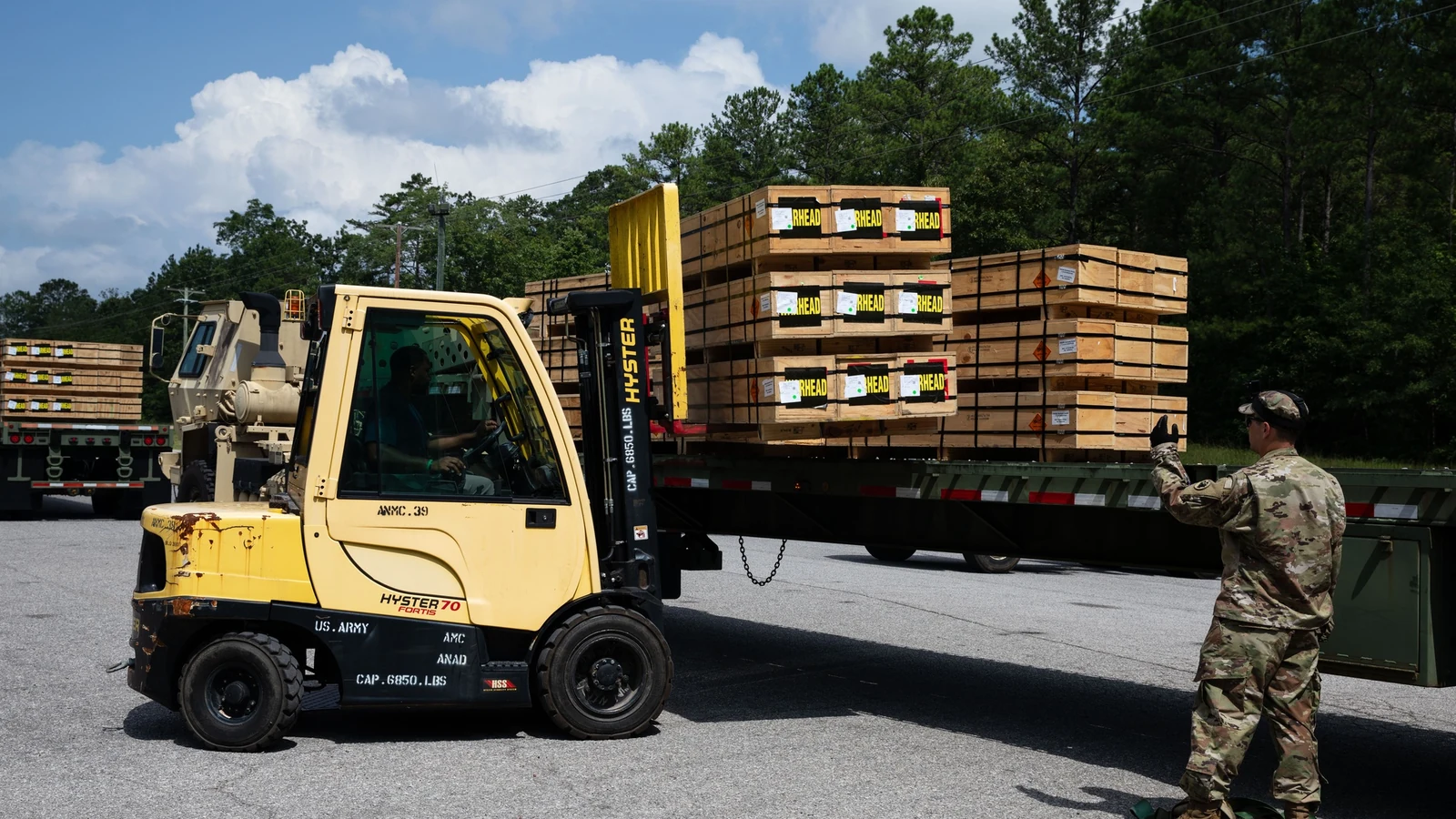
The underlying monthly table and endpoint calculations are available in the downloadable data file. The hero photograph shows Anniston Army Depot civilian employees during Operation Patriot Press 2024. It was made by Sgt. 1st Class James Braswell and is a public-domain Defense image.
Continue reading
More from FederalHiringData

Data investigationsAugust 25, 2026
Defense Contractor Reviews Reached 38% of Requirements. A 436-Position Staffing Plan Was Not Adopted.
DCSA recovered to more than 4,600 contractor security reviews and expanded mission staffing, but its last published requirement denominator still showed 37.6% coverage.
Data investigationsAugust 23, 2026
DOD Has a $285 Billion Maintenance Backlog. Its Facilities Workforce Is Shrinking.
DOD's reported repair backlog rose 80.8% after inflation while a selected civilian facilities-and-trades workforce proxy fell 11.4% after January 2025.
Data investigationsAugust 18, 2026
The Korea Exercise Was Cut. The Civilian Workforce Behind the Alliance Was Not
The U.S. defense presence in South Korea includes 2,903 appropriated-fund civilians, while 12,428 archived job announcements reveal the year-round system behind the alliance.
Federal Hiring Data Weekly
Get the biggest federal workforce changes in your inbox.
Subscribe to Federal Hiring Data Weekly for federal hiring trends, salary data, agency movements, and original investigations, with email confirmation before delivery.