August 23, 2026
DOD Has a $285 Billion Maintenance Backlog. Its Facilities Workforce Is Shrinking.
DOD's reported repair backlog rose 80.8% after inflation while a selected civilian facilities-and-trades workforce proxy fell 11.4% after January 2025.
By Evan Mercer
Published August 23, 2026Last edited August 23, 2026
At Minot Air Force Base, the office responsible for keeping buildings and utilities working said it needed 313 people in August 2024. It had 295 authorized positions, 258 people assigned and only 247 available for work. The base had no regularly assigned elevator technician. One of its three elevators was operating when the Government Accountability Office visited.
At Marine Corps Air Station Kaneohe Bay, the public works department reported a different version of the same constraint in June 2025: one plumber was responsible for multiple barracks and many other facilities.
Those are local examples inside a portfolio of 736,000 facilities worth an estimated $2.6 trillion. In a review released Aug. 21, GAO put the Defense Department's deferred maintenance and repair backlog at $285 billion for fiscal 2025. The department was requesting almost $20 billion that year for facility sustainment, restoration and modernization, yet every maintenance office in GAO's eight-installation sample still reported shortages in important skills.
The Pentagon's installation problem is not only a money problem. FederalHiringData's analysis of 21 civilian occupation series associated with civil engineering, facility operations and building trades found 28,547 covered DOD employees in June 2026, down 3,682, or 11.4%, from January 2025. It was the lowest observation in a series built from annual September FedScope files back to 2000 and recent monthly OPM data.
That total is a transparent workforce proxy, not DOD's official maintenance staff count. It excludes contractors and military personnel, and broad occupations such as civil engineering can support work beyond installation maintenance. But its direction is difficult to dismiss: the identifiable civilian bench was contracting while DOD carried a historically large repair burden, funded recurring sustainment below its own model and acknowledged that it had not fully identified its staffing gaps.
Hiring alone cannot erase a capital backlog. Buildings may need replacement, projects need appropriations and crews need materials, designs and access. But a repair plan without enough electricians, plumbers, mechanics, engineers and work-order specialists is also incomplete.
A backlog that rose faster than inflation
The $285 billion is not an annual maintenance budget. It is DOD's estimate of deferred maintenance and repair, work that was not performed when it should have been or was postponed to a future period. It covers accumulated needs across barracks, runways, hangars, hospitals, schools, utility networks and other facilities. About one-third of DOD buildings were more than 50 years old in fiscal 2025, according to GAO.
GAO's government-wide real-property series shows DOD's reported backlog rising from $120 billion in fiscal 2017 to $285 billion in fiscal 2025. That is a 137.5% nominal increase. FederalHiringData adjusted the annual figures with the Bureau of Labor Statistics' CPI-U annual averages. The 2017 figure equals about $157.6 billion in 2025 dollars, leaving a real increase of approximately 80.8%.

Inflation does not explain the growth, but neither should the line be read as a pure measure of physical deterioration. Backlog estimates can change when agencies inspect more assets, revise repair scopes, update labor and material prices, add or remove property, or change estimation methods. A previous GAO infrastructure review reported a somewhat different fiscal 2020 figure, illustrating why the public series is better treated as DOD's reported estimate than as a perfectly consistent engineering inventory.
The categories around that estimate matter. Sustainment is recurring maintenance and repair intended to keep a facility working over its expected life. Restoration repairs damage or restores capability lost through age. Modernization raises a facility to a new standard or adds functions. Major replacement and construction can move into the military construction process. Money assigned to one category cannot always substitute for another, and a new building is not the same intervention as repairing a failed boiler.
DOD has set a goal of requesting 90% of the modeled sustainment requirement. It has routinely fallen short. Across the Army, Navy, Marine Corps and Air Force, GAO calculated $69.1 billion in Facilities Sustainment Model requirements from fiscal 2021 through fiscal 2025. Budget requests averaged 80% of that amount, and obligations averaged 79%.
In fiscal 2025, the four services' modeled requirement was $16.327 billion. Requests and obligations totaled $12.636 billion, or 77%. The annual gap is not a direct addition to the $285 billion backlog, because the models and backlog estimates serve different purposes. It does show that DOD entered each year with less recurring sustainment funding than its model said was needed.

The totals also hide service choices. GAO reported that the Marine Corps requested less sustainment while directing resources toward restoration and modernization. A lower sustainment percentage is therefore not a dollar-for-dollar loss of total facility investment.
The public workforce measure fell 11.4%
DOD does not publish a complete, service-wide ledger showing how many people every installation maintenance office requires, how many positions are authorized, how many are filled and how many workers are available. GAO found that the services had not fully identified shortages or comprehensive strategies to address them. That makes a national workforce question surprisingly difficult to answer.
FederalHiringData constructed a conservative public proxy from 21 OPM occupation series covering architecture, construction control, civil engineering, facility operations, electrical work, plumbing and pipefitting, utilities, maintenance mechanics, HVAC, boilers, power control and water treatment. It excludes broader adjacent fields such as general engineering, engineering technical work and quality assurance. Some excluded employees support facilities, while some included employees support other missions. OPM cannot identify an employee's installation, project or work order.
The resulting series counted 29,931 employees in September 2000. It fell below 26,000 during the late 2000s, then generally climbed, reaching 32,229 in January 2025. By June 2026 it had fallen to 28,547, below every annual September observation in the 2000-2024 FedScope files.

The timing comparison is explicit. The long history uses September snapshots. The last points use January 2025, January 2026 and June 2026 monthly observations from the modern OPM data. June is not being presented as a full-year average.
Every military department in the proxy was smaller in June 2026 than in January 2025. The Army had the largest numerical decline, while the Defense-wide component had the largest percentage decline.
| Department or component | January 2025 | June 2026 | Change | Percent change |
|---|---|---|---|---|
| Army | 13,536 | 11,959 | -1,577 | -11.7% |
| Navy | 12,020 | 11,130 | -890 | -7.4% |
| Defense-wide | 1,148 | 564 | -584 | -50.9% |
| Air Force | 4,499 | 3,970 | -529 | -11.8% |
| Marine Corps | 1,026 | 924 | -102 | -9.9% |
These department and component totals are not a clean map of who owns the work. The Marine Corps is separated where OPM subelements support it, Defense-wide agencies may perform work unlike an installation office, and codes change over time. Contractors and military personnel also perform maintenance; the Air Force uses a substantial uniformed civil-engineering workforce outside OPM. Public records provide no common denominator for one combined headcount.
The civilian decline nevertheless matters because these employees often supply continuity, contract oversight, technical judgment and direct craft capacity. GAO's local cases show that an authorized billet is not always a worker available to complete a job. At Minot, 48 of the 295 authorized positions were not represented in the available workforce. GAO attributed the difference between assigned and available staffing partly to personnel detailed elsewhere, on extended leave or in training.
Civil engineers and maintenance mechanics led the losses
The decline was not confined to one occupational family. Civil Engineering, the largest selected series, fell from 7,877 employees in January 2025 to 6,803 in June 2026, a loss of 1,074, or 13.6%. Maintenance Mechanic fell by 592, or 14.7%. Equipment, Facilities and Services work fell by 443, and Facility Operations by 332.

The losses also reached specific trades that GAO described as difficult to recruit. The selected series lost 186 electricians, 107 high-voltage electricians, 106 air-conditioning equipment mechanics and 103 pipefitters. Architecture declined by 208 and Construction Control by 185.
Those counts do not prove that a person leaving series 0810 was working on a barracks project, or that an electrician's departure caused a specific outage. They show the changing size of the occupation pools from which installations draw civilian expertise.
GAO found the operational consequences at its reviewed bases. All eight maintenance offices reported key workforce shortages. Five installations considered remote by the relevant service said shortages led them to defer maintenance. Officials identified challenges recruiting high-voltage electricians, HVAC technicians, elevator specialists and workers qualified for nuclear facilities.
Air Force officials said Little Rock Air Force Base lost about 46% of its baseline maintenance workforce availability after 2025 staffing reductions and force-structure changes. At Kaneohe Bay, the lone plumber was not a colorful anecdote detached from the evidence; it was the staffing condition reported by the installation office responsible for many occupied facilities. At Minot, the absence of a regular elevator technician coincided with two nonworking elevators.
A separate GAO review of joint bases found facility-management staffing shortages at all 10 bases with available data during fiscal 2013 through fiscal 2023. Filled positions ranged from 68% to 97% of approved billets across bases and years. That range is historical and site-specific. It is not a DOD-wide 2026 vacancy rate, but it establishes that the staffing problem predates the latest headcount reduction.
Federal Hiring Data Weekly
Get the biggest federal workforce changes in your inbox.
Subscribe to Federal Hiring Data Weekly for federal hiring trends, salary data, agency movements, and original investigations, with email confirmation before delivery.
The workforce also carries succession risk. In June 2026, 27.2% of the selected proxy was age 55 or older, while 10.9% was under 30. OPM length-of-service data show 23.1% had at least 20 years of federal service. Age does not equal retirement eligibility, and tenure does not measure performance. The distribution does mean that replacing headcount is not identical to replacing experience with a utility network, base design standard or long-running contract.
Recruiting and pay make replacement harder
GAO's review of the Federal Wage System explains one obstacle facing installation trades. The system is supposed to align federal blue-collar pay with prevailing local wages, using market surveys. Annual statutory caps can prevent the full survey result from reaching federal pay schedules. DOD identified that cap as the most consequential challenge in the system, and agencies reported losing candidates during lengthy hiring and onboarding processes.
FederalHiringData identified 13,207 employees in the June 2026 proxy on wage-grade, wage-leader or wage-supervisor pay plans, 46.3% of the selected workforce. The classification is not a pay-gap estimate. It shows how much of the measured workforce sits inside the system GAO found could lag surveyed markets.
The public recruiting signal weakened sharply at the same time. The FederalHiringData historical USAJOBS archive contains 7,828 distinct DOD announcements opened in 2024 across the 21 selected series. That fell to 2,434 in 2025, a 68.9% decline. The partial 2026 archive contains 1,414 through Aug. 14.

The end years are partial: archive coverage begins March 1, 2017 for this query, and 2026 ends Aug. 14. The 2025 decline is a full-year comparison with 2024. Announcements are not vacancies, hires, selections or applications. One posting can advertise multiple positions or locations, and a visible vacancy can be filled through a pathway that does not map one-for-one to a public announcement.
The archive documents repeated recruiting at hard-to-staff locations: 704 selected announcements associated with Pearl Harbor, 311 with Twentynine Palms, 184 with Santa Rita in Guam, 175 with Fort Wainwright, 91 with Andersen Air Force Base and 63 with Minot. These are announcement-location matches, not unfilled-job counts; repetition can reflect turnover, multiple specialties or standing registers.
DOD's own workforce planning has not fully connected those signals to the maintenance mission. GAO reported that maintenance was not included in DOD's 2024 mission-critical occupation assessment, although civil engineering was. Three reviewed installation offices affected by 2025 deferred resignations and hiring restrictions said billets were permanently eliminated, reducing maintenance technicians, design engineers or administrative capacity. A model that counts only approved positions after elimination can make a shortage appear smaller without reducing the workload.
Contract spending adds capacity, but does not answer the staffing question
DOD buys a large amount of facility work from private firms. USAspending recorded $15.1 billion in fiscal 2025 obligations under product and service code group Z, maintenance, repair and alteration of real property. That was up from $9.9 billion in fiscal 2019 in nominal dollars.

The chart does not measure contractor headcount, hours or wages. Group Z includes alteration projects, and obligations can rise with material prices or project complexity. They cannot be divided by an assumed salary to estimate workers. Contracting can still offset civilian shortages: Fort Benning officials told GAO they used it partly because private firms had more pay and hiring flexibility.
Contracts do not eliminate the need for federal staff who define requirements, inspect work, manage funds and accept repairs. GAO found shortages among engineers, contract staff and administrators as well as tradespeople. A thin office can struggle to convert appropriations into supervised, accepted work even when a contractor is available.
That is why the evidence does not support a simple federal-versus-contractor conclusion. DOD needs a deliberate mix tied to the work at each installation. The public data can show civilian occupation changes and contract obligations. It cannot show whether the combined workforce has the right skills, enough people or the correct allocation across 736,000 facilities.
The work-order system cannot measure the national gap
The most consequential missing number may be workload itself. A credible workload-per-worker measure would require consistent records showing the work identified, priority, labor required, completion time and whether the customer accepted the result. GAO found that DOD's systems could not support that comparison.
Related research
Put this finding in context
Data investigationsAugust 21, 2026
DOD Cut 78,375 Civilian Jobs. The Work Did Not Disappear.
The 2025 reduction reached IT, contracting, engineering, logistics and weapons testing. Public records do not show a clean transfer of the work or its full cost.
Data investigationsAugust 19, 2026
The Federal Workforce Shrunk by 286,000. DOGE's Savings Are Harder to Prove
FederalHiringData finds a 12.4% workforce contraction and an estimated $22.8 billion decline in annualized basic-pay cost, while the public savings ledger remains incomplete.
Army work-order timestamps could be edited and were not always required to reflect when work actually occurred. Navy contractor work was sometimes absent from the system. Two similar Marine Corps installations recorded 51 and roughly 2,700 urgent work orders, a disparity too large to interpret as operational performance without understanding local recording practices. Air Force data included 2.4 million work orders missing dates.
The gaps also run in the other direction. At three Army installations, officials identified approximately 300 health and safety needs in barracks that had never been submitted as work orders. In GAO's customer survey, 17 of 37 respondents said work orders were sometimes closed before the work was complete.
Those weaknesses make national ratios tempting and unreliable. Dividing an incomplete work-order total by the OPM proxy would produce a precise-looking number with no stable meaning. Comparing services could reward the organization that records less work or closes records differently. FederalHiringData did not calculate either measure.
The information failure has practical consequences. DOD cannot reliably rank all maintenance demand, test whether staffing changes improve response times or show how much work is being shifted to contracts. Without a consistent workload ledger, the department's staffing requirement remains partly a collection of local estimates and authorized billets rather than a portfolio-wide capacity plan.
A capital plan needs a workforce plan
The evidence supports three conclusions, each narrower than the headline number might invite.
First, DOD's reported deferred maintenance burden has grown substantially even after inflation, while the services continued to request and obligate less recurring sustainment funding than their model identified. Money and capital planning remain central.
Second, the public civilian workforce most closely associated with installation engineering, operations and trades contracted sharply after January 2025. The decline reached occupations that installation officials already described as difficult to recruit. Contractors and military personnel can offset some of that capacity, but public data do not show a combined workforce requirement or filled total.
Third, DOD's work-order records are not consistent enough to connect the backlog, workforce and day-to-day workload at national scale. That prevents an honest estimate of how many additional employees are needed or how much of the $285 billion a larger workforce could retire.
A defensible maintenance strategy would publish the missing bridge: validated workload and staffing requirements by service and installation type, filled and available staffing by skill, time-to-hire and retention, contractor capacity, sustainment execution, and repair outcomes. It would distinguish recurring work that crews can prevent from becoming more expensive from capital projects that require design, authorization and construction funding.
The goal is not to assign every repair to a civil servant. It is to preserve enough public capacity to understand DOD's assets, oversee outside work and complete routine maintenance before it becomes another deferred project. At a $285 billion backlog, not knowing whether workforce capacity matches the mission is itself a management risk.
Readers can browse current federal jobs, explore federal workforce statistics, compare agency records and read more FederalHiringData investigations.
Methodology and limitations
Backlog and sustainment: Deferred-maintenance figures come from GAO's government-wide real-property reporting for fiscal 2017 through fiscal 2024 and GAO-26-107255 for fiscal 2025. FederalHiringData converted reported values to 2025 dollars using BLS annual CPI-U averages. The series can reflect estimation and scope changes as well as facility condition. Facilities Sustainment Model requirements, requests and obligations come from GAO-26-107255, table 4, and cover the Army, Navy, Marine Corps and Air Force. Sustainment is not the complete restoration, modernization or military-construction budget.
Civilian workforce proxy: FederalHiringData counted 21 specified OPM occupation series associated with architecture, construction control, civil engineering, building and facility management, electrical work, plumbing and pipefitting, utility systems, maintenance mechanics, HVAC, boiler plants, power control and water treatment. Historical observations use September 2000-2024 FedScope employment files. Recent comparisons use January 2025, January 2026 and June 2026 Federal Workforce Data. OPM records exclude contractors and military personnel and do not identify installation assignments or work orders. The proxy is not DOD's official maintenance workforce universe or vacancy ledger.
Services, age, tenure and pay: Service groupings use OPM department and agency-subelement fields and may be affected by reorganizations. Age 55 or older is not retirement eligibility. Length of service does not measure expertise or performance. Federal Wage System coverage uses identified wage-grade, leader and supervisor pay-plan codes; it is not a calculation of private-sector pay gaps.
USAJOBS: FederalHiringData counted distinct historical USAJOBS control numbers in the selected occupations under DOD departments. The annual chart begins March 1, 2017 and runs through Aug. 14, 2026. Location counts match normalized announcement locations and base names. Announcements are recruiting signals, not positions, vacancies, applications, selections or hires.
Contracts: Obligations come from the USAspending API for DOD awarding departments and product/service-code group Z. Values are nominal. The category includes maintenance, repair and alteration of structures and does not provide contractor headcount, hours, labor cost or proof that contractors replaced federal employees.
Base cases and work orders: Installation examples, joint-base staffing history and work-order limitations come from GAO-26-107255 and GAO-26-106832. GAO's eight-installation maintenance sample was selected for review and is not statistically generalizable to all DOD installations. The joint-base filled-position range spans bases and fiscal years 2013-2023; it is not a current department-wide vacancy estimate.
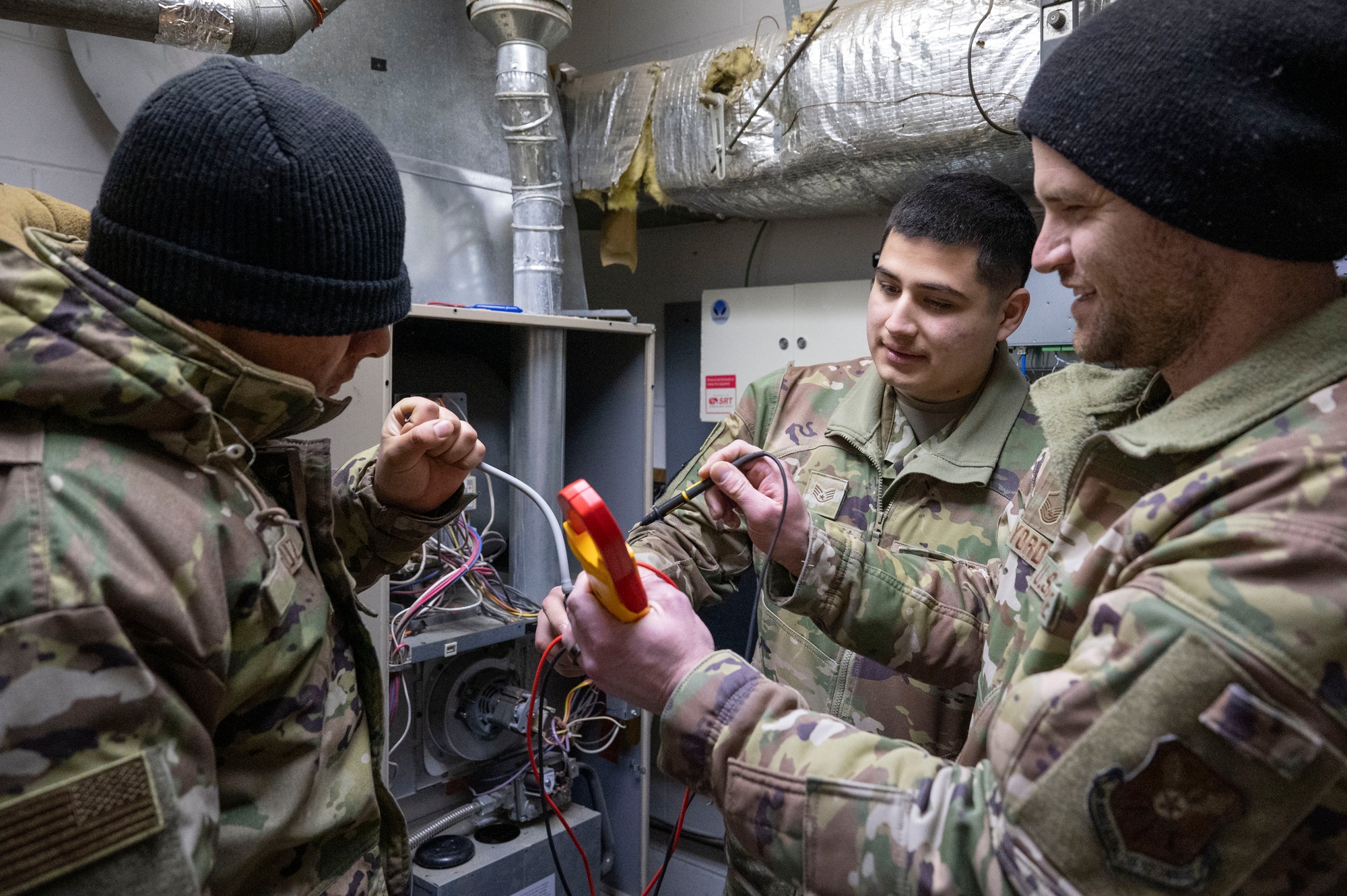
The hero photograph is an official U.S. Air Force image distributed through DVIDS. It shows 5th Civil Engineer Squadron HVAC specialists troubleshooting a furnace at Minot Air Force Base on Feb. 19, 2025. The people and equipment shown illustrate installation maintenance work; the image does not depict every staffing condition discussed in the article.
Continue reading
More from FederalHiringData

Data investigationsAugust 18, 2026
The Korea Exercise Was Cut. The Civilian Workforce Behind the Alliance Was Not
The U.S. defense presence in South Korea includes 2,903 appropriated-fund civilians, while 12,428 archived job announcements reveal the year-round system behind the alliance.

Data investigationsAugust 22, 2026
Two Army Depots Lost 785 Government Workers as Repair Work Became Harder to Plan
Anniston and Red River added 241 contractor personnel, but skills gaps, vehicle condition, parts, drawings and old machinery complicated billions in repair work.
Data investigationsAugust 22, 2026
Space Force Filled 75% of Its Documented Need. Now It Says Personnel Must Double.
A GAO review found 13,509 assignments against 18,002 documented requirements as the service planned to double personnel without a complete workforce ledger.
Federal Hiring Data Weekly
Get the biggest federal workforce changes in your inbox.
Subscribe to Federal Hiring Data Weekly for federal hiring trends, salary data, agency movements, and original investigations, with email confirmation before delivery.