August 21, 2026
DOD Cut 78,375 Civilian Jobs. The Work Did Not Disappear.
The 2025 reduction reached IT, contracting, engineering, logistics and weapons testing. Public records do not show a clean transfer of the work or its full cost.
By Evan Mercer
Published August 21, 2026Last edited August 21, 2026

The Defense Department did not stop maintaining ships, reviewing contracts, protecting networks or testing weapons when 78,375 civilian employees left its rolls. The missions remained. What changed was the number of civilian workers available to carry them out.
From Jan. 1, 2025, to Jan. 1, 2026, DOD's appropriated-fund civilian workforce fell from 793,155 to 714,780, according to the Government Accountability Office. That 9.9% contraction exceeded the department's publicly stated goal of reducing its civilian workforce by 5% to 8%. It followed two deferred-resignation programs, early-retirement offers, probationary terminations and a hiring freeze.
The topline is striking, but it does not answer the harder question: what became thinner? FederalHiringData's analysis of a separate, internally consistent OPM workforce series shows losses in information technology, contracting, engineering, logistics, finance, auditing, intelligence, quality assurance and healthcare. Every major DOD component contracted. Public USAJOBS recruiting fell sharply at the same time.
The record does not show a clean handoff of those functions to contractors or uniformed personnel. Selected service-contract obligations moved in different directions, and DOD did not consistently perform the workload, readiness and cost analysis federal law required. One small but consequential office offers a warning about what that uncertainty can mean: the Pentagon's independent weapons-testing organization lost half of its authorized civilian positions and told GAO that remaining staff had more work than they could handle.
This is not evidence that every departure weakened a mission. Components told GAO about benefits as well as challenges, and some work can be eliminated, automated or reorganized. It is evidence that the cut was historically unusual, operationally broad and still not fully accounted for.
A one-year contraction without a modern precedent
Two public workforce systems describe the 2025 reduction, and they should not be blended into one seamless series.
GAO analyzed the Defense Civilian Personnel Data System, or DCPDS, for appropriated-fund civilians. Its review included some employees in nonpay status. That is the source of the 78,375 figure and the appropriate source for the headline.
The Office of Personnel Management's FedScope and Federal Workforce Data files cover a different federal employment universe. They show 774,572 DOD civilians in January 2025 and 694,012 in January 2026, a decline of 80,560, or 10.4%. The totals differ because the source populations and reporting rules differ. The direction and scale do not.
The value of the OPM series is historical consistency. September snapshots can be followed from 1998 through 2024, and the modern OPM file reproduces the September 2019 and September 2024 totals exactly. In that record, the steepest prior September-to-September decline was 3.7%, from 1998 to 1999. The next largest was 3.6% in 2013. The 2025-to-2026 OPM change was nearly three times as steep as either.
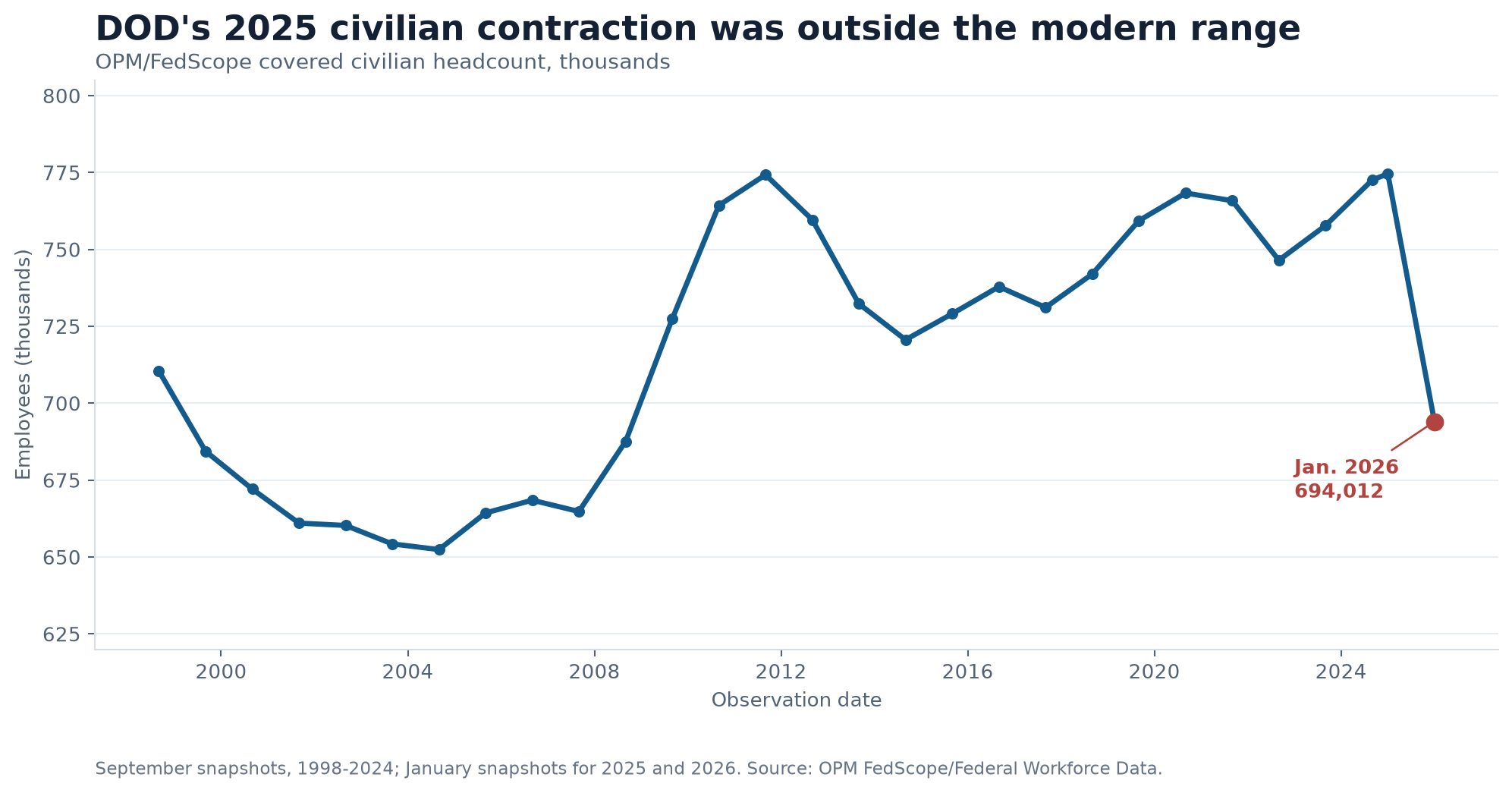
FederalHiringData calculation: The 10.4% OPM decline is the largest one-year contraction visible in the comparable public series. It is not a rerendering of GAO's 9.9% DCPDS finding; it is an independent check using a separate population.
GAO's monthly counts show how the reduction arrived. DOD employment edged up through March 2025, then fell every month through the following January. The largest break came between Sept. 1 and Oct. 1, when the count fell by 40,799 as deferred resignations took effect. Another 12,872 employees left the total between Dec. 1 and Jan. 1.
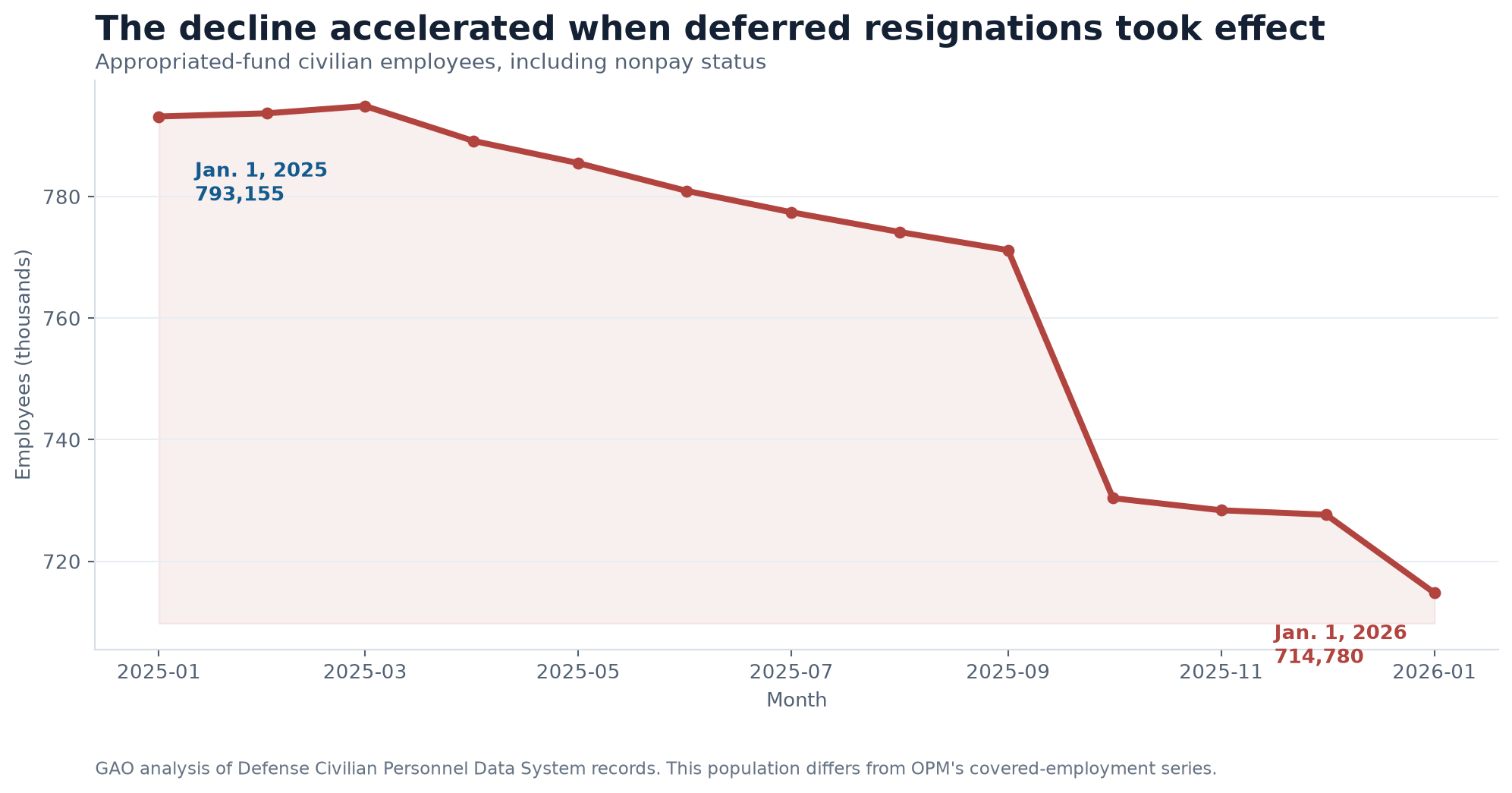
GAO counted about 53,200 approved deferred-resignation applications. By the end of 2025, 46,229 civilians had separated through those programs, while another 6,650 took early retirement. DOD also terminated about 1,573 probationary or trial-period employees, fewer than the recent annual average because litigation limited the effort.
The reduction was therefore neither a normal retirement wave nor a single reduction in force. It was a compressed combination of voluntary exits, delayed departures, restricted hiring and a small number of probationary terminations.
The losses landed in mission functions
The largest occupational decline was in the broad 0301 Miscellaneous Administration and Program series, down 6,934 employees in OPM's January-to-January snapshots. That category covers many program roles and cannot be translated into one function. The next losses were more specific.
Information Technology Management fell by 5,184. Management and Program Analysis fell by 4,496. Contracting lost 2,848, General Engineering 2,324 and Logistics Management 2,207. Financial Administration and Program lost 1,739; Electronics Engineering, 1,510; Security Administration, 1,202; Mechanical Engineering, 1,156; and Engineering Technical, 1,148.
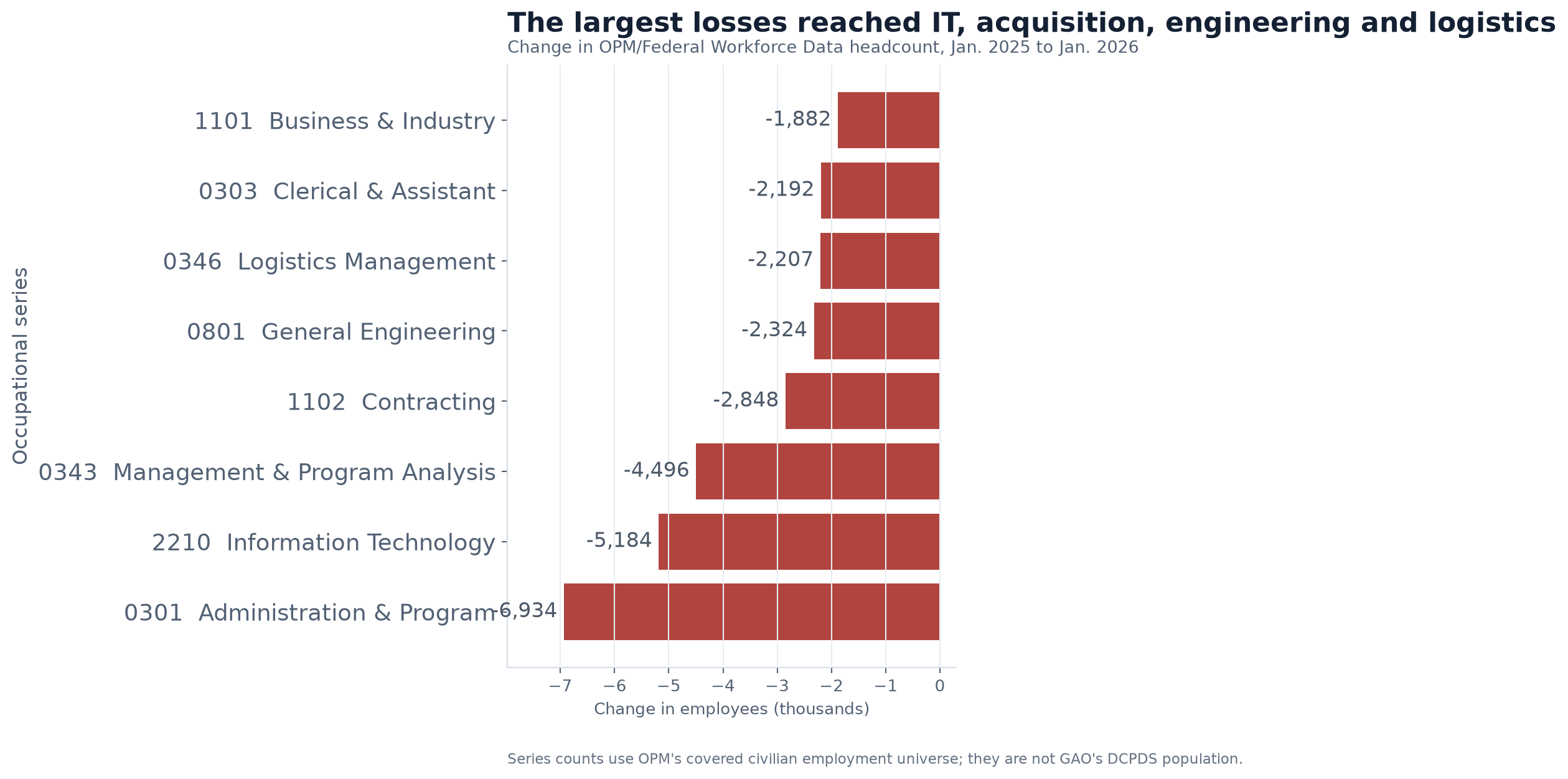
Other mission-facing series moved in the same direction. Auditing declined by 808, Quality Assurance by 706, Intelligence by 668, Operations Research by 637 and Nursing by 584. Aircraft Mechanic employment fell by 622. These are net changes in occupational-series headcount, not proof that a particular office lost a particular task. They do show that the reduction extended well beyond headquarters administration.
The component totals reinforce that point.
| OPM component | Jan. 2025 | Jan. 2026 | Change |
|---|---|---|---|
| Army | 221,195 | 193,976 | -27,219 (-12.3%) |
| Air Force | 173,193 | 153,754 | -19,439 (-11.2%) |
| Navy | 221,292 | 202,216 | -19,076 (-8.6%) |
| Defense-wide | 158,892 | 144,066 | -14,826 (-9.3%) |
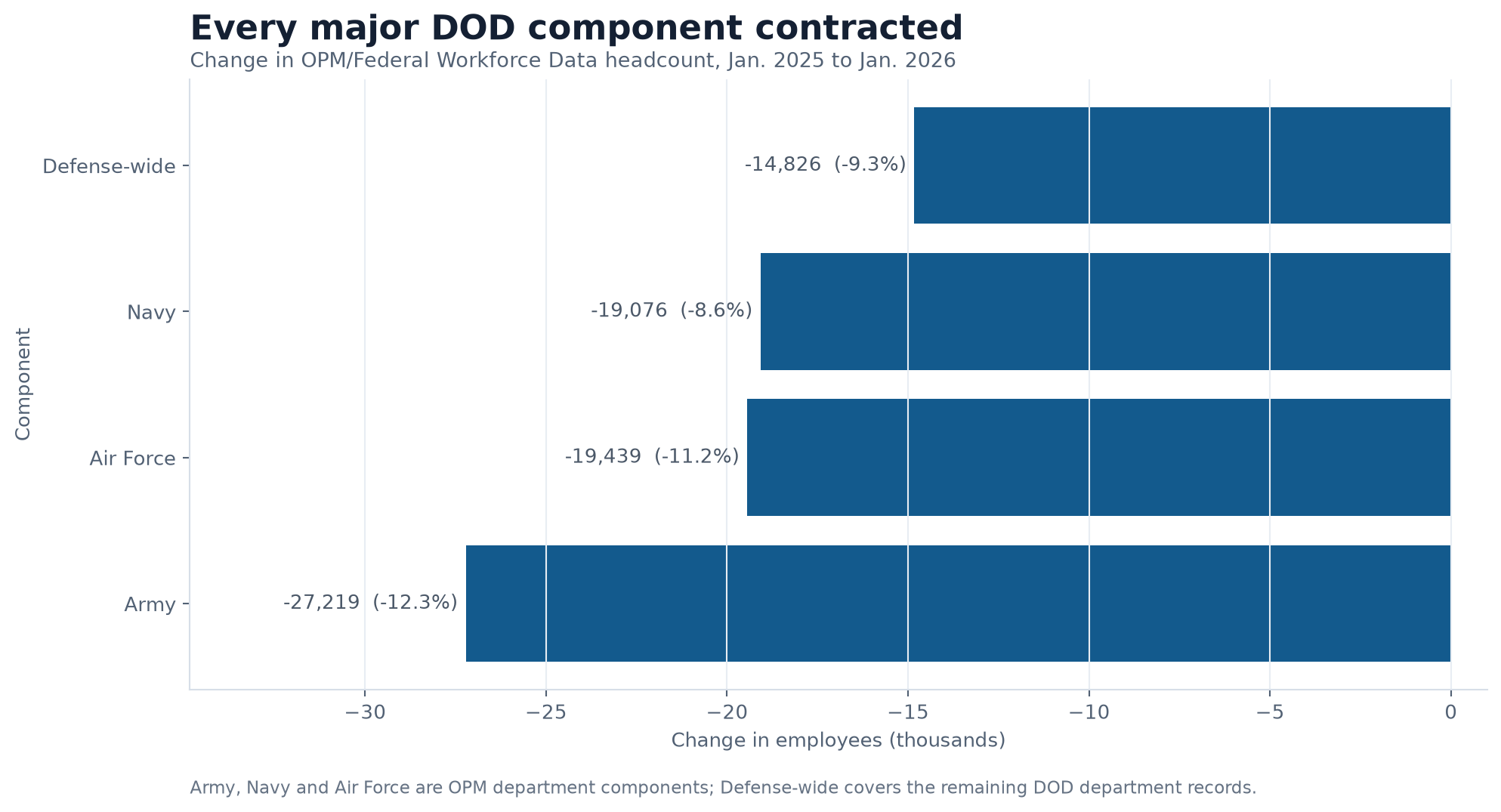
At the organizational level, the biggest absolute losses included Air Force Materiel Command, Naval Sea Systems Command, the Army Corps of Engineers, Army National Guard units, military treatment facilities under the Defense Health Agency, Naval Air Systems Command and Army Installation Management Command. Those commands touch depot work, acquisition, engineering, healthcare and the operation of bases.
DOD knew some of these functions were difficult to thin. GAO found that the Defense Contract Audit Agency repeatedly sought permission to hire contract auditors during the freeze. Its August 2025 request for 40 auditors warned of noncompliance, financial loss, operational inefficiency and higher workloads if audit staffing was disrupted. The Defense Health Agency sought exemptions for about 3,800 probationary employees and warned that losing them could affect medical readiness, trauma care and healthcare delivery.
Those exemption requests do not prove that every projected risk occurred. They show that components themselves identified specific work that could not simply be allowed to lapse.
Experience left from both ends
The public OPM action file records 116,179 DOD separation actions during calendar 2025. Quits accounted for 49,644. Voluntary retirements accounted for 38,883, and early retirements for 7,023. Terminations following an expired appointment or other causes accounted for 9,533. Only two actions were coded as reductions in force.
Just over half of those actions, 59,400, involved employees with at least 10 years of reported federal service. The count included 24,946 actions in the 10-to-19-year band, 17,751 in the 20-to-29-year band and 16,703 at 30 years or more.
FederalHiringData calculation: Workers with 10 or more years of federal service represented 51.1% of DOD separation actions in the OPM file. That is not the same as years at DOD, and years of service are not a direct measure of skill or productivity. They are a useful indicator of how much accumulated federal experience was attached to the exits.
The status snapshots show losses at both ends of the pipeline. Employees with fewer than five years of service fell from 248,363 in January 2025 to 195,038 in January 2026, a 21.5% decline. The 30-year-plus cohort fell from 41,933 to 32,076, down 23.5%. The middle contracted too, but less sharply.
Age followed a similar pattern. Employees under 30 fell by 15,512, while employees 55 and older fell by 25,423. In the action file, 52,851 separations involved employees age 55 or older. The result was not merely the loss of senior workers or the loss of recent hires. DOD narrowed its succession pipeline while also losing long-serving employees.
The formal budget plan lagged the exits
DOD normally manages civilian staffing through a multiyear programming and budgeting process. Components estimate future workload, force structure and personnel requirements; the department reviews those proposals; and Congress considers the resulting budget request. The 2025 workforce measures moved on a much faster track.
GAO's review of DOD budget records found that total programmed civilian FTE rose from 811,581 in fiscal 2022 to 827,397 in fiscal 2024. Fiscal 2025 was the first reviewed year with a department-wide decline, and that reduction was modest: 7,111 FTE, or 0.8%, to 820,286. The department-wide budget plan therefore still called for more civilian work in fiscal 2025 than it had in fiscal 2022.
The sharper planned reduction appeared in the fiscal 2026 request, after many employees had already elected deferred resignation or left. That request programmed 771,852 civilian FTE, about 48,400 below fiscal 2025. Twenty-eight of 40 components planned fewer FTE, and the median component reduction was 6.5%.
Federal Hiring Data Weekly
Get the biggest federal workforce changes in your inbox.
Subscribe to Federal Hiring Data Weekly for federal hiring trends, salary data, agency movements, and original investigations, with email confirmation before delivery.
FederalHiringData analysis: The sequence matters. DOD first used measures outside the normal programming process, then incorporated some of the resulting reductions into the next budget request. It does not mean the fiscal 2026 plan caused every 2025 departure, nor that every lost employee represented a permanently eliminated FTE.
It also helps explain why the public figures do not reconcile exactly. GAO's 78,375 is a change in people at two dates. The roughly 48,400 is a change in planned full-time-equivalent work over two fiscal years. A vacant position, a part-year employee and a full-year employee affect those measures differently.
Recruiting narrowed while critical occupations remained in demand
GAO found that DOD hired 33,781 appropriated-fund civilians in 2025, about 59,456 fewer than the average for the same months from 2016 through 2024. Hiring continued through exemptions, but the freeze changed its scale.
USAJOBS announcements show the public-facing side of that shift. The FederalHiringData historical USAJOBS archive contains 172,329 distinct DOD announcements opened in 2024 and 65,748 in 2025, a decline of 61.8%. The archive begins around March 2017, so the first year is partial. The 2026 bar runs through Aug. 14 and is also partial.
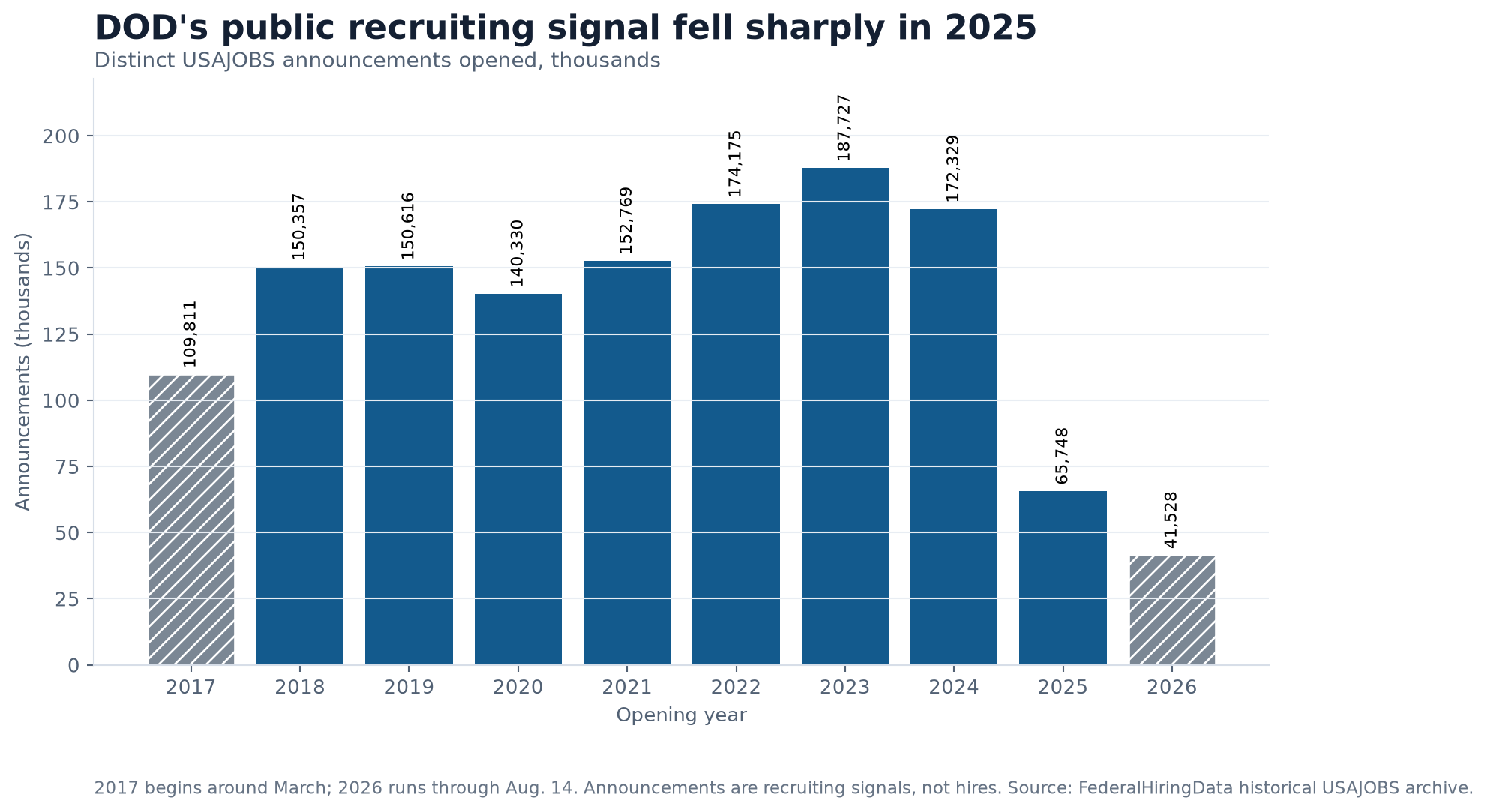
Announcements are not hires, and one announcement can advertise multiple openings. They are nevertheless a direct measure of how often DOD publicly recruited through USAJOBS.
The department still advertised in occupations it was losing. Announcements opened in 2025 included 2,731 in IT Management, 2,216 in Management and Program Analysis, 1,431 in General Engineering, 1,180 in Logistics Management, 1,058 in Contracting and 1,035 in Financial Administration and Program. DOD also posted 886 Security Administration announcements, 725 Nursing announcements, 582 Intelligence announcements and 498 in Quality Assurance.
That pattern is consistent with a selective rather than total hiring stop. It also exposes the replacement problem: advertising for a skill does not show whether the announcement produced a hire, how long the hiring took or whether the new employee replaced comparable experience.
Contractors were not a uniform substitute
DOD policy calls for the least costly mix of military, civilian and contractor personnel that can meet mission requirements. That makes contractor spending an obvious place to look for work displaced by civilian cuts. It is also easy to overread.
FederalHiringData compared fiscal 2024 and 2025 USAspending obligations in five service categories with related OPM civilian occupation groups. The results did not move as one substitution story.
Facilities-support obligations rose 29.1% to $10.0 billion while the related civilian group fell 3.0%. Professional, administrative and management-support obligations rose 2.1% while related civilian headcount fell 6.1%. IT and telecommunications obligations edged up 0.8% while related civilian headcount fell 3.7%.
But healthcare obligations fell 1.2% while the related workforce fell 5.4%. Facility-maintenance obligations also fell 1.2% while related headcount fell 4.6%.
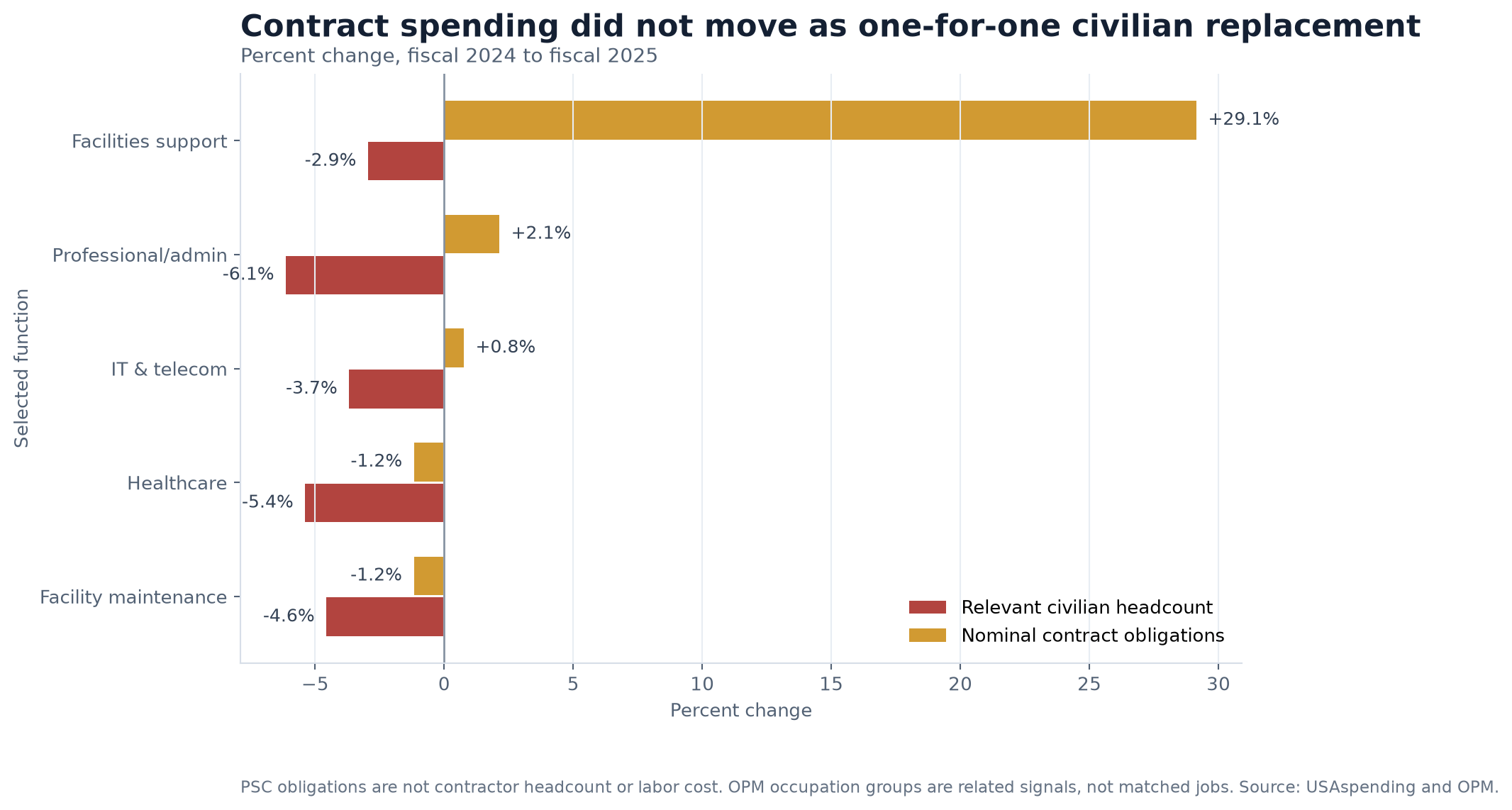
FederalHiringData analysis: The facilities-support increase is a signal worth following, not proof that contractors replaced specific civilians. Product and service codes capture obligations, including materials and nonlabor costs. They do not provide contractor headcount, and the OPM groups are related functions rather than matched positions. Inflation also raises nominal obligations even when the purchased quantity does not change.
The most defensible conclusion is narrower: available spending data do not show a uniform, one-for-one transfer of civilian work to contractors. Some categories rose, others fell, and the public data cannot identify the destination of most individual tasks.
The same limit applies to military personnel. In March 2025, a senior defense official said DOD was confident the deferred-resignation program would not push uniformed personnel into civilian-type work. GAO later found that components did not consistently document the analysis required to test stress on the military force, workload, readiness, operational effectiveness and fully burdened cost.
Without function-level workload records, the amount of work absorbed by service members remains unknown.
Related research
Put this finding in context

Data investigationsAugust 18, 2026
The Korea Exercise Was Cut. The Civilian Workforce Behind the Alliance Was Not
The U.S. defense presence in South Korea includes 2,903 appropriated-fund civilians, while 12,428 archived job announcements reveal the year-round system behind the alliance.
Data investigationsAugust 20, 2026
OPM's 35% Cut Was Its Deepest Since It Transferred an Entire Bureau
The federal government's HR agency now has fewer employees than at any reviewed point since 1998 while directing agencies to rebuild hiring and workforce planning.
One office shows the cost of a thinner bench
The Office of the Director, Operational Test and Evaluation is too small to represent the entire Defense Department. It is also one of the clearest public examples of what happened after civilian capacity was removed.
DOT&E provides independent oversight of operational and live-fire testing for weapon systems. A May 2025 memo directed it to eliminate nonstatutory or redundant functions and conduct a civilian reduction in force. GAO's subsequent review found that authorized civilian positions fell from 89 in May to 30 in June. By January 2026, the office had 45 authorized civilian positions, still 44 below the pre-reorganization level.
The number of programs on DOT&E's oversight list fell from 265 in fiscal 2024 to 173 in fiscal 2025. GAO did not attribute all 92 removals to staffing: programs also completed testing, were canceled or merged, or were judged no longer to require oversight. That counterevidence matters.
The capacity finding was nevertheless direct. Action officers told GAO they were assigned more programs than they could handle, programs outside their subject-matter expertise, or both. They warned of a greater risk that weapons could reach service members with operational shortcomings that were not documented. A separate support-contract work stoppage cut off access to test and evaluation data for about two months, while reduced secure workspace complicated classified oversight.
DOT&E is therefore a case study, not a department-wide verdict. It demonstrates that work does not become redundant merely because the office responsible for it becomes smaller. In this case, some oversight was narrowed, some was redistributed and some remained with fewer people and less expertise.
Lower payroll is not a net-savings estimate
DOD's fiscal 2026 budget request programmed 771,852 civilian full-time equivalents, down about 48,400, or 5.9%, from the fiscal 2025 level. That is not the same as GAO's 78,375-person headcount change. FTE measures funded work over a period; headcount measures people at a point in time.
The distinction matters for cost. Fewer employees generally reduce salary and benefit obligations after they leave. But deferred-resignation participants continued receiving salary and benefits while on administrative leave. A net calculation would also need any contractor replacement, overtime, military substitution, separation administration, future rehiring and training, and the cost of delays or weaker oversight.
No public record reviewed here supports a comprehensive net-savings figure for the 2025 DOD civilian reduction. Calling the payroll reduction "savings" without those offsets would turn an incomplete ledger into a conclusion.
The unanswered question is capacity
DOD's 2025 reduction was not a routine fluctuation. It was the deepest contraction in the available OPM history, and it reached the occupations that buy, secure, maintain, analyze and test the systems around the military force. Recruiting fell at the same time, limiting the department's ability to replace selected losses quickly.
Contract spending does not supply a simple answer about where the work went. Neither does military staffing. GAO found that eight of 12 interviewed components reported measurable benefits from the reductions, while nine reported challenges. Both can be true: an organization can remove layers or simplify a process while also losing expertise and increasing workload elsewhere.
The durable test is performance. Contract audit backlogs, depot schedules, cyber incidents, healthcare access, installation service, acquisition milestones and testing coverage can show whether a smaller workforce is meeting the mission. DOT&E already provides one measurable warning. Other components may produce different outcomes.
DOD agreed with GAO's recommendation to develop a plan for collecting and sharing lessons from the reduction. Until that work is done and the outcomes are public, the government can count the employees who left. It cannot fully account for the work they left behind.
Readers can browse current federal jobs, explore the federal workforce statistics, compare agency hiring data and read more FederalHiringData investigations.
Methodology and limitations
Verified facts attributed to GAO use GAO-26-108100 and GAO-26-108859. GAO's 2025 DCPDS population covers DOD appropriated-fund civilians and includes some nonpay-status employees. Its employee, deferred-resignation, hiring and programmed-FTE figures are preserved as reported.
FederalHiringData calculations use OPM Federal Workforce Data for January 2025 and January 2026, plus legacy FedScope September employment cubes from 1998 through 2024. The modern OPM series reproduces the legacy September 2019 and 2024 totals. The long-run chart therefore uses September observations through 2024, followed by January observations for 2025 and 2026. It does not splice GAO's DCPDS totals into the OPM series.
Occupational and component changes are net headcount differences between OPM snapshots. Broad series such as 0301 do not identify one program or task. Personnel actions are counts of action records, not necessarily unique people, and do not reconcile one-for-one with point-in-time status. Length of service is total reported federal service, not necessarily time at DOD and not a productivity measure.
USAJOBS analysis covers Army, Navy, Air Force and defense-wide department records in the FederalHiringData historical USAJOBS archive. Coverage begins approximately March 2017 and runs through Aug. 14, 2026 for this analysis. Announcement counts are distinct control numbers by opening year. They do not measure hires, applicants, selections or filled vacancies.
The contract comparison uses nominal fiscal-year obligations from USAspending product and service code groupings for facilities support, facility maintenance, healthcare, IT and telecommunications, and professional, administrative and management support. Those categories can include nonlabor costs and do not report contractor headcount. Related OPM occupation groups are contextual signals, not matched contractor and civilian jobs. The comparison cannot prove substitution or establish net savings.
The hero photograph shows Navy reservists working with Norfolk Naval Shipyard's civilian workforce in 2020. It illustrates the mix of personnel that can support a defense mission; it does not depict the 2025 reduction. The image is a public-domain U.S. Navy photograph by Aldo Anderson distributed through DVIDS.
Continue reading
More from FederalHiringData

Data investigationsAugust 18, 2026
FEMA's Public Workforce Count Fell 22% as GAO Warned of Readiness Risks
FEMA had 5,793 fewer covered civilian employees in June 2026 than in January 2025. GAO says the agency cut staff without the workforce planning needed to assess mission capacity.

Data investigationsAugust 20, 2026
GSA Cut 45% of Its Buildings Workforce. Some Dispositions Slipped.
GSA is still selling property, but GAO found restarted projects, fewer appraisers and no reliable measure of whether the accelerated program is actually faster.

Data investigationsAugust 19, 2026
Social Security Has 85% More Beneficiaries per Worker Than in 2000
Social Security added 25 million beneficiaries while losing 9,600 full-time permanent workers. Recent service gains show what technology changed—and what a thinner workforce still risks.
Federal Hiring Data Weekly
Get the biggest federal workforce changes in your inbox.
Subscribe to Federal Hiring Data Weekly for federal hiring trends, salary data, agency movements, and original investigations, with email confirmation before delivery.