August 20, 2026
OPM's 35% Cut Was Its Deepest Since It Transferred an Entire Bureau
The federal government's HR agency now has fewer employees than at any reviewed point since 1998 while directing agencies to rebuild hiring and workforce planning.
By Evan Mercer
Published August 20, 2026Last edited August 20, 2026
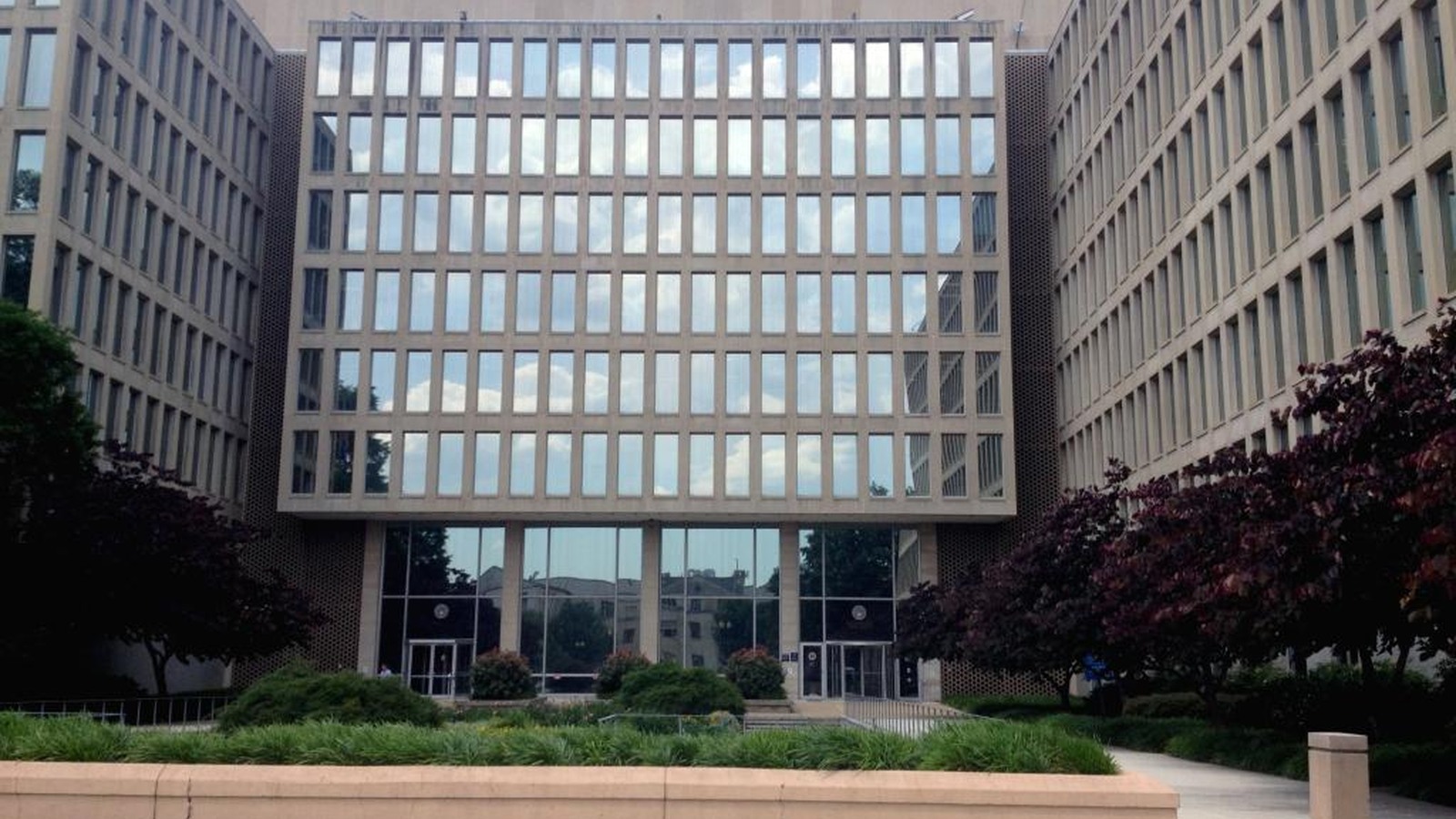
The last time the Office of Personnel Management lost this many employees, it also gave away an entire line of business.
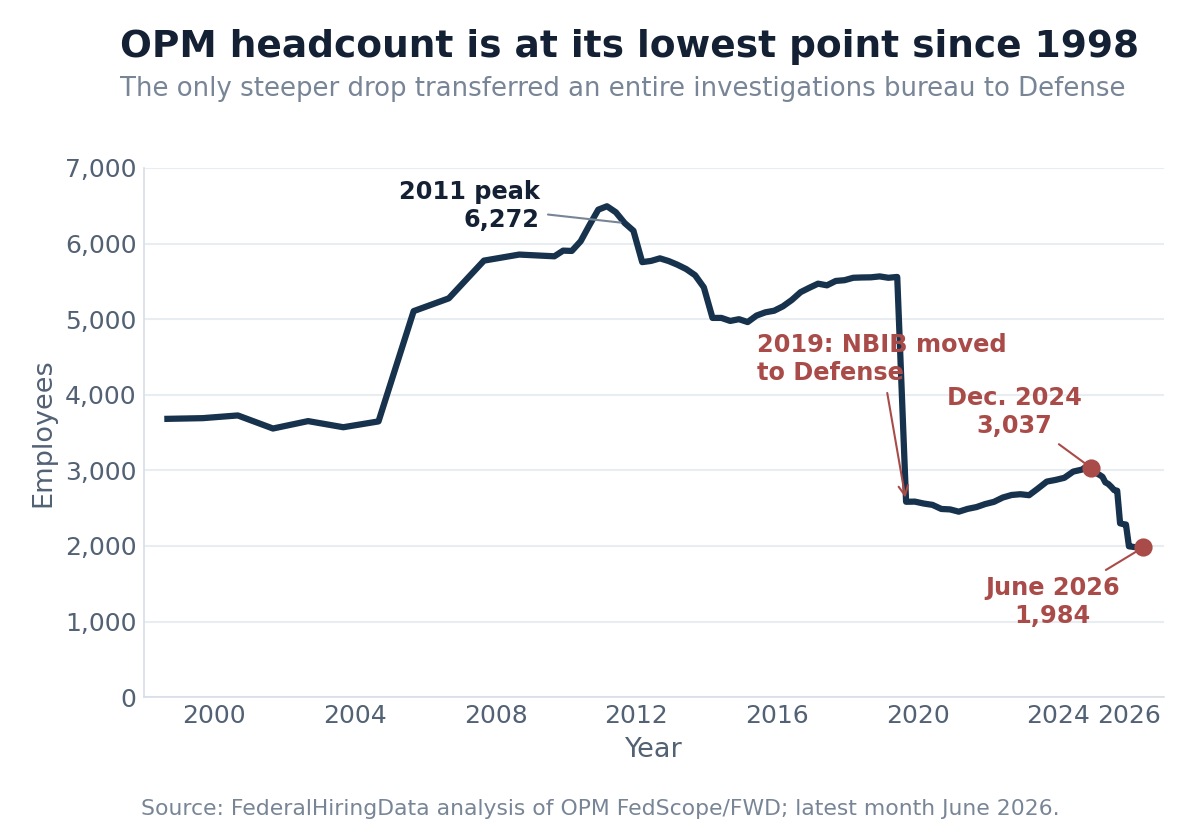
On October 1, 2019, the National Background Investigations Bureau moved from OPM to the Defense Department. Its mission, personnel and resources followed it. OPM's September headcount fell from 5,554 in 2018 to 2,585 in 2019, while annual personnel actions recorded a net loss of 3,003. OPM later said more than 3,000 people transferred, and Defense confirmed the bureau became part of its Defense Counterintelligence and Security Agency.
The new contraction is different. OPM's responsibilities did not move out with 1,052 workers. From December 2024 to March 2026, its headcount fell from 3,037 to 1,985, a 34.6% reduction, according to a FederalHiringData analysis of OPM's Federal Workforce Data. GAO reported the same decline, rounded to 35%. By June, OPM had 1,984 employees, essentially unchanged from March.
That leaves the federal government's central workforce agency smaller than at any reviewed point in the public series back to September 1998. It also leaves OPM with a larger strategic assignment. A July 30 directive requires agencies to forecast mission-critical, technology and early-career hiring; make at least 60% of external competitive-service selections from shared certificates; make early-career hires at least 33% of external hiring; and use a validated technical or approved alternative assessment in every external competitive hiring action, rather than relying on self-ratings alone. Agencies must report progress quarterly. OPM and the Office of Management and Budget will oversee the system.
This is the central test of OPM's downsizing: whether the smaller agency has enough capacity to improve hiring across government, operate retirement and insurance systems, police merit rules and maintain the workforce data needed to judge the results.
A cut unlike the 2019 transfer
In a mechanical ranking, the December 2024-to-March 2026 change is the 18th-steepest 15-month headcount decline in OPM's monthly data since 2015. That number needs an explanation. The 15 windows ranked above it are overlapping views of the same 2019 bureau transfer; the other two are overlapping windows from the current cut.
Count episodes rather than calendar windows, and there are two: the 2019 transfer, when mission and staff moved together, and the 2025-26 contraction, when staff left OPM's remaining organization. The latter is the deepest cut to the retained mission workforce in the available record.
The action data show how abruptly it happened. OPM recorded 1,206 separations and 170 accessions in calendar 2025, a net outflow of 1,036 actions. In 2024, by contrast, it had 470 accessions and 281 separations. Quits were the largest current separation category, followed by voluntary retirements. Reductions in force accounted for about 10% of the current action file. The deferred-resignation indicator covered 734 actions.
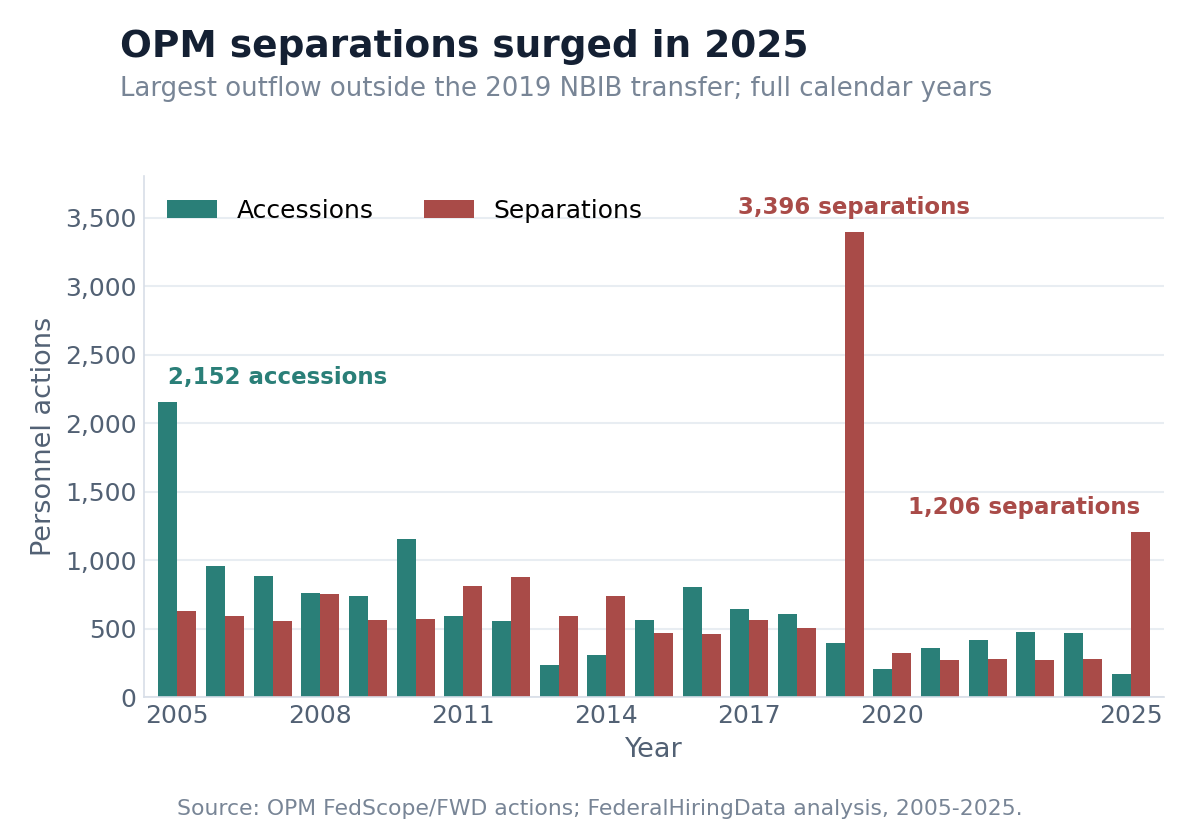
There are early signs of stabilization, rather than a rebuild. Through June 2026, OPM recorded 71 accessions and 61 separations. May and June together were net positive by 30 actions, but total headcount remained nearly flat because actions and monthly status do not reconcile one-for-one.
OPM's own recruiting signal also contracted. The FederalHiringData historical USAJOBS archive contains 1,152 distinct OPM announcements opened in 2024 and 642 in 2025, a 44% decline. There were 307 through August 13, 2026. Announcements are not hires, and OPM can post positions while delivering reimbursable hiring services for customers, so those figures are context rather than an internal staffing count.
Experience left from both ends
GAO found that 57% of the employees who left had at least 11 years of federal service; 18% had 31 years or more. Its June download counted 1,235 separation actions. The live workforce file has since been revised, and the current warehouse contains 1,238 for the action window. The revised records no longer reproduce GAO's service bands exactly, so GAO's frozen percentages are the appropriate figures for its finding.
The updated file supports another measure of the loss. Across 1,236 actions with valid service values, departing employees reported a combined 19,050.1 years of federal service, or 15.4 years per action. That is total federal service, rather than necessarily time spent at OPM. In the current records, 691 actions involved workers with at least 10 years, 425 involved 20 years or more, and 220 involved 30 years or more.
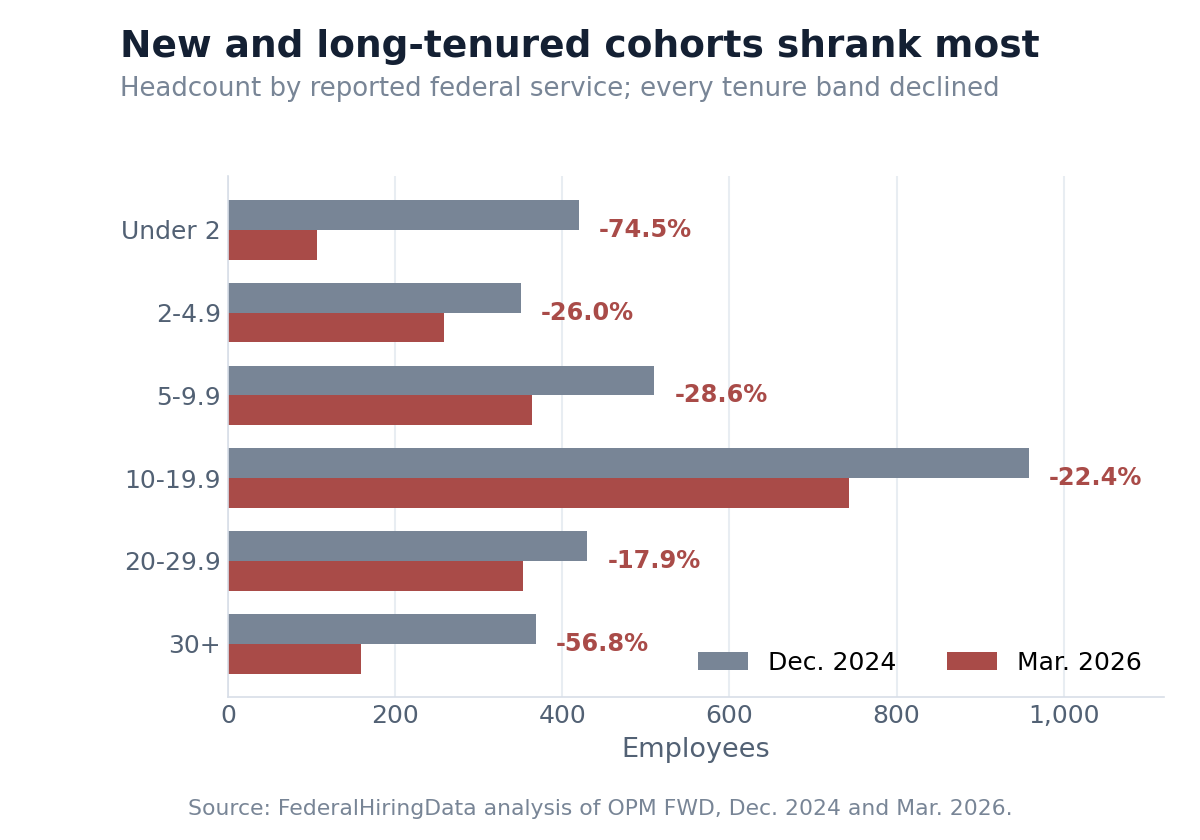
The status snapshots show a hollowing at both ends. Employees with fewer than two years of service fell from 420 to 107, down 74.5%. Employees with 30 years or more fell from 368 to 159, down 56.8%. The middle shrank too, but less sharply.
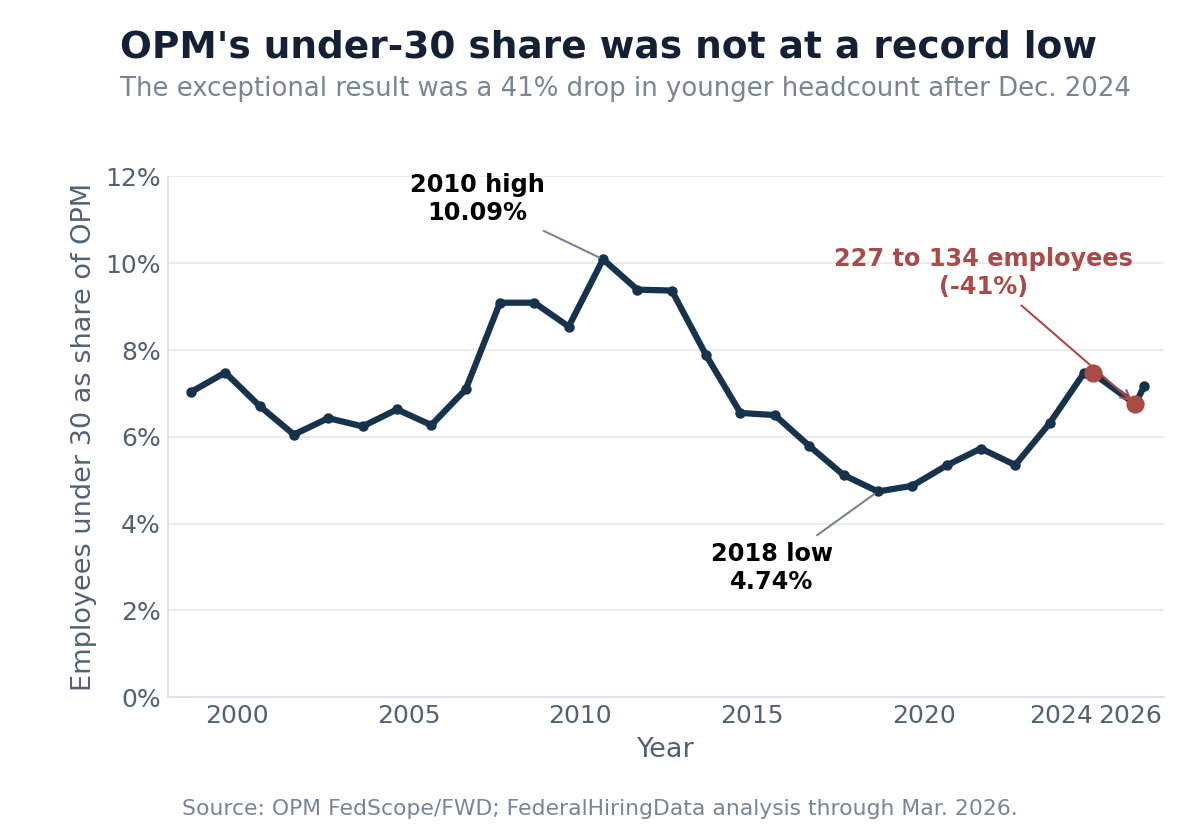
Age followed a similar pattern. OPM employees under 30 fell from 227 to 134, a 41.0% drop. Employees age 60 or older fell from 459 to 236, down 48.6%. The younger cohort's share of OPM declined from 7.47% to 6.75%.
The historical context matters. Under-30 employees were just 4.74% of OPM in 2018 and 4.87% after the bureau transfer in 2019. Their share reached 10.09% in 2010. March 2026 was therefore not a 20-year low. What stands out is the speed of the recent loss, immediately before OPM told the rest of government to reserve positions and money for early-career talent.
Entry-level structure weakened as well. GS-1 through GS-7 employment fell 40.0%, compared with 28.6% for GS-8 through GS-12. Two trainee series nearly disappeared: administrative and office-support student trainees fell from 17 to one, and IT student trainees from 14 to one.
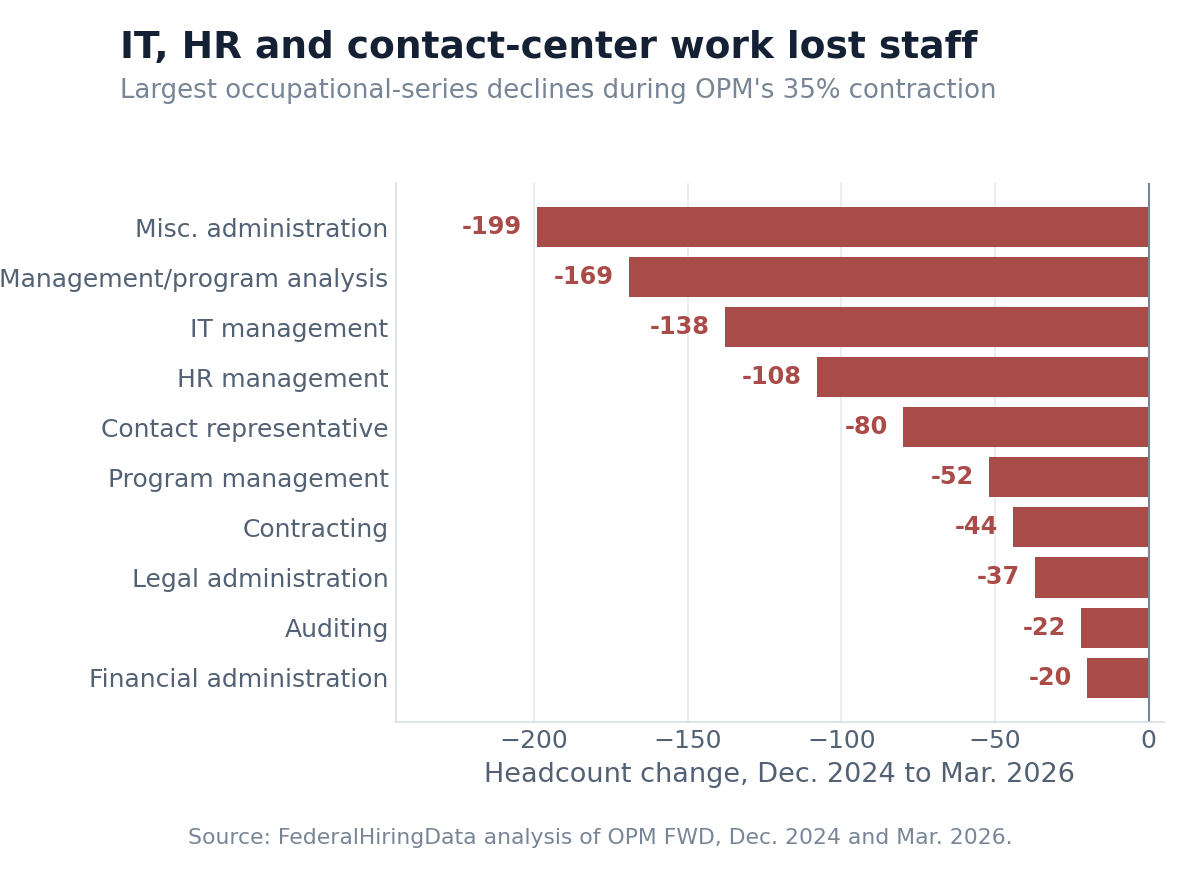
The losses also reached the jobs that operate OPM. IT management fell by 138 employees, HR management by 108, contact representatives by 80 and contracting by 44. Supervisors and managers declined from 492 to 332, a 32.5% reduction. Because that was slightly less than the agencywide cut, their share edged up from 16.2% to 16.7%.
Geographically, the biggest losses were in the District of Columbia, Pennsylvania, Maryland, Virginia and Georgia, where OPM has major headquarters and operating-center work. Public aggregate data do not identify each worker's office, so those state losses cannot be assigned to a specific closure.
Retirement is the live test
Retirement Services is where staffing, workload and automation meet in a service that former federal employees can feel directly.
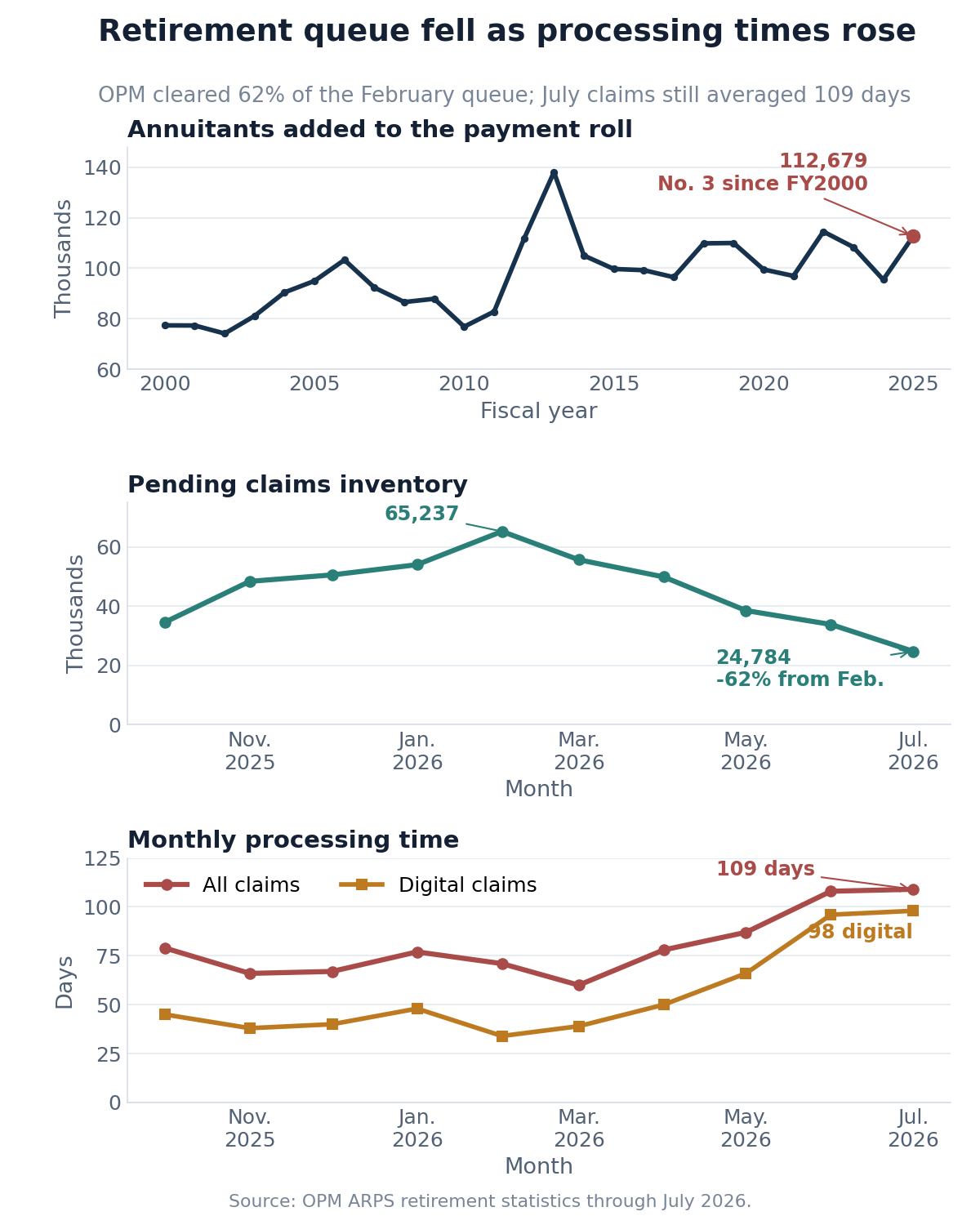
OPM added 112,679 annuitants to its payment roll in fiscal 2025, an 18.0% increase from 2024 and the third-highest total since 2000. Only 2013 and 2022 were higher. GAO's budget analysis found Retirement Services lost 165 FTE, or 16%, from fiscal 2024 to 2026. OPM's inspector general said more than 100 Retirement Services employees left through deferred resignations and regular retirements, while more than 20 planned hiring actions were canceled. The organization still received roughly 6,000 calls a day.
Automation has produced measurable gains. OPM reported more than 97,000 online retirement applications after launching its digital system in February 2025. As of November, digital applications averaged 38 days for approval, compared with 94 for paper, according to the fiscal 2027 budget request.
The 2026 surge complicated that record. Total pending inventory climbed to 65,237 in February, then fell 62% to 24,784 by July as OPM processed more cases. That is substantial throughput. But average total processing time moved in the opposite direction: 60 days in March, 78 in April, 87 in May, 108 in June and 109 in July. July digital cases averaged 98 days, while OPM said paper claims took 156. The monthly status report shows a system clearing its queue while making recent applicants wait longer.
Customer service was already strained. The inspector general reported more than 250 retirement-related complaints referred to the program after January 2025. About one-fifth concerned a lack of response, and roughly 30 had gone more than 100 days without an OPM response as of August 26, 2025.
The fiscal 2027 request holds Retirement Services at 863 FTE and increases its funding. That is important counterevidence to a story of uninterrupted cuts. It also establishes a clear performance test: whether digital processing can bring wait times back down without rebuilding the February inventory.
Ten offices did not mean ten vanished functions
GAO wrote that OPM eliminated ten offices. The underlying budget language is more qualified: it names ten "closed and reduced programs and offices" and a reduced IT function. Later records show a mix of closure, transfer and redistribution.
The Federal Executive Boards program was closed under an executive order. The Center for Leadership Development closure eliminated programs and services. Five former organizations remain grouped as closed offices in the fiscal 2027 budget: Communications; Diversity, Equity, Inclusion and Accessibility; Procurement Operations; Strategy and Innovation; and the Executive Secretariat, Privacy and Information Management.
Procurement did not disappear. OPM's Facilities, Security and Emergency Management office retains a Procurement Services division, and GSA now awards and administers about 80% of OPM's contract portfolio. Enterprise Risk Management moved into the Office of the Director. The former EHRI and HR Line of Business functions moved into Human Resources Solutions, where OPM still collects governmentwide workforce data and operates Federal Workforce Data.
In other cases, the record is incomplete. The budget does not identify a clear destination for all communications duties or the full set of privacy, records and executive-secretariat work. The Office of Small and Disadvantaged Business Utilization disappeared from the organization list, but the fiscal 2027 budget still describes unresolved Small Business Act compliance work. A closed box on an organization chart is not proof that its statutory work ended.
That uncertainty is not incidental. OPM told its inspector general that political leaders, HR officials and program offices conducted a comprehensive, data-informed workforce review. When the inspector general requested supporting records, OPM said there was "no relevant documentation" it could provide. OPM also declined GAO's requests for documents, a meeting and written answers, leaving GAO unable to assess the rationale, costs, benefits or mission effects of the changes.
The inspector general has identified effects that are already concrete. An IT audit coordinator and supporting staff left or were reassigned and were not replaced; audit responses slowed. A Postal Service Health Benefits infrastructure team had three people where OPM's own analysis said 11 were needed, while more than 60,000 enrollment records required reconciliation. The human-capital data team was abolished. All 16 recommendations to OPM from a 2021 National Academy of Public Administration study remained open, with no new fiscal 2025 progress update provided to the inspector general.
A wider assignment with a smaller bench
OPM's fiscal 2027 budget does not plan to restore its earlier staffing level. The all-resource request, including the inspector general, falls from 2,171.2 enacted FTE in 2026 to 2,073.7, about 4.5% lower. Retirement Services stays flat, but Human Resources Solutions falls from 338.4 to 298 FTE, the chief information office from 170.9 to 155, and Workforce Policy and Innovation from 124 to 109.
Those are the same parts of OPM expected to support shared certificates, USA Staffing, USAJOBS, technical assessments, workforce data, technology hiring and quarterly staffing-plan oversight. The staffing-plan memo requires agencies to identify accountable officials, reserve billets and budgets, document gaps in assessment coverage and explain misses against the new targets.
The government will soon have evidence of whether this model works. Shared-certificate selections, early-career hiring, technical-assessment coverage and quarterly variance reports are measurable. So are retirement wait times, IT audit recommendations, health-benefit reconciliation and workforce-data quality.
What the public record does not show is the analysis that justified cutting OPM first. Until the agency produces that record, improved outcomes can demonstrate that the smaller structure works. Missed targets and widening service gaps can show the opposite. The 35% figure identifies the scale of the bet; OPM's performance in fiscal 2027 will determine its cost.
Methodology and limitations
FederalHiringData analyzed OPM agency code `OM` in the local Federal Workforce Data warehouse, legacy FedScope September employment cubes from 1998 through 2024 and the FederalHiringData historical USAJOBS archive from March 2017 through August 13, 2026. The accompanying extracts and SQL preserve the snapshot and action periods used for each calculation.
Headcount is point-in-time employment, while budget FTE is a different measure. The historical decline ranking uses overlapping 15-month windows, so adjacent ranks are interpreted as episodes rather than independent events. Personnel actions and status snapshots do not reconcile one-for-one. The live Federal Workforce Data file has also revised separation records since GAO's download; GAO's frozen service-band percentages are retained for GAO's finding, while calculations from the current file are labeled separately.
Reported service is total federal service and cannot be read as tenure at OPM. Public location aggregates do not identify a worker's office, so state declines cannot establish which unit closed. USAJOBS announcements are postings, rather than hires, and some OPM announcements can support reimbursable work for customer agencies. Retirement ARPS totals cover the federal branches, the Postal Service and intelligence agencies, a broader universe than OPM's own workforce. Salary data were reviewed but are not central here because source definitions change and nominal averages are sensitive to workforce composition.
Continue reading
More from FederalHiringData

Data investigationsAugust 18, 2026
FEMA's Public Workforce Count Fell 22% as GAO Warned of Readiness Risks
FEMA had 5,793 fewer covered civilian employees in June 2026 than in January 2025. GAO says the agency cut staff without the workforce planning needed to assess mission capacity.

Data investigationsAugust 18, 2026
IRS Workforce Fell 29% as GAO Warned of Filing-Season Risks
The IRS had 29,663 fewer covered civilian employees in June 2026 than in January 2025. GAO says workforce-planning gaps and post-filing pressures pose risks to future operations.

Data investigationsAugust 20, 2026
GSA Cut 45% of Its Buildings Workforce. Some Dispositions Slipped.
GSA is still selling property, but GAO found restarted projects, fewer appraisers and no reliable measure of whether the accelerated program is actually faster.
Federal Hiring Data Weekly
Subscribe to Federal Hiring Data Weekly.
Subscribe to Federal Hiring Data Weekly. Confirm your email after signing up to receive federal hiring trends, salary data, agency movements, and original research.