August 20, 2026
GSA Cut 45% of Its Buildings Workforce. Some Dispositions Slipped.
GSA is still selling property, but GAO found restarted projects, fewer appraisers and no reliable measure of whether the accelerated program is actually faster.
By Evan Mercer
Published August 20, 2026Last edited August 20, 2026

The General Services Administration set out to sell or otherwise dispose of unneeded federal property faster. Then the agency cut the workforce responsible for buildings by about 45%.
One result appears in GSA's own fiscal 2025 performance report: a policy shift toward using commercial real-estate brokers “lengthened the disposition schedule of two properties into FY26.” The report does not name the properties, quantify the delay or say the shift caused GSA to miss its sales-revenue target. It is still a concrete admission that part of the new process added time rather than removing it.
GSA reported $45.68 million in fiscal 2025 gross sales revenue, excluding sales under the Federal Assets Sale and Transfer Act, against a target of $53.97 million. It sold 12 properties under that performance measure and projected $318 million in avoided delinquent maintenance. Those measures do not answer the central question: did the downsized organization move comparable properties faster?
The public record supports a careful answer. Staff departures created specific bottlenecks, forced some work to restart and reduced local and technical capacity. But incomplete transaction data and shifting program definitions make a national before-and-after speed comparison impossible.
A 45% workforce cut
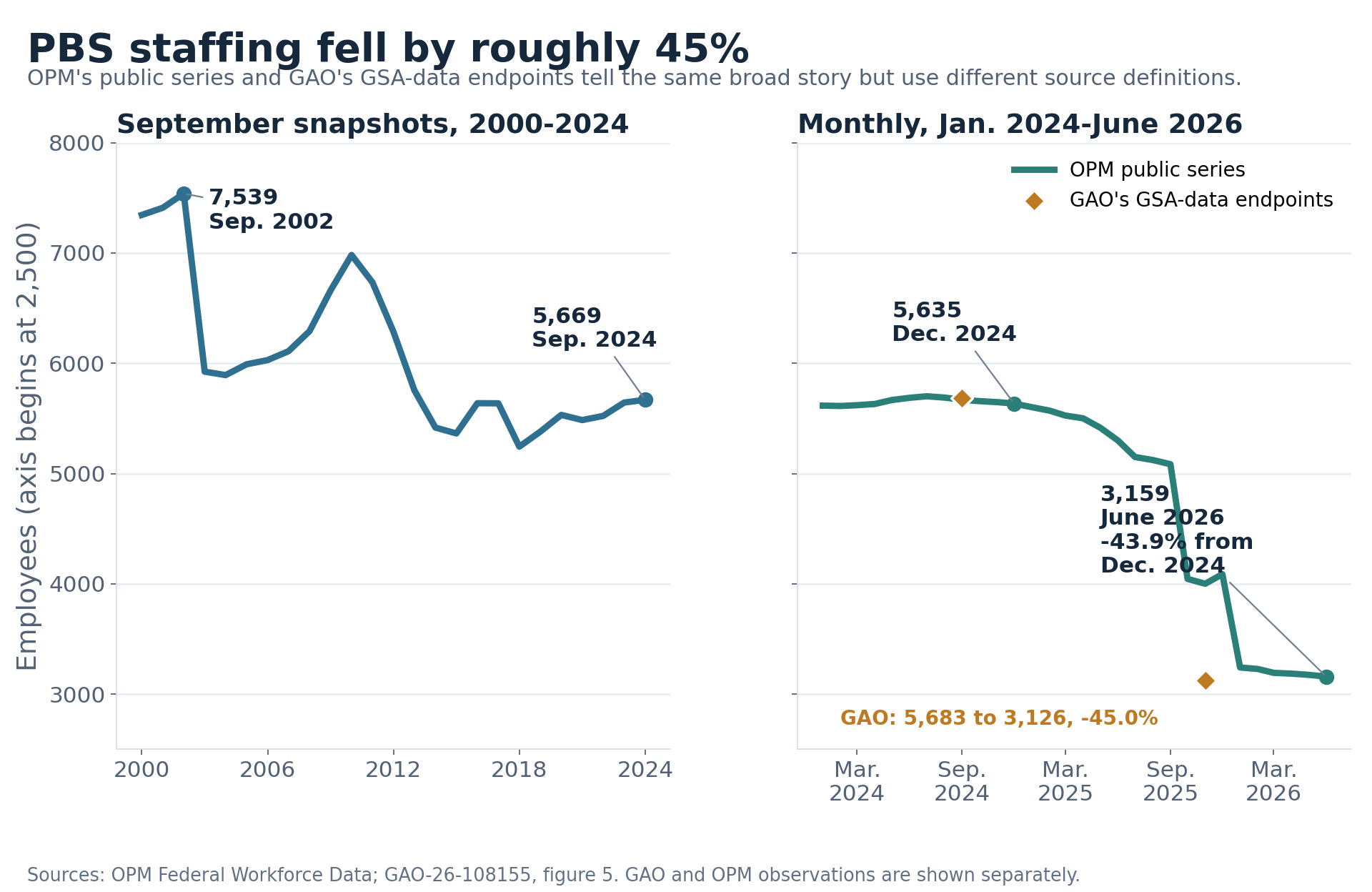
The Public Buildings Service, or PBS, manages the federal government's real-estate portfolio for GSA. According to the Government Accountability Office's April 2026 review of the reorganization, PBS staffing fell from 5,683 in September 2024 to 3,126 in November 2025. That is a loss of 2,557 employees, or 45.0%.
GSA made that reduction before it completed strategic workforce planning. GAO found that PBS mapped remaining employees into roles and assessed skill gaps after the major cuts. In December 2025, officials still did not know how many workers were needed to fill those gaps.
Office of Personnel Management data provide a separate public series. They should not be forced to match GAO's internal GSA figures, but they show the same broad contraction. PBS had 5,635 employees in December 2024 and 3,159 in June 2026, a decline of 2,476, or 43.9%. June 2026 was the lowest observation in the local PBS series, which begins in September 1998.
The longer history also supplies useful context. PBS had 7,539 employees in September 2002, then dropped sharply in 2003 and operated near 5,200 to 5,700 for much of the decade before 2025. The latest reduction did not begin from a historic staffing peak, and it was larger than the earlier one-year contraction visible in the September series.
The losses reached core property work
Headcount alone does not show what the agency lost. OPM occupational series indicate that the contraction reached work needed to prepare deals, assess buildings and manage projects.
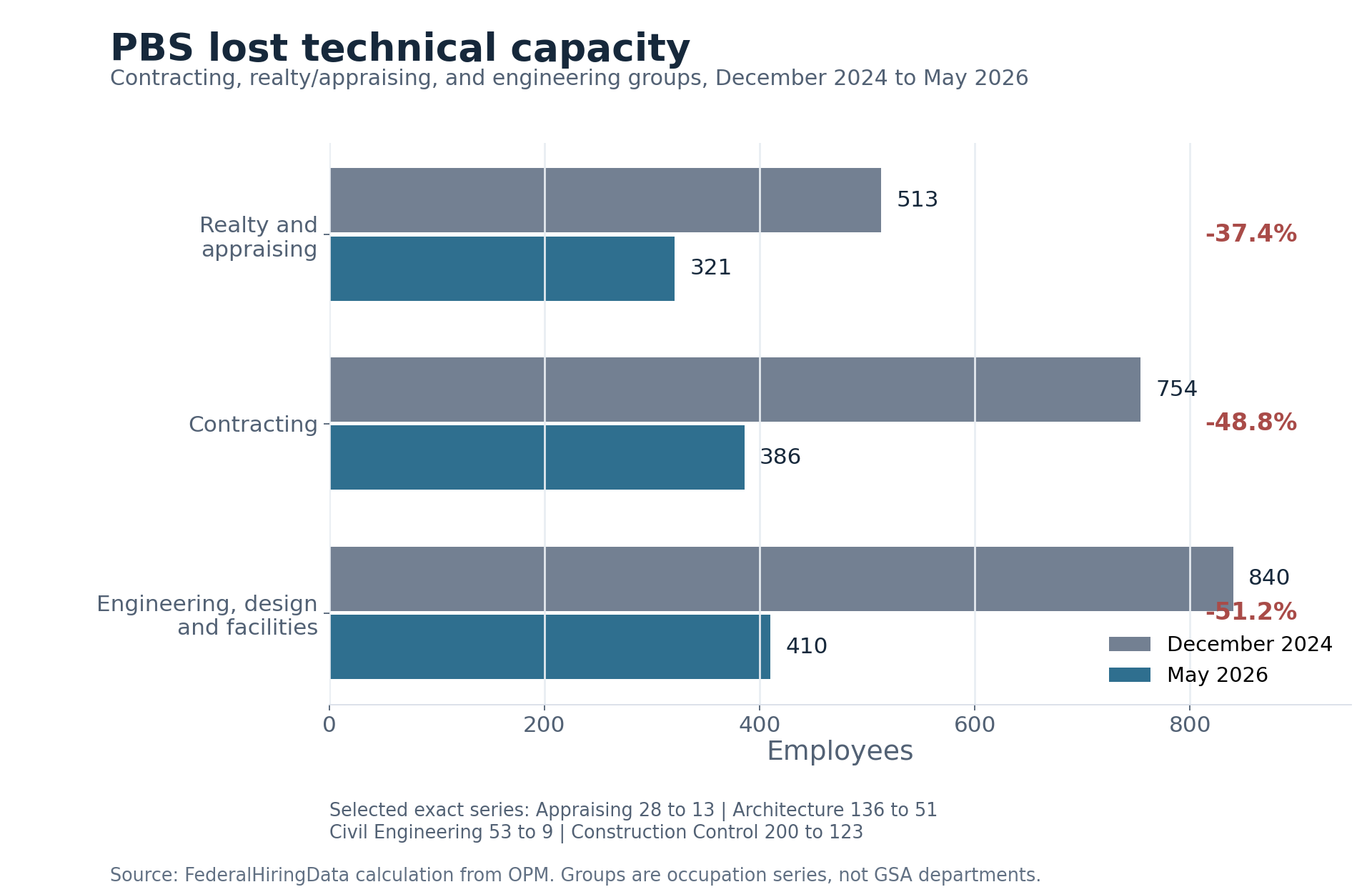
From December 2024 through May 2026, PBS contracting staff in occupational series 1102 fell from 754 to 386, down 48.8%. Realty and appraising staff fell from 513 to 321, down 37.4%. A defined group of engineering, design and facilities occupations fell from 840 to 410, down 51.2%.
The smaller series are more vivid. Appraising fell from 28 to 13 employees across PBS. Architecture fell from 136 to 51, civil engineering from 53 to nine, and construction control technical from 200 to 123. These are PBS-wide occupation codes, not counts of GSA departments. They also cannot isolate job titles such as asset manager or cost estimator.
GAO's narrower office-level evidence fills in part of that gap. The real-property disposal office fell from 75 employees in January 2025 to 48 in September. Its appraisers fell from five to two. A separate GAO functional figure reports 71 disposition workers in January and 48 in June, including reduction-in-force efforts. The timing and population differ, so the two starting values should not be treated as a discrepancy to average away.
Projects restarted and local access weakened
GAO documented how departures affected individual projects. In one case, an asset manager outside the relevant region had to take over a disposal and restart work, including procuring new title and environmental services. In another, a sale stalled after its project team left. The status of tenant relocation was unclear, and the disposal process restarted.
GSA officials also said fewer local employees made it harder to provide timely property access and tours for a broker-marketed building. Reduced staffing and travel meant fewer site visits, raising the risk that environmental or historic-preservation issues would surface late. A tenant agency said fewer cost estimators prolonged project timeframes because estimates needed to release space could not be produced promptly. Another tenant no longer knew whom to contact in some regions.
This is credible evidence of capacity-related delay. It is not a national estimate. GAO did not calculate a post-cut average preparation-to-sale time, and the public record does not identify the two properties GSA said slipped into fiscal 2026.
The old regional structure was not uniformly effective, either. Tenant agencies valued local knowledge and technical expertise, but they also reported inconsistent practices, poor communication about delays and unreliable property data. Centralization could improve consistency. The evidence shows disruption during the transition, not that every feature of the former organization worked well.
Selling federal property was already slow
Federal property disposal was a long-running management problem before the workforce cut. Federal real property has been on GAO's High-Risk List since 2003. Relocating tenants, completing environmental and historic reviews, screening property for other federal or public uses, and arranging funding can consume years.
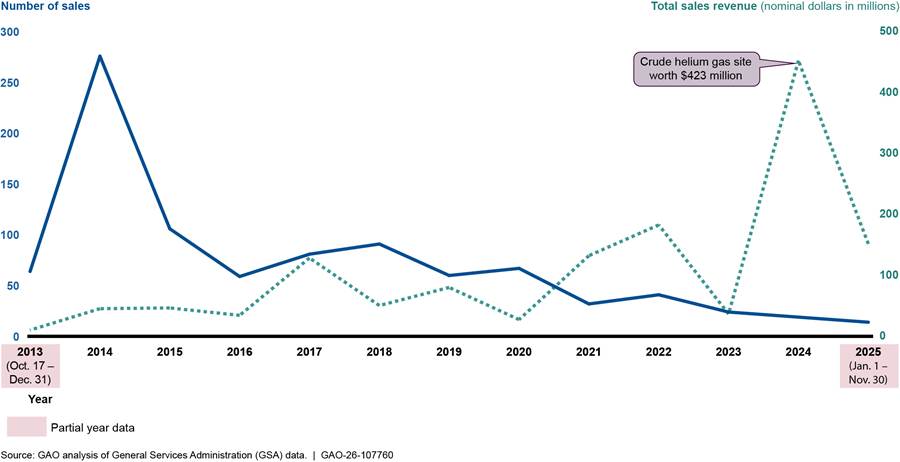
GAO's April 2026 sales review found that GSA completed 921 public real-property sales from October 17, 2013, through November 30, 2025, generating about $1.4 billion in nominal revenue. The annual counts use award date rather than closing date, and both 2013 and 2025 are partial periods.
Only 49 of those 921 sales involved GSA-owned properties, the subset most relevant to PBS capacity. They generated $474 million. Twenty-five were prepared and closed in about one year or less; 11 took longer than about three years. Those long cases predated the 2025 cuts and often involved tenant relocation, environmental work or statutory screening.
The 2024 revenue spike also needs context. A single $423 million crude-helium site sale drove most of it. Excluding that property, 2024 sales revenue was $28 million. An annual revenue chart therefore reflects the mix and value of properties as much as organizational speed.
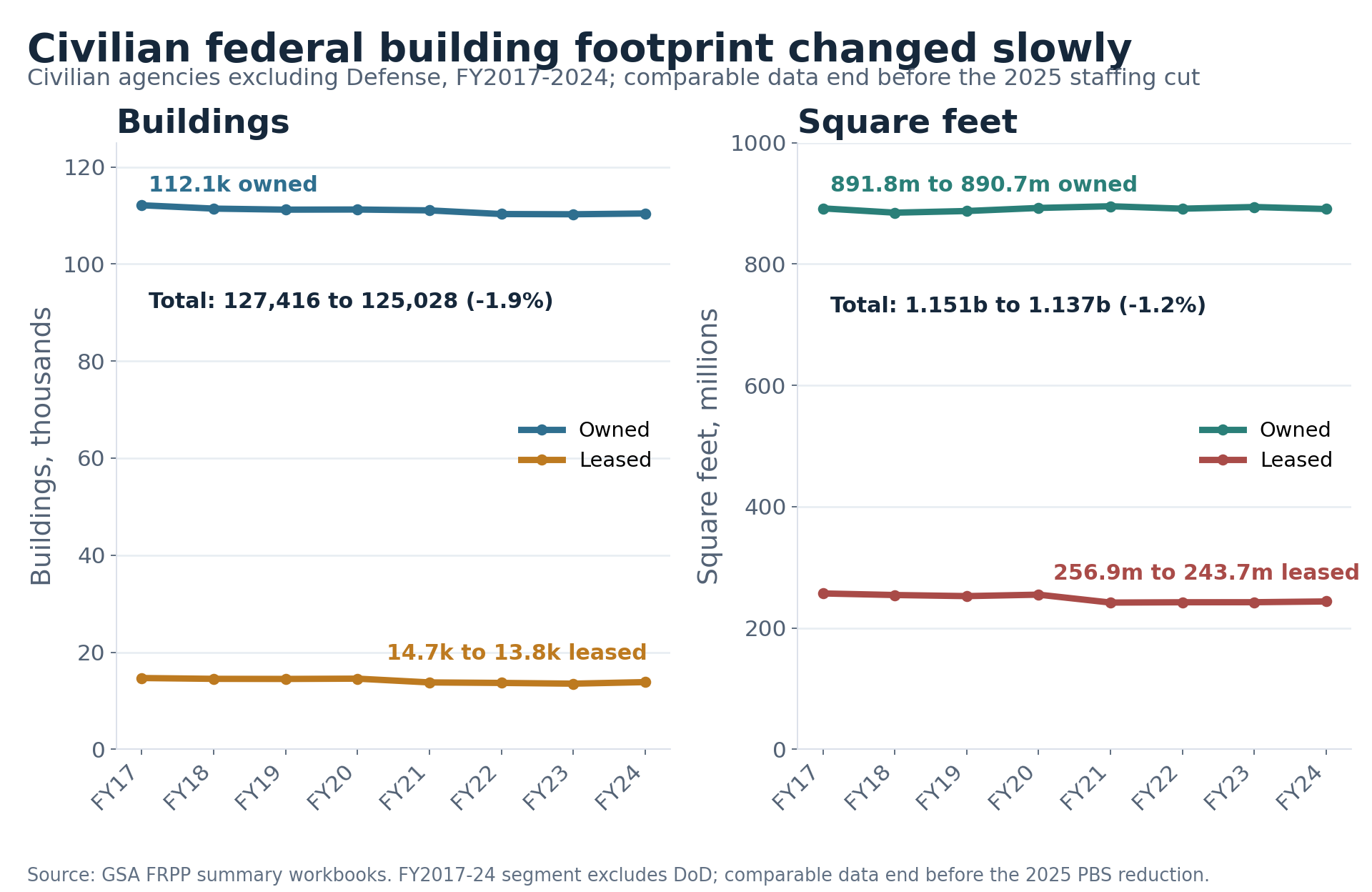
Before 2025, the broader civilian federal building footprint also changed slowly. Comparable GSA Federal Real Property Profile workbooks show that civilian agencies excluding the Defense Department went from 127,416 buildings in fiscal 2017 to 125,028 in fiscal 2024, down 1.9%. Total square footage fell 1.2%, from 1.151 billion to 1.137 billion. That series ends before the PBS reduction and should not be joined to the current GSA-managed inventory, which covers a different population.
The accelerated list was mostly inherited work
GSA announced an accelerated-disposition initiative in March 2025. But the list was not a clean set of newly discovered properties moving through a new process from the same starting date.
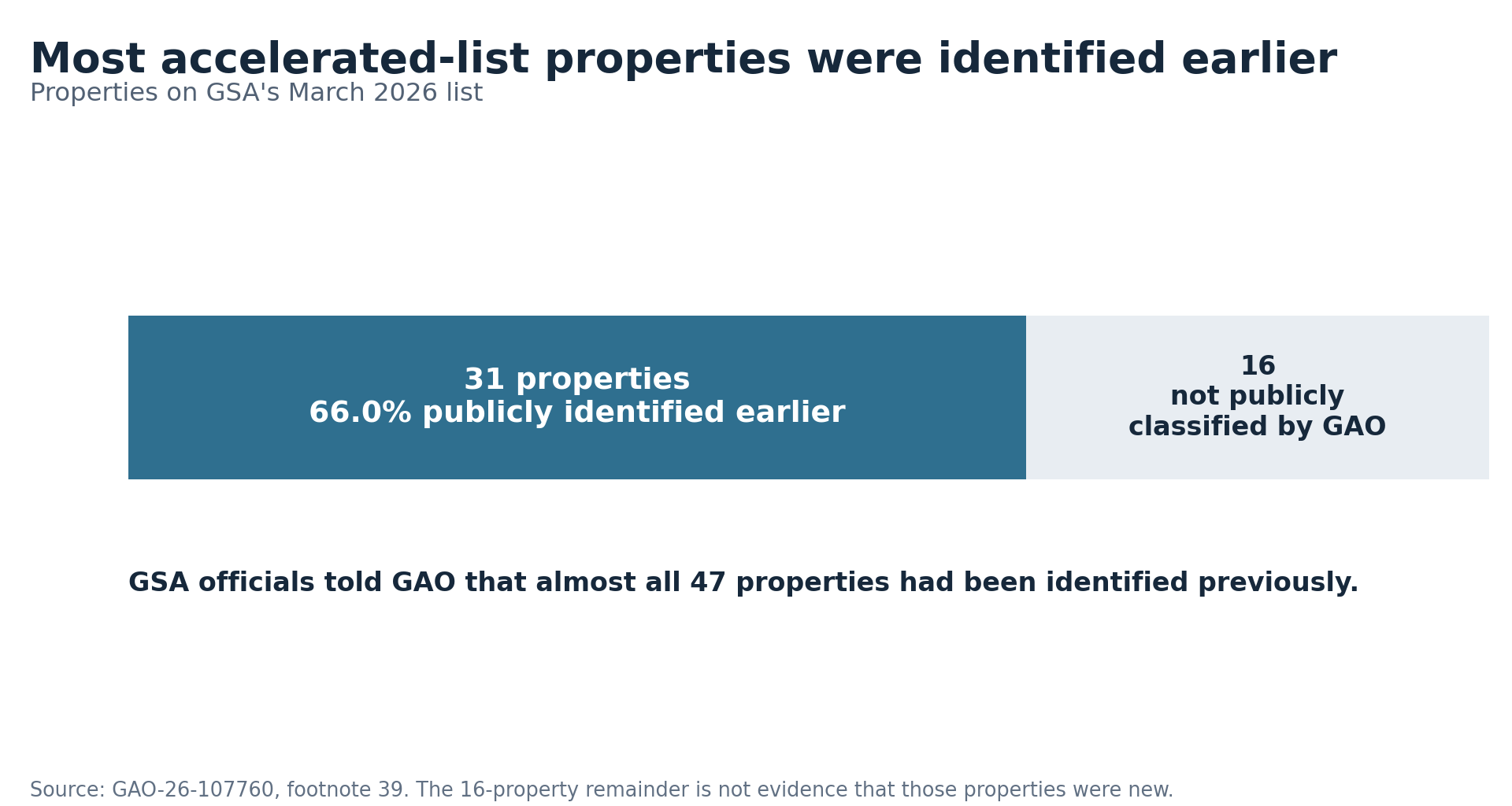
By March 2026, the list contained 47 properties. GAO found that 31 had already been publicly announced in 2023 or 2024 or recommended for disposal through the Federal Assets Sale and Transfer Act. That is 66.0% of the list. GSA officials told GAO that almost all 47 had been identified previously.
The other 16 cannot defensibly be labeled “new.” They are simply not classified in GAO's public prior-identification count. This matters because measuring time from the initiative's announcement would ignore work already completed, while measuring from an earlier internal identification date is impossible with the published data.
The initiative also changed scope. By September 2025, officials described its focus as identifying unneeded properties, and GAO reported in February 2026 that the approach remained unclear. Without a stable definition, a list count cannot by itself establish acceleration.
What the 2026 page shows
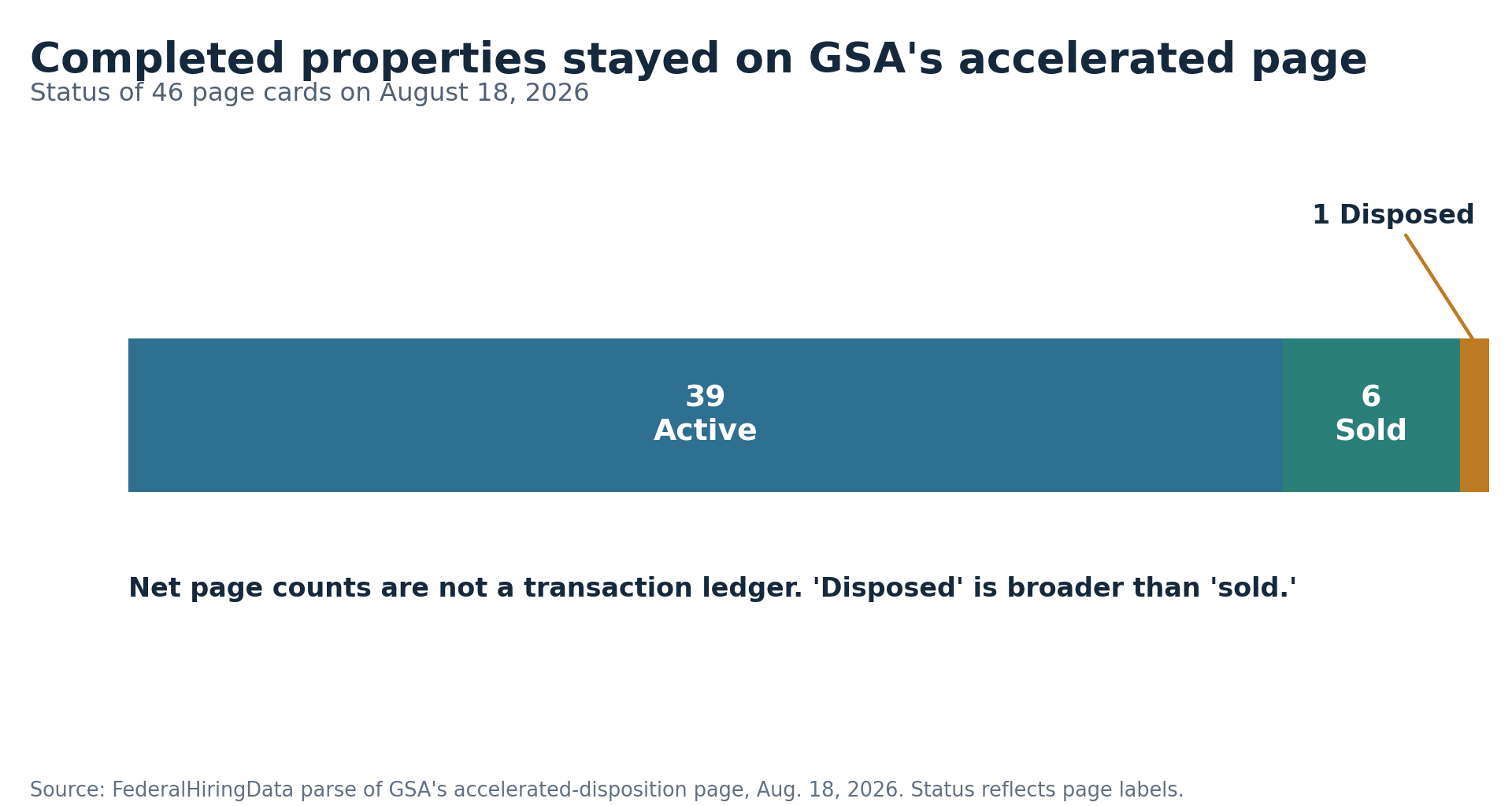
GSA's accelerated-disposition page contained 46 property cards on August 18, 2026. Thirty-nine were active, six were marked sold and one was marked disposed. Completed properties remained on the page, so the drop from 47 cards in March to 46 in August does not represent one completed transaction.
The six sold cards and one disposed card show that work continued after the reduction. They do not establish how quickly it moved. “Disposed” is broader than “sold,” and the page's date-listed and status fields are not transaction-level closing records.
Four properties were assigned to brokers in 2025: the Solomon Courthouse, 7th and D Streets, the Liberty Loan Building and River Road. None had closed by GAO's November 2025 cutoff. By August 18, 2026, GSA marked the first three sold and River Road disposed. The reviewed public sources do not provide a complete, comparable set of sale prices, commissions and start-to-finish timelines. USAspending records show zero federal obligations for the four task orders because fees may be paid from sale proceeds; zero obligations do not mean the brokers worked for free.
GSA argued that brokers could bring marketing expertise, develop reuse concepts and relieve internal capacity constraints. It had previously believed broker-led sales could be less cost effective and take longer. GAO recommended that GSA compare the results. With only four initial task orders and incomplete outcome data, no such comparison is yet defensible.
What the evidence cannot prove
There is no reliable national estimate of how the staffing cut changed average sale time. GAO found incomplete closing dates for 55 of 327 sales from 2018 through 2024, incomplete cost data for 172, and three sold properties missing from GSA's system. The lead sales-data analyst left through the spring 2025 deferred resignation program.
The missing data weaken both sides of the argument. They prevent a claim that the reorganization broadly slowed sales, and they prevent GSA from showing that its “accelerated” approach saved money or time across comparable cases. The most supportable conclusion is narrower: specific work slowed or restarted, capacity weakened sharply, and the aggregate effect remains unknown.
GSA has publicized continued activity, including a July 2026 claim of more than 127 properties disposed of since January 20, 2025, $614 million in proceeds and $1.15 billion in avoided maintenance and operating costs. Those figures cover disposal methods beyond sales and come from a different period and scope than the annual performance measure. They should not be inserted into GAO's sales series or treated as proof of faster processing.
The holding-cost stakes are real but cannot be assigned to the two delayed properties. GAO reported $106 million in annual operating costs for the 45 properties on the November 2025 accelerated list. If that entire portfolio remained held and costs accrued evenly, that equals about $290,411 per day or $8.83 million per average month. It is a portfolio scenario, not an estimate of the cost of the two schedule slips, whose identities and expenses are unknown.
Methodology and limitations
FederalHiringData queried the local DuckDB warehouse for PBS employment under agency subelement code `GS03`, using OPM monthly employment snapshots through June 2026. September observations from 2000 through 2024 form the long annual series. Occupational comparisons use December 2024 and May 2026 endpoints. The grouped occupation codes are documented in the chart-ready extracts and are disjoint, but they do not correspond to GSA offices or isolate individual job titles.
GAO staffing values were transcribed from accessible figures and kept separate from OPM values because the source extracts, timing and treatment differ. GAO's June 2025 functional counts include reduction-in-force efforts and are not treated as observed OPM payroll snapshots.
The building-footprint analysis uses official GSA FRPP summary workbooks. Only the civilian-agency segment excluding Defense from fiscal 2017 through fiscal 2024 is connected. Earlier workbooks include Defense and use different definitions. Current GSA owned-and-leased inventory figures are not appended because they cover GSA-managed buildings rather than the same government-wide population.
The accelerated-page count is a reproducible parse of the live GSA page as captured on August 18, 2026. It records card labels, not legal closing status. Historical Wayback coverage for the current URL begins in January 2026, so it cannot reconstruct the original March 2025 list. All calculations, source hashes, query text and uncertainty classifications are preserved in the research pack. Readers can explore broader federal workforce trends in statistics, search current public-service openings through jobs, and find related accountability reporting under articles.
The next test is measurable
GSA has agreed to create goals and measures for the accelerated approach, including avoided cost and timeliness. The useful comparison will separate similar properties, identify a consistent start and closing date, and report complete holding costs, preparation costs, broker fees and net proceeds.
That comparison should distinguish GSA-led and broker-led sales without assuming either model is faster. Until those data exist, the record is clearest at the project level: a much smaller workforce kept disposing of property, but some deals restarted, two schedules slipped and the agency lacked the information needed to say whether the new system was accelerating overall.
Continue reading
More from FederalHiringData

Data investigationsAugust 18, 2026
FEMA's Public Workforce Count Fell 22% as GAO Warned of Readiness Risks
FEMA had 5,793 fewer covered civilian employees in June 2026 than in January 2025. GAO says the agency cut staff without the workforce planning needed to assess mission capacity.

Data investigationsAugust 18, 2026
The Korea Exercise Was Cut. The Civilian Workforce Behind the Alliance Was Not
The U.S. defense presence in South Korea includes 2,903 appropriated-fund civilians, while 12,428 archived job announcements reveal the year-round system behind the alliance.
Data investigationsAugust 20, 2026
OPM's 35% Cut Was Its Deepest Since It Transferred an Entire Bureau
The federal government's HR agency now has fewer employees than at any reviewed point since 1998 while directing agencies to rebuild hiring and workforce planning.
Federal Hiring Data Weekly
Subscribe to Federal Hiring Data Weekly.
Subscribe to Federal Hiring Data Weekly. Confirm your email after signing up to receive federal hiring trends, salary data, agency movements, and original research.