August 25, 2026
The Coast Guard Plans to Add 15,000 Military Members. Only 26% of Its Workforce Requirements Are Current.
Recruiting rebounded, but cutter vacancies widened and covered civilian employment fell 9.9% as Force Design accelerated.
By Evan Mercer
Published August 25, 2026Last edited August 25, 2026
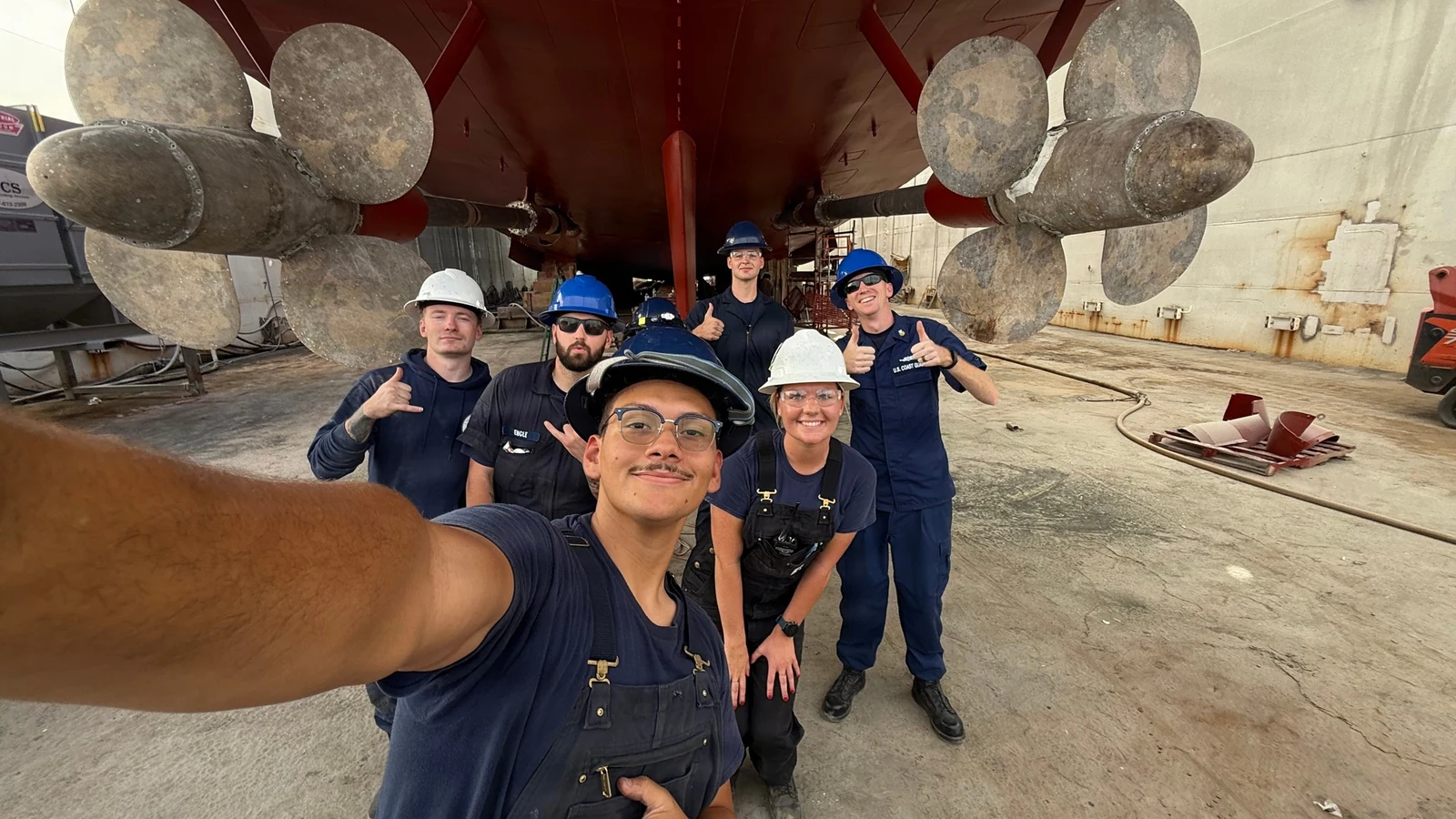
Six Coast Guard members stood beneath the hull of the *Reliance* last September, dwarfed by twin propellers and a ship that had just spent eight months in dry dock. Their assignment was not simply to sail it. The crew had stayed with the 210-foot cutter through structural repairs intended to keep a vessel commissioned in 1964 operating safely.
That photograph captures the human side of the Coast Guard's modernization problem. Congress has supplied billions of dollars for new cutters, aircraft, technology and facilities. Force Design 2028 promises a larger, more agile service. Yet the Coast Guard still depends on people who operate aging assets, oversee new acquisitions and keep both generations of equipment ready at the same time.
The service says it will add at least 15,000 active-duty and Reserve military members by the end of fiscal 2028. Recruiting has finally supplied momentum: enlisted accessions rose from 3,126 in fiscal 2023 to 4,422 in fiscal 2024 and more than 5,200 in fiscal 2025.
The planning beneath that growth remains unfinished. The Government Accountability Office reported that, as of March 2026, the Coast Guard had current workforce requirement determinations for only about 26% of its total workforce. That was progress from 6% in 2020, but it still left roughly three-quarters without an up-to-date determination.
FederalHiringData's analysis adds a separate warning about the civilian side. Office of Personnel Management records show Coast Guard civilian employment falling from 9,677 in September 2024 to 8,723 in June 2026, a decline of 954, or 9.9%. Most of the selected technical occupations examined here became smaller, including engineering, inspection, maintenance, logistics, aviation maintenance and naval architecture. Contracting was a notable exception.
Those findings do not erase the recruiting recovery or prove the Coast Guard cannot execute Force Design. They establish a narrower contradiction: the service is pursuing rapid military growth and large capital investments while its workforce model remains incomplete, its cutter crews remain short-staffed and its covered civilian workforce is smaller than it was two years ago.
The immediate shortfall is not one number
The Coast Guard's current public workforce page separates active-duty military members, civilians and the Selected Reserve. That distinction matters. Each population has a different authorization, hiring or accession system, and the gaps cannot be treated as interchangeable vacancies.

| Workforce component | Authorized | Onboard | Difference | Difference rate |
|---|---|---|---|---|
| Active-duty military | 41,426 | 40,757 | 669 | 1.6% |
| Civilian | 9,962 | 8,739 | 1,223 | 12.3% |
| Selected Reserve | 7,000 | 6,240 | 760 | 10.9% |
The military number is much healthier than the position the Coast Guard reported at the end of fiscal 2024. GAO said the service was about 2,600 enlisted members, or 8.5%, below its enlisted target then. The current 669-person difference covers the broader active-duty military workforce, not enlisted members alone, so the two figures are not a perfect before-and-after series. They nevertheless show that the recent recruiting rebound materially improved onboard strength.
The civilian figure points in the other direction. The official page reports 1,223 civilian vacancies, a 12.3% gap between authorized and onboard staffing. OPM's June 2026 covered-employment count of 8,723 is only 16 below the Coast Guard's current onboard civilian count, a useful cross-check despite differences in timing and coverage.
The Reserve remains separate again. Its 760-person gap cannot be added to the active-duty shortage and called an enlisted shortfall. Force Design's 15,000-member goal includes both active-duty and Reserve members, but current public documents do not provide a complete unit-by-unit allocation of that growth.
Recruiting recovered after five years of losses
The path to the current active-duty position was not steady. Coast Guard data analyzed by GAO show that enlisted gains exceeded losses in fiscal 2017 and 2018, then fell below losses every year from fiscal 2019 through fiscal 2023.

The worst year in GAO's series was fiscal 2022, when the published net-flow measure was negative 42%. In fiscal 2023, the Coast Guard recruited 3,126 enlisted members and lost more than 3,800. The direction reversed in fiscal 2024: 4,422 recruits exceeded the 4,200 target, and gains were more than 1,000 above losses.
Fiscal 2025 was stronger again. In its January 2026 Force Design update, the Coast Guard said it enlisted more than 5,200 active-duty members, exceeding 110% of its goal and recording its highest total since 1991. The same update said the service reached 104% of its Reserve enlisted goal and 100% of its active-duty officer mission.
That is substantial counterevidence to a story framed only around shortage. The Coast Guard expanded recruiting offices, added recruiters, increased marketing, offered incentives and broadened outreach. GAO found that much of the fiscal 2024 improvement was associated with more offices and recruiters, rather than a clear increase in underlying interest. The service had 65 offices in fiscal 2024 and planned seven more in fiscal 2025. Recruiter staffing was headed toward as many as 500 by summer 2026, nearly double its early-2021 low of 257.
The recovery also came with measurement questions. GAO found that the Coast Guard had not fully assessed which recruiting initiatives produced the results. A virtual call center placed more than 82,000 calls in fiscal 2024 and generated about 1,140 applications, but an application is not an accession. Technical-school partnerships had produced only three new recruits by fiscal 2024, with seven more scheduled as of February 2025. The Scout Talent and Refer program, by contrast, accounted for nearly 22% of new recruits that year.
As of Aug. 25, 2026, no final fiscal 2026 recruiting or end-strength result was public. The defensible current conclusion is that the rebound is real and the FY2024 enlisted deficit has narrowed; it is too early to say how much of the 15,000-member Force Design goal has become sustained net growth.
A 15,000-member goal rests on a workforce model that is 26% current
Force Design describes the Coast Guard as not right-sized for its missions. It links the 15,000-member military growth target to readiness, a growing fleet and new capabilities. GAO found that Coast Guard officials called the figure a minimum based partly on assets the service is acquiring.
But a force-wide staffing target and a workforce requirements determination answer different questions. The first says how much the military population should grow. The second identifies the number and mix of people required in particular units and functions.

In 2020, only 6% of the workforce had current requirements determinations. By March 2026, the Coast Guard had reached 26%. That fourfold improvement is meaningful. It also means 74% was still outside the current requirements inventory when the service embarked on a plan to add at least 15,000 military members within less than three fiscal years.
GAO did not conclude that 15,000 was necessarily too many or too few. It concluded that the basis was unclear without current requirements for the entire workforce. Its June 2026 recommendations asked the Coast Guard to align Force Design's foundational documents with missions and measurable targets and to create an evaluation plan across organization, people, technology, and contracting and acquisition. Both recommendations remained open when this analysis was completed.
This is not paperwork detached from operations. A service can meet an aggregate recruiting goal and still have the wrong mix of ratings, grades or specialties in the wrong places. It can fill an authorized billet while the assigned member is in training, on medical leave or otherwise unavailable. It can add crews for new cutters while leaving shore support, acquisition management, IT or maintenance teams thin.
Force Design itself recognizes that problem. Its people plan calls for changing the mix across grades and specialties, rebuilding the enlisted workforce, revitalizing the Reserve and removing obstacles for civilians. The unresolved issue is whether the underlying requirements system can guide those choices fast enough.
Cutter vacancies show what an aggregate count misses
GAO's cutter review provides the clearest unit-level warning. Cutter crew and shore-based support vacancy rates rose between fiscal 2017 and fiscal 2024, even before Force Design's new military growth target.

In fiscal 2017, 401 cutter crew and support positions were vacant, about 5% of the total. By fiscal 2024, the count had reached 1,104 vacancies out of 8,832 positions, about 13%.
The fiscal 2024 total included 968 vacant crew positions among 8,016 cutter billets, or about 12%, and 136 vacancies among 816 cutter-support positions, or about 17%. Support teams include shore-based maintenance and weapons augmentation units. Their vacancy rate had increased more than fivefold from 2017, according to GAO.
Even those numbers may understate operational scarcity. Position data show whether someone is assigned, not whether that person is available to deploy or work. Coast Guard officials told GAO that cutters sometimes sailed without full crews and that commanders moved personnel between cutters through local arrangements that were not always reported upward. Crew members then absorbed missing duties and could lose scheduled rest.
The service responded by redistributing risk. Its Force Alignment Initiative de-staffed 23 seasonal boat stations, reduced duplicative search-and-rescue coverage at 19 stations, laid up seven 87-foot patrol boats, put five harbor tugs on standby and laid up four 210-foot medium-endurance cutters in fiscal 2024. Personnel from those cutters were reassigned to short-staffed units.
That strategy can improve staffing where assets remain active. It also demonstrates why a service-wide onboard number is insufficient. A military workforce can move closer to its aggregate authorization while the mix of deployable cutter crews, maintenance teams and specialized skills remains constrained.
The ships are a parallel readiness limit
People are not the only constraint. GAO found a cutter fleet with more failures, more deferred maintenance and less availability. Adding personnel would not by itself restore machinery that is obsolete, waiting for parts or beyond its planned service life.
| Readiness measure | Period | Published result |
|---|---|---|
| Cutter fleet | January 2025 | 241 cutters |
| Serious maintenance issues | FY2018 to FY2023 | 3,134 to 3,782, up 21% |
| Partially mission-capable cutter days | FY2018 to FY2024 | 3% to 8% |
| Unplanned maintenance spending | FY2020 to FY2024 | $31.9M to $48.4M, up 52% in real terms |
| Deferred cutter maintenance | FY2024 | $179M |
| Cutter crew and support vacancies | FY2024 | 1,104 of 8,832 positions |
The Coast Guard's 241 cutters include vessels of different ages, missions and sizes. GAO reported that serious maintenance issues that crews could not resolve rose 21% from fiscal 2018 through fiscal 2023. The share of cutter days spent partially mission-capable increased from about 3% in fiscal 2018 to 8% in fiscal 2024. Deferred maintenance reached $179 million in fiscal 2024, nearly nine times the inflation-adjusted 2019 amount.
Older cutters create labor demand even when they are scheduled for replacement. Crews and technicians must keep them safe while new vessels are designed, delivered and brought into service. Complex new systems can also require new training and specialized support. FederalHiringData does not assume that each new cutter creates a fixed staffing requirement; the public record does not support that calculation across the fleet.
Federal Hiring Data Weekly
Get the biggest federal workforce changes in your inbox.
Subscribe to Federal Hiring Data Weekly for federal hiring trends, salary data, agency movements, and original investigations, with email confirmation before delivery.
Asset availability is therefore both counterevidence and part of the workforce story. A short-staffed crew can limit operations on a capable ship. A fully staffed crew cannot deploy an unavailable ship. Modernization has to solve both constraints together.
The civilian workforce shrank as modernization accelerated
Military recruiting receives most of the public attention, but civilians perform much of the acquisition, engineering, contracting, IT, logistics, inspection and industrial work that turns funding into usable capability.
OPM's longest clean Coast Guard series in FederalHiringData's warehouse begins in September 2003, after the service moved into the newly created Department of Homeland Security. Covered civilian employment rose from 6,693 then to 9,677 in September 2024. It fell to 9,225 by September 2025 and 8,723 by June 2026.

The 954-person decline from September 2024 to June 2026 is not a count of vacancies and does not establish why each person left. It is a change in covered onboard employment. The Coast Guard's own current page separately shows 1,223 civilian vacancies against authorization.
The occupational record shows that the decline was broad among the technical series most relevant to modernization and sustainment.

| Selected civilian occupation | Sept. 2024 | June 2026 | Change | Percent change |
|---|---|---|---|---|
| Inspection, investigation and compliance (1801) | 382 | 331 | -51 | -13.4% |
| Maintenance mechanic (4749) | 206 | 180 | -26 | -12.6% |
| General engineering (0801) | 169 | 150 | -19 | -11.2% |
| Electrical engineering (0850) | 81 | 65 | -16 | -19.8% |
| Logistics management (0346) | 140 | 127 | -13 | -9.3% |
| Aircraft mechanic (8852) | 132 | 119 | -13 | -9.8% |
| Naval architecture (0871) | 57 | 45 | -12 | -21.1% |
| Information technology (2210) | 727 | 721 | -6 | -0.8% |
| Contracting (1102) | 464 | 476 | +12 | +2.6% |
Contracting's growth is important counterevidence. It suggests the civilian contraction was not uniform and that at least one core acquisition occupation received additional capacity. Marine machinery mechanics were unchanged at 98, and several smaller engineering series declined by only four positions.
The larger pattern still matters. Inspection and compliance lost 51 employees. General and electrical engineering lost 35 combined. Maintenance mechanics, aircraft mechanics and logistics lost 52 combined. Naval architecture fell by more than one-fifth, although the absolute change was 12 employees. The figures do not tell us whether work moved to military personnel, contractors or another occupation code.
Nor do they prove that each decline caused an acquisition delay. What they establish is that the Coast Guard entered its biggest modernization push with fewer covered civilians in most of the selected occupations that oversee, maintain and support assets.
Public civilian recruiting did not offset the decline
FederalHiringData's historical USAJOBS archive provides a different measure: public recruiting announcements rather than onboard employees. It contains Coast Guard announcements beginning in approximately March 2017.

For complete years, Coast Guard announcements rose from 2,334 in 2018 to a peak of 3,826 in 2022. The count was 3,301 in 2023 and 2,880 in 2024, then fell to 1,160 in 2025. That was a 59.7% decline from 2024.
The archive shows the technical recruiting base beneath those totals. Across the available period, it includes 1,326 Information Technology Management announcements, 1,285 Contracting announcements, 1,118 Inspection and Compliance announcements, 770 Maintenance Mechanic announcements, 515 Marine Machinery Mechanic announcements and 461 General Engineering announcements.
An announcement is not a vacancy, applicant, offer or hire. One control number can advertise one opening, multiple openings or a standing roster. The Coast Guard can also hire through internal actions or authorities not represented by a public announcement. The 2025 decline cannot be translated into 1,720 missing employees.
It is nevertheless evidence that visible civilian recruiting contracted at the same time OPM employment declined. The archive also helps identify what the Coast Guard has historically recruited: the workforce supporting modernization is not limited to naval engineers. It includes contracting officers, IT specialists, inspectors, mechanics, logisticians, accountants, training specialists and program managers.
The fiscal 2026 budget connects assets to positions, but not to the full growth target
The fiscal 2026 congressional budget justification includes position changes for specific initiatives. These are planned positions in the Operations and Support account, not counts of onboard employees, and they should not be added mechanically to the 15,000-member Force Design goal.
Related research
Put this finding in context
Data investigationsAugust 23, 2026
DOD Has a $285 Billion Maintenance Backlog. Its Facilities Workforce Is Shrinking.
DOD's reported repair backlog rose 80.8% after inflation while a selected civilian facilities-and-trades workforce proxy fell 11.4% after January 2025.
Data investigationsAugust 18, 2026
The Korea Exercise Was Cut. The Civilian Workforce Behind the Alliance Was Not
The U.S. defense presence in South Korea includes 2,903 appropriated-fund civilians, while 12,428 archived job announcements reveal the year-round system behind the alliance.
| Selected FY2026 program change | Position change |
|---|---|
| Force Design 2028 - People: Maximize Readiness | +108 |
| Fast Response Cutter follow-on | +74 |
| Force Design 2028 - People: Medical Care | +31 |
| Commercial icebreaker follow-on | +11 |
| Enterprise IT follow-on | +2 |
| Decommission three 210-foot cutters | -264 |
The Fast Response Cutter item is unusually concrete. It funds crews and mission support for cutters scheduled for delivery, including maintenance, logistics and weapons support at homeports. The commercial icebreaker item includes operating and maintenance support. The two Force Design people items add 139 positions for readiness and medical care.
The negative 264 positions associated with retiring three 210-foot cutters do not mean 264 people necessarily leave the Coast Guard. Positions can be redirected, as the service did during earlier force-alignment actions. The table illustrates that asset choices and workforce choices are linked at the program level even when the broader 15,000-member allocation is not public.
Congress has made the scale of modernization unmistakable. GAO reported that the Coast Guard received nearly $25 billion in fiscal 2025 supplemental funding and about $13.5 billion in fiscal 2026 appropriations. The service said more than $3 billion of the supplemental funding had been obligated by January 2026 and expected 75% to be obligated by the end of fiscal 2026.
Money can buy ships, technology and facilities. It cannot substitute for a current requirements model, recruit and train a specialist instantly, or make an aging cutter available while it awaits parts.
What would show that Force Design is closing the gap
The Coast Guard's strongest evidence is its recruiting result. More than 5,200 enlisted recruits in fiscal 2025 is not a projection, and the current active-duty authorization gap is far smaller than the FY2024 enlisted shortfall. The service has also expanded recruiting capacity, reorganized leadership and begun funding named crew and support requirements for new assets.
The next test is distribution and durability.
First, the service can publish progress toward current requirements determinations beyond the March 2026 level of 26%, with milestones for the remaining workforce. That would let Congress and the public see whether the 15,000-member target is being converted into specific needs rather than treated as an aggregate.
Second, cutter data can distinguish assigned strength from staff availability. GAO recommended collecting and assessing availability because assigned personnel can be unavailable and local swaps can conceal pressure. DHS disagreed with that recommendation, saying existing processes were sufficient. GAO maintained that availability data would improve assignment decisions.
Third, civilian workforce reporting can show whether the decline has ended in acquisition, engineering, logistics, IT, inspection and maintenance functions. Contracting's small increase is a useful start, but it does not replace naval architects, mechanics or engineers.
Finally, asset metrics should move with workforce metrics. Fewer partially mission-capable days, less deferred maintenance and improved operational availability would provide evidence that people and capital investments are producing usable readiness.
Force Design 2028 is often described as a technology and acquisition plan. Its hardest dependency is more basic. The Coast Guard must know which people it needs, recruit them, retain them, put them in the right specialties and give them assets that can operate. The service has begun to solve the recruiting part. The public record does not yet show that the rest of the workforce system has caught up.
Methodology and limitations
FederalHiringData analyzed official Coast Guard, GAO, OPM and USAJOBS records available through Aug. 25, 2026. Military, civilian and Reserve populations are kept separate throughout.
Current authorized and onboard counts come from the Coast Guard workforce page. GAO's fiscal 2024 military composition counted 30,602 active-duty enlisted members, 8,280 active-duty officers and 6,329 Selected Reserve members. The Defense Manpower Data Center reported 42,600 assigned active-duty Coast Guard members worldwide in March 2026. DMDC and Coast Guard totals use different dates and coverage rules, so FederalHiringData used them as cross-checks rather than joining them into one trend line.
The enlisted net-flow chart reproduces GAO's published percentage labels for fiscal 2017 through fiscal 2024. The fiscal 2025 recruiting count is a lower bound because the Coast Guard reported "more than 5,200." No final fiscal 2026 result was available by the analysis date.
Cutter vacancy rates were digitized from GAO-25-107222 Figure 10 and rounded to the nearest whole percentage point. Exact fiscal 2017 and fiscal 2024 vacancy counts come from the report text. Vacancy rates measure assigned positions, not staff availability or workload.
The civilian series uses September FedScope snapshots for Coast Guard subelement `HSAC` from 2003 through 2024, followed by September 2025 and June 2026 OPM Federal Workforce Data. September 2003 is the first clean post-DHS observation in the local long-run series. Covered employment excludes military personnel and does not count contractors as federal employees.
The occupation comparison uses selected Coast Guard civilian series in September 2024 and June 2026. It is not a complete accounting of every occupation and can be affected by recoding or organizational change. Headcount changes do not establish causes or workload effects.
USAJOBS analysis counts distinct control numbers with Coast Guard agency code `HSAC` by close year. Historical coverage begins approximately in March 2017. Announcements can carry multiple occupations and locations, and they do not equal vacancies, applications, selections or hires.
Budget positions and FTE remain separate from onboard headcount. Program changes are proposals in the fiscal 2026 justification and do not establish that every position was filled. FederalHiringData did not estimate contractor headcount or a fixed crew requirement for each new asset.
Article research and writing used no OpenAI API calls.
Official records and further reading
- GAO-26-109215: Coast Guard modernization and Force Design 2028
- GAO-25-107222: Cutter maintenance and workforce challenges
- GAO-25-107224: Recruiting progress and remaining weaknesses
- GAO-25-107869: Enlisted retention and workforce shortfall
- Coast Guard Force Design 2028
- Coast Guard workforce counts
- OPM Federal Workforce Data downloads
- Browse current federal jobs
- Explore federal workforce statistics
Continue reading
More from FederalHiringData
Data investigationsAugust 22, 2026
Space Force Filled 75% of Its Documented Need. Now It Says Personnel Must Double.
A GAO review found 13,509 assignments against 18,002 documented requirements as the service planned to double personnel without a complete workforce ledger.

Data investigationsAugust 22, 2026
Two Army Depots Lost 785 Government Workers as Repair Work Became Harder to Plan
Anniston and Red River added 241 contractor personnel, but skills gaps, vehicle condition, parts, drawings and old machinery complicated billions in repair work.
Data investigationsAugust 21, 2026
DOD Cut 78,375 Civilian Jobs. The Work Did Not Disappear.
The 2025 reduction reached IT, contracting, engineering, logistics and weapons testing. Public records do not show a clean transfer of the work or its full cost.
Federal Hiring Data Weekly
Get the biggest federal workforce changes in your inbox.
Subscribe to Federal Hiring Data Weekly for federal hiring trends, salary data, agency movements, and original investigations, with email confirmation before delivery.