August 24, 2026
Aguadilla Crossed TSA's Cargo Threshold. Permanent Inspectors Still Weren't Stationed There.
Puerto Rico's cargo system relied on three federal inspection missions with different hours and staffing constraints, while public data could not show the full airport-level gap.
By Evan Mercer
Published August 24, 2026Last edited August 24, 2026
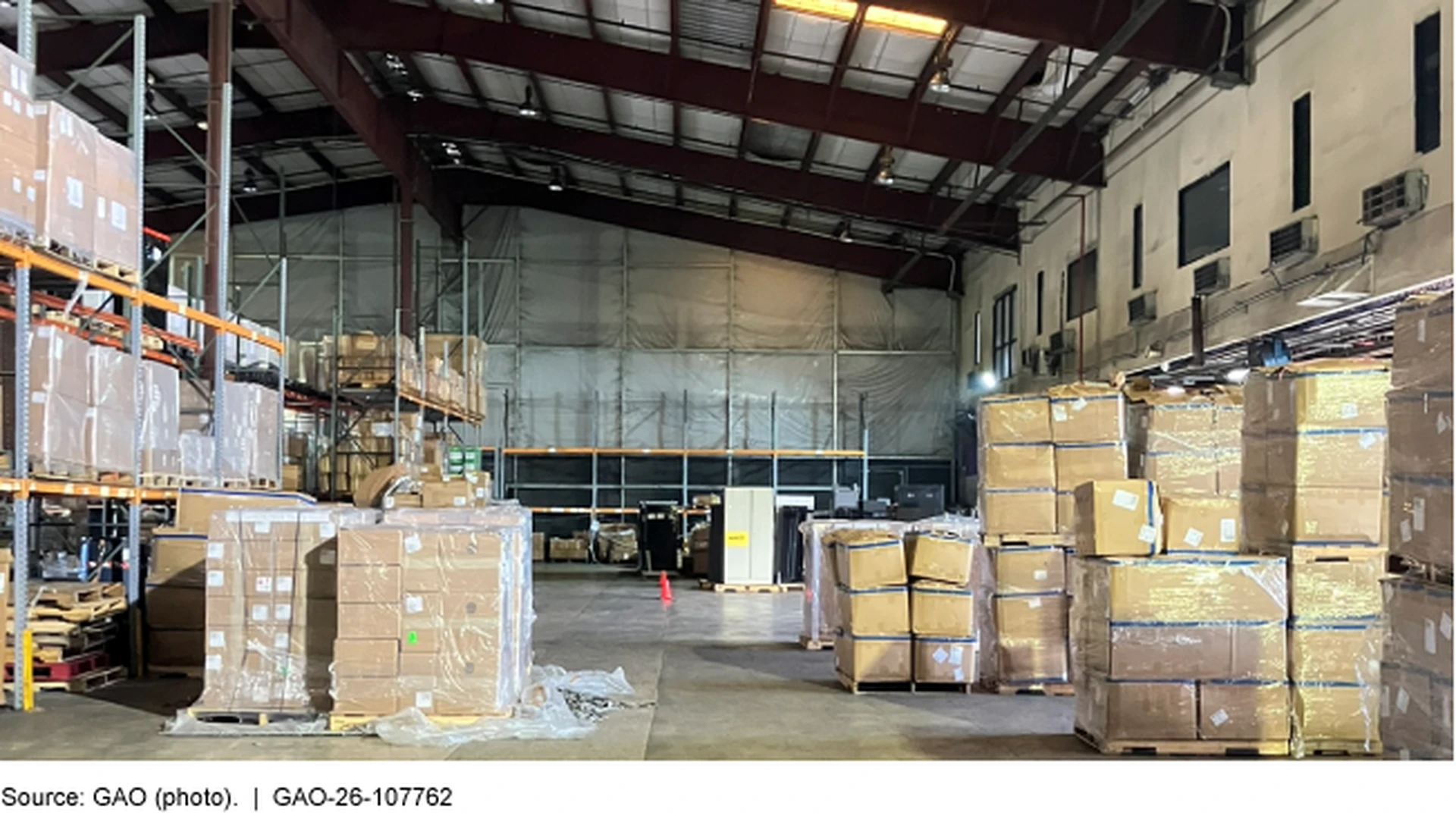
At Rafael Hernandez International Airport in Aguadilla, cargo volume had met the Transportation Security Administration's threshold for permanent staff by 2023. Two years later, those employees still had not been permanently stationed there.
TSA officials told the Government Accountability Office in August 2025 that budget availability and staffing metrics had prevented the placement. It was an unusually concrete finding in a federal inspection system whose airport-level workforce is otherwise difficult to see in public data.
The gap matters because Puerto Rico's air-cargo network depends on several federal handoffs. TSA secures goods traveling by aircraft. U.S. Customs and Border Protection examines international cargo for customs and trade compliance. The Department of Agriculture screens many Puerto Rico shipments headed to the mainland for pests and prohibited agricultural material. A shipment can clear one mission and still wait on another.
GAO found constraints across all three systems, but not one simple island-wide shortage. It also found a cargo market that had shifted toward San Juan, infrastructure that still needed work and demand that did not always support added routes or longer government hours. The defensible conclusion is narrower: round-the-clock cargo operations were relying on inspection systems with different schedules, specialties and measures of adequate staffing.
A threshold without a permanent post
Aguadilla's predicament is counterintuitive. Its cargo volume fell 69% between 2015 and 2024, from roughly 260 million pounds to 85 million. The decline reflected several forces, according to GAO's interviews: newer aircraft no longer needed the airport as a refueling stop, Hurricane Maria damaged infrastructure, and carriers could move more cargo through competing airports.
Yet the remaining activity was enough to cross TSA's own threshold for permanent cargo staff. GAO did not publish the threshold, the number of employees needed or the number temporarily covering the work. It reported only that Aguadilla had met the measure since 2023 and that permanent placement had not followed.
That distinction is important. Crossing a TSA staffing threshold does not mean the airport has enough demand to justify every other service. CBP told GAO that Puerto Rico needed more staff, but current cargo volume did not warrant longer operating hours. Transportation officials similarly said Aguadilla did not have enough flights outside its tower's regular hours to qualify for added Federal Aviation Administration resources.
The agencies were answering different questions. TSA was measuring the security-screening workload. CBP was weighing international customs coverage. FAA was assessing air-traffic demand. A carrier, meanwhile, was deciding whether a route could cover its cost. The threshold exposed a missing post inside one system, not proof that every public agency should expand on the same schedule.

Three federal missions ran on three clocks
The inspection agencies did not offer interchangeable services. GAO described TSA as responsible for keeping explosives and destructive devices off aircraft. CBP inspected goods moving to and from international destinations. USDA's Animal and Plant Health Inspection Service required predeparture agricultural screening for many shipments from Puerto Rico to the mainland.
| Federal function | What it covered | Availability GAO reported | Constraint GAO identified |
|---|---|---|---|
| TSA security screening | Goods transported on aircraft | 24 hours at San Juan and Aguadilla | Aguadilla met the permanent-staff threshold, but permanent staff had not been placed |
| CBP customs inspection | International goods and trade compliance | San Juan weekdays, 7 a.m.-midnight; Saturday, 3 p.m.-midnight | Additional staff were needed, but volume did not support permanently extended hours |
| USDA agricultural screening | Puerto Rico cargo departing for the mainland | San Juan weekdays, 8 a.m.-4:30 p.m.; after hours by request | No staff dedicated to cargo inspections, such as entomologists, and too few staff for permanent extended hours |
TSA's 24-hour coverage did not erase the shorter customs and agricultural windows. Carrier and ground-handler representatives told GAO that limited overnight and weekend availability for CBP and USDA could delay inspections when cargo flights arrived at those times. An international flight seeking to arrive outside CBP's hours could be denied approval and required to arrive during operating hours, officials said, though they characterized that outcome as uncommon.
USDA's specialization gap could carry a different kind of delay. Officials said the agency had no Puerto Rico employees dedicated to cargo inspection, including entomologists. When staff discovered a possible pest, they might have to ship the specimen to a mainland laboratory for identification. GAO did not say how often that occurred or how long it took, so there is no support for an island-wide delay estimate.
Officials also said recent USDA staff reductions had disrupted inspections and could affect the timing and quality of perishable shipments. Freight forwarders were pursuing certifications that would let them perform USDA screening in their own warehouses. That could move some work closer to the cargo, but it would not turn private screeners into federal entomologists or resolve every laboratory question.

San Juan gained the cargo Aguadilla lost
Puerto Rico's three international airports handled about 621 million pounds of cargo in 2024, according to GAO's analysis of Bureau of Transportation Statistics records. That was above the 2019 low of 501 million pounds but below the 630 million recorded in 2015 and again in 2021. The market fluctuated; it did not rise in a straight line.
Inside that total, the geography changed sharply. San Juan increased from about 360 million pounds in 2015 to 530 million in 2024. Aguadilla fell from about 260 million to 85 million. Ponce handled less than 50,000 pounds in the few years when it reported cargo and was not a regular cargo airport.
The largest 2024 lanes show why inspection timing is tied to hubs and carrier networks. San Juan-Miami carried 141.8 million pounds in both directions. San Juan-Memphis carried 107.7 million, followed by San Juan-Cincinnati at 81.5 million and San Juan-Louisville at 81.1 million. Aguadilla's largest lane, to Memphis, carried 59.2 million pounds. Its largest listed international lane, to Santo Domingo, carried 13 million.
Those are route totals, not shipment records. They do not reveal what was inside a particular aircraft, where each package began, or its final destination after a hub transfer. GAO noted that express carriers moved much of Puerto Rico's cargo through Memphis and Louisville, while half of the domestic all-cargo and combination-carrier volume ran through Miami in 2024.

The cargo was valuable as well as heavy
Federal Hiring Data Weekly
Get the biggest federal workforce changes in your inbox.
Subscribe to Federal Hiring Data Weekly for federal hiring trends, salary data, agency movements, and original investigations, with email confirmation before delivery.
The consequences of a mistimed inspection are most visible in Puerto Rico's health-care exports. GAO's analysis of Census trade data found 14.9 million pounds of pharmaceuticals and 6 million pounds of medical devices left Puerto Rico by air in 2024. Together they represented 49% of reported outbound air-cargo weight and 89% of reported value.
| Outbound commodity | Reported weight | Share of weight | Reported value | Share of value |
|---|---|---|---|---|
| Pharmaceuticals | 14.9 million lb. | 35% | $35.8 billion | 76% |
| Medical devices | 6.0 million lb. | 14% | $6.0 billion | 13% |
| All other commodities | 21.4 million lb. | 51% | $5.4 billion | 11% |
These totals have important limits. Census excludes some low-value shipments, and Puerto Rico-specific trade records can miss goods that clear customs at another U.S. port. The figures also exclude ocean freight. They establish that high-value and temperature-sensitive goods are part of the system; they do not show that a particular inspection delay spoiled a particular shipment.
Physical capacity can be just as consequential. GAO found that CBP lacked dedicated cargo-inspection warehouse space at San Juan, Aguadilla and Ponce. USDA lacked dedicated space at Aguadilla and Ponce. Stakeholders also cited aging warehouses, cold-storage needs, apron constraints, roadway congestion and power reliability.
The public workforce record stops short of the question
FederalHiringData reconstructed Puerto Rico agency records from OPM's legacy FedScope files beginning in 2000 and the current Federal Workforce Data files through June 2026. The result is useful chiefly because it shows what cannot be measured responsibly.
The public series counts whole-agency covered records in Puerto Rico, not employees assigned to air cargo. Modern Puerto Rico geography is absent for CBP. TSA's public OPM coverage excludes much of the operational workforce. Reporting changes also break the series in 2012 and again when the source format changes after 2014. Connecting those breaks would turn a disclosure change into a false workforce event.
In the June 2026 extract, OPM reported 204 covered APHIS records and 35 TSA records in Puerto Rico, down from 454 and 86 in September 2025. Those changes are consistent with a smaller public footprint, and GAO separately reported recent USDA reductions. But the numbers cannot establish how many agriculture specialists, entomologists, security inspectors or screeners were available at each airport. CBP's modern absence makes a three-agency total impossible.

That limitation should shape oversight. A public chart can show agency-level records, and GAO interviews can document operating constraints, but neither supplies the denominator needed to calculate an airport cargo-inspector vacancy rate. Any precise shortage claim would exceed the evidence.
Recruiting shows activity, not capacity
Our historical USAJOBS archive provides a second, different window. It contains 358 CBP, 112 TSA and 120 APHIS announcements with at least one Puerto Rico location from March 2017 through Aug. 14, 2026. San Juan and Aguadilla were the two most frequent location labels in that cohort.
The announcements included transportation security officers, import specialists, CBP officers and supervisors, agriculture specialists, plant-protection technicians, and plant-protection and quarantine officers. That variety confirms recurring recruitment around the agencies that touch cargo. It does not identify which jobs supported a particular airport shift or how many applicants became employees.
Related research
Put this finding in context

Data investigationsAugust 24, 2026
TSA Has More Than 1,300 Aviation Inspectors. Its Cybersecurity Role Map Is Outdated.
TSA added aviation cybersecurity requirements as its broad inspection and compliance workforce contracted and its public cyber role map remained outdated.

Data investigationsAugust 24, 2026
FAA Received 23 Electric-Propulsion Projects. Its Certification Skill-Gap Review Is on Hold.
FAA says current electric-aircraft projects remain supported, but two certification branches reported an eight-position specialty gap as a selected technical workforce fell 7.3%.

Archive coverage is also incomplete for 2024 and 2025, so annual posting counts would create a misleading trend. The agency totals are best treated as evidence that recruiting occurred across the period. They are not vacancy counts, and repeated announcements may reflect replacement hiring, multiple locations, standing registers or other hiring strategies.
Readers looking for positions that are open now should use the current federal jobs search, which is intentionally separate from this historical analysis. The agency directory and statistics page provide broader context without converting archived announcements into current openings.
Concrete, cold storage and demand still mattered
Staffing was only one part of the cargo equation. San Juan had completed a $4.9 million cargo-access-road project that airport representatives said reduced congestion. A 2017 express-carrier renovation added 76,000 square feet of warehouse space. Even there, stakeholders said warehouses and cold storage needed expansion or modernization.
Aguadilla had a long runway and developable land, but GAO documented hurricane-damaged warehouse space, limited apron parking, highway congestion and a runway reconstruction program costing more than $200 million, supported by about $94 million in federal grants. Its contract air-traffic tower was authorized for 14 hours, with some additional hours purchased through a separate agreement. Carriers paid extra when they needed service beyond the regular schedule.
Demand imposed another brake. Foreign carriers told GAO that Puerto Rico often did not generate enough volume for direct routes to every export market. Lufthansa Cargo had left after newer aircraft reduced the need for an Aguadilla refueling stop and cargo volume did not justify the call. Infrastructure, schedules, inspection coverage and commercial demand all interacted; none alone explains the market's direction.
The practical question is therefore not whether Puerto Rico needs a single larger inspection workforce. It is whether each handoff has enough specialized coverage, at the right airport and hour, for the cargo the market is actually moving. GAO documented warning signs at those handoffs. Public data still cannot show their full scale.
Methodology and limitations
FederalHiringData used GAO-26-107762 as the principal operational source. GAO analyzed BTS T-100 air-carrier records and Census FT900 and FT895 trade data, reviewed government documents, visited Puerto Rico's three international airports and interviewed a nongeneralizable sample of 29 stakeholders. GAO's airport series is published in rounded millions of pounds; this article preserves that precision.
We reproduced GAO's 2015-2024 airport series, 2024 route table, health-care commodity table, federal responsibility descriptions and reported operating hours. Statements about staffing, dedicated inspection space, mainland laboratory review and carrier experience are attributed to GAO's interviews and retain the report's qualifiers. We did not estimate delay frequency, vacancy rates, spoilage or staffing requirements because the public sources do not provide defensible denominators.
The workforce analysis uses OPM legacy FedScope September employee-level files for 2000-2014 and Federal Workforce Data September files for 2015-2025, with June 2026 as the latest observation. Puerto Rico is identified by code RQ. Counts cover whole agencies and are not cargo assignments. Public-reporting discontinuities are shown as breaks, and modern CBP geography is unavailable.
The recruiting analysis uses distinct announcements in the FederalHiringData historical USAJOBS archive with Puerto Rico locations and agency identities for CBP, TSA or APHIS. Coverage begins in March 2017 and is incomplete in 2024-2025. Announcements can cover multiple locations and do not equal hires, vacancies or onboard employees. Analysis was completed Aug. 24, 2026. Article research and writing used no OpenAI API calls.
Official records and further reading
Continue reading
More from FederalHiringData
Data investigationsAugust 23, 2026
FAA's Aviation-Weather Network Was Designed for 90 Meteorologists. Staffing Fell to 69.
The last verified federal count found 69 meteorologists in a 90-position aviation-weather design. Public records show recruiting in 2026, but not a verified recovery.

Data investigationsAugust 22, 2026
The OSHA System Had 48,000 Workers per Inspector in 1989. The 2026 Estimate Is 84,000.
The covered workforce grew far faster than the documented federal-state inspector pool, while recent federal staffing and inspection activity also declined.

Data investigationsAugust 21, 2026
National Park Visits Rose 13%. September Staffing Fell 17%.
The park system still builds a summer workforce, but same-month OPM data show a thinner permanent base beneath 323 million annual visits.
Federal Hiring Data Weekly
Get the biggest federal workforce changes in your inbox.
Subscribe to Federal Hiring Data Weekly for federal hiring trends, salary data, agency movements, and original investigations, with email confirmation before delivery.