August 23, 2026
The 2030 Census Test Cut Its Hiring Goal 91%. Its Workforce Assessment Is Paused.
The first major 2030 field test shrank from six sites to two and from 1,247 planned workers to 112 while a bureau-wide skills assessment remained paused.
By Evan Mercer
Published August 23, 2026Last edited August 23, 2026
The Census Bureau began its first major field test for the 2030 Census this spring with a much smaller plan than the one it announced two years earlier.
The original design called for six test sites and a staffing goal of 1,247 workers. By February 2026, the plan had two sites and a goal of about 112. That is a reduction of 1,135 planned workers, or 91%. The Bureau also reduced or removed 10 of the 19 operational activities it originally intended to test, according to a June Government Accountability Office review.
The smaller test is not an empty exercise. About 154,600 housing units in Huntsville, Alabama, and Spartanburg, South Carolina, were invited to participate. Census takers began visiting nonresponding households in June, and the test continues through August 31. It is examining whether postal workers can help collect responses in person and whether field staffing, training and infrastructure can work differently in 2030.
But the scope change landed as the Bureau was confronting a separate workforce problem. GAO found that an agency-wide assessment intended to identify skills gaps was paused as of February. Census officials said roles for employees participating in the assessment still had to be established, and a broader reorganization tentatively planned for fiscal 2027 could delay that work.
The evidence does not establish why the Commerce Department narrowed the test. Commerce had not answered GAO's request for its rationale as of May, and the public record does not support filling that gap with speculation. What the record does show is a tightening calendar: a smaller 2026 test, a paused workforce assessment, a planned 2028 dress rehearsal and a census that must count the country in 2030.
The plan contracted on three dimensions
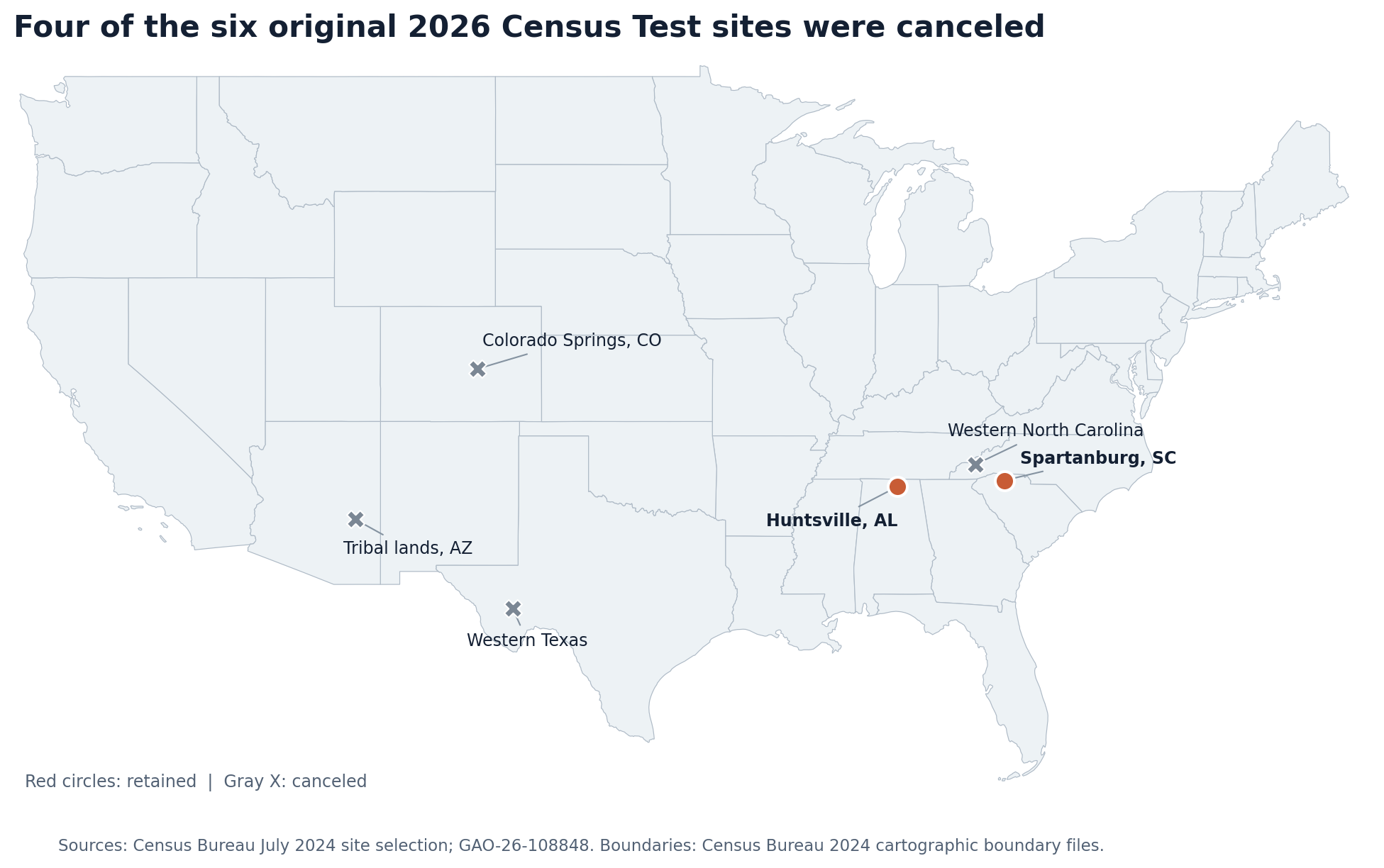
The site reduction is the most visible change. In July 2024, Census selected Colorado Springs; Huntsville; Spartanburg; tribal lands on the Fort Apache and San Carlos reservations in Arizona; four counties and the Qualla Boundary in western North Carolina; and four counties in western Texas.
Only Huntsville and Spartanburg remained in the final plan. The two cities were retained largely for a pilot that compares different ways of using U.S. Postal Service employees during in-person follow-up, according to Census and GAO.
The staffing plan contracted at the same time. GAO said the original hiring goal was 1,247: 1,195 Census employees and 52 postal workers across six sites. The revised goal was about 112: 60 Census employees and the same 52 postal workers at two sites. The 91% reduction is a comparison of planning goals, not a count of people ultimately hired, trained or sent into the field.
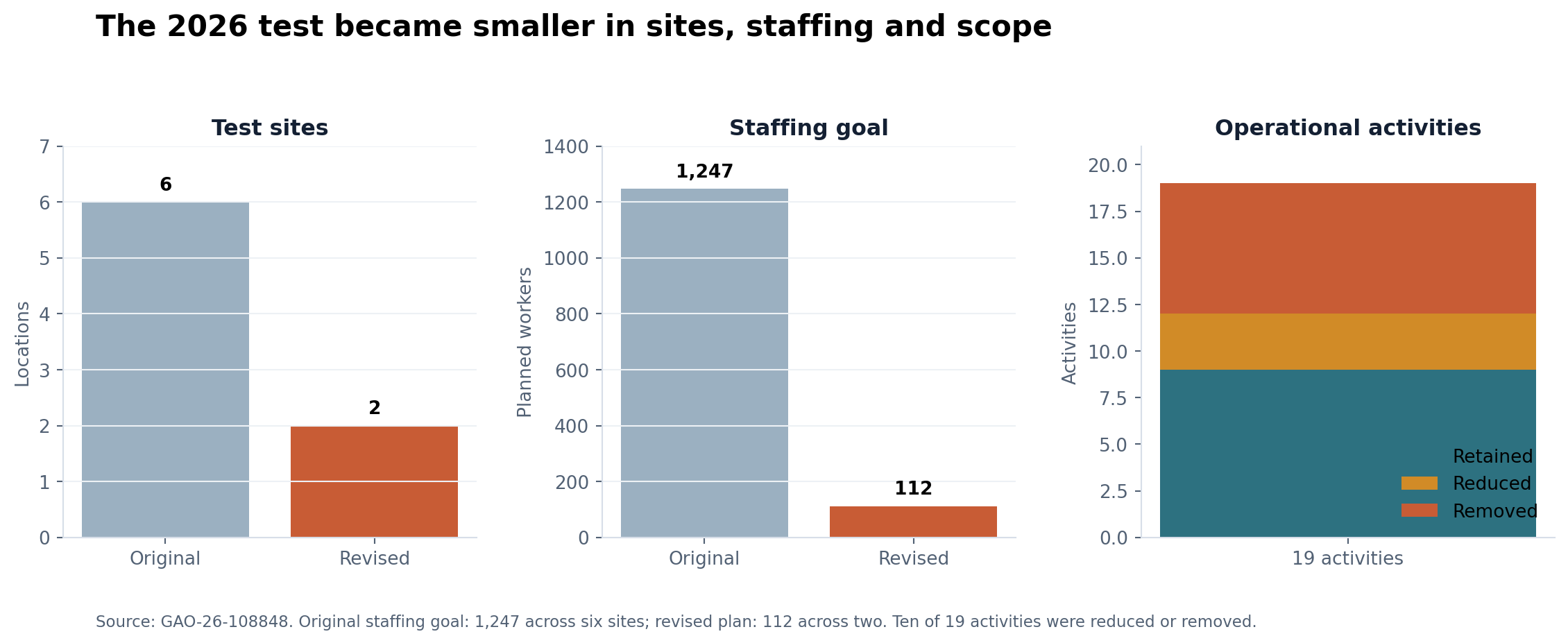
The operational plan narrowed too. Nine of the original 19 activities were retained without the reductions GAO identified. Three were reduced. Seven were removed. The removals included all three planned evaluations of an in-office enumeration model, a group-quarters internet response option, new address-processing methods, combined field operations and the use of staff across multiple housing-unit and group-quarters operations.
That matters because a census test is an evidence-producing operation. When an activity is removed, the immediate loss is not a program that was guaranteed to work. It is the chance to learn under field conditions whether the proposed method works well enough, where it fails and what staffing or technology it requires.
Commerce agreed with GAO's recommendation that Census research and test the removed design features before finalizing the 2030 design. The recommendation remained open when FederalHiringData reviewed it.
Two sites now carry the field test
The two remaining locations are not interchangeable. Huntsville has approximately 81,000 invited housing units; Spartanburg has about 73,600. Starting June 1, workers could visit households that had not responded online. Census said the field period would end August 31.
The USPS pilot also uses two different employment arrangements. In Huntsville, participating postal workers are directly hired by the Census Bureau for work outside their USPS hours. They hold two separate federal positions during the test and identify themselves as Census employees while collecting responses.
In Spartanburg, participating postal workers collect responses during their normal routes as USPS employees. Other, non-postal census takers cover separate areas. Treating every postal participant as a Census employee would therefore be wrong: that description fits the Huntsville arrangement, not the Spartanburg one.
Census's March public release described approximately 25 postal workers and 25 other census takers at each site, or roughly 100 workers. GAO described a February staffing goal of about 112. The sources were produced at different times and do not reconcile every position. The defensible conclusion is the scale: roughly one hundred workers in the final field plan, compared with a goal above twelve hundred in the original six-site plan.
The retained pilot could still answer an important question. Postal carriers know routes and communities, already visit most addresses, and may reduce the cost or difficulty of reaching households that do not respond on their own. It could also reveal complications in training, supervision, confidentiality, device use and the division of work between agencies. A smaller test can produce valuable evidence; it simply cannot replace evidence from activities it no longer includes.
Ten operational tests were narrowed or removed
The complete activity inventory shows what survives and what does not. “Reduced” is different from “removed”: near-real-time processing and integration work remains in the test, but at less than the originally planned scope.
| Original operational activity | Final status |
|---|---|
| In-Office Enumeration Model Input Data | Removed |
| In-Office Enumeration Model Accuracy | Removed |
| In-Office Enumeration Model Results | Removed |
| Person Characteristic Frame | Retained |
| Person Matching and Linkage | Retained |
| Centralized Address Control | Retained |
| Near Real-Time Processing | Reduced |
| New Methods for Processing Addresses Without an Identifier | Removed |
| Group Quarters Internet Self-Response Option | Removed |
| Centralized Administrative Support | Retained |
| Direct Shipment of Devices | Retained |
| Direct Shipment of Kits | Retained |
| Virtual Hiring and Training | Retained |
| Combined Field Operations | Removed |
| In-Field Self-Response Using a Quick-Response Code | Retained |
| Multi-Operational Field Staff for Group Quarters and Housing Unit Cases | Removed |
| Integration of Multiple Operation Processing Segments in Near Real Time | Reduced |
| Functionality of Near Real-Time Data Processing | Reduced |
| USPS Pilot for In-Field Enumeration | Retained |
The remaining portfolio emphasizes field execution. Census officials told GAO that the revised test would focus on the postal pilot and on enhancements to field infrastructure, staffing and training. Virtual hiring and training, direct shipment of devices and kits, centralized administrative support and in-field QR-code response all remain.
The removed activities reach beyond staffing. An internet response option for people in university halls and other group quarters would have tested a different way to collect data from populations that do not fit the standard household model. The in-office enumeration activities would have examined whether administrative records and other data could reduce or replace some visits. Those questions may still be researched elsewhere, but the two-site field test will not produce the originally planned evidence on them.
GAO framed the consequence as risk, not certainty. Less evidence can make final design decisions more difficult and can contribute to cost or quality problems later. It does not prove that any specific 2030 operation will fail.
The permanent agency and the decennial workforce are different systems
The Census Bureau does far more than conduct the once-a-decade count. Its permanent and longer-term staff run household and business surveys, produce economic and demographic statistics, maintain geographic frames, protect data, build systems and prepare for the next decennial census.
OPM data show that covered Census employment also moves with the decennial cycle. September headcount rose to 19,547 in 2009 and 19,172 in 2010. It climbed again to 20,947 in 2019 and 21,890 in 2020. By September 2024 it was 13,232; September 2025 was 11,288; and the latest June 2026 observation was 10,764.
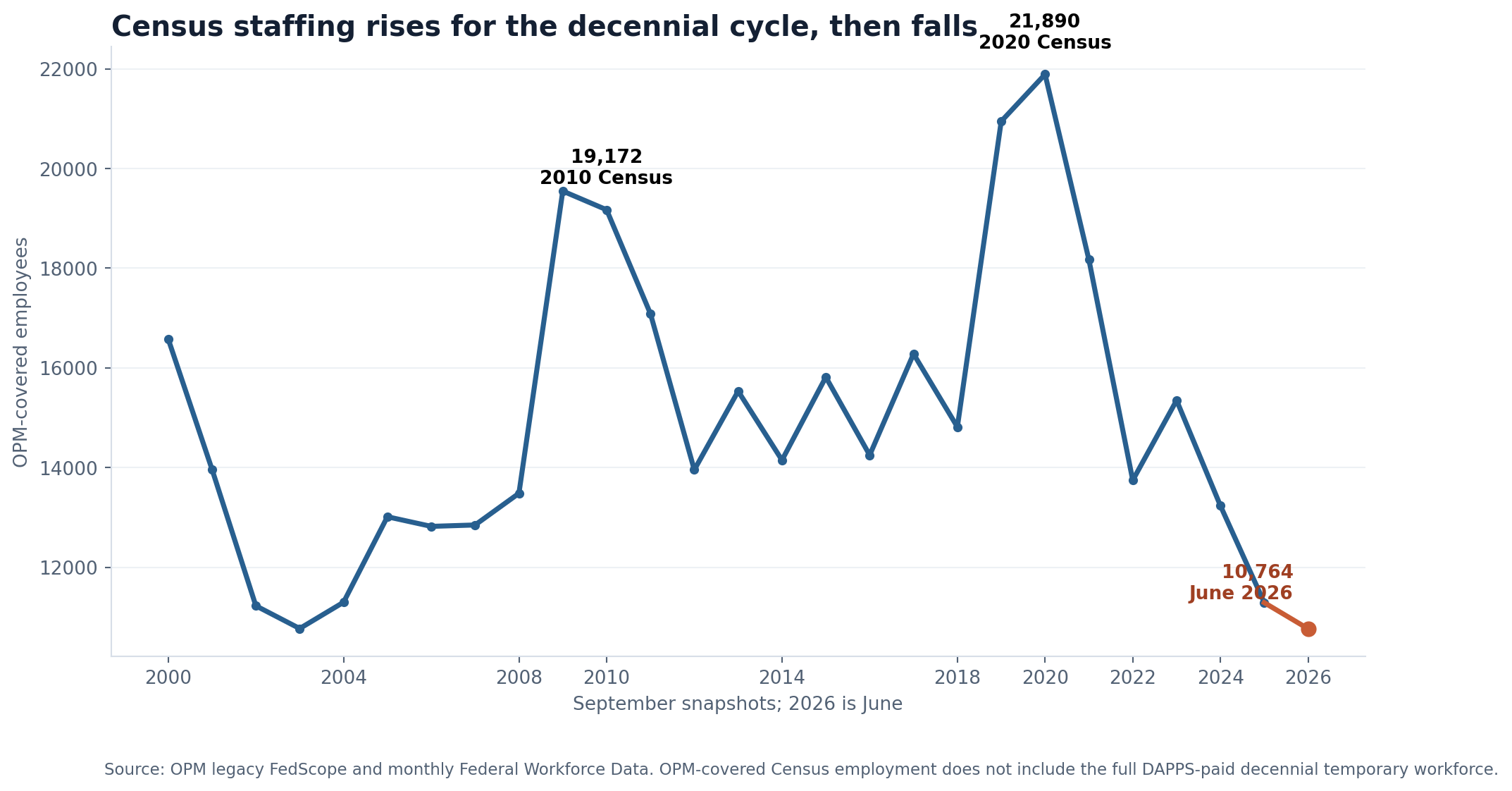
Those totals are useful, but they are not the entire decennial field workforce. Census used a separate Decennial Applicant, Personnel and Payroll System, known as DAPPS, for much of its temporary 2020 operation. OPM's appointment files capture a large nonpermanent buildup, but not every enumerator paid through DAPPS.
Within OPM-covered employment, permanent appointments fell from 13,026 in September 2015 to 9,872 in September 2020, 9,047 in September 2024 and 7,541 in June 2026. Nonpermanent appointments rose to 12,018 in September 2020, then receded to 3,223 by June 2026.
Federal Hiring Data Weekly
Get the biggest federal workforce changes in your inbox.
Subscribe to Federal Hiring Data Weekly for federal hiring trends, salary data, agency movements, and original investigations, with email confirmation before delivery.
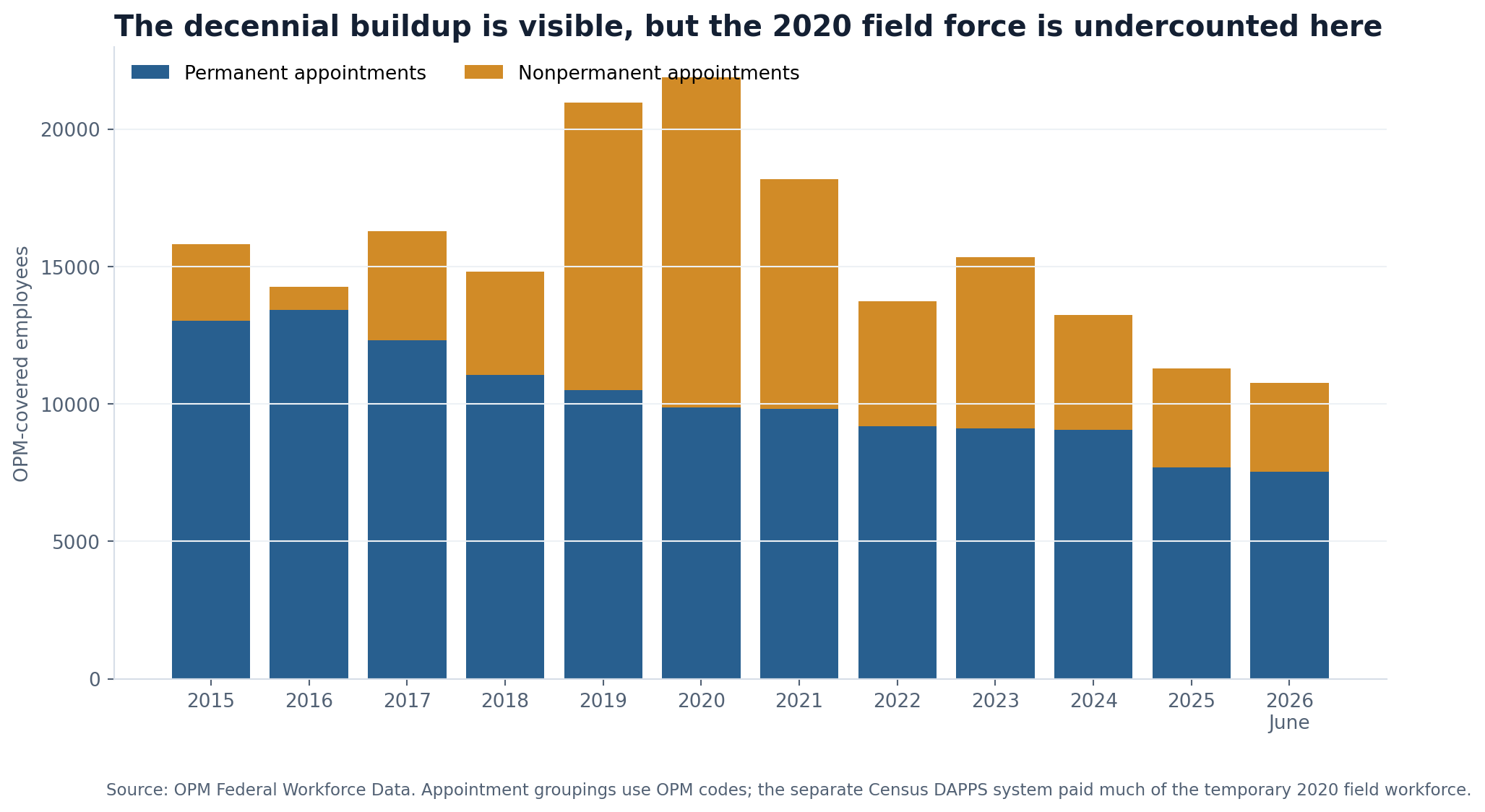
The more immediate comparison is January 2025 to June 2026. OPM-covered employment fell from 13,306 to 10,764, a decline of 2,542, or 19.1%. GAO used exact agency snapshots and found a 16% decline from 13,312 employees on January 20, 2025 to 11,119 on October 22. GAO attributed part of the decrease to early-retirement and deferred-resignation programs.
The two calculations use different dates and extraction methods, but they point in the same direction. Neither reveals how many remaining employees are assigned to the 2030 Census, nor whether every departure created a vacancy in a mission-critical role.
The 2020 count required a workforce far larger than one monthly file shows
The Bureau's operational assessment offers a better view of temporary scale. Census accepted 3.086 million applications and hired up to 523,260 employees for the 2020 Census. That cumulative number included recruiting assistants, census field supervisors, clerks, office supervisors, listers, enumerators and trainees. It does not mean more than half a million people were working simultaneously.
DAPPS recorded its highest weekly count of paid temporary workers from August 9 through August 15, 2020: 288,204. A September 15 operational briefing reported 426,448 enumerators hired since January 1, with 224,406 active and 69,294 in training. Those figures describe different stages and dates. Applications, selections, training invitations, cumulative hires, active workers and weekly paid workers are not interchangeable.
The reconstruction also shows churn. GAO reported that about 35% of people who began enumerator training had not shown up for field work during the 2020 nonresponse follow-up operation. A hiring plan therefore has to account for more than the number of offers. Background checks, training completion, attrition, assignment, supervision and payroll all affect the usable field force.
That experience is relevant to the 2030 cycle without being a direct forecast. The 2018 End-to-End Census Test was the last full dress rehearsal before 2020 and revealed workforce and training problems under census-like conditions. The current plan again uses a first field test, in 2026, followed by a dress rehearsal in 2028. Fewer 2026 activities do not automatically imply a repeat of 2020's problems, but they leave fewer opportunities to discover some problems before the final rehearsal.
Technical occupations were declining as the assessment paused
GAO said the Bureau had agency-wide gaps in modern information-technology engineering and cybersecurity. Its separate review of Census enterprise IT found weaknesses in schedule reliability, requirements and cost estimates across modernization programs. The 2020 Census relied on 52 IT systems, which illustrates why decennial workforce planning extends well beyond hiring enumerators.
FederalHiringData compared selected OPM occupation series between January 2025 and June 2026. Information Technology Management fell from 1,083 to 832. Statistics fell from 1,518 to 1,252. Management and Program Analysis fell from 620 to 500, Mathematical Statistics from 356 to 290, Statistical Assistants from 433 to 245, Geography from 153 to 131, Program Management from 114 to 80, Computer Science from 68 to 55 and Data Science from 39 to 31.
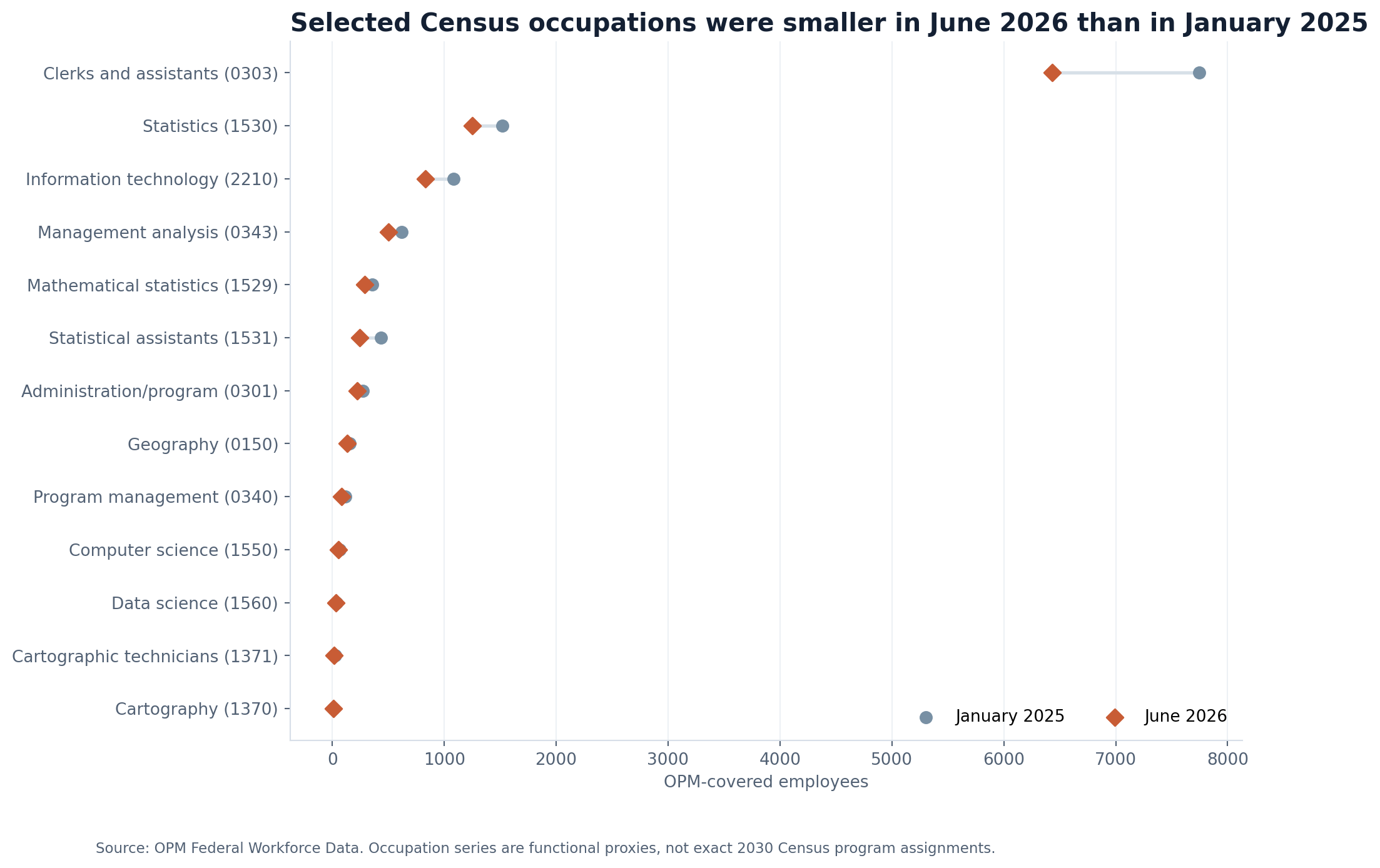
These series are functional proxies, not 2030 program rosters. An employee classified in series 2210 may support another survey or enterprise system. A statistician may work outside decennial planning. The data show the agency's available covered workforce by occupation, not the allocation of those employees to the test.
Age adds another planning dimension. In June, 5,523 of 10,764 OPM-covered Census employees were 55 or older, or 51.3%. Among selected series, the share was 38.0% for IT specialists, 58.0% for statistical assistants, 62.5% for cartographic technicians and 44.4% for cartographers. Age 55 is not a retirement-eligibility test, and it should not be converted into a forecast of departures. It does identify where succession and knowledge-transfer questions may deserve attention.
That is why the paused workforce assessment matters. GAO said a central principle of workforce planning is identifying gaps in the number, deployment and alignment of skills. Census officials said the assessment was paused until participating employee roles were established. If work waits for a fiscal 2027 reorganization, GAO warned, it could collide with the period when the Bureau needs to hire and train people for 2030.
USAJOBS recorded the last buildup, but not the whole field force
Related research
Put this finding in context

Data investigationsAugust 23, 2026
NASA Cut Its Civil-Service Workforce 22%. Now It Wants Core Technical Work Back In-House.
NASA lost more than 4,000 civil servants before directing its centers to restore in-house engineering, operations and science capability.

Data investigationsAugust 18, 2026
The Korea Exercise Was Cut. The Civilian Workforce Behind the Alliance Was Not
The U.S. defense presence in South Korea includes 2,903 appropriated-fund civilians, while 12,428 archived job announcements reveal the year-round system behind the alliance.
The FederalHiringData archive contains 15,516 distinct Census announcements opened from March 16, 2017 through August 13, 2026. The annual count rose from 642 in partial 2017 to 3,534 in 2018 and 6,839 in 2019, then fell to 1,157 in 2020. It was 98 in 2025 and 141 in partial 2026.
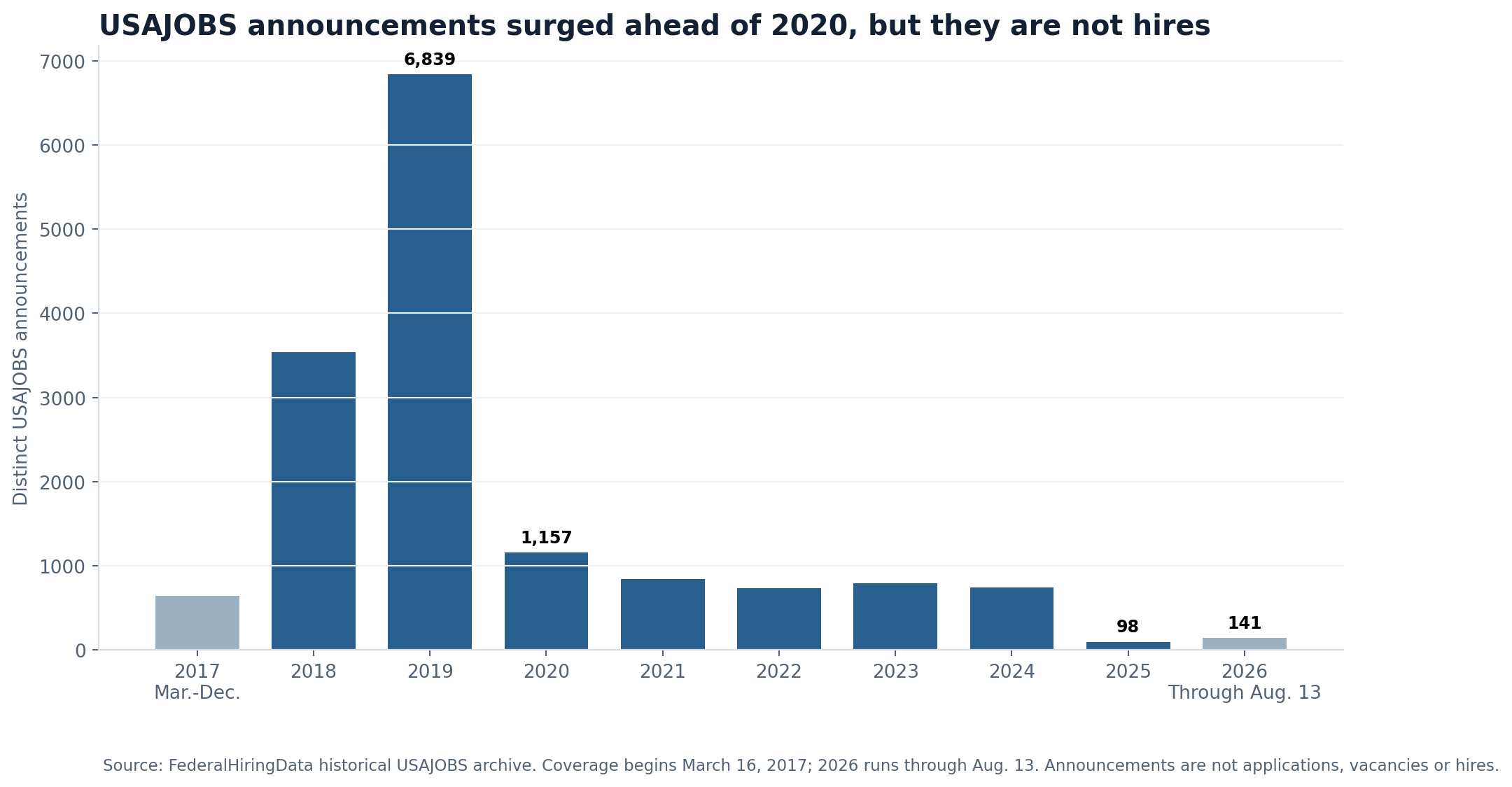
The titles explain what the archive can see. Partnership Specialist, Census Field Manager, Recruiting Manager, Area Census Office Manager and Information Technology Manager were among the most frequent 2017-2020 titles. That is evidence of the recruiting and management infrastructure built around the decennial operation.
It is not a census of enumerator hiring. Much of the temporary field campaign ran through a separate Census hiring portal, and one USAJOBS announcement can support multiple selections or no selection. Announcement counts cannot be added to DAPPS hires or treated as vacancies filled.
The archive is most useful as a leading indicator of recruiting structure. It shows when the Bureau created the partnership, office and supervisory apparatus that helped recruit and manage a much larger temporary workforce. Whether a similar apparatus appears before 2030 will be measurable, but the current partial-year count is too early to define the whole cycle.
What the narrower test can still establish
The current test is active, not canceled. It can produce evidence about online response, in-person follow-up, postal-worker participation, device and kit shipment, virtual hiring and training, centralized support, person matching, address control and near-real-time processing at its revised scale.
Its strongest limitation is equally concrete: it cannot produce the originally planned field evidence for seven removed activities, and three more will be examined at reduced scope. Commerce accepted the recommendation to fill those evidence gaps before the final design, but agreement is not completion. Both GAO recommendations were open when this article was prepared.
The next checkpoints are observable. Census can disclose what the two-site pilot learned, where and when removed activities will be tested, whether the workforce assessment restarts, which skills it identifies as scarce, and how those findings change hiring before the 2028 dress rehearsal.
The two open GAO recommendations provide a public ledger for that follow-through. One asks for research and testing of the removed design features before Census finalizes the 2030 design. The other asks the Bureau to determine its decennial workforce needs early enough to address skills gaps. Future status updates should show whether the agency moved from agreement to completed evidence and staffing decisions.
The stakes are not a general claim that the agency is unprepared. They are a scheduling problem. Census has to turn research into a final design, systems, training and a national workforce on a fixed constitutional timetable. A smaller test and a paused workforce assessment leave less room to discover that a method or skill mix does not work as expected.
Readers can explore current federal jobs, compare federal workforce statistics, browse agency records and read more FederalHiringData investigations.
Methodology and limitations
Test design: Site, staffing and activity-status comparisons come from GAO-26-108848 and Census Bureau 2024-2026 planning materials. The staffing reduction compares original and revised goals, not actual workers hired. “Retained” means GAO did not identify the activity as reduced or removed; it does not mean the activity was unchanged in every implementation detail.
Workforce: FederalHiringData queried OPM legacy FedScope and monthly Federal Workforce Data for Census subelement CM63. The long series uses September snapshots from 2000 through 2025 and June 2026 as the latest endpoint. OPM-covered headcount excludes contractors and does not capture the complete DAPPS-paid decennial temporary workforce. Appointment groups follow published OPM codes.
Occupations and age: Occupational series are broad classifications, not exact assignments to the 2030 Census, 2026 Test or enterprise IT programs. The age calculation counts published age groups 55-59, 60-64 and 65 or older. It is an age-exposure measure, not retirement eligibility or a prediction of attrition.
2020 temporary workforce: Application, hiring, active-worker and weekly payroll figures come from the Census Field Infrastructure operational assessment, Census operational briefings, DAPPS payroll tables and GAO reviews. They refer to different stages, dates and worker universes and are presented separately.
Recruiting archive: FederalHiringData counted distinct Census USAJOBS control numbers under agency code CM63 or a Census agency label. Coverage begins March 16, 2017 and runs through August 13, 2026. Announcements are not applications, vacancies, selections or hires. Much temporary enumerator recruiting used a separate Census portal.
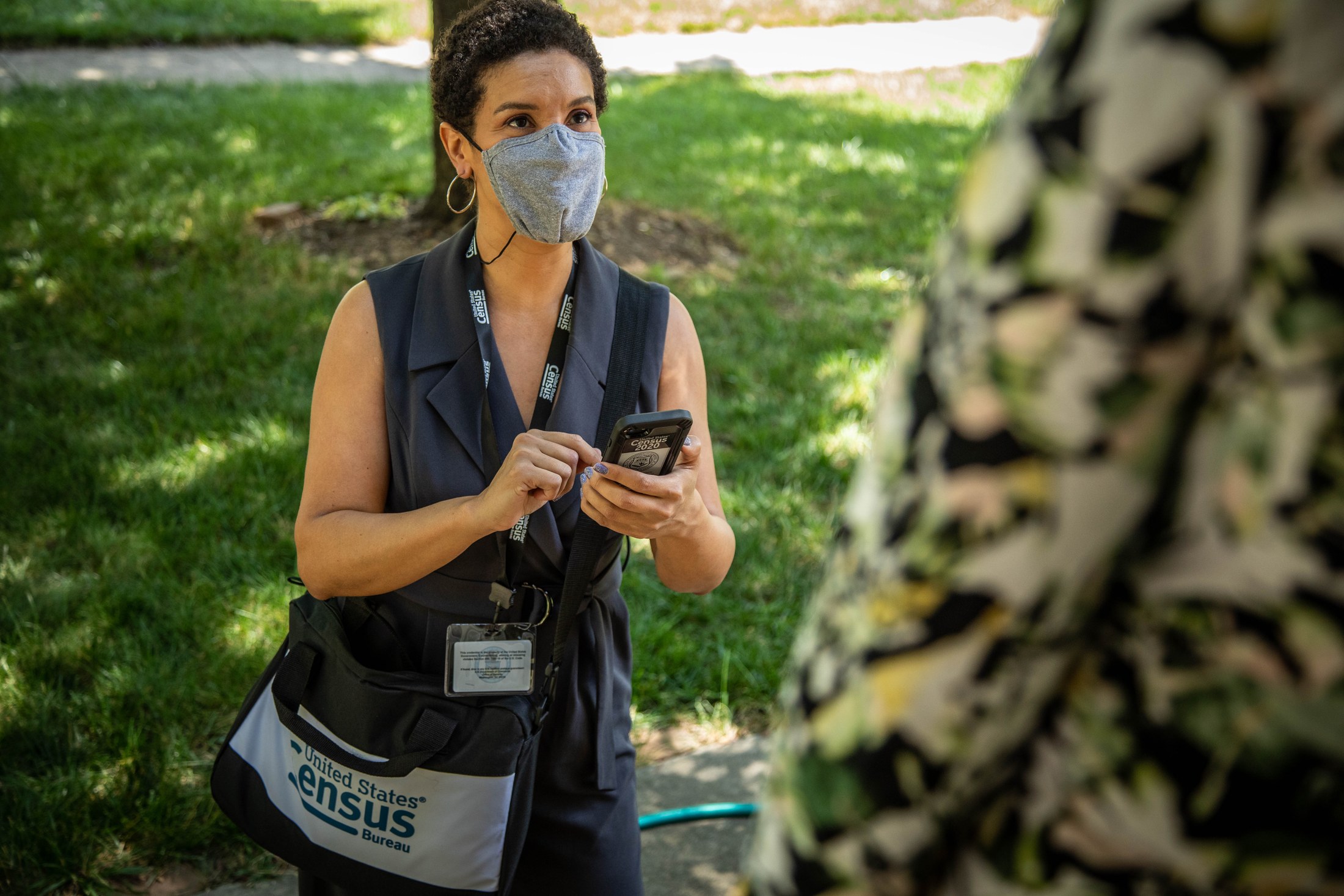
The hero photograph is an official Census Bureau image from its 2020 enumeration photo library. It shows a census taker recording information on a government-issued phone and illustrates field work rather than the specific 2026 sites.
Continue reading
More from FederalHiringData
Data investigationsAugust 20, 2026
OPM's 35% Cut Was Its Deepest Since It Transferred an Entire Bureau
The federal government's HR agency now has fewer employees than at any reviewed point since 1998 while directing agencies to rebuild hiring and workforce planning.

Data investigationsAugust 20, 2026
GSA Cut 45% of Its Buildings Workforce. Some Dispositions Slipped.
GSA is still selling property, but GAO found restarted projects, fewer appraisers and no reliable measure of whether the accelerated program is actually faster.
Data investigationsAugust 21, 2026
DOE Has an $8 Billion Cleanup Mission. Its Federal Oversight Workforce Fell to 856.
DOE's nuclear-cleanup office lost one-third of its federal staff in two years while engineering, contracting and safety-related vacancies widened.
Federal Hiring Data Weekly
Get the biggest federal workforce changes in your inbox.
Subscribe to Federal Hiring Data Weekly for federal hiring trends, salary data, agency movements, and original investigations, with email confirmation before delivery.