August 20, 2026
OPM Says 7% of Federal Workers Are Early Career. Its 33% Hiring Target Counts Something Else.
Under-30 hires already topped one-third of external federal hiring in fiscal 2024 and 2025, but OPM's new target uses a broader unpublished numerator.
By Evan Mercer
Published August 20, 2026Last edited August 20, 2026

The federal government's newest early-career hiring goal arrives with two numbers that sound like a before and after.
Only about 7% of the federal workforce is early career, the Office of Personnel Management says in its fiscal 2027 budget request. In a July 30 staffing memo, OPM told agencies to make at least 33% of new external hires early-career hires in fiscal 2027.
But 7% and 33% do not measure the same thing.
That means the target cannot be evaluated with one before-and-after ratio. Age, formal Pathways status, entry grade and prior work experience are separate indicators, and OPM has not published the operational numerator that will determine whether agencies meet the goal.
The percentages use different denominators
OPM Director Scott Kupor has described the first figure as employees under age 30, a share of the existing workforce. The second is a share of new external hires and uses a broader category: recent graduates, interns, Pathways participants and "other entry-level talent." An OPM Merit Hiring Plan FAQ extends the idea from students and trainees to people with less than five years of experience.
Federal workforce records cannot reproduce that category. They can show a hire's age, federal service, grade and formal Pathways status. They do not show every hire's prior experience outside government.
That missing definition changes the meaning of the target. FederalHiringData's analysis of OPM records found that workers under 30 were already 33.7% of new external hires in fiscal 2024 and 34.6% in fiscal 2025. Formal Pathways-flagged hires were 5.0% and 1.8%, respectively. The policy category is broader than Pathways and is not the same as age, but OPM has not published the governmentwide baseline or coding rule that would place it between those observable markers.
The 33% goal could be a modest correction to recent age-based hiring. It could also require a large rebuild of formal entry routes. Until OPM publishes its numerator, the public cannot tell which one agencies are being asked to deliver.
The workforce did not simply get older every year
The current shortage of young federal employees has a longer and less linear history than the 7% figure suggests.
In September 2000, 129,042 of the 1.76 million employees in OPM's covered workforce were under 30, or 7.3%. That share climbed through the 2000s and reached 11.3% in September 2010, when the government had 239,468 workers under 30. It then fell to 8.1% in 2014, recovered to 9.0% in September 2024 and stood at 8.3% in June 2026, the latest month in the local OPM data.
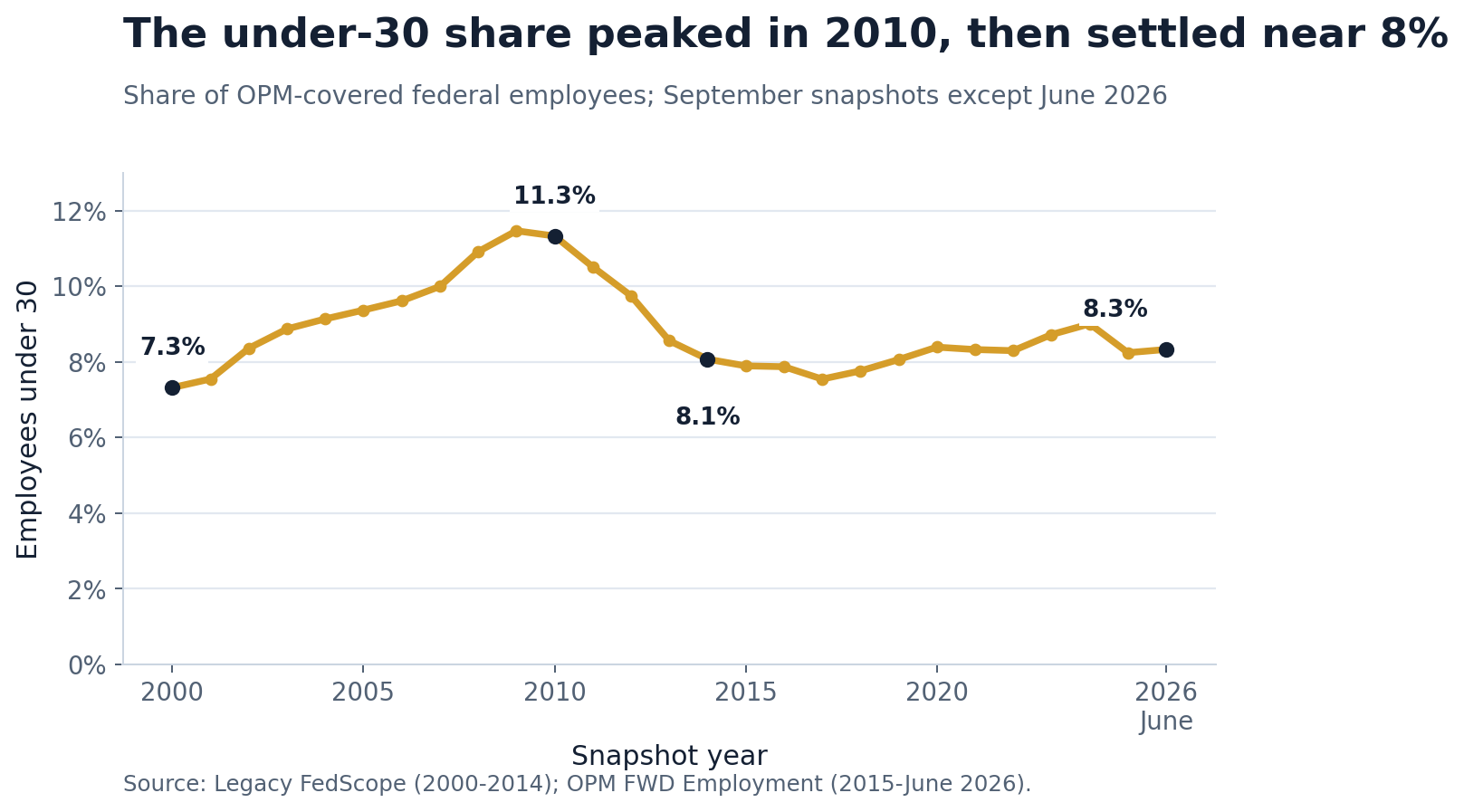
The difference between OPM's rounded "about 7%" statement and the June result likely reflects timing, population or rounding. It does not change the larger finding: workers under 30 make up a small share of the federal workforce, but the current level is not a 25-year low. It is close to where the government started this century after a substantial hiring peak around 2010.
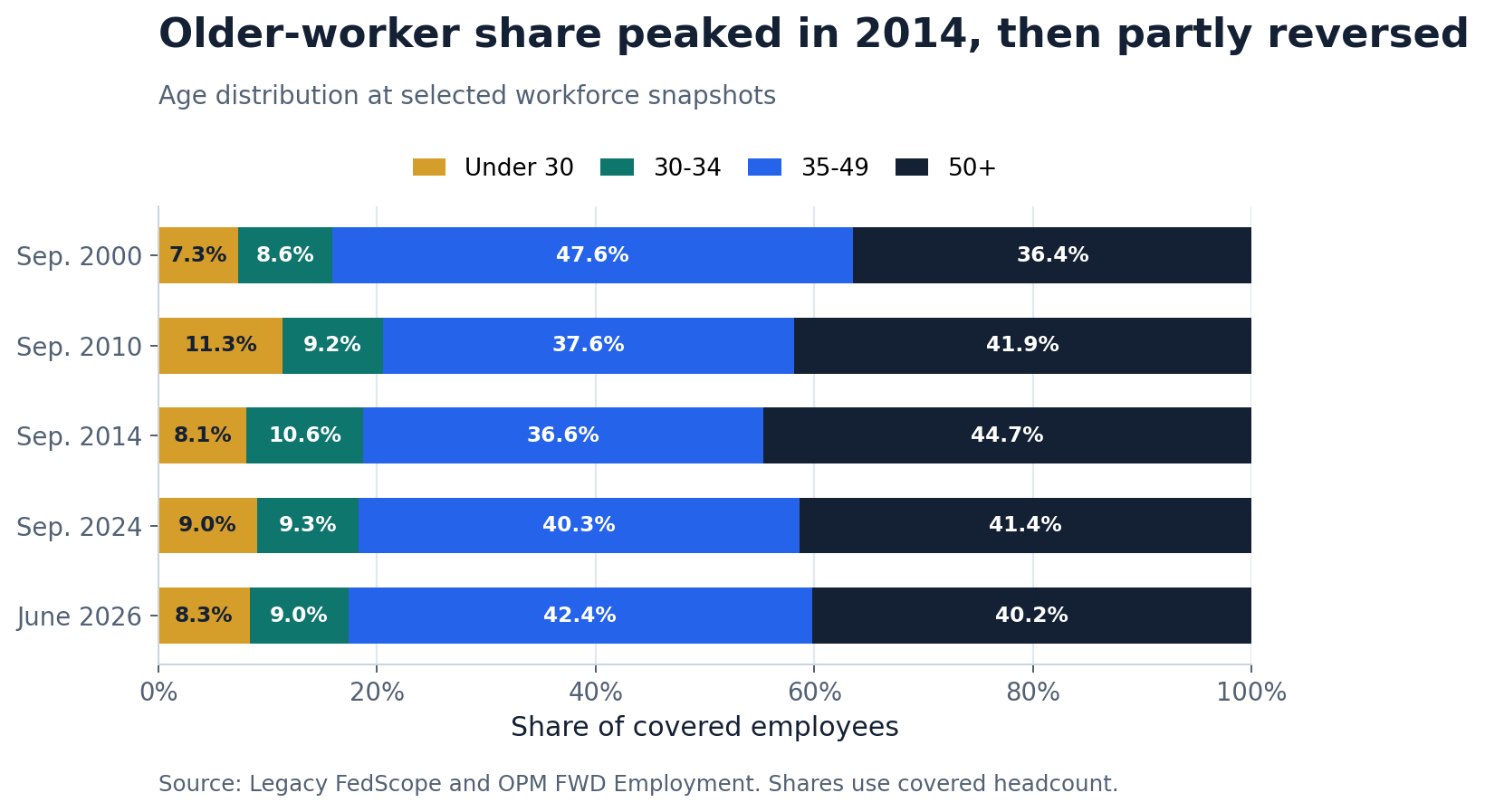
The older-worker share also rejects a straight-line story. Employees age 50 or older rose from 36.4% of the workforce in 2000 to 44.7% in 2014. Their share then declined, reaching 41.4% in September 2024 and 40.2% in June 2026.
A service measure shows the more immediate pipeline break. Employees with less than five years of federal service rose from 16.8% of the workforce in 2000 to 31.7% in 2010. They were 32.5% as recently as September 2024, then fell to 23.4% by June 2026. Short federal tenure is not the same as early career: it includes experienced private-sector recruits and excludes young employees who have already served five years. But its recent drop captures how quickly the government's new-worker base narrowed.
The 2025 contraction weakened replenishment
From September 2024 to June 2026, OPM-covered headcount fell by 359,916, or 15.6%. The under-30 population fell faster, dropping 45,623, or 21.9%. Its share declined by 0.68 percentage points. The under-35 population fell 19.7%.
Yet the age-50-plus share also fell, by 1.15 points. The contraction weakened the youngest part of the workforce more than the whole, but it did not accelerate every measure of federal aging.
Hiring and separation flows show why the young-worker stock came under pressure. In fiscal 2024, 90,139 under-30 external hires exceeded exits in the same age group, excluding transfers, by 50,071. In fiscal 2025, the margin nearly disappeared: 51,066 hires against 50,505 exits, a difference of just 561.
Even that slim positive balance does not guarantee growth in the under-30 workforce. Employees age out of the group every month. By fiscal 2025, hiring was barely replacing the under-30 workers who left, before accounting for those who turned 30.
One-third is familiar by age, enormous by Pathways
OPM's target becomes easier to size when it is applied to actual recent hiring totals.
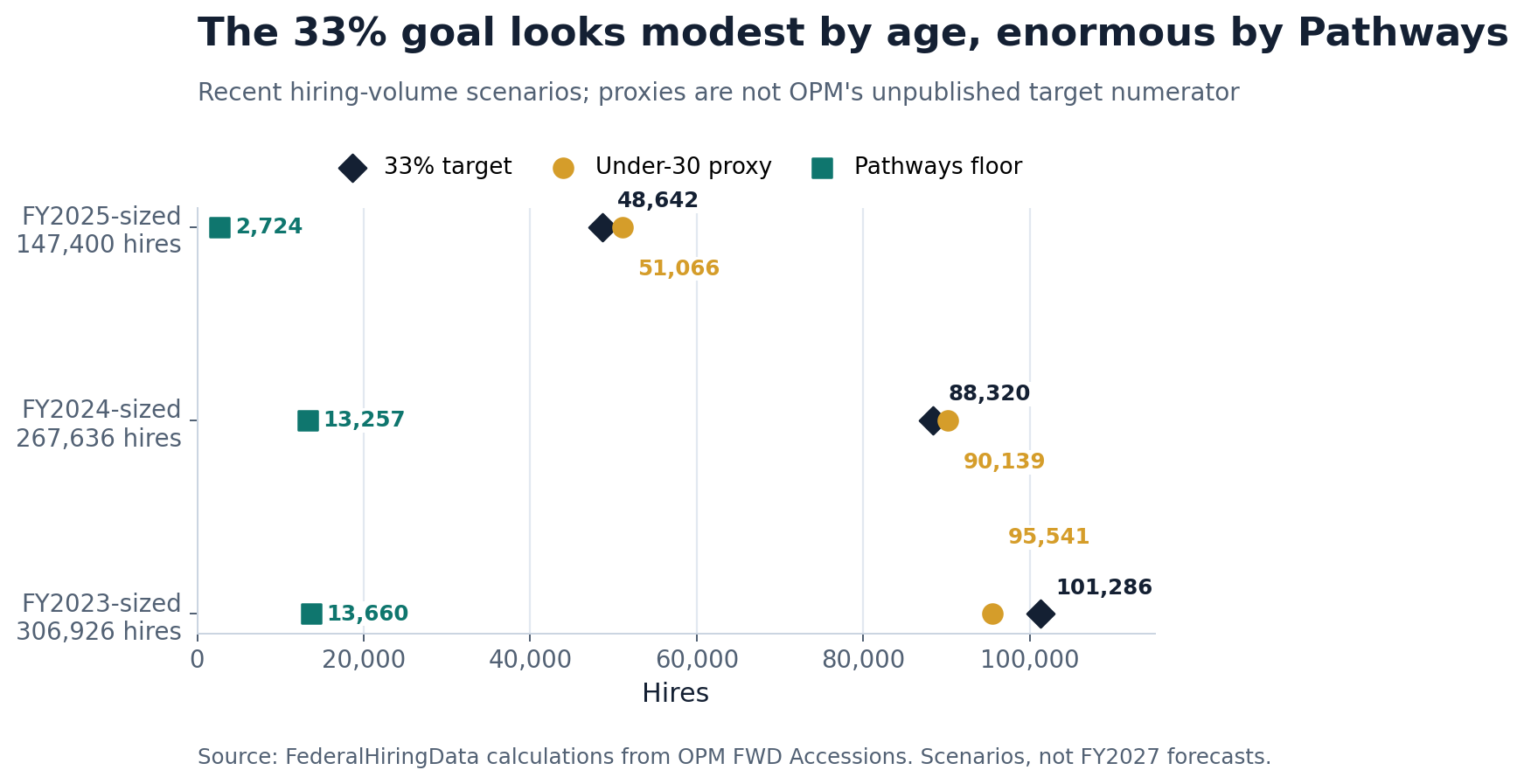
At fiscal 2025's 147,400 external hires, a 33% target would require 48,642 early-career hires. At fiscal 2024's 267,636 hires, it would require 88,320. At fiscal 2023's 306,926, it would require 101,286. Those are scenarios based on recent volumes, not forecasts of fiscal 2027 hiring.
Using age alone, the government was already above the line in the two most recent complete fiscal years. It hired 51,066 people under 30 in fiscal 2025, 2,424 more than the one-third scenario. In fiscal 2024, it hired 90,139, or 1,819 more.
Nor would a one-third under-30 mix be historically unusual. Under-30 workers were 42.2% of external hires in fiscal 2005, 40.1% in 2010 and 35.4% in 2014. The share fell to 31.1% in fiscal 2023 before moving back above one-third.
Formal Pathways hiring is a different story. In March 2025, the Government Accountability Office reported that Pathways hires had fallen 64% from fiscal 2013 to fiscal 2023, from 28,422 to 10,299, despite a rebound after 2021. GAO called Pathways the government's primary vehicle for placing students and recent graduates into positions that can lead to permanent careers. It also emphasized that the program supplements rather than replaces competitive hiring.
GAO found that OPM had not identified the factors driving Pathways trends, had not collected feedback from most participants and had not completed a process for gathering and sharing recruiting lessons. OPM agreed with all three recommendations.
The more recent FWD field is not proven identical to GAO's legal-authority-based series, so the two should not be joined into one line. On its own, however, FWD shows another sharp drop: Pathways-flagged external hires fell from 13,257 in fiscal 2024 to 2,724 in fiscal 2025, down 79.5%.
At fiscal 2025's hiring volume, Pathways alone would need 45,918 additional hires to reach one-third. That is not what OPM's broader target requires, but it shows why the definition matters. A policy can appear already achieved by age and transformational by formal program status.
Junior grades are a signal, not a universal definition
Entry grades add another view. GS-1 through GS-9 accounted for 83.1% of new external GS hires in fiscal 2005. The share was 77.9% in 2014, 69.8% in 2023 and 61.6% in 2025. Fiscal 2025 included 13,438 external hires at GS-5, 10,681 at GS-7 and 9,442 at GS-9.
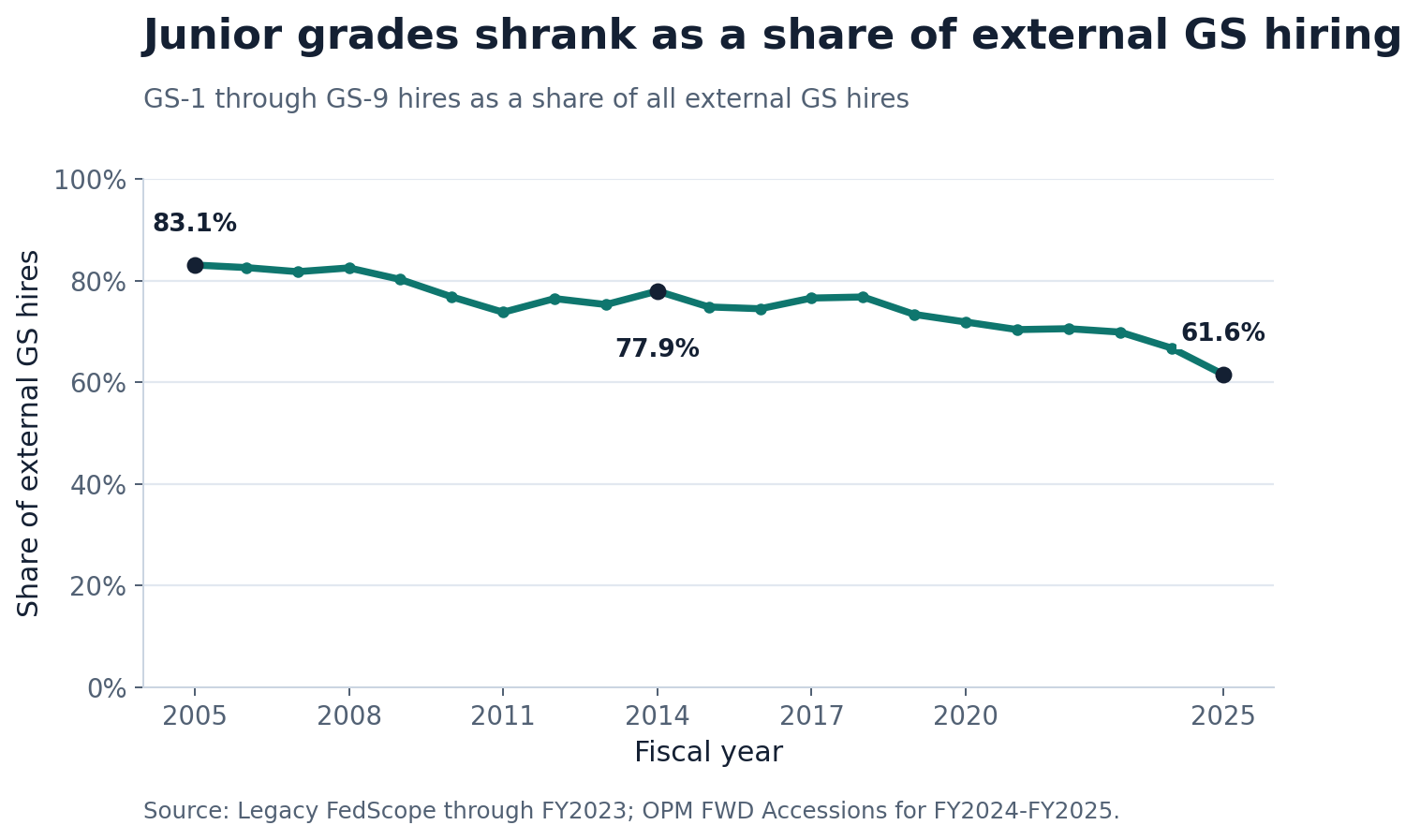
Those grades cannot define early career across every field. In fiscal 2024, workers under 30 made up 59.6% of science and math external hires and 49.8% of engineering and architecture hires. But only 39.2% and 31.5% of external GS hires in those pipelines, respectively, entered at GS-5, GS-7 or GS-9. Specialized degrees and labor markets can push legitimate entry points higher. In IT and cyber's 2210 series, only 19.8% of fiscal 2024 external hires were under 30, and 19.2% of GS hires entered at those three grades.
By contrast, human resources had a smaller under-30 share, 24.1%, while 65.0% of its external GS hiring occurred at GS-5, GS-7 or GS-9. An occupation-aware target would need to recognize both kinds of pipeline.
The vacancy trail narrowed before the new goal
The FederalHiringData historical USAJOBS archive provides a view of the opportunities applicants could actually see. The analysis identified postings with explicit title references to Recent Graduates, student trainees, interns, internships or Pathways. It is deliberately narrower than all entry-level work: a GS-7 accountant or junior engineer without one of those terms is not counted.
The archive contains 3,338 such announcements in calendar 2024 and 515 in 2025, an 84.6% decline. All archived announcements also fell sharply, from 366,628 to 146,684, or 60.0%, but the explicit early-career cohort contracted much faster. In 2026, the archive recorded 396 title-signaled announcements through August 14, a partial year that should not be compared with a full-year bar.
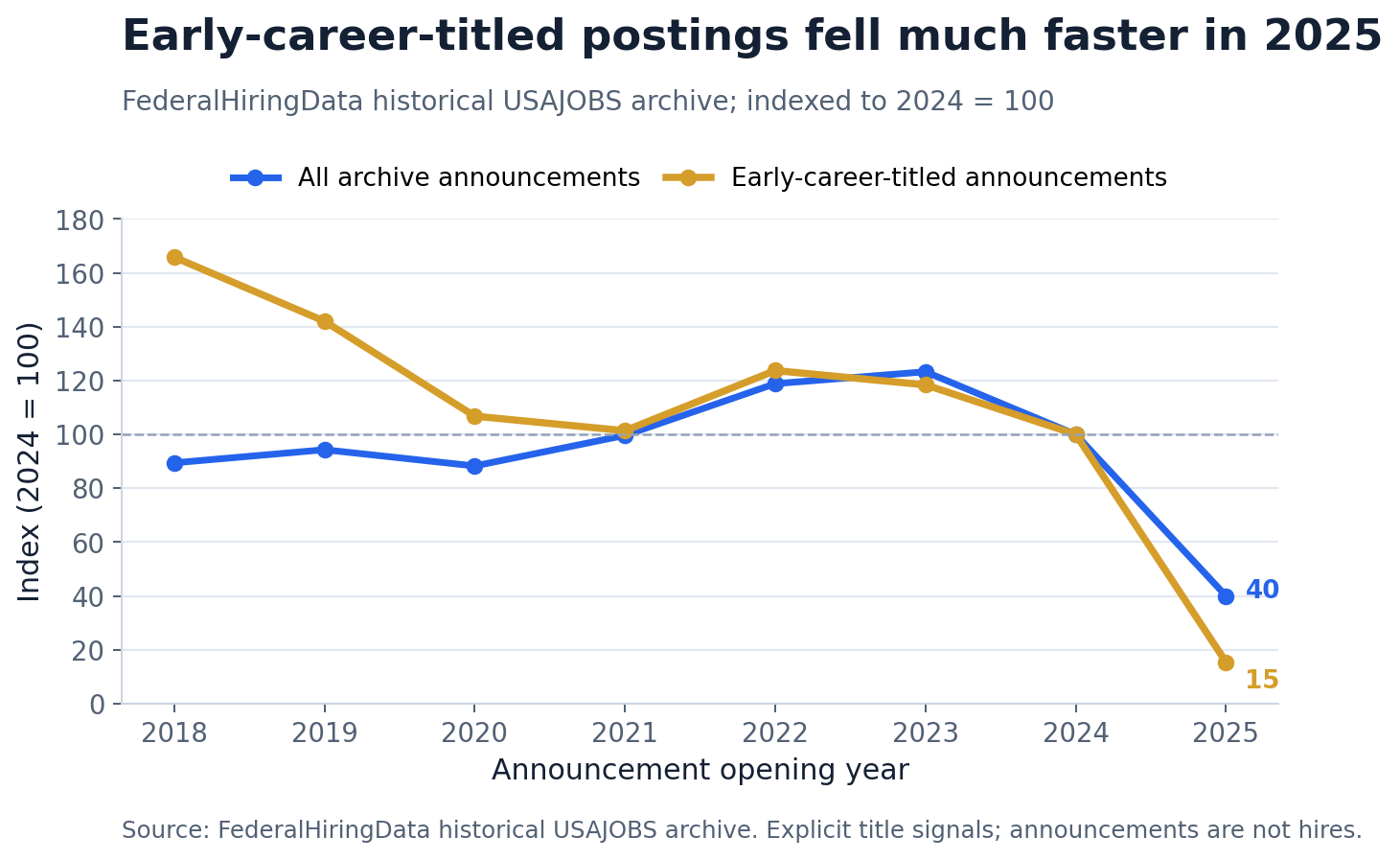
These are announcement counts, not vacancies, applicants, selections or hires. Some postings advertise multiple openings and locations; others may be cancelled or extended. Even with those limits, the pattern describes a much smaller visible on-ramp going into the year agencies are being asked to rebuild it.
Recent-graduate announcements were typically brief. The median posting was open 14 calendar days in 2024; student and internship titles had a 13-day median. Recent-graduate titles started at GS-1 through GS-9 in 93.9% of 2024 postings, compared with 71.4% of student and internship titles. Median advertised annual minimum pay was $54,728 for the recent-graduate group and $39,488 for the student/internship group, in nominal dollars.
The all-period title cohort was concentrated in recognizable feeder series: 7,366 announcements in the 0399 Administration and Office Support Student Trainee series, 2,944 in 0899 Engineering and Architecture Student Trainee, 1,973 in 0099 General Student Trainee and 1,743 in 0599 Financial Management Student Trainee. The District of Columbia appeared in 7,215 announcements, followed by California, Maryland, Texas and Virginia; a multi-location announcement can count in more than one state.
Remote and public-access history is weaker. No posting in the classified cohort carries a remote-eligible flag, but archive metadata are not consistent enough to read that as proof that none allowed remote work. In 2026 through August 14, 52 of 396 were marked telework eligible. Of 291 records with a known audience field, 154 carried a public-audience flag. The missing fields prevent a reliable long-run trend.
Agency pipelines cannot be scored by one age cutoff
Agency differences are equally large. In June 2026, among agencies with at least 1,000 covered employees, workers under 30 ranged from 14.6% at Agriculture and 14.0% at the FDIC to 0.9% at the Securities and Exchange Commission and 1.7% at the Federal Communications Commission. Health and Human Services had only 3.1% under 30 while 19.6% were 60 or older. Homeland Security had 11.5% under 30 and 10.3% age 60 or older.
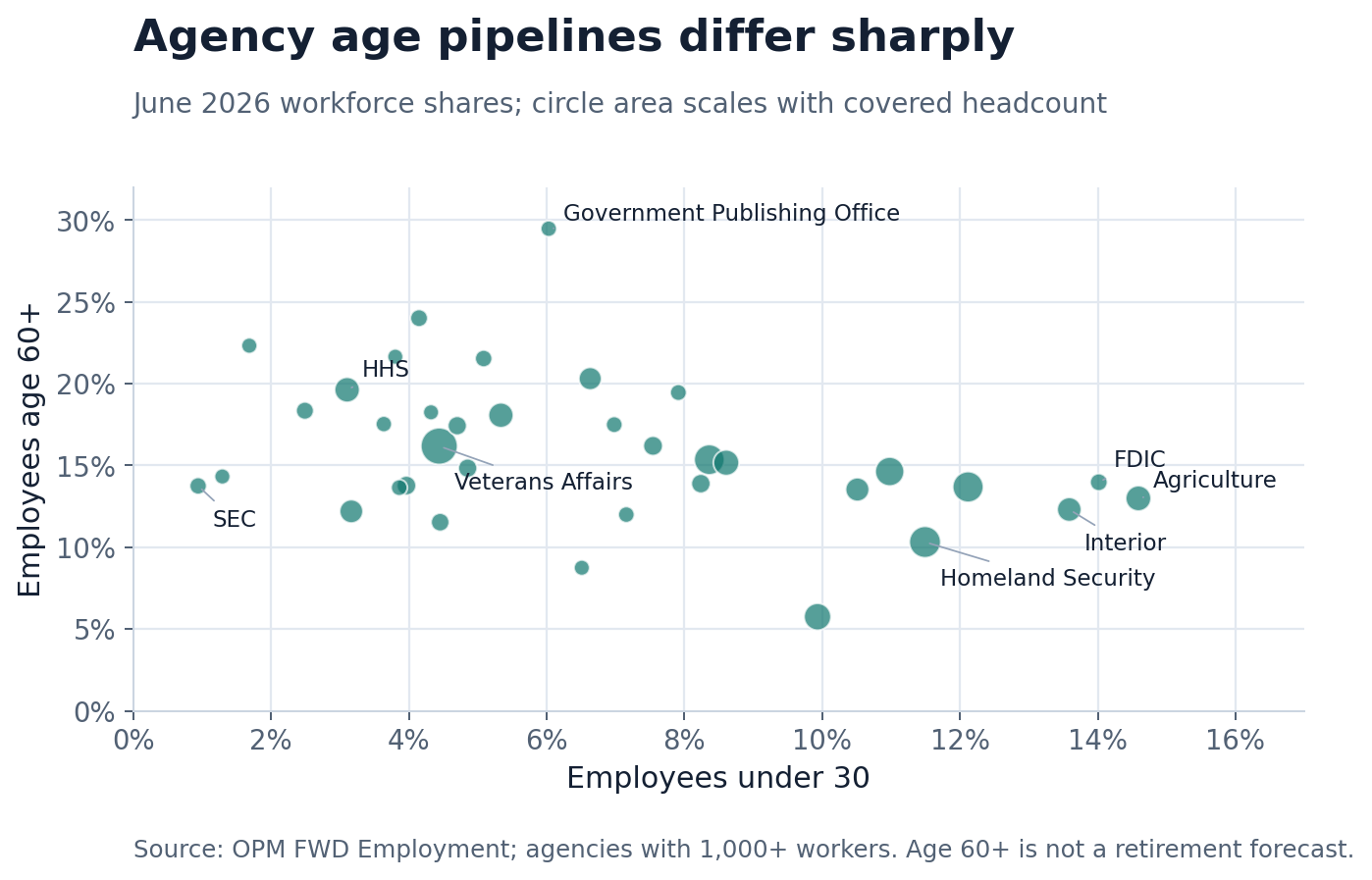
Those figures are not a scoreboard. Missions, occupations, seasonal work, pay systems and reporting populations differ. They do show why OPM will need agency-level numerator and denominator data if the governmentwide target is to reveal more than a single average.
What applicants may notice first
The staffing memo pairs early-career hiring with two other changes that could alter the application process.
Agencies are directed to target shared certificates for at least 60% of new external competitive-service hiring. A shared certificate allows multiple agencies to select from one assessed pool instead of making applicants repeat nearly identical applications. OPM's USAJOBS talent-pool service supplies part of that infrastructure. If agencies use it as intended, one competition could expose an applicant to several employers. It could also make the design of the common assessment and the clarity of location preferences more consequential.
The memo also sets a 100% target for validated technical assessments or approved alternatives in covered external hiring actions, including direct-hire actions. OPM lists structured interviews, work samples, subject-matter-expert technical evaluations and USA Hire among the possible tools. The change follows the Chance to Compete Act implementation plan and guidance moving agencies away from unsupported self-ratings.
For applicants, that should mean less weight on questionnaires that ask candidates to rate their own expertise and more on demonstrating it. But common pools also raise the stakes of a single assessment, and agencies can document why a target is not achievable and propose a quarterly trajectory. The quality of the test, accommodations, notice and reuse rules will matter as much as the percentage target.
The new plan has a plausible route to widen the federal on-ramp: rebuild internships and recent-graduate hiring, open ordinary entry positions, share assessed pools and make skills demonstrations portable. Its public scorecard is not ready.
OPM has defined the denominator for the 33% goal. It has not published a reproducible numerator, the recent baseline or agency results. Without those pieces, a government that already hired more than one-third of its external entrants under age 30 could report success without showing that it expanded formal pathways, increased visible openings or added people with genuinely limited career experience.
That is the test for fiscal 2027. The target should measure a rebuilt pipeline, not merely give a new name to hiring the government was already doing.
Methodology and limitations
FederalHiringData analyzed OPM legacy FedScope employment cubes for September 2000-2014; OPM Federal Workforce Data employment, accessions and separations through June 2026; and the FederalHiringData historical USAJOBS archive from March 2017 through August 14, 2026. External hires are new competitive, excepted-service and Senior Executive Service hires. Separations exclude transfers. Under 30 and Pathways status are reported as non-equivalent observable proxies, not as OPM's unpublished target numerator. Fiscal 2026 and calendar 2026 are partial and are not used as full-year comparisons.
Hero image: NSWCDD Intern Day 2025, Naval Surface Warfare Center Dahlgren Division. Photo by Dorina Watermolen, July 24, 2025. DVIDS photo ID 9267675, public domain subject to DVIDS restrictions.
Continue reading
More from FederalHiringData

Data investigationsAugust 18, 2026
FEMA's Public Workforce Count Fell 22% as GAO Warned of Readiness Risks
FEMA had 5,793 fewer covered civilian employees in June 2026 than in January 2025. GAO says the agency cut staff without the workforce planning needed to assess mission capacity.

Data investigationsAugust 19, 2026
Social Security Has 85% More Beneficiaries per Worker Than in 2000
Social Security added 25 million beneficiaries while losing 9,600 full-time permanent workers. Recent service gains show what technology changed—and what a thinner workforce still risks.
Data investigationsAugust 20, 2026
OPM's 35% Cut Was Its Deepest Since It Transferred an Entire Bureau
The federal government's HR agency now has fewer employees than at any reviewed point since 1998 while directing agencies to rebuild hiring and workforce planning.
Federal Hiring Data Weekly
Subscribe to Federal Hiring Data Weekly.
Subscribe to Federal Hiring Data Weekly. Confirm your email after signing up to receive federal hiring trends, salary data, agency movements, and original research.