August 27, 2026
Eight GS-15 Steps Pay the Same in San Francisco. Federal Pay Compression Has Spread to 37 Localities.
FederalHiringData found 21,453 identifiable GS-15 employees in officially capped steps as the 2026 ceiling flattened upper rates in 37 locality tables.
Published August 27, 2026Last edited August 27, 2026
A GS-15 job in San Francisco still has 10 numbered steps. Its 2026 salary table does not have 10 distinct salaries.
Step 1 pays $184,950. Step 2 pays $191,116. Step 3 reaches $197,200. Then the ladder stops moving: steps 4, 5, 6, 7, 8, 9 and 10 all pay the same $197,200 locality rate.
The flat line is not a typo. Federal law limits General Schedule pay with locality adjustments to Executive Schedule level IV. For 2026, OPM lists that ceiling at $197,200. In the country's highest-paying locality, eight of the 10 GS-15 steps now run into it.
FederalHiringData's review of every official OPM locality table found that the problem is no longer confined to one coast. Thirty-seven of 58 locality tables have at least one capped GS-15 step in 2026, up from 19 of 34 published tables in 2015. New York has six capped steps. Washington, Los Angeles and Houston each have five.
The schedule effect reaches a large share of the senior GS workforce. OPM's June 2026 employment records identify 39,150 GS-15 employees with valid steps and locality areas that FederalHiringData could match to a published table. 21,453 of them, or 54.8%, occupied a locality-and-step combination marked as capped by OPM. Another 11,375 valid-step records had their locality redacted and were not assigned to either side of that calculation.
This is pay compression in literal form: different rungs of the same grade lead to one payable salary. It changes what a step increase can deliver, narrows the salary difference between experienced GS-14 and GS-15 employees in San Francisco, and makes the top of a USAJOBS range less informative than it appears.
The cap reaches from one step to eight
OPM publishes a separate General Schedule table for each locality area. FederalHiringData downloaded the machine-readable 2015 through 2026 tables, read OPM's explicit `Statutory_Cap_Applies` field for every GS-14 and GS-15 step, and recovered four broken 2024 XML files from OPM's official HTML tables. The result is a year-by-year map of where the step ladder actually flattens.

In 2015, 15 locality tables had no capped GS-15 steps and 19 had at least one. San Francisco had five capped steps; New York, Los Angeles and Houston each had three; Washington had two. By 2026, the count of tables with compression had nearly doubled to 37, although OPM also expanded the total number of locality areas from 34 to 58.
That changing denominator matters. The increase does not describe one fixed set of geographic boundaries. New locality areas were created, and some names and boundaries changed. It does show that, across the salary tables workers and agencies actually use each year, a capped upper tier became much more common.
The 2026 distribution is uneven. Twenty-one locality tables still have no capped GS-15 steps, including Rest of U.S. Seventeen have only step 10 capped. At the other end, San Francisco has eight and New York six.

| Capped GS-15 steps | 2026 locality areas |
|---|---|
| 8 | San Jose-San Francisco-Oakland |
| 6 | New York-Newark |
| 5 | Houston-The Woodlands; Los Angeles-Long Beach; Washington-Baltimore-Arlington |
| 4 | Alaska; Boston-Worcester-Providence; Chicago-Naperville; Denver-Aurora; Hartford-East Hartford; San Diego-Chula Vista-Carlsbad; Seattle-Tacoma |
| 3 | Dallas-Fort Worth; Detroit-Warren-Ann Arbor; Minneapolis-St. Paul; Philadelphia-Reading-Camden; Sacramento-Roseville |
| 2 | Atlanta-Athens-Clarke County-Sandy Springs; Miami-Port St. Lucie-Fort Lauderdale; Portland-Vancouver-Salem |
| 1 | Albany-Schenectady; Austin-Round Rock-Georgetown; Buffalo-Cheektowaga-Olean; Cincinnati-Wilmington-Maysville; Cleveland-Akron-Canton; Colorado Springs; Columbus-Marion-Zanesville; Dayton-Springfield-Kettering; Hawaii; Huntsville-Decatur; Laredo; Milwaukee-Racine-Waukesha; Phoenix-Mesa; Pittsburgh-New Castle-Weirton; Raleigh-Durham-Cary; Richmond; St. Louis-St. Charles-Farmington |
| 0 | Albuquerque-Santa Fe-Las Vegas; Birmingham-Hoover-Talladega; Burlington-South Burlington-Barre; Charlotte-Concord; Corpus Christi-Kingsville-Alice; Davenport-Moline; Des Moines-Ames-West Des Moines; Fresno-Madera-Hanford; Harrisburg-Lebanon; Indianapolis-Carmel-Muncie; Kansas City-Overland Park-Kansas City; Las Vegas-Henderson; Omaha-Council Bluffs-Fremont; Palm Bay-Melbourne-Titusville; Reno-Fernley; Rest of U.S.; Rochester-Batavia-Seneca Falls; San Antonio-New Braunfels-Pearsall; Spokane-Spokane Valley-Coeur d'Alene; Tucson-Nogales; Virginia Beach-Norfolk |
The full table also shows a quieter change. San Francisco's compressed tier grew from steps 6-10 in 2015 to steps 3-10 in 2026. New York expanded from three capped steps to six. Washington went from two to five. Rest of U.S. retained 10 distinct GS-15 salaries throughout the period.

One legal ceiling, two different pay limits
The cap that flattens a locality table is easy to confuse with a different federal compensation limit.
Under 5 U.S.C. 5304) and OPM's maximum GS pay guidance, a General Schedule rate plus locality pay cannot exceed Executive Schedule level IV. That is the $197,200 ceiling printed with an asterisk in the 2026 locality tables. The base GS schedule, before locality or a special-rate supplement, has a separate level V limit.
The aggregate limitation on pay is different. OPM's aggregate-pay guidance says the ordinary limit for total covered compensation is Executive Schedule level I, $253,100 in 2026. That calculation can include basic pay, awards, certain bonuses, differentials and other covered payments. Amounts above it may be deferred under the governing rules. It does not authorize an agency to ignore the lower level IV ceiling when setting the employee's locality rate, and an agency cannot defer basic pay.
That distinction prevents two opposite mistakes. A GS-15 at the locality cap is not necessarily barred from every award or additional payment. But an award does not restore a missing step rate or permanently raise salary for the position.
Special rates and other systems require more care. OPM says an employee can be entitled to the greatest applicable locality, special or retained rate, and other statutes can authorize different schedules. Title 38 health-care pay, Senior Executive Service pay, administratively determined systems and agency-specific authorities are not interchangeable with the standard GS locality table.
FederalHiringData therefore limited its main calculation to OPM records coded pay plan GS, grades 14 or 15, steps 1-10, and an identifiable standard locality table. It did not fold GG, Title 38, SES or other pay plans into the GS denominator.
The exclusion is not academic. OPM reported 403 GS-15 employees with adjusted basic pay above $197,200 in June; 401 were at the Department of Veterans Affairs. Those records should not be called violations. They point to special, retained or health-care-related pay authorities that the standard locality table does not explain.
The step ladder stops at different places
The 2026 tables make the practical effect visible.

| 2026 locality | Distinct rates before cap | First capped step | Step 1 | Last distinct rate | Steps at $197,200 |
|---|---|---|---|---|---|
| San Francisco | 2 | 3 | $184,950 | $191,116 at step 2 | 3-10 |
| New York | 4 | 5 | $174,347 | $191,782 at step 4 | 5-10 |
| Los Angeles | 5 | 6 | $172,476 | $195,474 at step 5 | 6-10 |
| Houston | 5 | 6 | $170,618 | $193,369 at step 5 | 6-10 |
| Washington | 5 | 6 | $169,279 | $191,850 at step 5 | 6-10 |
| Rest of U.S. | 10 | None | $147,945 | $192,331 at step 10 | None |
OPM describes a within-grade increase as movement from one step to the next after the employee meets performance, waiting-period and other requirements. The waits are one year for moves to steps 2-4, two years for moves to steps 5-7 and three years for moves to steps 8-10. It normally takes 18 years to travel from step 1 to step 10 without a quality step increase.
In San Francisco, the numbered progression continues after step 3, but the 2026 locality rate does not. A qualifying employee can advance administratively from step 3 to step 4 and still remain at $197,200. The same is true for the next six steps unless a later annual table lifts the ceiling enough to create separation again.
This does not mean step status is worthless. It can matter if the cap rises, the employee moves to another locality or another pay action uses the underlying step. It does mean the current salary table provides no immediate locality-rate increase between the capped steps.
The uncapped schedule pressure is larger than the table can display. FederalHiringData applied OPM's 46.34% San Francisco locality percentage to the 2026 GS-15 base schedule. The mechanical step-10 result is about $240,438, or $43,238 above the payable ceiling. In 2015, the same base-plus-locality calculation was about $178,563, $19,863 above that year's $158,700 ceiling.
Those implied figures are analytical comparisons, not payable salaries. The official salary is the capped amount. They show how much of the nominal base-and-locality formula is being truncated at the top.
More than half of identifiable GS-15 employees were in capped steps
Salary tables show where compression is possible. OPM's employment data show where employees actually sit.
The June 2026 snapshot contained 50,690 GS-15 employees coded to valid steps 1-10. FederalHiringData matched 39,150 to an official locality table. The remaining 11,540 included 11,375 records whose locality was redacted, 146 marked outside a locality area and 19 with invalid locality codes.
Among the matched records, 21,453 employees occupied a step that OPM marks as capped. That was 54.8%. A separate check of the salary field reached a similar result: 21,649 of 39,297 employees with reported adjusted basic pay were listed at exactly $197,200, or 55.1%.
The two measures are close but not identical. The first asks whether the employee's standard locality-and-step combination is capped. The second asks whether the reported salary equals the ceiling and can include other pay-setting situations. FederalHiringData treats the schedule-and-step measure as the cleaner estimate of standard GS compression.
Federal Hiring Data Weekly
Get the biggest federal workforce changes in your inbox.
Subscribe to Federal Hiring Data Weekly for federal hiring trends, salary data, agency movements, and original investigations, with email confirmation before delivery.

Washington dominates the count. Its matched records placed 16,845 GS-15 employees in steps 6-10, far more than any other locality. San Francisco followed with 690, Houston 614, New York 522, Denver 381 and Atlanta 369.
That is a workforce-composition result, not a claim that Washington's cap is more severe than San Francisco's. San Francisco has eight flattened steps, but Washington has vastly more GS-15 employees in the OPM file. Severity of the schedule and number of affected employees answer different questions.
GS-14 compression remains much narrower. Only San Francisco's 2026 GS-14 table is capped, at steps 9 and 10. The matched OPM records placed 342 GS-14 employees in those standard combinations. Other reported GS-14 salaries at or above $197,200 can reflect special or retained rates and were not relabeled as ordinary locality compression.
The advertised maximum is often the cap
The salary ceiling also shapes what applicants see before they enter government.
FederalHiringData queried its nonoverlapping historical USAJOBS archive and current records for announcements coded pay plan GS whose grade range included 15. The result was 76,351 unique announcements from March 2017 through Aug. 14, 2026. Of 76,189 with annual pay intervals, 54,534, or 71.6%, advertised a maximum equal to that year's level IV ceiling.

The annual share ranged from 59.1% in 2019 to 76.6% in 2020. It was 74.2% in partial 2026. The archive begins in March 2017, and 2026 is incomplete, so neither edge year is a full-year comparison.
An announcement maximum at the ceiling does not prove the selected employee was offered $197,200. It can describe the top step, a multi-grade ladder, multiple duty locations or a broad hiring range. A single announcement can cover many vacancies or one; some do not report a reliable opening count. Announcement totals therefore cannot be converted into employees, vacancies or hires.
Location adds another warning. The archive found 22,798 cap-matched announcements with a Washington location, 2,197 with Atlanta, 2,043 with Arlington and 1,501 with Alexandria. Those city counts overlap when one control lists several places. OPM locality boundaries can also include counties and cross state lines. FederalHiringData did not force every raw job location into an OPM locality when the announcement lacked the precise duty-station evidence needed for that assignment.
For an applicant, the posted maximum answers “what is the highest rate this announcement displays?” It does not answer “what will my offer be?” A new GS employee is usually appointed at step 1, although agencies can use superior-qualifications authority in qualifying cases. Current federal employees may be covered by promotion, maximum-payable-rate or retained-pay rules. The agency's written offer and official worksite determine the actual rate.
Promotions can run into the same wall
OPM's two-step promotion rule generally entitles a GS employee promoted without a break in service to the lowest rate in the higher grade that is at least two within-grade increases above the employee's existing base rate, after the required geographic and pay-schedule steps. If the calculated amount exceeds the higher grade's maximum, OPM's rule uses that maximum unless a higher existing rate qualifies for retained pay.
The cap can therefore truncate a promotion increase.
San Francisco is the clearest case. GS-14 step 8 pays $193,930. Steps 9 and 10 pay $197,200. GS-15 step 1 pays $184,950, step 2 pays $191,116, and every step from 3 through 10 pays $197,200. An employee already receiving the capped GS-14 locality rate cannot obtain a higher standard locality rate merely by moving to one of those GS-15 steps in the same 2026 schedule.
That is not a promise about a specific personnel action. Promotions can coincide with worksite changes, special rates, retained pay and other rules. Agencies must perform the formal calculation. It is evidence that the published standard schedule has no room above the cap.
Applicants comparing a GS-14 and GS-15 opportunity should separate three questions:
| Question | What to verify |
|---|---|
| What salary can the agency offer now? | Pay plan, grade, step, official worksite, locality table, special-rate table and the written offer |
| What does future step progression pay? | Which steps are distinct in the current table and which are marked with OPM's statutory-cap asterisk |
| What happens on promotion or transfer? | The applicable OPM pay-setting rule, geographic conversion, special or retained rate, and the new position's maximum |
Retirement and bonuses do not erase the distinction
Related research
Put this finding in context

Pay and benefitsAugust 19, 2026
Federal Pay Rose 14%. Prices Rose Nearly Twice as Fast.
Consumer prices rose 27.7% from January 2021 through July 2026 while the GS base schedule rose 14.4%. Locality pay narrowed, but did not erase, the loss in scheduled purchasing power.
Pay and benefitsAugust 27, 2026
One in Four USAJOBS Announcements Outside Urban Areas Advertised a Hiring Incentive
FederalHiringData found incentive language in 26.43% of exact-location postings outside Census urban areas, versus 17.57% inside them.
Locality pay generally counts as basic pay for retirement purposes. OPM describes the FERS high-3 as the highest average basic pay earned during any three consecutive years, including salary amounts on which retirement deductions are withheld and excluding overtime and bonuses.
That means the salary actually payable under the cap can enter a high-3 calculation. It does not support a universal dollar estimate of “lost retirement.” A high-3 depends on the employee's exact pay history, retirement coverage, dates, work schedule and consecutive three-year period. An uncapped theoretical schedule rate was never paid and should not be inserted into an annuity formula as though it were.
Awards and recruitment or retention payments are a separate issue. Some can raise cash compensation in a year, subject to their own authority and the aggregate limitation. They generally do not replace a higher permanent basic-pay rate. An applicant should not treat a possible bonus as equivalent to a distinct upper step.
The cap rose more slowly than both prices and San Francisco's schedule pressure
Executive Schedule level IV increased from $158,700 in 2015 to $197,200 in 2026, a 24.3% rise. CPI-U increased 42.9% from January 2015 through July 2026. The implied uncapped San Francisco GS-15 step-10 amount increased 34.7%.

CPI does not set the Executive Schedule or General Schedule. It is a purchasing-power comparison, not the statutory formula. The San Francisco line is also a calculated base-plus-locality amount before the cap, not a payable rate. Together, the series explain why more of the nominal ladder can collide with a ceiling even when that ceiling rises.
The one-year direction can move differently. The total number of capped GS-15 steps across all locality tables slipped from 96 in 2025 to 95 in 2026 because salary-table relationships shift by small amounts. The number of localities with any compression remained 37. “Spreading” describes the longer 2015-2026 schedule record, not an uninterrupted increase every year.
What a GS-15 applicant should read before accepting
Find the exact pay table. The city in an announcement is not always enough. OPM locality areas can cross county and state lines. Confirm the official worksite and the table the agency will use.
Ask whether a special rate applies. A special salary rate, retained rate or Title 38-related authority can change the payable result. Do not infer the governing schedule from the job title alone.
Treat the maximum as a ceiling, not an offer. The top of a USAJOBS range often equals level IV because the announcement spans GS-15 steps or locations. The written offer identifies the actual step and salary.
Look beyond the current year without inventing the future. Congress and the President can change pay schedules and statutory ceilings. A step that is compressed in 2026 may separate later, remain flat or be affected by a new table. No current announcement can guarantee a future adjustment.
For promotions, ask HR to show the calculation. The two-step rule, geographic conversion, special rates and retained pay can interact. A generic online calculator may not reproduce the agency's official pay-setting action.
For retirement, use actual covered basic pay. High-3 estimates should use the employee's real salary history and retirement record, not the theoretical uncapped values in this analysis.
Current openings can be checked in the FederalHiringData jobs search. The statistics page separates active listings from the historical archive, and the occupations directory can help applicants compare announcement patterns by series.
Methodology and limitations
FederalHiringData downloaded the official OPM General Schedule pages and all linked XML salary tables for 2015 through 2026. It retained tables whose type was GS, excluded the base table from locality counts, and read annual rate, locality percentage, salary cap and OPM's statutory-cap flag for grades 14 and 15. OPM returned zero-filled files for four 2024 localities; the analysis rejected those invalid responses and parsed OPM's official HTML versions instead. The published schedule is authoritative; implied uncapped rates are FederalHiringData calculations using the base rate and listed locality percentage.
The workforce analysis uses OPM's June employment snapshots. Its current denominator includes pay plan GS, grade 15 and valid steps 1-10. Locality names were crosswalked to OPM salary-table codes. The main employee count excludes redacted, invalid and non-locality records rather than assigning them. OPM counts are reported employees, not positions authorized or vacancies. Adjusted basic pay is not total compensation.
The USAJOBS analysis uses 3.09 million canonical, nonoverlapping records in the FederalHiringData historical archive and current layer, then selects pay-plan GS announcements whose grade range spans 15. Annual pay maxima are compared with the OPM level IV rate in the announcement's opening year. The archive begins March 2017 and runs through Aug. 14, 2026 for this analysis. Salary ranges are advertised values, not payroll. One announcement can list multiple locations, vacancies or hiring paths.
The CPI comparison uses BLS CPI-U series CUUR0000SA0, January 2015 through July 2026. CPI measures consumer prices; it does not determine federal salary law.
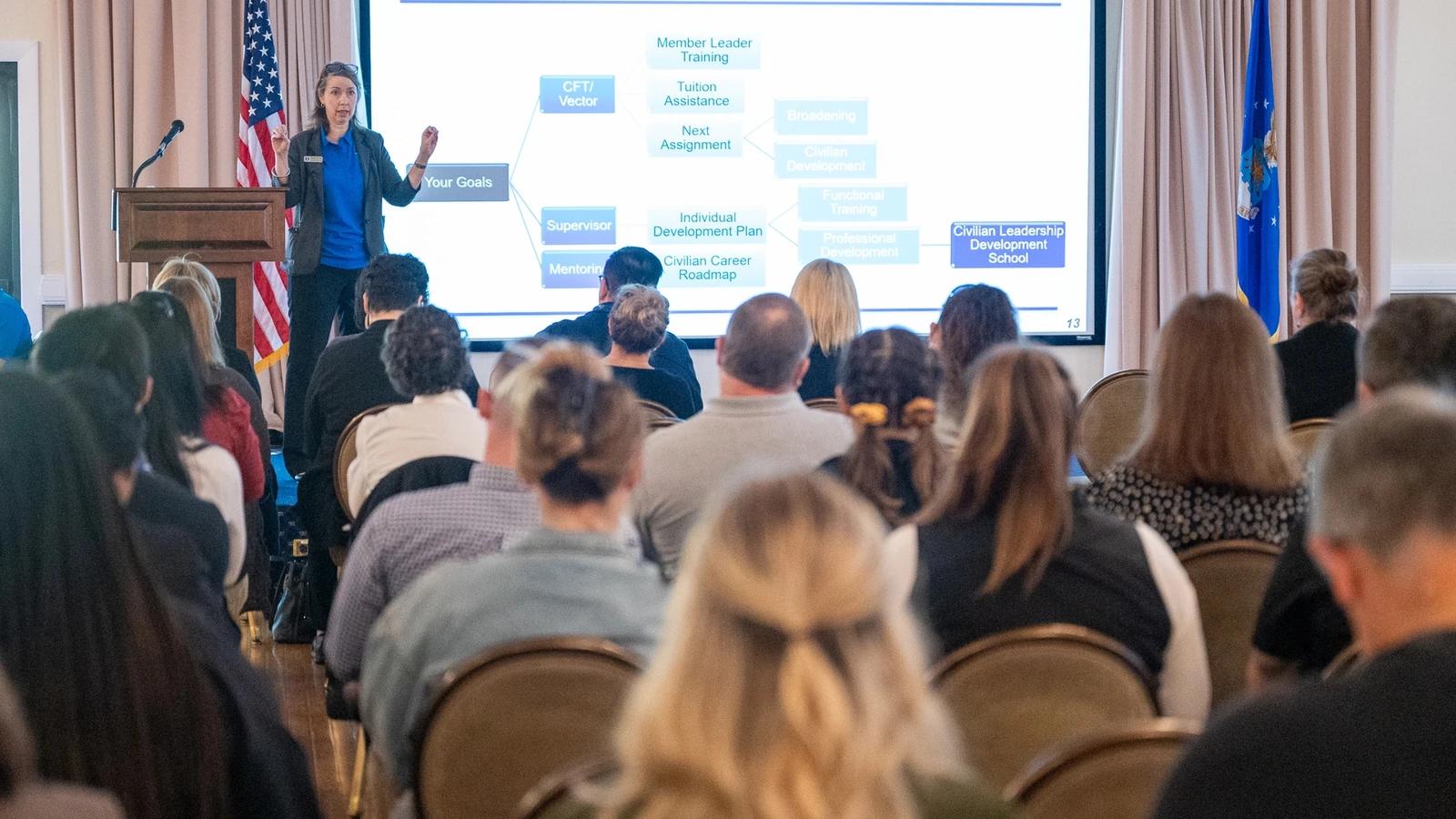
Hero image: Air Force Personnel Center Civilian Talent Development Chief Rebecca Venters speaks at a civilian career-management roadshow at Hanscom Air Force Base on Sept. 11, 2024. U.S. Air Force photo by Mark Herlihy via DVIDS, public domain. The event supplies career-development context; it is not evidence about any participant's grade or pay.
The numbered GS ladder still reaches step 10. In the most compressed localities, salary does not. For applicants and employees near the top, the useful question is no longer just “what step am I?” It is “does this step have a distinct payable rate where I work?”
Continue reading
More from FederalHiringData
Pay and benefitsAugust 27, 2026
The TSP Now Lets Ages 60-63 Save $35,750. FERS Savers Ages 60-69 Averaged 10.8%.
The TSP raised contribution ceilings and added Roth rules in 2026, but FRTIB and OPM data show why the changes reach federal savers unevenly.

Pay and benefitsAugust 18, 2026
TSP Loan and Hardship-Withdrawal Use Rose in 2025
TSP loan use reached 9.5% of active FERS participants and hardship-withdrawal use reached 4.9%, even as participation, deferrals and account balances also increased.
Data investigationsAugust 19, 2026
The Federal Workforce Shrunk by 286,000. DOGE's Savings Are Harder to Prove
FederalHiringData finds a 12.4% workforce contraction and an estimated $22.8 billion decline in annualized basic-pay cost, while the public savings ledger remains incomplete.
Federal Hiring Data Weekly
Get the biggest federal workforce changes in your inbox.
Subscribe to Federal Hiring Data Weekly for federal hiring trends, salary data, agency movements, and original investigations, with email confirmation before delivery.