August 27, 2026
The TSP Now Lets Ages 60-63 Save $35,750. FERS Savers Ages 60-69 Averaged 10.8%.
The TSP raised contribution ceilings and added Roth rules in 2026, but FRTIB and OPM data show why the changes reach federal savers unevenly.
Published August 27, 2026Last edited August 27, 2026
A federal employee turning 62 in 2026 can put as much as $35,750 of pay into the Thrift Savings Plan. That is $3,250 more than the ceiling for a worker turning 59 and $11,250 more than the limit for someone under 50.
The larger number is real. Reaching it is another matter.
Federal Retirement Thrift Investment Board data show that FERS participants ages 60 through 69 deferred an average 10.8% of estimated salary in 2025, the highest rate of any age group in the report. At a $150,000 salary, contributing $35,750 would require 23.8%. At $200,000, it would require 17.9%.
Those comparisons do not say that nobody reaches the limit. They show how far the new statutory ceiling sits above observed cohort averages, even for the oldest and highest-saving groups. They also expose the central complication in the TSP's 2026 changes: the workers most able to use catch-up contributions face a new Roth requirement that public federal pay data cannot count precisely.
Beginning this year, catch-up contributions generally must be Roth for a participant whose 2025 wages from the employer sponsoring the plan exceeded $150,000. The test uses wages defined for Federal Insurance Contributions Act purposes. It does not use a USAJOBS salary range, a worker's current basic-pay rate or household income.
At the same time, the TSP made Roth in-plan conversions available. That feature can move money already in a traditional balance into Roth, producing taxable income now in exchange for the possibility of tax-free qualified withdrawals later. It is separate from the payroll catch-up rule, and it cannot be reversed.
FederalHiringData combined FRTIB account and savings records with the latest Office of Personnel Management workforce snapshot to examine who is positioned to use the changes and where the public data stop. The result is not a tax recommendation. It is a map of three different decisions that arrived under one Roth label: how much to contribute, how new catch-up dollars are taxed and whether to convert old traditional money.
The 2026 TSP has three contribution ceilings
The ordinary elective-deferral limit rose to $24,500 in 2026. That is the combined employee total for traditional and Roth contributions for most TSP participants. Employer automatic and matching contributions do not consume that employee limit.
Participants who turn 50 or older during the calendar year can make catch-up contributions after reaching the regular limit. The standard catch-up increased to $8,000, producing a $32,500 employee ceiling.
SECURE 2.0 created a higher catch-up for participants who turn 60, 61, 62 or 63 during the year. The 2026 amount is $11,250, for a combined employee ceiling of $35,750. At 64, the catch-up returns to the standard amount.
The timing is easy to blur. The age-60-to-63 higher catch-up first became available in 2025. For 2026, its dollar amount remained $11,250 while the ordinary elective-deferral limit rose by $1,000 and the standard catch-up rose by $500. The separate higher-wage Roth-only catch-up requirement began in 2026 after a statutory implementation delay. A participant can therefore qualify for the larger age-based ceiling without being subject to Roth-only treatment, and can be subject to Roth-only treatment while qualifying only for the standard $8,000 catch-up.

| Age during 2026 | Regular employee limit | Catch-up limit | Combined employee limit |
|---|---|---|---|
| Under 50 | $24,500 | Not eligible | $24,500 |
| 50-59 | $24,500 | $8,000 | $32,500 |
| 60-63 | $24,500 | $11,250 | $35,750 |
| 64 or older | $24,500 | $8,000 | $32,500 |
The higher amount applies by age reached during the calendar year, not age on Jan. 1. The official TSP table translates that into birth years for 2026: people born from 1963 through 1966 receive the $11,250 catch-up.
TSP uses a spillover method. Participants do not file a separate catch-up election. Contributions beyond the regular limit automatically become catch-up contributions, up to the applicable ceiling. That automatic treatment matters for the Roth rule: a worker can make traditional regular contributions, but the portion recognized as catch-up may have to switch to Roth.
The TSP cautions employees eligible for agency matching not to hit the limit too early. Matching is generally tied to each pay period. A participant who reaches the annual ceiling before year-end can miss matching contributions in later pay periods. The risk is especially relevant when a person raises payroll deductions for the age-60-to-63 limit and then fails to lower them in the year they turn 64.
The maximum demands a savings rate well above the cohort average
A dollar limit can look attainable without a salary denominator. Putting the two together changes the picture.
At a $100,000 salary, the ordinary $24,500 ceiling equals 24.5% of pay. The age-50 catch-up ceiling equals 32.5%, and the age-60-to-63 ceiling equals 35.8%. At $150,000, the corresponding shares are 16.3%, 21.7% and 23.8%. Only at $250,000 does the $35,750 maximum fall to 14.3%.

These are illustrations, not eligibility calculations. TSP contribution percentages are applied through payroll, and the compensation used in a real account can differ from the annualized salary shown in OPM or a vacancy announcement. The chart also excludes automatic and matching contributions because they do not count toward the employee elective-deferral ceiling.
The comparison is still useful. FRTIB's 2025 report found an overall average FERS deferral rate of 9.3%. The rate increased with age: 7.9% for participants 29 and younger, 8% for ages 30-39, 8.5% for 40-49, 10% for 50-59 and 10.8% for 60-69. It eased to 10.3% for participants 70 and older.

The age categories are a hard limitation. FRTIB groups 60 through 69 together, while the special statutory limit covers only 60 through 63. The 10.8% rate therefore describes the nearest public cohort, not the exact eligible group. It is an average, not a median, and it does not reveal the share who reached any limit.
Salary produces the same gradient. Participants in the lowest estimated-salary quintile deferred 7.4% on average; the highest quintile averaged 10.8%. Participation itself was high across the distribution, ranging from 93.8% in the lowest quintile to 98.3% in the highest.

That is important counterevidence to a simple affordability story. Higher-paid and older FERS participants did save more aggressively. The new catch-up capacity is not purely theoretical. But average rates near 11% remain far below the share required to contribute $35,750 on many federal salaries.
FRTIB estimates salary from agency automatic contributions in its behavioral report and excludes overtime and performance awards. The agency also cautions that an enrollment-source change after the TSP's 2022 recordkeeping transition affects comparisons. FederalHiringData therefore uses the 2020-2025 trend to establish direction, not to claim a perfectly uninterrupted measurement series.
The Roth-only catch-up rule is narrower than it sounds
The phrase "Roth catch-up requirement" can be read too broadly. It does not force all contributions by a higher-paid worker into Roth.
Under the IRS rule, a catch-up-eligible participant whose prior-year FICA wages from the employer sponsoring the plan exceeded the threshold must designate catch-up contributions as Roth. For 2026 contributions, the relevant 2025 threshold is more than $150,000. A person at exactly $150,000 is not above it.
Catch-up treatment begins only after employee deferrals exceed the regular $24,500 limit, unless another applicable plan limit causes it earlier. A participant can still divide the regular $24,500 between traditional and Roth. The required Roth treatment attaches to the catch-up dollars.
The TSP says the switch happens automatically for most people, while some participants should check with their payroll office. A worker who does not already have a Roth TSP balance will have one created by the first Roth catch-up contribution. A worker who does not want Roth catch-up can adjust contributions to avoid exceeding the regular limit.
The wage definition prevents a clean public headcount. OPM's June 2026 employee snapshot reports annualized adjusted basic pay and five-year age bands. The law looks backward to 2025 FICA wages from the plan-sponsoring employer. Basic pay can omit or treat components differently from FICA wages, and the time periods do not match.
FederalHiringData found 1,953,300 covered employees in the June OPM snapshot. Of those, 257,642 had adjusted basic pay above $150,000. Among employees age 50 or older, 137,595 were above that basic-pay level. These figures describe the pay distribution. They do not estimate the number subject to Roth-only catch-up.

OPM reports 174,828 covered employees ages 60 through 64. That band includes 64-year-olds, who receive the lower catch-up, and does not identify who participates in TSP, who reaches $24,500 or whose prior-year FICA wages crossed the threshold. Even the intersection of age and adjusted basic pay cannot be relabeled an affected population.
Federal Hiring Data Weekly
Get the biggest federal workforce changes in your inbox.
Subscribe to Federal Hiring Data Weekly for federal hiring trends, salary data, agency movements, and original investigations, with email confirmation before delivery.
This is a case where refusing a precise estimate is more accurate than publishing one. The public sources omit at least three required dimensions: exact eligible age, prior-year FICA wages from the relevant employer and actual deferrals beyond the regular limit.
Roth use was already expanding before the mandate
The Roth-only catch-up rule arrives after several years of growing Roth use.
FRTIB reported 1,014,278 FERS accounts with a Roth balance at the end of 2023, 25% of the 4.06 million FERS accounts in that report. The share rose to 26.3% in 2024, 27.3% in 2025 and 28.5% in June 2026.

An account with a Roth balance is not necessarily receiving Roth contributions now. The participant may have contributed in an earlier year, rolled money in or, beginning in 2026, completed an in-plan conversion. Account counts are also not unique-person counts because a person can have more than one TSP account category.
The June snapshot shows large differences across retirement systems.
| Account category | Total accounts | Accounts with Roth balance | Roth account share |
|---|---|---|---|
| FERS | 4,131,134 | 1,178,970 | 28.5% |
| Blended Retirement System | 1,751,595 | 1,083,325 | 61.9% |
| Legacy uniformed services | 1,189,553 | 613,121 | 51.5% |
| CSRS | 217,961 | 8,911 | 4.1% |
| All TSP account categories | 7,337,158 | 2,888,349 | 39.4% |
The Blended Retirement System had the largest Roth footprint by share. FERS, the largest account category, had a much lower share. CSRS was lower still. A uniform message about "TSP participants" therefore masks substantially different starting points.
The balance composition is different from the account count. FRTIB reported $98 billion in Roth assets against $1.155 trillion in total TSP assets in June, or 8.5%. Roth appeared in about two-fifths of accounts but represented less than one-tenth of assets. That gap is consistent with Roth's later introduction, smaller balances in many Roth accounts and different participant histories; it does not identify a cause for any one account.
In-plan conversion is a separate and irreversible tax event
Roth in-plan conversion adds another path to a Roth balance, but it should not be confused with Roth catch-up contributions.
A catch-up contribution moves current pay into TSP after taxes. An in-plan conversion moves an amount already in the traditional TSP balance into the Roth balance. The converted taxable amount is included in income for the conversion year. Future qualified Roth growth and withdrawals can be tax-free under IRS rules.
The TSP's conversion page, updated June 15, confirms that the feature is available to active participants, separated and retired participants, and spouse beneficiary participants with eligible vested traditional balances. The minimum conversion is $500. Participants generally must leave at least $500 in specified traditional payroll sources, and they may complete up to 26 conversions per account each calendar year.
The immediate tax bill cannot be withheld from the amount converted. The participant must pay it from personal funds outside the conversion. A conversion cannot be reversed or changed. Required minimum distributions must be satisfied first, and spousal consent is not required.
Those mechanics make conversion a different decision from selecting Roth for future payroll deductions. Converting a large balance can increase taxable income, affect marginal tax rates and interact with other tax provisions. Keeping money traditional preserves tax deferral but leaves future withdrawals generally taxable. FederalHiringData cannot determine which treatment is preferable for an individual.
The practical distinction is timing:
| Decision | Money involved | Immediate tax treatment | Reversible? |
|---|---|---|---|
| Traditional payroll contribution | New pay | Generally reduces current taxable income | Future elections can change |
| Roth payroll contribution | New pay | Included in current taxable income | Future elections can change |
| Required Roth catch-up | New pay above the regular limit for covered higher-wage participants | Included in current taxable income | Future contribution election can change |
| Roth in-plan conversion | Existing eligible traditional balance | Taxable amount added to income in conversion year | No |
The January FRTIB board attachment described conversion as a February rollout. The live TSP page now provides eligibility rules, a calculator and transaction instructions, so the current evidence supports calling the feature launched rather than planned.
Related research
Put this finding in context

Pay and benefitsAugust 18, 2026
TSP Loan and Hardship-Withdrawal Use Rose in 2025
TSP loan use reached 9.5% of active FERS participants and hardship-withdrawal use reached 4.9%, even as participation, deferrals and account balances also increased.

Pay and benefitsAugust 19, 2026
Federal Pay Rose 14%. Prices Rose Nearly Twice as Fast.
Consumer prices rose 27.7% from January 2021 through July 2026 while the GS base schedule rose 14.4%. Locality pay narrowed, but did not erase, the loss in scheduled purchasing power.
A trillion-dollar plan is changing at the margin and at the core
The rule changes affect a plan that has grown sharply in scale. FRTIB's latest public participant report shows total assets rising from $473 billion at the end of 2016 to $1.073 trillion at the end of 2025. The June 2026 total was $1.155 trillion.

Market performance, contributions, withdrawals and participant flows all affect asset totals. The line is not a measure of worker saving alone. The 2022 decline, for example, cannot be interpreted as participants withdrawing the difference.
The scale matters because even narrow rules can touch large dollar flows. FRTIB counted 4.15 million contributing accounts across its reported participant categories in June, along with 2.72 million noncontributing and 350,000 separated accounts. The conversion feature reaches active and separated participants, not just employees making payroll contributions.
At the same time, the behavioral evidence keeps the catch-up expansion in proportion. FERS participation was 96.2% in 2025. The average deferral rate was 9.3%. The policy problem is not simply whether workers have access to TSP; it is how far their actual contribution rate is from the maximum and what tax treatment applies once they cross it.
What federal employees should verify
The 2026 changes create a short list of factual questions, not a universal answer.
First, identify the limit for the age reached in 2026. Turning 60, 61, 62 or 63 qualifies for the $11,250 higher catch-up. Turning 64 returns the catch-up to $8,000.
Second, separate the regular limit from catch-up. The first $24,500 is the ordinary combined traditional-and-Roth employee limit. Catch-up treatment generally begins above it.
Third, check the correct wage record. The Roth-only catch-up test looks to 2025 FICA wages from the employer sponsoring the plan and asks whether they exceeded $150,000. Current salary, adjusted basic pay, household income and an advertised salary range are not substitutes.
Fourth, protect matching across pay periods. Participants eligible for agency or service matching should calculate deductions so contributions continue through the final pay period. Hitting the annual limit early can forfeit later matching opportunities.
Fifth, treat conversion as a tax transaction. A Roth in-plan conversion is not merely a bookkeeping switch. It can add taxable income, must be funded with outside cash for the tax bill and cannot be undone.
The official TSP contribution-limits page and Roth conversion page provide the current operating rules. Participants with payroll-specific questions should use their agency or service payroll channel; tax decisions may warrant professional advice.
Methodology and limitations
FederalHiringData analyzed normalized FRTIB annual-report measures in the local federal research warehouse for 2020 through 2025. The main behavioral comparisons use the 2025 Annual Report to Congress. FRTIB defines the annual FERS cohort as civilian participants active throughout the year and estimates salary using the agency automatic 1% contribution; the estimate excludes overtime and performance awards. Average deferral rates use the report's methodology and are not medians.
Current account and asset values come from the July 2026 FRTIB Participant Activity Report, which reports June statistics. Total-asset history uses Dec. 31 values for 2016 through 2025 and June for 2026. The Aug. 25 board meeting occurred before publication, but its participant attachment was not publicly posted when FederalHiringData checked on Aug. 27. No August value was inferred from the meeting notice.
FederalHiringData queried OPM's June 2026 Federal Workforce Data for covered employee counts by age band and annualized adjusted basic pay. OPM headcount excludes contractors and does not equal TSP account counts. Adjusted basic pay is not prior-year FICA wages, and the 60-64 age band includes an ineligible age for the higher catch-up. OPM figures are therefore context, not estimates of workers subject to the Roth rule.
TSP account rows are not unique people. A Roth balance does not prove current Roth contributions. Contribution ceilings exclude automatic and matching contributions. Illustrative salary percentages divide the employee limit by stated annual salary and do not model individual payroll, taxes or compensation definitions.
This article provides general public-data analysis, not individualized tax, investment or retirement advice. Tax outcomes depend on personal circumstances and changing law.
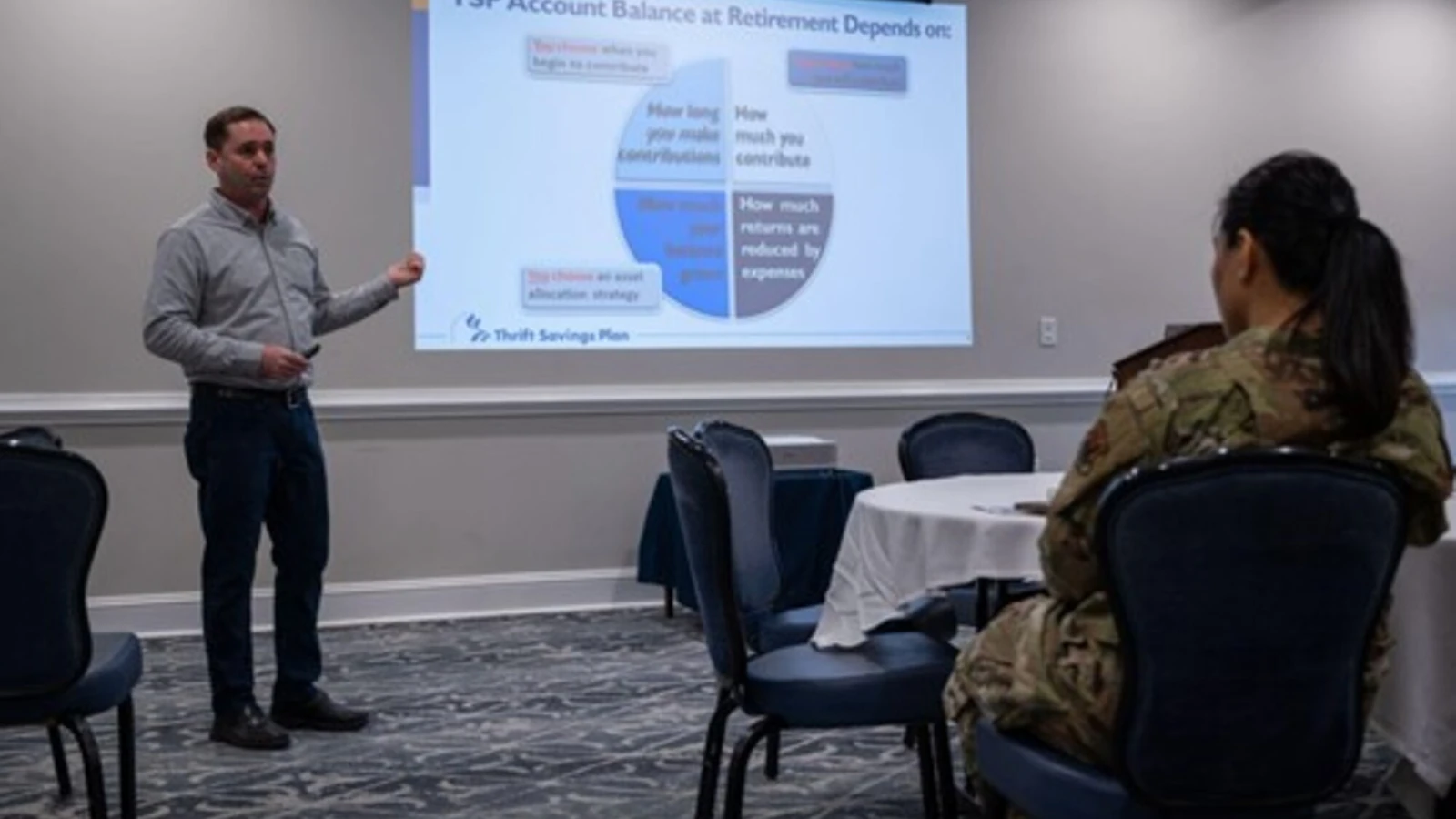
Hero image: James E. Quick presents a TSP briefing during the Joint Base Langley-Eustis Financial Readiness Summit on Feb. 25, 2025. U.S. Air Force photo by Airman 1st Class Donnell Ramsey.
Readers can browse current federal job announcements, compare federal workforce statistics, read the separate analysis of TSP loans and hardship withdrawals, or visit the complete FederalHiringData article archive.
The biggest number in the 2026 rules is $35,750. The more consequential number for many participants may be 10.8%: the observed savings pace of the nearest older FERS cohort. The law widened the top of the funnel. Pay, payroll timing and tax treatment still determine who can reach it.
Continue reading
More from FederalHiringData
Data investigationsAugust 19, 2026
Social Security Has 85% More Beneficiaries per Worker Than in 2000
Social Security added 25 million beneficiaries while losing 9,600 full-time permanent workers. Recent service gains show what technology changed—and what a thinner workforce still risks.
Workforce trendsAugust 17, 2026
Retirement Was 38% of Federal Separations in 2025. Quits Were Still More Common.
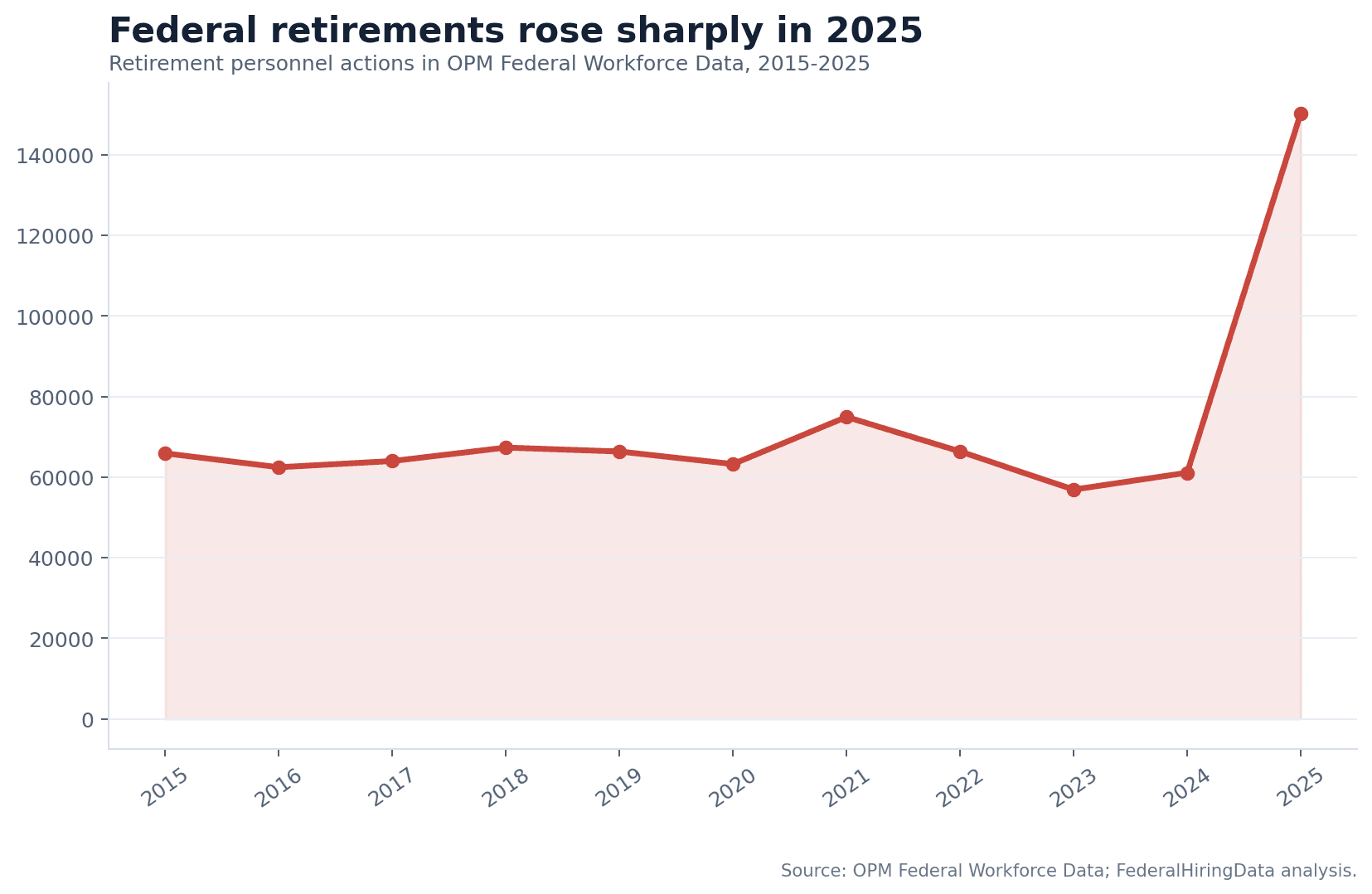
OPM data record 390,934 federal separation actions in 2025. Retirements accounted for 150,299, while quits remained the largest single category.

Data investigationsAugust 20, 2026
Federal Fire Staffing Rebounded in 2026. All of the Net Gain Came From Nonpermanent Appointments.
Interior built a new wildland fire service, but the Forest Service has not joined it. Federal records show the 2026 staffing rebound came entirely from nonpermanent appointments.
Federal Hiring Data Weekly
Get the biggest federal workforce changes in your inbox.
Subscribe to Federal Hiring Data Weekly for federal hiring trends, salary data, agency movements, and original investigations, with email confirmation before delivery.