August 24, 2026
VA Left 584 HUD-VASH Case-Manager Jobs Unfilled. Most Nonreferrals Had No Recorded Reason.
VA expanded HUD-VASH staffing and vouchers, but 584 case-manager positions were vacant and most nonreferrals had no documented explanation.
By Evan Mercer
Published August 24, 2026Last edited August 24, 2026
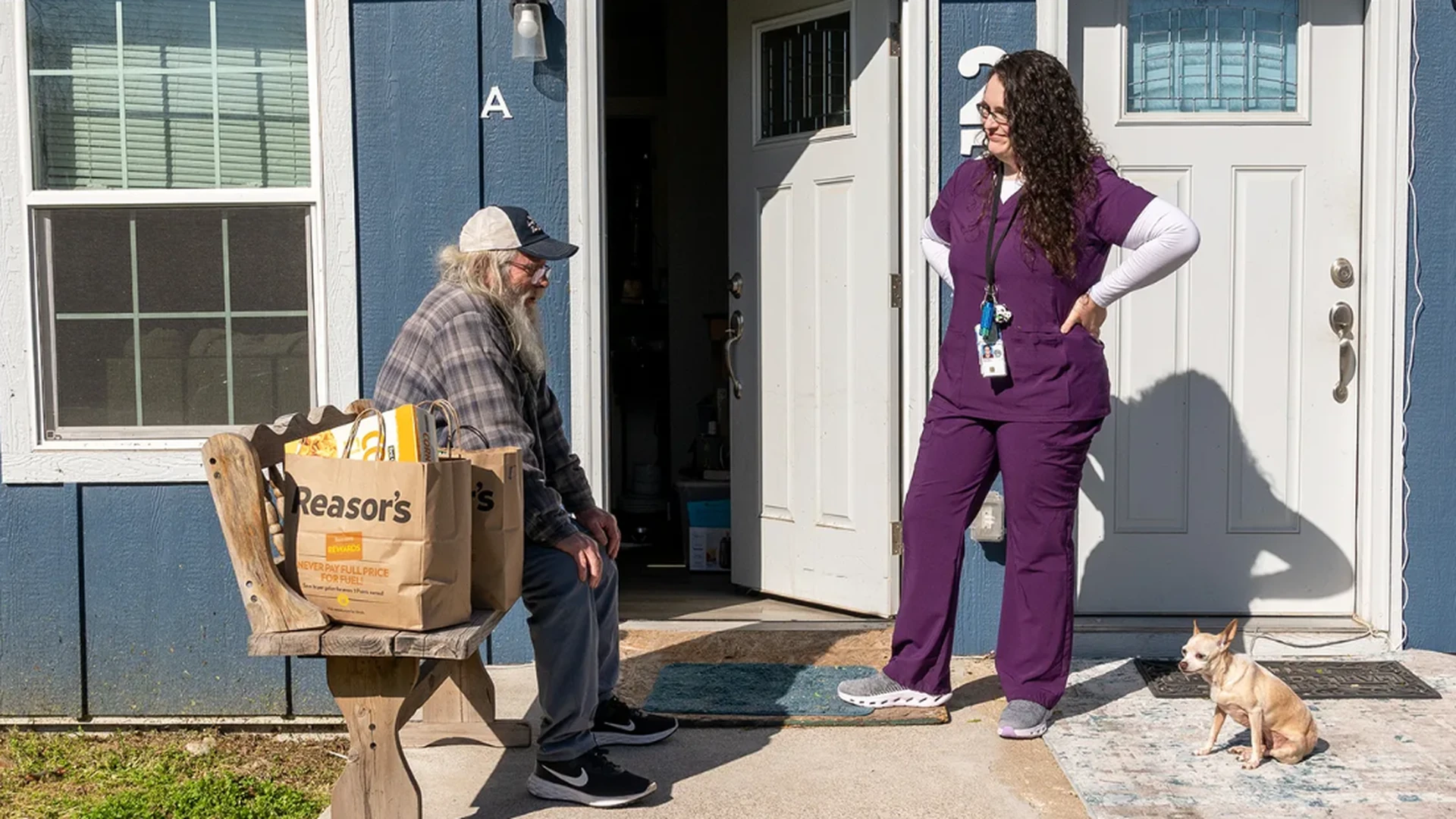
A housing voucher can pay rent. It cannot inspect an apartment, find a landlord, coordinate health care, replace an identity document or help a veteran remain housed after a crisis.
That work sits on the service side of HUD-VASH, the joint Department of Housing and Urban Development and Department of Veterans Affairs program that pairs rental assistance with VA case management. At the end of fiscal 2024, VA had authorized 4,159 case-manager positions for the program. It had filled 3,575. The other 584 were vacant.
The national vacancy rate was 14%, but the burden was not evenly distributed. Of 129 VA medical centers with at least two HUD-VASH case managers, 33 had vacancy rates of 20% or more, according to a March 2026 Government Accountability Office investigation. Annual turnover ran between 20% and 26% in every fiscal year from 2020 through 2024. VA told GAO that filling a vacancy took seven to eight months on average.
FederalHiringData found that those dedicated shortages existed inside a much larger social-work workforce that expanded dramatically over the long run. Covered Veterans Health Administration employment in Social Work Series 0185 rose from 3,925 in September 2000 to 20,297 in June 2026. The historical USAJOBS archive also contains 3,552 VHA announcements with HUD-VASH in the title since March 2017.
Broad growth and sustained recruiting did not guarantee that every medical center had enough people available for a specialized housing program. Nor does a vacancy prove that a veteran went unhoused. Housing supply, rent, landlord participation and local voucher administration all affect whether assistance becomes a lease.
The central problem is narrower and more consequential: VA could count its case-manager vacancies, but it could not determine their full effect on veterans seeking HUD-VASH help. From fiscal 2020 through 2024, 174,045 completed forms did not lead to a referral. Most of them, 151,296, had no reason documented.
A voucher needs a service system
HUD supplies vouchers to participating public housing agencies. VA identifies eligible veterans, refers them to the program and provides case management. The two sides have to move together.
A case manager may assess a veteran's needs, connect the veteran with medical or behavioral-health care, coordinate benefits, help obtain documents, work through housing searches and support the veteran after lease-up. Housing specialists and program assistants can share parts of the workload. Local housing agencies issue and administer the vouchers. Landlords decide whether to participate and whether an available unit meets program requirements.
VA increased authorized HUD-VASH case-manager positions by 358 from fiscal 2020 through 2024, a 9.4% expansion. Filled positions rose by 313. Unfilled positions moved from 539 to 584 and reached 701 in fiscal 2022.

The annual unfilled share ranged from 14% to 18%. That percentage is a position count at the end of each fiscal year, not a measure of daily staffing, caseload or service quality. A job may be vacant for only part of a year. A filled position may be occupied by someone in training, on leave or carrying an unusually difficult caseload.
Turnover adds another dimension. GAO found that between one-fifth and slightly more than one-quarter of case managers left their HUD-VASH positions each year from fiscal 2020 through 2024. Some may have remained at VA in another role. The public report does not provide exact annual rates or a complete destination breakdown.
The operational effect can still extend beyond the vacant seat. Existing staff absorb cases, supervisors recruit and train replacements, and veterans may encounter different case managers over time. GAO reported that 40% to 60% of employees in VA homeless programs said they experienced burnout in each annual survey from fiscal 2020 through 2024. That survey covers the broader homeless-program workforce, not only HUD-VASH case managers.
The picture is therefore not a simple national shortage ratio. It is a service network managing vacancies, turnover and uneven local workloads while veterans move through a housing market that does not pause for recruitment.
The national rate concealed local gaps
Fifty-two of the 129 medical centers in GAO's analysis had vacancy rates of 10% or less at the end of fiscal 2024. Thirty-three had rates of at least 20%. The remaining 44 fall between those bands, a FederalHiringData calculation from GAO's reported totals.

Among the 61 medical centers authorized for at least 25 case managers, vacancy rates ranged from zero to 34%, with a 14% average. A veteran's experience could therefore depend heavily on where the request entered the system even when the national average appeared stable.
GAO's public report does not name the 33 high-vacancy medical centers. Its figure displays the distribution without center identifiers. FederalHiringData did not construct a geographic vacancy map because assigning rates to specific facilities would require data the public report does not provide.
Recruitment restrictions compounded the local problem. VA officials told GAO that fiscal 2024 guidance mistakenly paused recruiting for 350 HUD-VASH case-manager positions even though the positions were supposed to be exempt. VA clarified that exemption in August 2024.
Confusion reappeared after the 2025 federal hiring freeze. HUD-VASH positions were again exempt, but GAO heard that interviews were delayed and some tentative offers were rescinded before the policy was understood locally. Vacant case-manager positions that were not under recruitment rose from 140 in January 2025 to 186 in June, an increase of 33%. In July, 27% of vacant positions were not being recruited.
These figures do not show that the freeze created every vacancy. They show that an exemption on paper did not immediately produce consistent hiring practice across a decentralized health system.
A fivefold social-work expansion did not answer the local question
The dedicated case-manager data begin in fiscal 2020. OPM records provide a longer but broader view.
VHA employed 3,925 covered workers in Social Work Series 0185 in September 2000. The count passed 10,000 in 2012, reached 16,005 in September 2019 and peaked at 21,575 in September 2024. It stood at 20,297 in June 2026.

The series includes social workers across VHA hospitals, clinics and programs. Most do not work in HUD-VASH. It excludes HUD-VASH case managers classified in other occupations, including counselors, nurses and psychologists. It is context for the professional labor pool, not a substitute staffing count.
That hard limit matters because the trends can move in opposite directions. VHA could expand social work overall while a particular medical center struggled to recruit housing case managers. A large national occupation total says little about local licensure, grade, specialty, workload or the willingness of candidates to accept a position in an expensive housing market.
Historical recruiting shows sustained demand. FederalHiringData identified distinct VHA announcements whose titles included “HUD-VASH” or “HUD VASH.” Counts increased from 197 in the partial 2017 archive year to 637 in 2023, then declined to 425 in 2024 and 316 in 2025. The 2026 archive contains 115 through Aug. 14.

Announcements are not hires, vacancies or employees. One announcement can fill multiple positions, support a standing register or close without a selection. Internal transfers and nonpublic authorities may never appear in this cohort. The decline after 2023 cannot be read as a precise decline in hiring.
The archive does show what VA advertised. Social Work Series 0185 appeared in most title-matched notices. GS-12 was the largest single grade pattern, followed by GS-9-to-11 career-ladder announcements. Median advertised ranges varied across years and localities.
| Pay and grade pattern | Distinct announcements | Median advertised annual range |
|---|---|---|
| GS-12 | 1,626 | $87,552-$113,900 |
| GS-9 to GS-11 | 692 | $61,974-$96,612 |
| GS-11 | 335 | $64,649-$84,049 |
| GS-13 | 99 | $105,666-$139,364 |
These are medians of posted minimums and maximums for annual-pay announcements, not employee salaries or guaranteed offers. Locality, special salary rates, qualifications and announcement dates differ.
Recruiting was geographically broad. California appeared in 688 title-matched announcements, Washington in 477, Oregon in 225, Texas in 144 and Florida in 131. A multi-location announcement can count in more than one state. Those figures reveal where notices offered duty stations; they do not identify where GAO found the highest vacancy rates.
Hiring was only one capacity lever
Federal Hiring Data Weekly
Get the biggest federal workforce changes in your inbox.
Subscribe to Federal Hiring Data Weekly for federal hiring trends, salary data, agency movements, and original investigations, with email confirmation before delivery.
Posting more jobs was not VA's only option, and a national announcement count would be a poor target by itself. A medical center needs enough case-management time for its local voucher inventory, referral flow and veteran population. The needed mix can include federal case managers, supervisors, housing specialists, program assistants and qualified community partners.
VA used recruitment and retention incentives for some homeless-program positions in fiscal 2022 and 2023. Those incentives were not generally available in fiscal 2024, when case-manager vacancies still numbered 584. The public record does not show how many HUD-VASH employees received an incentive or whether it changed local retention.
Pay is only part of the labor-market problem. A GS-12 social-work announcement can offer a six-figure maximum in a high-locality area and still compete with local health systems, private providers and other VA programs for licensed candidates. Lower-graded career-ladder positions can widen the candidate pool, but they require supervision and development. Senior roles may be easier to classify than to fill in communities where housing costs also make the program difficult for veterans.
Work design matters as much as headcount. A case manager spending time locating units, resolving documentation problems or coordinating inspections has less time for clinical and stabilization work. Housing specialists and assistants can absorb some of those tasks. Their filled HUD-VASH positions increased from 119 in fiscal 2020 to 142 in fiscal 2024, according to GAO. That growth was useful but small beside more than 3,500 filled case-manager positions.
Community capacity can also supplement the federal workforce. Collaborative case-management agreements allow a local organization to provide services while a public housing agency administers the voucher. Contracted case management can be used under defined conditions. Those arrangements may reach veterans faster than waiting months for a federal vacancy to clear, but they still require funding, oversight, data sharing and a qualified local provider.
The management question is therefore not simply how many vacancies VA can eliminate. It is which vacancies constrain referrals or lease-up, which centers need retention support, which duties can move to housing specialists, and where a community partner can add capacity without fragmenting care. The missing referral reasons made that prioritization harder.
More vouchers did not eliminate the lease-up gap
The effective HUD-VASH voucher inventory increased from 99,894 at the end of fiscal 2020 to 112,234 at the end of fiscal 2024. Leased vouchers increased from 77,943 to 86,862.
Utilization remained below 80% in each year. It fell to 73.5% in fiscal 2022 and recovered to 77.4% in fiscal 2024.

The gap between 112,234 effective vouchers and 86,862 leased vouchers in fiscal 2024 was 25,372. It would be wrong to call those 25,372 unused vouchers a case-manager shortage.
GAO documented multiple constraints. Some communities lacked affordable units, accessible units or units that passed inspection. Landlords could decline to participate. Veterans needed time to search and complete lease requirements. Housing agencies differed in administrative capacity. Local rents rose faster than voucher payment standards in some markets.
Average monthly housing-agency rent payments per leased HUD-VASH unit increased from $706 in fiscal 2020 to $953 in fiscal 2024, a 34.9% rise. Regional averages and utilization differed sharply in fiscal 2024.
| Region | Average monthly rent payment | Voucher utilization |
|---|---|---|
| Northeast | $1,021 | 82.9% |
| Midwest | $629 | 81.7% |
| South | $807 | 80.2% |
| West | $1,180 | 71.8% |
| Puerto Rico and outlying areas | $750 | 61.5% |
Staff capacity belonged in that mix, not outside it. Two housing agencies told GAO that partner medical centers discouraged requests for more vouchers because they did not have enough case managers. VA approved 57 new HUD-VASH staff in June 2024 to support 1,739 vouchers HUD awarded the prior September.
VA also used alternatives. As of June 2025, 63 collaborative case-management agreements allowed qualified local partners to provide services. Contract funding increased 200% from 2022 to 2024. A statutory contracting trigger applies where more than 15% of prior-year vouchers went unused because of insufficient VA case management and a relevant position remained vacant for at least nine months.
Those tools can expand capacity, but they do not make workforce planning optional. VA still needs to know whether local case management, housing assistance and clinical support are sufficient for the vouchers a community can actually lease.
Most nonreferrals had no documented explanation
The weakest measurement point appeared before lease-up.
Related research
Put this finding in context

Data investigationsAugust 24, 2026
IRS Had 126 AI Use Cases. Its Technical Workforce Fell 28%.
Most IRS AI use cases were still in development as a selected technical-workforce proxy fell by 2,459 employees from January 2025 through June 2026.
Data investigationsAugust 23, 2026
USCIS Had 12.1 Million Cases Pending. Its Formal Backlog Was 7 Million.
Receipts exceeded completions by 929,000 in the first half of fiscal 2026 as covered employment remained 11% below its January 2025 peak.
VA completed 292,198 HUD-VASH referral forms from fiscal 2020 through 2024. Of those, 118,153 led to a referral and 174,045 did not. For 151,296 of the nonreferrals, 87%, the form contained no reason.

Only 22,749 nonreferrals had a documented reason. Among that subset, 946 forms said current staffing did not allow new admissions. That is 4% of documented reasons. It is not 4% of all nonreferrals, and it is not a complete estimate of staffing's effect.
The missing 151,296 reasons dominate the denominator. Staffing may have mattered in some of those cases, or not at all. A veteran may have been ineligible, declined participation, moved, entered another program or stopped responding. The public data cannot resolve the distribution.
VA generally required a reason only for veterans identified as chronically homeless, a subgroup GAO said represented about 30% of individual veterans experiencing homelessness in 2023. That policy made the referral database poorly suited to a systemwide staffing assessment.
GAO recommended that VA require medical centers to document reasons for nonreferral, including insufficient case-management capacity, and use those data when assessing staffing needs. VA agreed in principle but did not fully agree with the proposed implementation timetable.
The recommendation is not bureaucratic housekeeping. Without a reason, a closed form cannot tell managers whether a program lacked staff, lacked housing, lacked an eligible referral or simply lost contact. Vacancy counts show available positions. Referral reasons show where capacity may have changed access. VA needs both.
The outcome trend is strong, but it does not settle capacity
Veteran homelessness continued to decline while these staffing gaps persisted. The January 2025 point-in-time count found 32,495 veterans experiencing homelessness, 56.1% fewer than in 2010 and 1.2% fewer than in 2024. The total included 18,977 sheltered and 13,518 unsheltered veterans.
VA also reported that it permanently housed 51,936 unique veterans in fiscal 2025, the largest annual total in seven years and 4,011 more than in fiscal 2024. Those are important results and strong counterevidence to any claim that HUD-VASH had stopped functioning.
They do not prove that local case-management capacity was adequate everywhere. A national point-in-time count measures one night and combines many federal, state, local and nonprofit interventions. The permanently housed total spans VA homelessness programs, not HUD-VASH alone. Neither measure identifies veterans who were not referred because a medical center lacked capacity.
The responsible conclusion is therefore not that vacancies caused homelessness, or that a record-low count made vacancies harmless. HUD-VASH produced substantial housing outcomes while carrying a persistent dedicated vacancy rate, high turnover and weak access-stage documentation.
That combination makes local management the next question. VA can identify centers with high vacancy rates. It can distinguish positions under recruitment from positions sitting idle. It can record why a referral stopped. It can compare available case-management capacity with voucher allocations, local rent and lease-up conditions.
If those measures are connected, VA can decide whether a center needs more federal hiring, faster hiring, different grades, retention incentives, contracted capacity, a collaborative agreement or fewer vouchers until service capacity catches up. Without that connection, national totals can conceal the point where a veteran encounters the program.
Methodology and limitations
FederalHiringData reviewed GAO-26-107517, released March 30, 2026, for HUD-VASH positions, filled and unfilled counts, medical-center vacancy distribution, turnover, recruitment restrictions, burnout, contracting, referral forms, voucher inventory, leasing, rent and regional utilization. The 44 medical centers in the middle vacancy band are calculated as the remainder of 129 after GAO's reported groups of 52 and 33.
The public GAO report does not identify medical centers in its vacancy distribution. No facility-level map was produced. Interview examples in the report, including an illustrative caseload as high as 80, are nongeneralizable and are not used as national measures.
The VHA social-work history uses OPM legacy FedScope employee-level September files for 2000 through 2014 and OPM Federal Workforce Data for September 2015 through 2025 and June 2026. It uses VHA subelement VATA and Social Work Series 0185. Counts cover employees represented in the source, not full-time equivalents, contractors or HUD-VASH assignments. The 2026 observation is June and should not be compared as an annual average.
The recruiting analysis counts distinct VHA announcement control numbers in the FederalHiringData historical USAJOBS archive with “HUD-VASH” or “HUD VASH” in the title. Coverage begins in March 2017 and runs through Aug. 14, 2026. The 2017 and 2026 bars are partial. Announcements are not hires, vacancies, selections or employees. State counts can include the same announcement more than once when it listed multiple locations. Pay summaries include annual-pay notices; one hourly notice was excluded from annual medians.
Veteran homelessness and permanent-housing figures come from VA's June 25, 2026 and Nov. 18, 2025 public releases. The point-in-time count is a one-night estimate and is not a HUD-VASH performance total. Annual unique-veteran housing figures cover VA homelessness programs more broadly.
The hero is an official Department of Veterans Affairs Homeless Programs image published June 9, 2026. The source page identifies Jennifer Edwards as a HUD-VASH case manager with the Eastern Oklahoma VA Health Care System speaking with a veteran during a home visit.
Readers can browse current VA openings, explore federal workforce statistics, compare agency profiles and read more FederalHiringData investigations.
Continue reading
More from FederalHiringData

Data investigationsAugust 23, 2026
FAA's Aviation-Weather Network Was Designed for 90 Meteorologists. Staffing Fell to 69.
The last verified federal count found 69 meteorologists in a 90-position aviation-weather design. Public records show recruiting in 2026, but not a verified recovery.

Data investigationsAugust 22, 2026
Air Force Depots Filled 90% of Positions. One Delay Metric Reached 73%.
Aggregate staffing looked healthy, but bottleneck skills, unplanned work and revised completion targets concealed a much more complicated maintenance problem.
Data investigationsAugust 22, 2026
CBP Added 206 Northern Agent Positions. The Number of Agents Fell by 125.
CBP authorized a larger northern Border Patrol workforce, but onboard agents fell and support positions remained unfilled as one sector drove the 2024 encounter surge.
Federal Hiring Data Weekly
Get the biggest federal workforce changes in your inbox.
Subscribe to Federal Hiring Data Weekly for federal hiring trends, salary data, agency movements, and original investigations, with email confirmation before delivery.