August 22, 2026
Immigration Courts Hired 192 Judges. The Backlog Is Still Measured in Millions.
EOIR reported record judge hiring and more than 1 million case completions, but the court still carried fewer than 3.53 million pending cases in May.
By Evan Mercer
Published August 22, 2026Last edited August 22, 2026
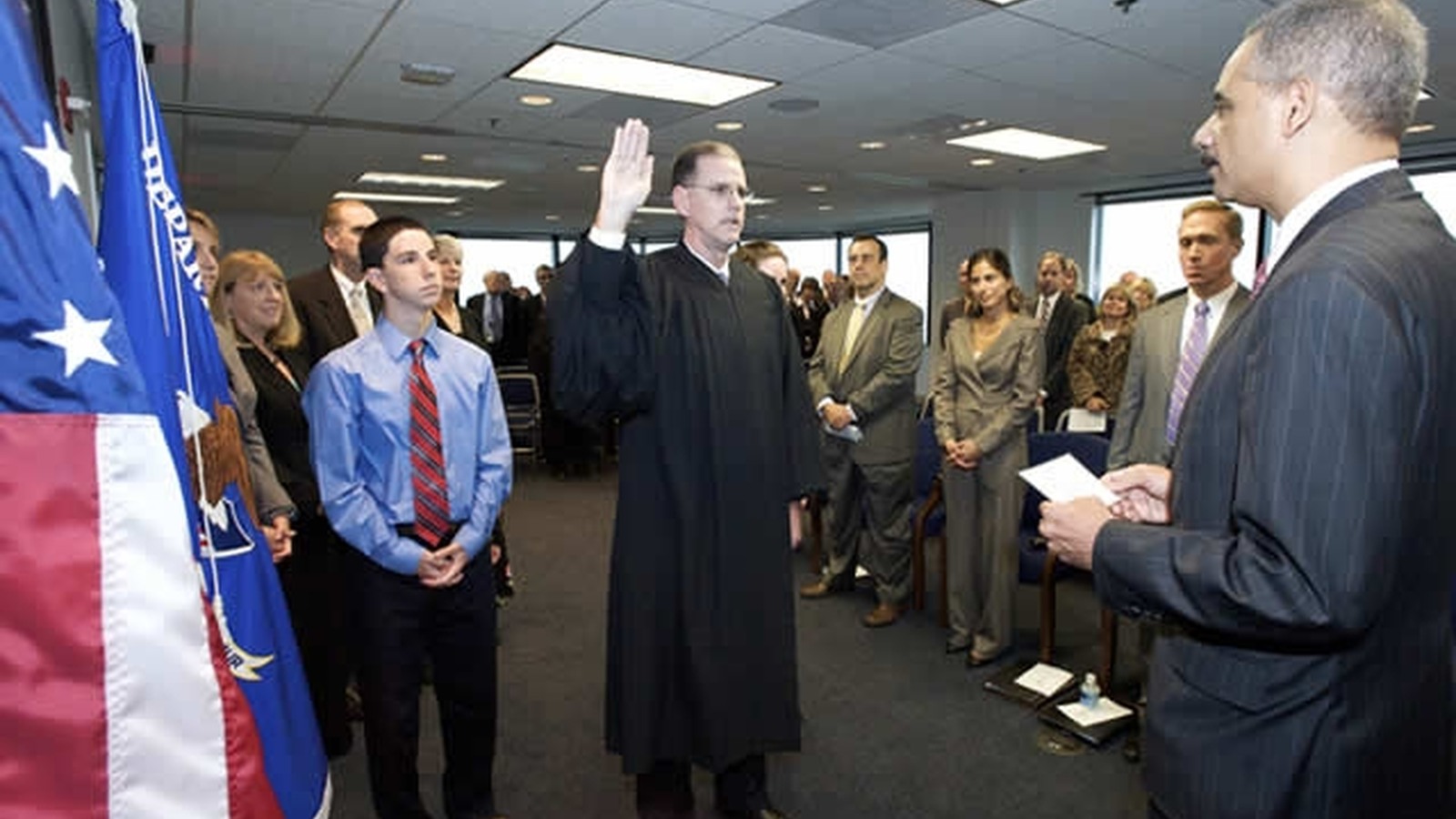
The federal immigration courts hired 192 permanent immigration judges through the third quarter of fiscal 2026, more than in any full year shown in the Executive Office for Immigration Review's published hiring series. The same system still carried fewer than 3.53 million pending cases in May.
Both numbers can be true. EOIR increased its adjudicator ranks after a sharp 2025 decline, while the volume of unresolved work remained measured in millions. A record hiring class changes the court's capacity at the margin; it does not erase the accumulated docket, and a judge count alone cannot explain why pending cases rise or fall.
The more complete picture includes receipts, completions, support staff and hearing infrastructure. It also includes a major operational change: nearly one-third of about 2 million immigration hearings in fiscal 2025 were remote. Remote hearings can reduce travel and make calendars more flexible, but the Government Accountability Office found technology and interpretation limits that can make some proceedings slower.
The useful question is therefore not whether 192 hires will "solve" the backlog. It is whether EOIR can retain and support a larger corps, complete cases faster than new work arrives, and disclose enough comparable data to separate durable capacity from a temporary surge.
Record hiring followed a one-year contraction
EOIR's July 2026 hiring data show 662 permanent immigration judges on board as of June 30. That total includes reemployed annuitant judges and excludes temporary judges. EOIR separately reported 53 temporary immigration judges.
The annual series is unusually volatile. Permanent hires rose from 56 in fiscal 2016 to 133 in 2023, fell to 46 in 2024 and just 14 in 2025, then reached 192 during the first three quarters of 2026. The number on board climbed from 289 in 2016 to 735 in 2024, dropped to 634 in 2025 and recovered to 662 by June 2026.

Those categories require care. The 192 figure excludes sitting judges hired into supervisory immigration-judge positions, while the on-board count includes reemployed annuitants. Temporary judges are reported outside both figures. Dividing a caseload by 662 can illustrate scale, but it cannot measure an individual judge's docket or productivity because some judges supervise, cases differ greatly in complexity and work is distributed unevenly among courts.
The rebound also followed a major loss. Even after the 2026 hires, the permanent/reemployed-annuitant corps remained 73 below the 2024 total. Adding 53 temporary judges puts more adjudicators in courtrooms, but it does not make those appointments equivalent to permanent capacity.
Millions of pending cases remain after a measurable decline
The Justice Department said in May that EOIR had completed more than 1.08 million cases since Jan. 20, 2025, and reduced the pending immigration-court caseload by more than 447,000, from about 4 million to under 3.53 million. Earlier agency releases used different starting points and dates. That is why every backlog number needs an as-of date rather than being treated as a permanent fact.
The decline is significant, but 3.53 million is still more than five thousand pending cases for every permanent or reemployed-annuitant judge on board in June. That rough ratio is not a workload quota. It ignores temporary judges, supervisory duties, support resources, case age and complexity, and cases that may close without a full merits hearing. It simply shows why even historically large hiring cannot rapidly clear the inventory on its own.
Backlog movement is arithmetic before it is interpretation. Pending cases decline when completions and other closures exceed newly filed cases and reopened work. Staffing may raise completion capacity, but referrals, legal rules, docket priorities and case-management policies can change the other side of the equation. EOIR has attributed recent completion gains to both staffing and policy changes. The public record does not isolate how much of the decline came from each factor.
For a durable improvement, completions must remain above incoming work without sacrificing procedural requirements. A one-year reduction does not prove that balance will hold. It does create a measurable baseline for testing whether the 2026 hiring class changes future receipts-versus-completions trends.
Remote hearings became core court infrastructure
The Government Accountability Office analyzed nearly 6 million immigration hearings held from fiscal 2022 through 2025. About 3.8 million, or 63%, were in person. Roughly 2.2 million were remote, and about 1.7 million of those remote proceedings used Webex.
Remote volume grew almost 50% over the four-year period, while total hearings grew faster. Fiscal 2025 alone had about 2 million hearings, nearly 150% more than fiscal 2022. In-person proceedings increased most sharply as courts moved beyond pandemic disruption, so remote hearings became more numerous even as their share fell.
The format also differed by custody status. About 73% of the roughly 731,000 hearings for detained respondents were remote, compared with about one-third of hearings for non-detained respondents. Moving detained respondents can impose security and transportation costs, making remote appearance operationally attractive.
Judges and attorneys GAO interviewed generally described benefits: lower travel costs, greater scheduling flexibility and broader access to private counsel. Those interviews were drawn from selected courts and are not a national satisfaction survey. They identify practical advantages, not a causal estimate of cases completed.
Technology does not remove every bottleneck
Remote capacity is not identical to faster adjudication. EOIR's Webex setup did not provide simultaneous interpretation while preserving the court's required audio recording. When the interpreter and respondent were not together, participants often relied on consecutive interpretation, pausing after each statement. Officials and stakeholders told GAO that process could make a hearing take two or three times as long.
That limitation matters in a system where language services are routine. GAO found hearings for non-English speakers accounted for about 5.7 million of the nearly 6 million proceedings it reviewed, including around 2 million remote hearings. A remote calendar may save travel while consuming more courtroom time if interpretation must be sequential.
Technology quality, access to a private space, judge preferences and the type of hearing also affect whether remote participation is suitable. Bond and detained proceedings were especially likely to be remote. A complex merits hearing may present different needs. EOIR policy leaves substantial discretion with judges, and GAO did not recommend a single remote share for every court.
The evidence supports a narrow conclusion: remote hearings are now a major part of EOIR's operating capacity. It does not support saying they caused the recent backlog decline.
Federal Hiring Data Weekly
Get the biggest federal workforce changes in your inbox.
Subscribe to Federal Hiring Data Weekly for federal hiring trends, salary data, agency movements, and original investigations, with email confirmation before delivery.
The workforce is larger than the judge corps
FederalHiringData's calculation from OPM monthly employment files shows covered EOIR civilian employment rising from 1,372 in January 2015 to 2,230 in June 2026. The recent path moved the other way: the covered workforce fell from 2,696 in December 2024 to 2,230 in June 2026, a decline of 466, or 17.3%.

That series is not a judge count. It includes the covered federal employees coded to EOIR and excludes categories outside the OPM extract. It is useful because judges cannot process a national docket without legal assistants, attorneys, paralegals, analysts, information-technology specialists, clerks and managers.
The FederalHiringData historical USAJOBS archive found 679 distinct EOIR announcements opened from March 2017 through Aug. 11, 2026. Attorneys led the matched series with 216 announcements, followed by 78 in information-technology management and 75 in general legal and kindred administration. Legal assistance and paralegal specialties appeared as well.

Announcement counts are not hires or vacancies. One announcement can advertise multiple positions, and recurring announcements may represent continuing recruitment. The archive nevertheless shows why a judge-only narrative is incomplete: EOIR repeatedly sought the support and systems workforce that makes adjudication possible.
The annual announcement count fell from 73 in 2024 to 49 in 2025 and 21 in the partial 2026 archive through Aug. 11. That does not contradict the record judge class because immigration judges are hired through a specialized process and an announcement is not an accession. It illustrates why separate personnel measures should not be merged.
A larger corps still faces a capacity test
EOIR's 2026 hiring is a concrete expansion after the 2025 decline. The department also swore in a record class of 77 permanent and five temporary judges in May, followed by additional classes. Those appointments create more potential hearing capacity, but the outcome depends on assignment, training, retention and support.
The next useful public measures are straightforward. EOIR can report permanent, temporary, supervisory and reemployed-annuitant judges separately; publish monthly receipts, completions and pending cases with revision dates; disclose judge and support staffing by court; and preserve comparable hearing-medium data. Court openings and closures should be linked to staffing so geographic changes do not disappear inside a national total.
For the public, the most important signal will be whether pending cases continue falling after the hiring surge while case-completion and pending-time measures improve. If the corps expands but support staffing contracts, or receipts again exceed completions, the backlog can resume growing. If completions stay above receipts, the inventory can shrink even though millions remain.
The record hiring class is therefore not the conclusion. It is the beginning of a measurable test.
Related research
Put this finding in context

Data investigationsAugust 18, 2026
Federal FOIA Backlog Hit 339,671 as DHS Carried Nearly Half
The federal FOIA backlog rose 27% in fiscal 2025. DHS held 168,505 pending requests while request volume grew and two different public staffing measures moved downward.

Data investigationsAugust 22, 2026
The Patent Backlog Started Falling. USPTO Is Trying to Hire 1,500 Examiners.
The unexamined patent inventory fell by 60,933 applications as USPTO reached about half of its fiscal 2026 patent-examiner hiring goal.
Receipts and completions are the decisive balance
The pending inventory is a stock; new cases and completions are flows. A larger judge corps can increase the completion side, but DHS referrals determine much of the incoming side. Court closures, reopening, appeals and docket policy can also change the arithmetic. Any claim that hiring "beat" the backlog must show those flows over the same period.
EOIR's historical statistics show why annual context matters. The pending inventory expanded across years in which the judge corps also grew, because incoming work and older unresolved cases outpaced completions. The fiscal 2025 and 2026 decline is notable precisely because that balance changed. It should be evaluated with final, revision-dated tables rather than a press-release snapshot alone.
Geography adds another layer. A national corps of 662 permanent or reemployed-annuitant judges does not show which courts received the 2026 hires, which courts lost experienced judges or where support staff and interpreters were available. New judges assigned to courts with different case mixes will not produce identical completion totals.
The July hiring release includes court assignments for new judges in accompanying biographies. A durable public workforce series should aggregate those assignments while protecting personal information, then link them to local receipts, completions, pending time and hearing volume. That would make it possible to see whether capacity improved where the workload was concentrated.
Until those linked data are available, the responsible conclusion is limited: EOIR added adjudicators rapidly and reported a smaller pending inventory, but the public record does not isolate the share of the decline attributable to hiring.
What the numbers can and cannot show
The available evidence establishes five facts. EOIR hired 192 permanent immigration judges through fiscal 2026's third quarter. It had 662 permanent or reemployed-annuitant judges and 53 temporary judges on board June 30. DOJ reported fewer than 3.53 million pending cases in May. Nearly 6 million hearings occurred from fiscal 2022 through 2025. Remote proceedings accounted for about 2.2 million.
It does not establish that any one policy produced the backlog decline, that remote hearings always improve throughput or that every judge carried an equal share of pending cases. It also does not convert USAJOBS announcements into hires.
Those limitations do not weaken the story. They define it. Immigration-court capacity depends on the relationship among people, incoming work and operating systems. In 2026, EOIR added judges at record speed. The unresolved question is whether the entire institution can turn that hiring surge into sustained adjudicative capacity.
Methodology and limitations
Judge hiring and on-board figures come from EOIR's July 2026 Immigration Judge Hiring release. Pending-caseload and completion figures come from the Justice Department's May 2026 investiture announcement and are reported with the agency's as-of date. EOIR warns that its case data can change as staff update records.
Hearing totals and remote-hearing findings come from GAO-26-108110, published July 15, 2026. GAO analyzed EOIR Case Access System records and excluded records unlikely to represent completed hearings. Its stakeholder interviews and observations were selected for variation and were not nationally generalizable.
FederalHiringData calculated monthly covered EOIR employment from OPM Federal Workforce Data from January 2015 through June 2026. We counted distinct historical USAJOBS control numbers matched to EOIR from March 7, 2017 through Aug. 11, 2026. Announcements are recruitment activity, not positions filled or employees hired. The 2026 announcement total is partial and is not compared as a complete year.
Readers can review EOIR's changing workload and adjudication statistics, browse current federal jobs, compare occupations and read more FederalHiringData investigations.
Continue reading
More from FederalHiringData
Data investigationsAugust 21, 2026
The SPR Fell to a 1982 Low. Its 293 Million Barrels Are Not the Whole Story.
The reserve is historically thin, but inventory alone misses America's larger production base, aging delivery system and incomplete public refill ledger.

Data investigationsAugust 18, 2026
The USS Abraham Lincoln Is Still at Sea. A $192.6 Million Maintenance Plan Is Waiting
The carrier's deployment has outlasted its published maintenance calendar. More than 25,000 archived Navy job announcements show the shore-side labor system around its homeport.

Data investigationsAugust 21, 2026
National Park Visits Rose 13%. September Staffing Fell 17%.
The park system still builds a summer workforce, but same-month OPM data show a thinner permanent base beneath 323 million annual visits.
Federal Hiring Data Weekly
Get the biggest federal workforce changes in your inbox.
Subscribe to Federal Hiring Data Weekly for federal hiring trends, salary data, agency movements, and original investigations, with email confirmation before delivery.