August 26, 2026
NIH Counted 1,096 Data-Science Staff. It Still Cannot Say How Many It Needs.
NIH learned to count a broad data-science workforce, but GAO says it still lacks a staffing requirement as headcount and technical recruiting contracted.
By Evan Mercer
Published August 26, 2026Last edited August 26, 2026

The National Institutes of Health can now count a broad data-science workforce. It still cannot show how many people, with which competencies, it needs.
In December 2023, NIH identified 1,096 employees performing data-science or data-science-related duties across more than 40 occupational series, according to the Government Accountability Office's latest recommendation updates. NIH built an annual data-call process and a workforce dashboard with retirement projections, turnover measures, accession and separation trends, and machine-learning estimates of turnover risk. GAO accepted that progress and closed one recommendation as implemented.
The larger planning problem remained open in July 2026. GAO said NIH still had not demonstrated a data-science staffing requirement, analyzed its workforce to identify competency and staffing gaps, developed metrics to track progress, or required reporting to agency leadership. The agency had a count. It did not have a documented answer to the question that makes the count useful: 1,096 compared with what need?
That measurement gap has become more consequential. NIH's 2025-2030 Strategic Plan for Data Science calls for new software and computational methods, artificial intelligence, a federated biomedical-data infrastructure, better clinical and human-derived data, and a stronger data-science community. Its AI initiatives emphasize data that are ready for machine learning, governance, privacy, bias and interdisciplinary expertise. Those commitments broaden the technical work NIH must fund, perform and oversee.
Meanwhile, public workforce data show a sharp contraction. FederalHiringData found that NIH's covered federal workforce fell from 21,512 employees in January 2025 to 16,460 in June 2026, a decline of 5,052, or 23.5%. A deliberately narrow proxy for public technical and analytical occupations fell from 1,331 to 1,079, down 252, or 18.9%. The official Data Science series fell from 73 employees to 46.
Those figures do not prove NIH is short exactly 252 technical workers. They do something more limited and more useful: they show why a staffing requirement matters. Without one, neither NIH nor the public can tell whether the remaining workforce is sufficient for the agency's expanding data mission, where gaps are concentrated, or whether contractors and outside researchers are covering work that federal employees once performed.
NIH solved the counting problem, not the requirements problem
GAO's 2023 report separated workforce planning into distinct steps. An agency must establish a process, define competency and staffing requirements, analyze its current workforce, identify gaps, act on those gaps, and monitor progress. Completing one step does not complete the sequence.
NIH has made tangible progress since the audit. It created a process to identify staff whose duties include data science even when their formal occupational series says something else. It conducted a data-science competency workshop in May 2024. It issued a reusable position description and job analysis for OPM's Data Science series, GS-1560. It built a hiring toolkit and began using OPM's Agency Talent Portal. Its 2025-2030 strategy gives data infrastructure, AI and workforce development a formal place in the agency's agenda.
But eight of GAO's nine workforce-planning recommendations remained open or partially addressed as of July 2026.
| Workforce-planning question | GAO status in July 2026 | What NIH had demonstrated |
|---|---|---|
| Is there a comprehensive planning process? | Open, partially addressed | NIH documented staff identification, but not a complete recurring process for requirements, gap analysis and leadership reporting. |
| How many data-science staff are needed? | Open | NIH had not demonstrated staffing requirements. Officials said future annual data calls would serve as a needs assessment. |
| Are competency and staffing needs reassessed? | Open, partially addressed | NIH reassessed competencies in a May 2024 workshop, but had not assessed staffing needs. |
| Has NIH identified competency and staffing gaps? | Open | NIH had not demonstrated a completed gap analysis. |
| Are strategies tied to identified gaps? | Open, partially addressed | Hiring tools and position descriptions existed, but GAO said they were not linked to measured gaps. |
| Are progress metrics and leadership reports required? | Open | GAO said NIH had not demonstrated metrics or required leadership reporting. |
| Can NIH track its data-science staff? | Closed, implemented | NIH identified 1,096 employees in more than 40 series and established annual data calls and a workforce dashboard. |
The distinction is not procedural trivia. A count is a supply measure. A staffing requirement expresses demand. A gap analysis connects the two, including the competencies that raw headcount cannot show. NIH's own tracking method recognizes this complexity by looking across more than 40 series rather than treating one job code as the entire workforce.
The public data cannot reproduce that internal duty-based count. It can, however, show the direction and scale of recent workforce change.
A 26-year workforce series ended at its lowest point
FederalHiringData reconstructed NIH's covered employee headcount from Office of Personnel Management records. The series uses September snapshots from 2000 through 2025 and June 2026, the latest public partial-year observation.
NIH had 16,937 covered employees in September 2000. Headcount rose above 19,000 during the expansion following the 2008 financial crisis, then declined for much of the 2010s. It rebounded from 17,692 in September 2019 to 21,097 in September 2024. By September 2025 it had fallen to 17,466. June 2026 brought the count to 16,460, below every September observation in the 2000-2025 series.

The chart is a headcount series, not a full-time-equivalent measure. It covers federal employees represented in OPM's public data, not contractors, fellows who are outside the covered personnel system, university researchers, grantee staff or other people working in the larger NIH-funded biomedical enterprise. The June 2026 point is not a full-year total; it is an onboard snapshot.
Those boundaries are especially important at NIH. GAO reported that about 84% of NIH funding supported the extramural research community in fiscal 2022. The agency said it received roughly 54,000 research-project grant applications a year and funded almost 50,000 new and continuing grants supporting about 300,000 researchers. Those researchers are part of NIH's mission ecosystem. They are not NIH federal employees.
Federal staff still perform work that cannot be measured by grant dollars alone: setting program direction, administering awards, organizing peer review, evaluating data-management plans, operating intramural research, managing repositories and infrastructure, and overseeing privacy, security and scientific integrity. A larger grant portfolio or dataset does not mechanically translate into a specific number of federal data scientists. That is precisely why NIH needs a documented requirements method rather than a ratio invented from public spending.
A narrow proxy shows the same contraction
No public occupational filter can recreate NIH's internal list of employees performing data-science duties. Data work can appear in health science, epidemiology, biology, medicine, grants management and many other series. OPM itself noted when it created series 1560 in 2021 that data-science work may remain in other occupations. A Health Scientist (Data Science), for example, need not be coded as 1560.
FederalHiringData therefore used a narrow, transparent proxy rather than presenting a false comprehensive count. It includes Information Technology Management and its Computer Specialist predecessor, plus Data Science, Computer Science, Statistics, Mathematical Statistics, Mathematics and Operations Research. IT is shown separately because most 2210 employees should not be called data scientists.
The selected proxy grew from 934 employees in September 2000 to 1,278 in September 2024. It reached 1,331 in January 2025, then fell to 1,079 in June 2026.

The similarity between NIH's internal 1,096 count from December 2023 and the public proxy's 1,079 in June 2026 is coincidental, not a valid trend comparison. The internal count covered duties across more than 40 series at one point in time. The proxy covers eight published series, including broad IT work, at another. One cannot be subtracted from the other.
What can be compared is the proxy against itself over time. Every included modern series was smaller in June 2026 than in January 2025.
| Selected occupational series | January 2025 | June 2026 | Change | Change |
|---|---|---|---|---|
| Information Technology Management, 2210 | 943 | 765 | -178 | -18.9% |
| Computer Science, 1550 | 149 | 128 | -21 | -14.1% |
| Mathematical Statistics, 1529 | 84 | 70 | -14 | -16.7% |
| Data Science, 1560 | 73 | 46 | -27 | -37.0% |
| Statistics, 1530 | 66 | 56 | -10 | -15.2% |
| Mathematics, 1520 | 15 | 14 | -1 | -6.7% |
| Operations Research, 1515 | 1 | 0 | -1 | -100.0% |
| Selected proxy total | 1,331 | 1,079 | -252 | -18.9% |

Series 2210 accounted for 178 of the 252-person decline. That does not show that 178 biomedical-data specialists left; 2210 covers a wide range of technology work. The 27-person decline in series 1560 is more specific, but the series is new and does not contain everyone doing data science. The cautious conclusion is that both the broad technology base and several narrow analytical occupations became smaller.
Hiring almost stopped while separations accelerated
Federal Hiring Data Weekly
Get the biggest federal workforce changes in your inbox.
Subscribe to Federal Hiring Data Weekly for federal hiring trends, salary data, agency movements, and original investigations, with email confirmation before delivery.
OPM personnel-action files show how abrupt the transition was. In the selected proxy, NIH recorded 189 accessions and 53 separations during calendar 2024. In 2025, it recorded 10 accessions and 228 separations. During January through June 2026, it recorded one accession and 32 separations.

These are personnel actions, not necessarily unique people. An accession can reflect an appointment action and a separation can reflect a departure action; neither identifies the person's project, competency or replacement status. Still, the reversal is large enough to explain why the public headcount fell. The selected workforce did not merely drift downward through ordinary turnover. Recorded separations greatly exceeded incoming actions during 2025.
The remaining workforce also has an age profile that makes planning more than a one-year issue. In June 2026, 471 of the 1,079 employees in the proxy were 55 or older, or 43.7%. Fifty were younger than 35. Age does not establish retirement intent, and seniority can be an asset in scientific and institutional work. It does mean that NIH needs a recurring view of likely departures and skill transfer, not a one-time inventory.
Most of the proxy, 759 employees, was in OPM tenure group 1, covering career employees or appointments carrying no tenure restriction or condition. Another 157 were career-conditional or serving a probationary or trial period, and 156 were in term, temporary, provisional or other tenure-group-3 appointments. Those categories describe appointment status, not skill level or length of service.
NIH's internal Workforce Analytics Workbench is designed to examine retirement projections, turnover and accessions. GAO's open recommendation asks the agency to connect those supply measures to an actual recurring needs assessment. The public record does not show that connection.
USAJOBS recruiting fell before a partial 2026 return
FederalHiringData also examined distinct NIH announcements in the same selected occupational series. To avoid comparing a partial 2026 with full earlier years, each bar covers announcements opened from Jan. 1 through Aug. 26.
The archive shows 148 selected technical announcements in that window during 2024. The count fell to 11 in 2025 and rose to 20 in 2026. The 2026 figure is above the prior year's low but remains 86.5% below the 2024 same-window count.

An announcement is not a vacancy, hire or person. One posting can advertise multiple positions, locations or grades; another can be canceled without a selection. The archive measures public recruiting activity, not staffing outcomes. It nevertheless supplies an independent sign that the hiring channel narrowed sharply during the same period that separations exceeded accessions.
The titles also show how NIH recruiting language evolved. Explicit "Data Scientist" titles were absent in the same-window 2018 archive, appeared after OPM developed the new series, and reached 26 announcements in 2024. There were two in 2025 and two through Aug. 26, 2026. Statistician and bioinformatics or computational titles also fell to zero in the keyword series during the last two windows.

The title chart is intentionally narrower than the occupational chart. A posting can recruit a statistician without putting "statistician" in the title, and a scientist can perform computational work under another title. It measures language visible to applicants, not the whole recruiting portfolio.
There are signs of renewed activity. NIH posted two Data Scientist announcements in March 2026 and an IT Specialist (Data Management) announcement in July. The agency's reusable GS-1560 position description and hiring toolkit may make targeted recruiting easier. But a handful of announcements cannot show whether the agency is filling the competencies and staffing levels it needs, because those needs remain undocumented in the material GAO reviewed.
The mission became more data-intensive, not less
Related research
Put this finding in context
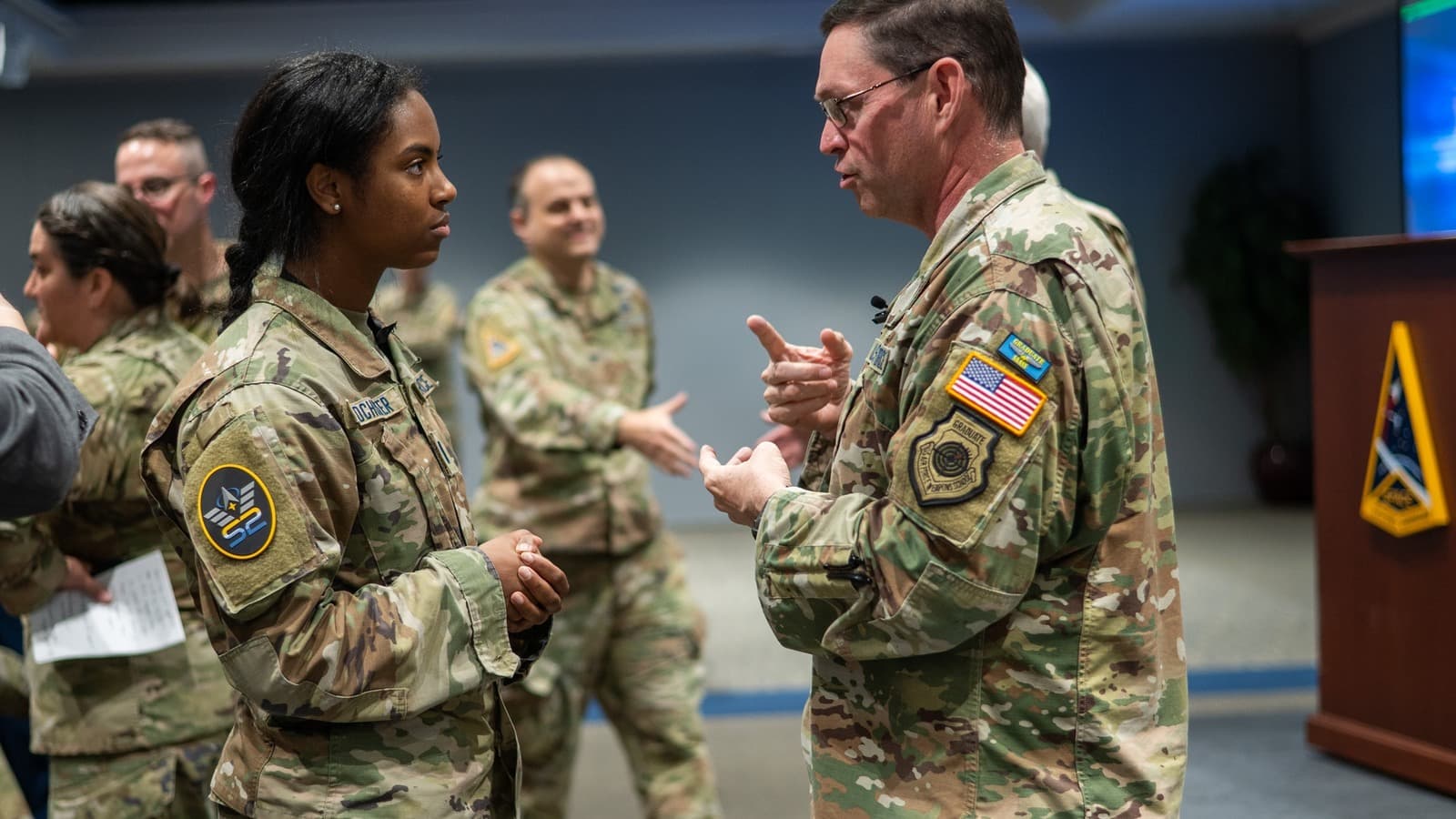
Data investigationsAugust 22, 2026
Space Force Filled 75% of Its Documented Need. Now It Says Personnel Must Double.
A GAO review found 13,509 assignments against 18,002 documented requirements as the service planned to double personnel without a complete workforce ledger.
Data investigationsAugust 18, 2026
FEMA's Public Workforce Count Fell 22% as GAO Warned of Readiness Risks
FEMA had 5,793 fewer covered civilian employees in June 2026 than in January 2025. GAO says the agency cut staff without the workforce planning needed to assess mission capacity.
NIH's data agenda is broader than a list of software projects. The 2025-2030 strategy covers genomic, transcriptomic, proteomic, metabolomic, imaging, clinical-trial, electronic-health-record, sensor, wearable, geospatial, survey and observational data. It calls for data that are findable, accessible, interoperable and reusable; sustainable repositories and workspaces; privacy and consent protections; responsible AI; and a federated research-data infrastructure.
Each layer creates different federal workforce demands. A statistician evaluating research design is not interchangeable with an engineer securing cloud infrastructure. A program officer assessing a data-management plan does not perform the same work as a bioinformatician building a genomic pipeline. A privacy specialist, contracting officer, grants-management specialist and scientific-review officer may all be necessary to move one data-intensive program from an idea to a governed federal activity.
This is why counting everyone in series 2210 as a data scientist would be misleading. It is also why counting only series 1560 would miss much of the work. NIH's more than 40-series inventory is a sensible response to a mission that crosses occupational boundaries.
The agency's Office of Data Science Strategy also works through partnerships with institutes, other agencies, universities, industry and philanthropy. NIH's cloud and contractor relationships can provide specialized capability and flexible capacity. Public contract dollars, however, cannot be converted into contractor headcount or treated as a direct substitute for federal expertise. Contract descriptions do not consistently identify every worker or assignment, and federal employees still must define requirements, manage awards, protect data and judge performance.
GAO's original report highlighted another federal responsibility: NIH staff administer tens of billions of dollars in annual grants. Program and review staff need enough data-science knowledge to assess applications and data-management plans, not merely to conduct intramural analysis. A workforce plan therefore has to address technical specialists and the data literacy of employees whose formal occupation is not technical.
Progress is real, but adequacy remains unknowable
The strongest counterargument to a story of planning failure is NIH's documented progress. It built the tracking process GAO requested. It found 1,096 people performing relevant duties. It created a dashboard. It held a competency workshop. It developed a standard data-scientist position description and recruitment tools. It issued a new five-year strategic plan and continues operating AI, data-sharing and infrastructure initiatives.
Those actions matter. They mean NIH is not starting from zero, and the public evidence does not establish that biomedical research systems are failing because of a staff shortage. FederalHiringData found no defensible public measure linking the recent headcount decline to slower grants, repository outages, degraded scientific review or weaker research outcomes. It would be wrong to manufacture that causal chain.
But the same progress sharpens the unresolved question. If NIH can identify supply, track turnover and forecast departures, it should be able to state the requirement against which those measures are judged. GAO said in July that it still could not.
The 1,096 figure is therefore both an achievement and a warning about false precision. It tells NIH who may be doing the work. It does not tell Congress, agency leadership or the public whether 1,096 was enough in 2023, whether 1,079 people in a narrower public proxy is enough now, or which competencies are most exposed after the 2025 contraction.
NIH's data-science strategy promises to measure progress through implementation tactics and evaluation. Workforce planning needs the same discipline. The next credible public milestone is not another broad statement that data science matters. It is a documented staffing and competency requirement, a repeatable gap analysis, and a report showing what NIH did about the result.
Until then, NIH can count part of its data-science workforce. It cannot answer the harder question the count was supposed to resolve.
Methodology and limitations
FederalHiringData used OPM legacy FedScope employee-level files for September 2000 through September 2014 and OPM Federal Workforce Data for September 2015 through September 2025 and June 2026. NIH is identified by agency subelement HE38. Headcount represents covered onboard employees, not full-time-equivalent staffing.
The selected proxy includes series 2210 and predecessor 0334, plus 1515, 1520, 1529, 1530, 1550 and 1560. It excludes broad scientific series that could include data-science duties because including every biologist or health scientist would overstate the workforce. It also omits genuine data-science staff classified elsewhere. The proxy does not identify competencies, assignments, contractors, fellows or grantee researchers.
Personnel-action counts are not necessarily unique people. Historical recruiting uses distinct USAJOBS control numbers and the same Jan. 1-Aug. 26 window in 2018-2026. FederalHiringData historical USAJOBS coverage begins in March 2017. Announcements are not vacancies, applications, selections or hires.
GAO recommendation statuses were rechecked on Aug. 26, 2026. The analysis does not estimate a staffing requirement, convert grant funding into workload, or infer operational harm that public performance data cannot establish.
Sources and further reading
- GAO-23-105594: Data Science — NIH Needs to Implement Key Workforce Planning Activities
- NIH Strategic Plan for Data Science, 2025-2030
- NIH artificial-intelligence initiatives
- NIH Office of Data Science Strategy
- OPM Federal Workforce Data
- FederalHiringData historical job research
- Browse federal workforce statistics
- Read more FederalHiringData investigations
Continue reading
More from FederalHiringData
Data investigationsAugust 25, 2026
CDC Lost 3,636 Covered Employees. Health Science Took the Largest Hit.
CDC's covered workforce fell 28% after December 2024. Health-science and public-health program roles led the losses, while recruiting nearly stopped.

Data investigationsAugust 24, 2026
NOAA Lost 2,630 Employees. Its Technical Workforce Was Still Thinner in June 2026.
NOAA's covered workforce fell 21.1% from December 2024 through June 2026, with broad losses across science and technical occupations and only selective rebuilding.

Data investigationsAugust 24, 2026
TSA Has More Than 1,300 Aviation Inspectors. Its Cybersecurity Role Map Is Outdated.
TSA added aviation cybersecurity requirements as its broad inspection and compliance workforce contracted and its public cyber role map remained outdated.
Federal Hiring Data Weekly
Get the biggest federal workforce changes in your inbox.
Subscribe to Federal Hiring Data Weekly for federal hiring trends, salary data, agency movements, and original investigations, with email confirmation before delivery.