August 29, 2026
Recent-Graduate Job Posts Fell 95%. Only 91 Had Returned in 2026
Dedicated Recent Graduate job postings fell from 700 in 2024 to 36 in 2025. Ninety-one had returned through Aug. 26, 2026, concentrated in July and August.
Published August 29, 2026Last edited August 29, 2026

The federal government's most visible on-ramp for new graduates almost vanished from USAJOBS in 2025.
FederalHiringData found 700 job announcements explicitly recruiting Recent Graduates in 2024. In 2025, it found 36. That was a 94.9% decline in one year.
The program has begun to reappear. Through Aug. 26, 2026, agencies had posted 91 announcements with Recent Graduate or Recent Grad in the title. That was more than twice the total for all of 2025, but still only 13% of the 2024 count. More than half of the 2026 postings opened in July or August.
The result is not a full rebound. It is a narrow, late return in a recruitment channel designed for people near the start of their careers.
The distinction matters because a loose search produces a very different number. The archive contains 26,440 announcements that listed the USAJOBS Recent graduates audience path. Only 6,211 of those also used Recent Graduate language in the title. Many of the rest were ordinary, specialist or senior jobs open to several groups, including Recent Graduates.
This investigation uses the stricter title measure to answer an applicant-facing question: how often did agencies visibly advertise a job as Recent Graduate recruiting?
A 95% collapse, followed by a partial return
FederalHiringData reviewed distinct USAJOBS control numbers opened from March 1, 2017 through Aug. 26, 2026. An announcement entered the main cohort only when its title explicitly contained Recent Graduate, Recent Graduates, Recent Grad or Recent Grads.
That rule identified 8,109 announcements. The annual series peaked at 1,256 in 2018, moved unevenly afterward, reached 1,127 in 2022 and then fell to 700 in 2024. The 2025 count of 36 was not a continuation of an ordinary decline. It was a break in the series.
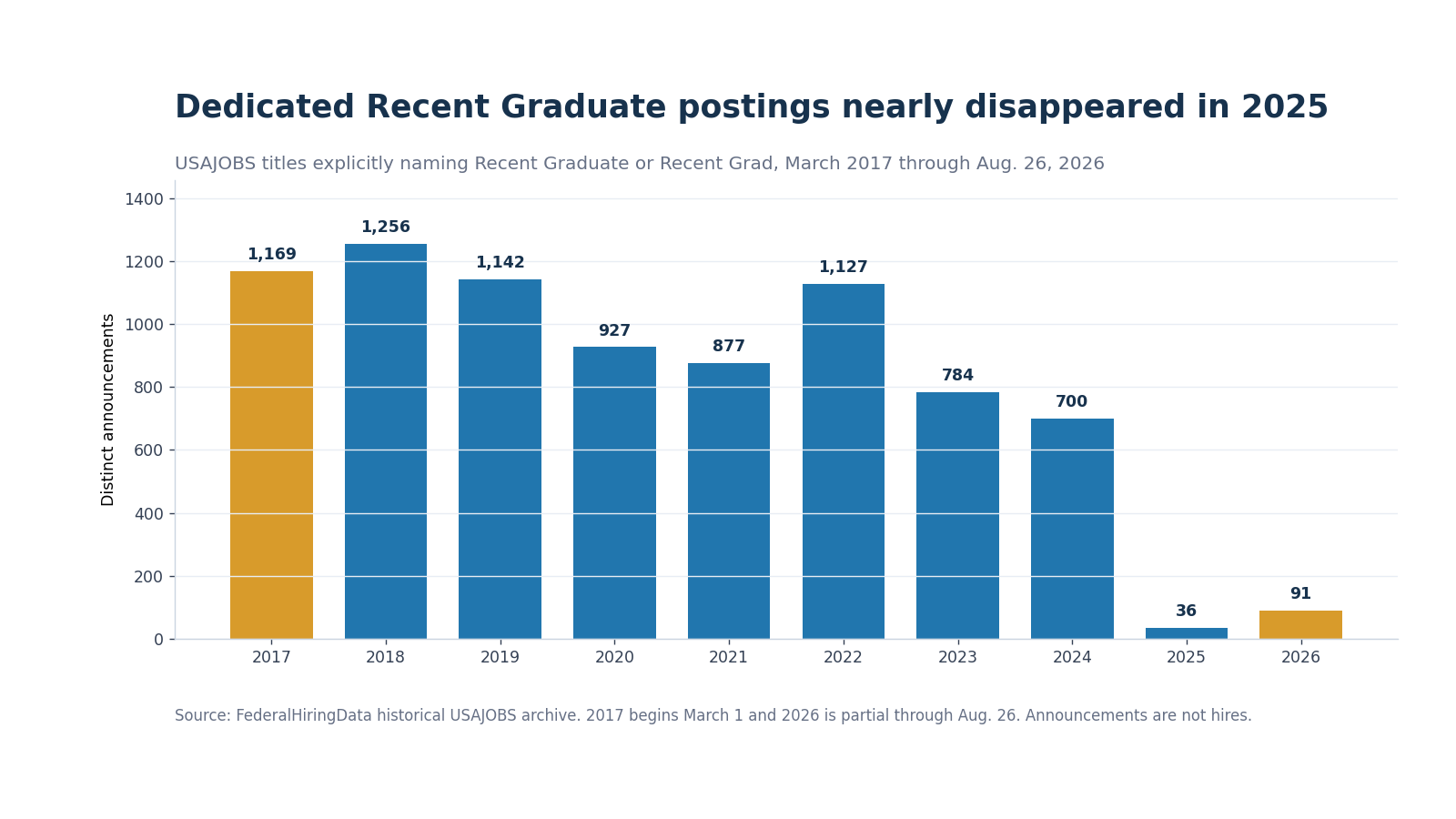
The 2026 count needs two labels. It is partial, and it is a posting count rather than a hire count. Ninety-one announcements through Aug. 26 cannot be compared as a complete year against 700 in 2024. It can establish that agencies had already surpassed 2025's exceptionally low total.
The monthly pattern makes the tentative return clearer. Only two qualifying announcements opened in January 2026, eight in February and 18 in March. April produced four. May produced none. June produced two.
Then 31 opened in July and 26 through Aug. 26. Those two months supplied 57 of the year's 91 postings.
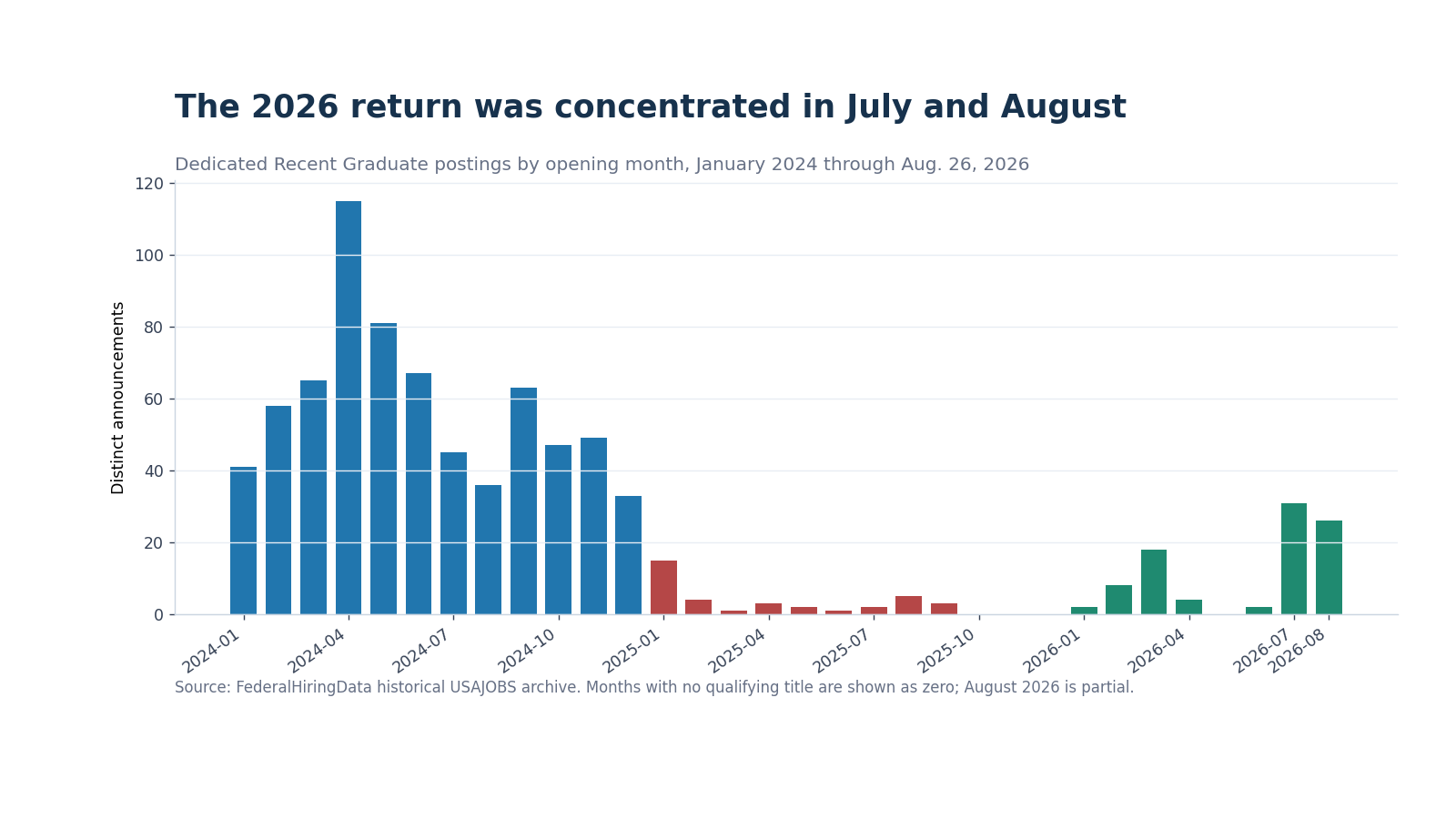
That concentration is encouraging to applicants who saw few openings early in the year. It is not enough to establish that the program has returned to its old scale. If the 2026 total stopped at 91, it would remain 87% below the 2024 full-year count. Even a strong final four months would begin from a deep hole.
Why the hiring-path filter can overstate dedicated recruiting
USAJOBS uses hiring paths to tell applicants which groups may apply. The developer code for Recent graduates is `GRADUATES`. The generic Students path uses a separate `STUDENT` code.
Those fields are valuable for finding opportunities, but they are not a clean measure of a dedicated Recent Graduates campaign. FederalHiringData found:
| Classification | Distinct announcements |
|---|---|
| Title explicitly named Recent Graduate or Recent Grad | 8,109 |
| Explicit Recent graduates audience path | 26,440 |
| Both the title and the path | 6,211 |
| Title only | 1,898 |
| Audience path only | 20,229 |
The 20,229 path-only announcements are the reason this article does not use 26,440 as its headline series. Classification audits found the path on jobs with high advertised grades, specialized experience and many other eligibility paths. A Recent Graduate might have been eligible for some of those jobs, but the announcement was not necessarily an entry-level recruiting vehicle.
The reverse mismatch also matters. Another 1,898 announcements explicitly recruited Recent Graduates in the title without a stored Recent graduates path signal. A path-only analysis would miss them.
The title rule favors precision over completeness. An agency can run a qualifying Recent Graduates appointment without putting the phrase in the title. That means 8,109 should not be treated as every use of the authority. It is the best bounded count of announcements that visibly presented themselves to applicants as Recent Graduate recruiting.
Recent Graduates, internships and PMF are not interchangeable
Pathways is an umbrella, not one program.
The Recent Graduates Program generally serves people who completed a qualifying degree or certificate within the previous two years. USAJOBS says qualifying veterans may receive a longer eligibility period, up to six years after completion, when military service obligations prevented them from applying within the ordinary window.
Internships serve current students and other eligible participants in qualifying educational programs. The Presidential Management Fellows Program is a separate, centrally administered leadership-development route for people with advanced degrees.
FederalHiringData kept those title-defined cohorts separate. The archive contained 26,362 Student Trainee, Intern or Internship announcements and 209 Presidential Management Fellow or PMF announcements during the same broad period. Neither count was added to the 8,109 Recent Graduate total.
That separation also keeps this analysis distinct from a broader early-career target. OPM's governmentwide hiring plans may group interns, Recent Graduates, apprentices and other entry routes. A broad policy target can be useful without measuring the same thing as a title-defined USAJOBS recruitment series.
Social Security built the largest visible on-ramp
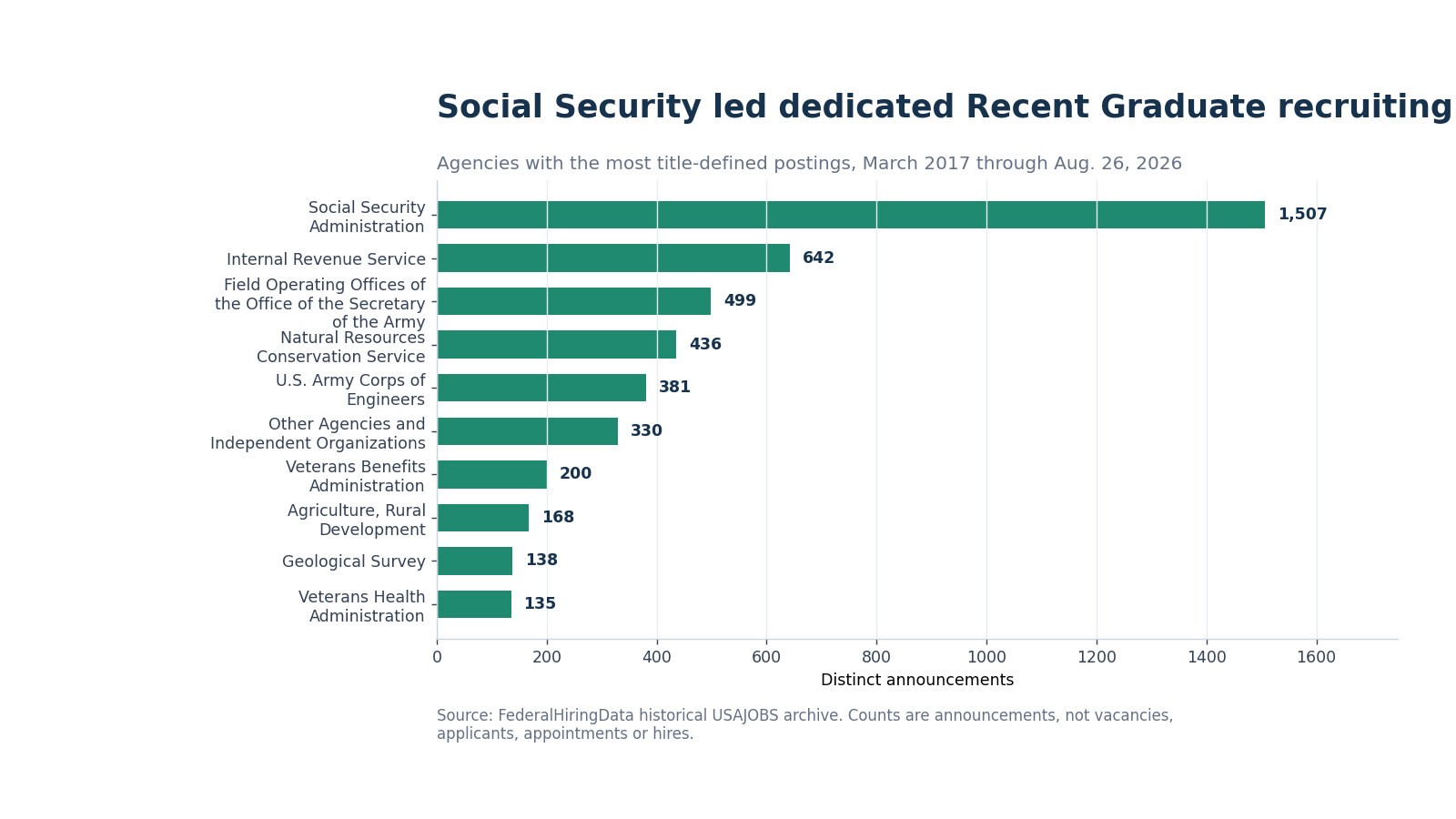
Social Security Administration led the archive with 1,507 dedicated Recent Graduate announcements. It accounted for 18.6% of the title-defined cohort.
Internal Revenue Service followed with 642. Field Operating Offices of the Office of the Secretary of the Army had 499, Natural Resources Conservation Service had 436, and U.S. Army Corps of Engineers had 381.
Related research
Put this finding in context

Hiring processAugust 29, 2026
2,158 Active Federal Job Posts Had a Clear Degree Mandate. Thousands More Let Experience Count.
A crosswalk of 13,613 active job postings and OPM qualification standards found 2,158 clear degree mandates, concentrated in medicine and licensed professions.

Data investigationsAugust 26, 2026
State Plans to Close Five Overseas Posts. They Employ Just Six U.S. Direct Hires.
Five planned State Department post closures cover six U.S. direct hires, while the agency's OPM-covered Civil Service workforce fell by 3,239.
| Agency | Dedicated Recent Graduate announcements |
|---|---|
| Social Security Administration | 1,507 |
| Internal Revenue Service | 642 |
| Army Secretary field operating offices | 499 |
| Natural Resources Conservation Service | 436 |
| U.S. Army Corps of Engineers | 381 |
| Other Agencies and Independent Organizations | 330 |
| Veterans Benefits Administration | 200 |
| Agriculture, Rural Development | 168 |
| U.S. Geological Survey | 138 |
| Veterans Health Administration | 135 |
The ranking describes announcement behavior over more than nine years. It is not a current-agency leaderboard and does not count people hired.
The agencies active in the 2026 title cohort were different. Bonneville Power Administration led with 10 postings through Aug. 26. Defense Information Systems Agency had seven. Department of Energy Headquarters and the Census Bureau had five each. National Telecommunications and Information Administration, Defense Finance and Accounting Service, and the Executive Office for U.S. Attorneys each had four.
Those are small numbers. They show that the return was spread across organizations rather than driven by a restoration at Social Security or IRS, the two historical leaders.
Social insurance, contact work, analysis and IT led the occupations
The archive's occupational mix reflects the agencies that used the program most heavily.
Series 0105, Social Insurance Administration, led with 784 announcements. Series 0962, Contact Representative, followed with 600. Management and Program Analysis had 440, Information Technology Management had 378, and Miscellaneous Administration and Program had 267.
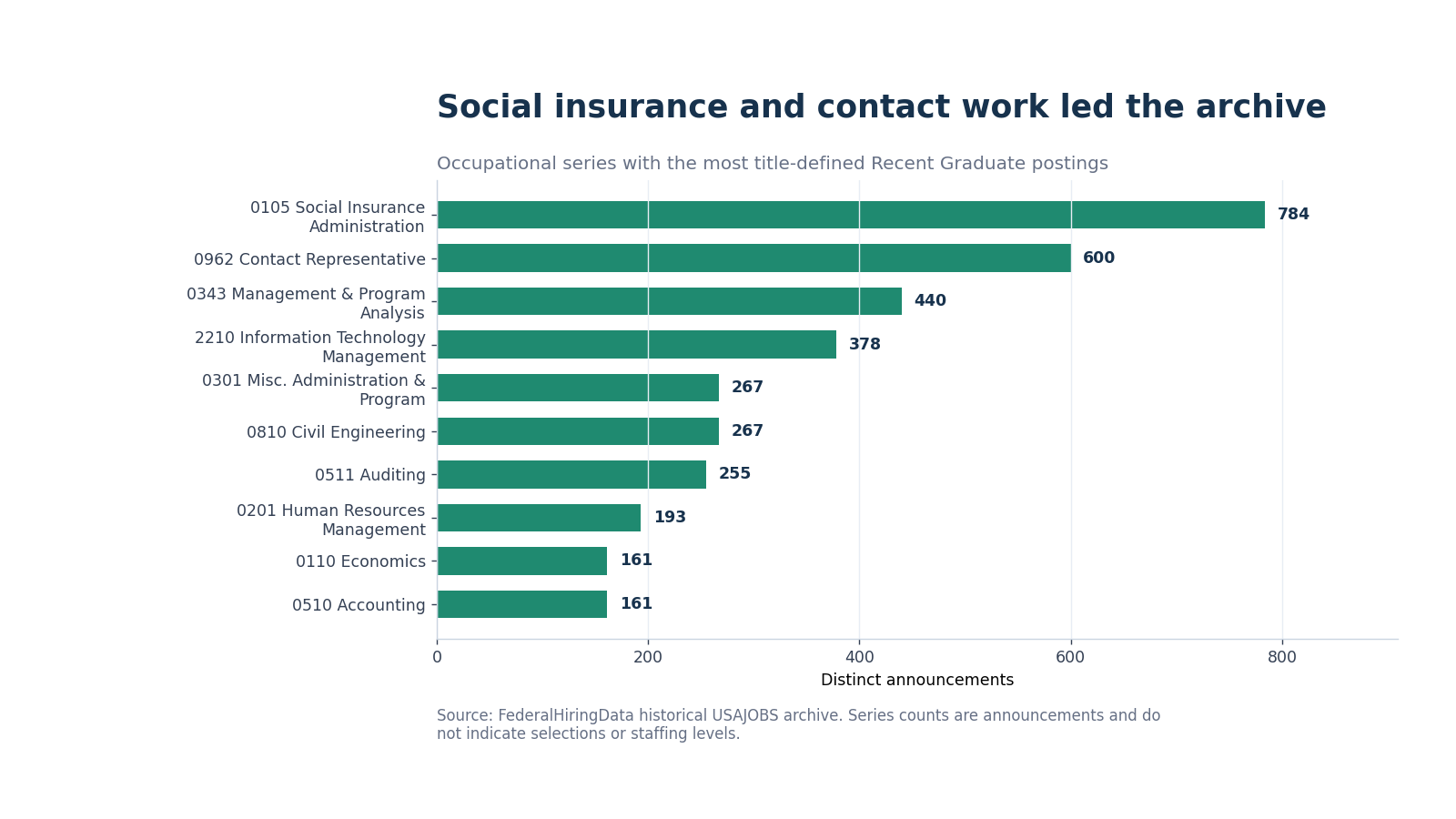
The top 15 also included Civil Engineering, Auditing, Human Resources Management, Economics, Accounting, Inspection and Enforcement, Loan Specialist, Budget Analysis, Contracting and General Engineering.
That breadth is important for applicants. Recent Graduate recruiting was never limited to generic office support. The archive contains technical, analytical, financial and engineering entry routes alongside public-contact and benefits work.
In the partial 2026 cohort, Information Technology Management led with 12 announcements and Management and Program Analysis had eight. That is a change from the historical mix, but the sample is too small to declare a durable occupational shift.
An occupational-series count is not a vacancy count. One announcement can cover several jobs, locations or grades. It also does not show how many people applied, were referred or were selected.
GS-7 was the most common advertised grade
Recent Graduates jobs were concentrated near the early-career end of the General Schedule, but the archive was not limited to one entry grade.
GS-7 alone was the leading advertised low/high combination with 1,825 announcements. GS-7-to-9 followed at 1,483. GS-5-to-7 had 1,251, GS-9 alone had 1,045, and GS-5-to-9 had 726.
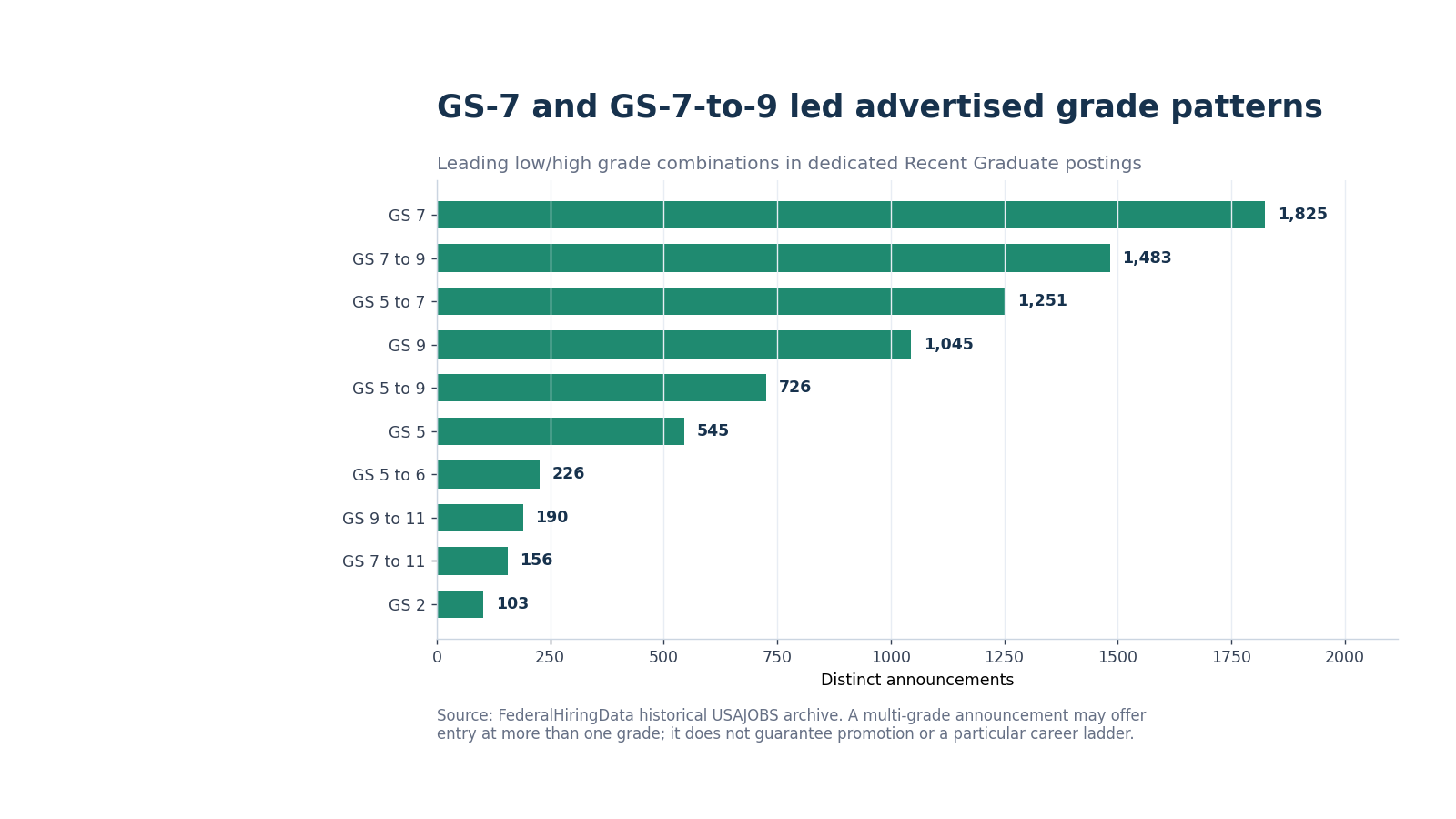
A multi-grade range can mean an agency is willing to select at more than one grade. It does not, by itself, promise a career ladder or promotion to the highest listed grade. Applicants need to read the promotion-potential and qualification language in the announcement.
The partial 2026 cohort retained the early-career pattern. Of 91 postings, 88 started at GS-9 or below and 52 advertised more than one grade.
Annual-pay records showed a median advertised minimum of $57,736 and a median advertised maximum of $91,815 in 2026. Those medians use only the 91 announcements explicitly labeled as annual pay. Hourly records are excluded rather than converted with an assumed schedule.
An advertised maximum is not guaranteed compensation. Actual starting pay can depend on grade, step, locality, qualifications, special rates and the agency's pay-setting decision.
The practical conditions became tighter after 2024
The visible on-ramp changed in more than volume.
| Opening year | Announcements | Median days open | Open 7 days or less | Started at GS-9 or below | Advertised multiple grades | Median annual pay range |
|---|---|---|---|---|---|---|
| 2024 | 700 | 14 | 151 | 682 | 411 | $54,728-$88,926 |
| 2025 | 36 | 8 | 10 | 32 | 14 | $57,164-$89,853 |
| 2026 through Aug. 26 | 91 | 10 | 17 | 88 | 52 | $57,736-$91,815 |
The typical 2026 posting remained open longer than the 2025 median, but four days less than in 2024. Seventeen of 91 were open seven days or less.
Federal Hiring Data Weekly
Get the biggest federal workforce changes in your inbox.
Subscribe to Federal Hiring Data Weekly for federal hiring trends, salary data, agency movements, and original investigations, with email confirmation before delivery.
FederalHiringData also audited the closing mechanism in current enriched Job records. All 91 title-defined rows with that field available had a known mechanism; 31 used an applicant cutoff. That is 34.1% of the current enriched sample.
An applicant cutoff can close an announcement once the agency receives a stated number of applications, even if the listed closing date is later. The 31-record count does not supply the numeric caps and should not be projected over the entire historical archive, where the enriched field is not uniformly available.
For applicants, the lesson is straightforward: preparing a resume and transcript after a good announcement appears can be too late. A seven-day window or an application cap rewards people who already have documents ready.
What the 2026 return looked like on USAJOBS
At the Aug. 29 production capture, 12 title-defined Recent Graduate announcements were marked active. The sample below shows the range of roles. Status and closing dates can change, so readers should confirm every opportunity on USAJOBS or through the current FederalHiringData jobs search.
| Job at capture | Agency | Series | Advertised grades | Advertised annual pay |
|---|---|---|---|---|
| Financial Analyst (Auditor) Recent Grad | U.S. International Trade Commission | 0511 | GS-9 | $70,623-$91,815 |
| Computer Scientist (Cyber) - CES Recent Graduate | Defense Information Systems Agency | 1550 | GS-7 to 13 | $57,736-$158,322 |
| Recent Graduate - Auditor | Office of Inspector General | 0511 | GS-7 | $53,361-$82,007 |
| Program Support Specialist (Recent Graduate) | Department of Energy Headquarters | 0301 | GS-7 to 9 | $50,460-$86,461 |
| Investigative Analyst (Recent Graduate) | Federal Aviation Administration | 1805 | FAA G band | $68,120-$105,595 |
| Paralegal Specialist - Pathways Recent Graduate | Executive Office for U.S. Attorneys | 0950 | GS-7 to 9 | $50,460-$89,703 |
| Public Utilities Specialist (Rates) (Recent Grad) | Bonneville Power Administration | 1130 | GS-9 | $66,505-$86,461 |
| Recent Graduate - Industrial Hygienist | Occupational Safety and Health Administration | 0690 | GS-7 to 9 | $50,460-$92,541 |
The sample should not be read as a forecast of the program. It shows what the tentative return looked like: cyber, auditing, program support, investigation, legal support, utilities and occupational health rather than one governmentwide intake campaign.
OPM appointment records show a separate contraction
USAJOBS announcements do not show who was hired. To test whether the posting collapse had a parallel in workforce records, FederalHiringData queried its local OPM Federal Workforce Data warehouse.
The OPM extract identifies aggregate new hires in the `RECENT GRAD` Pathways group. It recorded 2,544 in fiscal 2024 and 810 in fiscal 2025, a 68.2% decline. Fiscal 2026 had 215 through June.
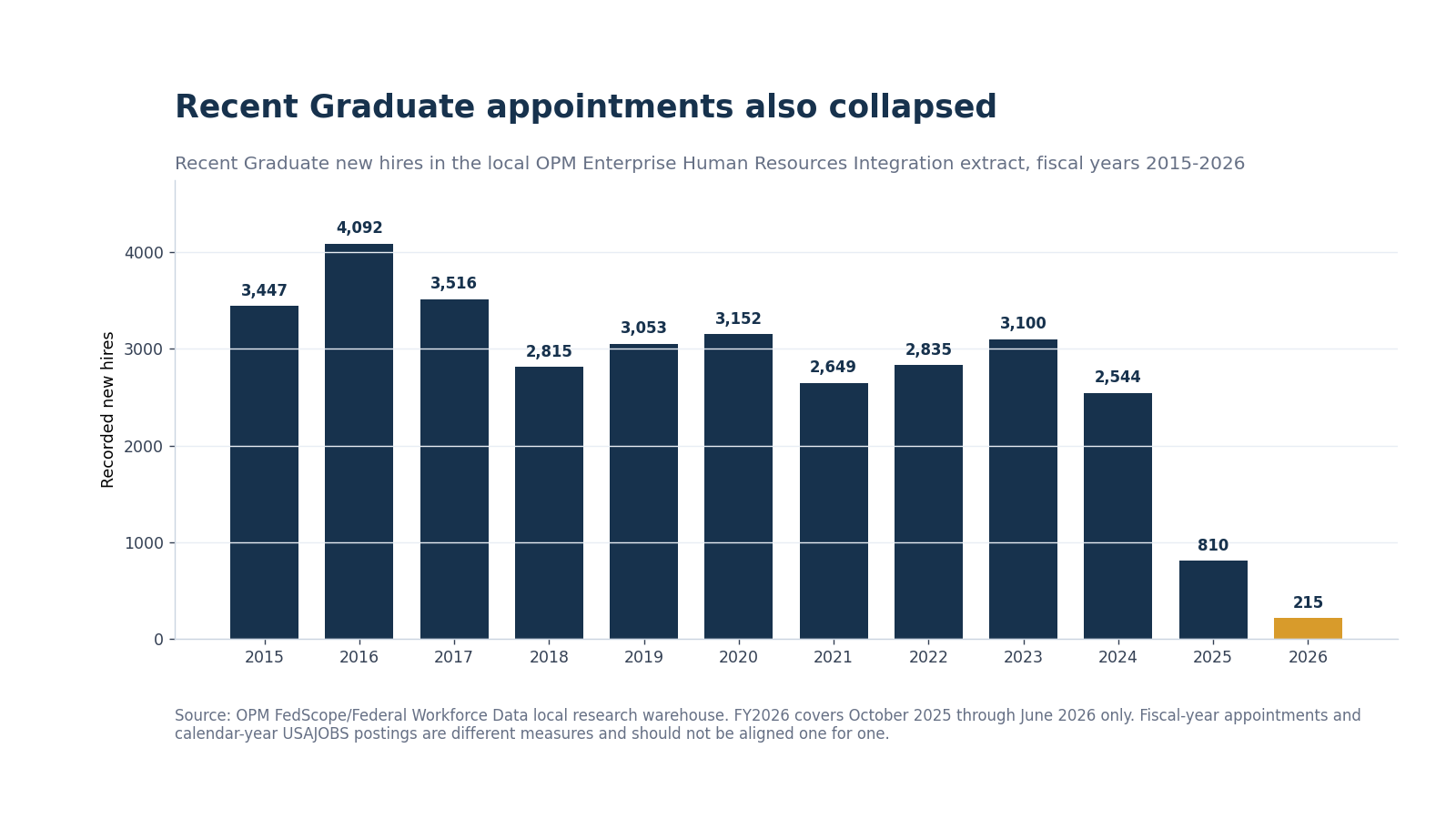
The OPM and USAJOBS series corroborate contraction, but they do not measure the same event.
The announcement series uses calendar opening dates. The OPM series uses fiscal-year personnel actions. An announcement can cover more than one vacancy. A person can enter through a mechanism not represented by one public title. Time can pass between posting and appointment. FederalHiringData therefore does not divide hires by announcements or align the two curves one-for-one.
The OPM series begins in fiscal 2015 because the earlier Pathways classification in the local extract shows a coverage break. Fiscal 2026 is partial through June. Those boundaries prevent an apparently neat but misleading comparison.
GAO reported a broader decline across the Pathways programs and said OPM had not determined what drove agency-level fluctuations. GAO's measure includes more than title-defined Recent Graduate recruiting, so it provides context rather than the denominator for this article.
The program offers development, not an automatic permanent job
The Recent Graduates Program is designed as a developmental appointment. OPM says appointments generally last one to two years and include training, a development plan and career-development support.
OPM's training guidance says agencies must assign a mentor within 90 days and establish an individual development plan within 45 days. Recent Graduates generally receive at least 40 hours of formal interactive training for each program year.
Successful participants may be eligible for conversion to a term or permanent position, depending on the program, agency, performance and governing rules. Conversion is not automatic. An announcement's advertised grade range also does not independently promise conversion or promotion.
Eligibility is separate from qualification. Being within the Recent Graduate window means an applicant may use the path. The person still has to meet education, experience and specialized requirements in the announcement.
How applicants can use the narrow return
The data suggests a practical search routine.
Use both the path and title terms. Start with the USAJOBS Recent graduates filter, but also search for `recent graduate`, `recent grad` and `Pathways`. The 1,898 title-only announcements in the archive show why either method alone can miss opportunities.
Check the eligibility clock. Most applicants must have completed a qualifying degree or certificate within the previous two years. Qualifying veterans may receive up to six years when service obligations prevented timely application. The announcement and governing rules control individual eligibility.
Prepare the record before the posting arrives. Keep the federal resume, transcripts, proof of degree completion and any required eligibility documents ready. In 2026, the median posting stayed open 10 days; nearly one in five stayed open no more than seven days.
Read the opening mechanism. An applicant cap can end the window early. Submit a complete application rather than a fast but incomplete one.
Treat the grade span carefully. A GS-7-to-9 posting can permit selection at multiple grades. It does not guarantee GS-9 entry or a promotion schedule. Read promotion potential, qualification standards and specialized experience.
Search beyond generic administration. Information technology, auditing, engineering, economics, contracting, budget and enforcement series all appear in the archive. A degree-aligned occupational series can be more useful than searching only `Recent Graduate` without a field.
Verify whether the job is still open. This article uses a historical archive and a time-stamped current sample. It does not promise that any listed announcement remains active.
Methodology and limitations
FederalHiringData queried its historical USAJOBS archive and current Job table read-only. The unit was one distinct control number. The archive begins March 1, 2017, making that year partial. The 2026 series ends Aug. 26.
The main classifier required Recent Graduate or Recent Grad language in the title. It excluded generic Students labels and kept title-defined internships and PMF announcements separate. The explicit Recent graduates audience path was audited independently because it can appear on postings that are not dedicated entry recruiting.
Agency and occupation rankings count distinct announcements in each group. Grade pairs use advertised low and high grades. Annual salary medians include only records whose source interval explicitly says annual or per year; 57 hourly records in the full cohort were not annualized. Location totals are announcement-location pairs and are not additive because one announcement can list several places.
The analysis cannot observe applications, referrals, interviews, selections, appointments or hires from USAJOBS fields. It cannot determine why agencies reduced or restored postings. It does not claim the 91 partial-year announcements represent a full governmentwide recovery.
The OPM comparison uses aggregate `RECENT GRAD` new-hire records from fiscal 2015 through June 2026. OPM fiscal years and USAJOBS calendar years differ, and neither series should be added to or divided by the other.
The hero shows a prospective civilian hire speaking with a 502nd Civil Engineer Group representative at a Joint Base San Antonio recruiting fair on April 12, 2023. It is a public-domain U.S. Air Force photograph by Brian Boisvert distributed through DVIDS. It supplies recruiting context; it does not identify a participant as a Recent Graduate.
A return, but not yet a restoration
The Recent Graduates Program remained visible in federal rules while its dedicated USAJOBS footprint collapsed. Thirty-six postings in 2025 were a small remnant of a channel that had produced 700 only one year earlier.
The 91 announcements through Aug. 26, 2026 are meaningful because they break that near-disappearance. The July and August concentration shows active recruiting across cyber, finance, legal support, analysis, engineering and other fields.
But the archive does not support calling the on-ramp restored. The partial-year count remains far below 2024. Historical leaders such as Social Security and IRS are not driving the return. OPM appointment data shows a parallel contraction rather than an outcome rebound already in hand.
For applicants, that makes timing more important, not less. The path is appearing again, but in smaller numbers, often for short windows and sometimes behind applicant caps. The opportunity is real. So is the scarcity.
Related research
More from FederalHiringData
Data investigationsAugust 21, 2026
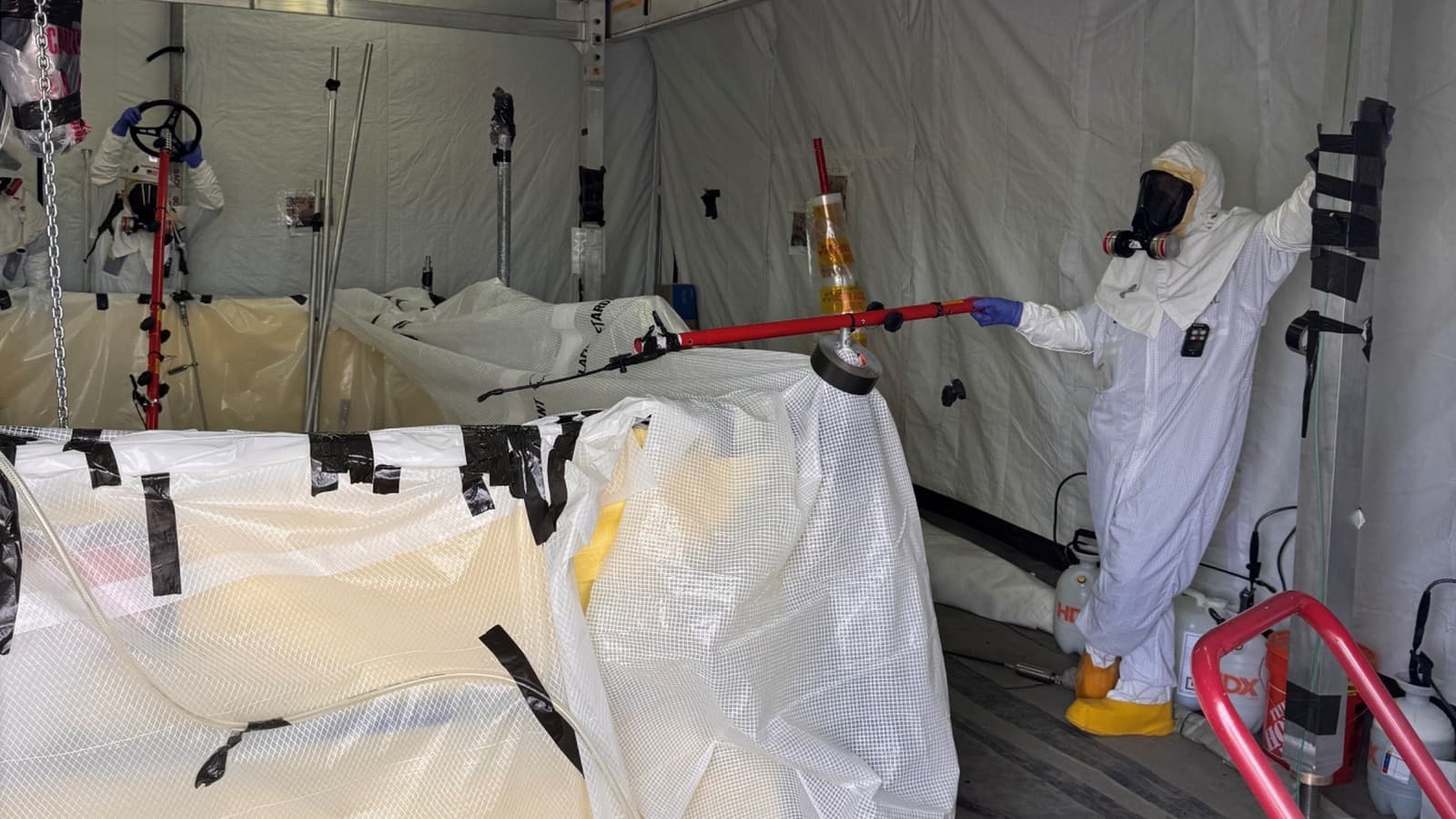
DOE Has an $8 Billion Cleanup Mission. Its Federal Oversight Workforce Fell to 856.
DOE's nuclear-cleanup office lost one-third of its federal staff in two years while engineering, contracting and safety-related vacancies widened.
Data investigationsAugust 18, 2026
IRS Workforce Fell 29% as GAO Warned of Filing-Season Risks
The IRS had 29,663 fewer covered civilian employees in June 2026 than in January 2025. GAO says workforce-planning gaps and post-filing pressures pose risks to future operations.
Data investigationsAugust 23, 2026
FAA's Aviation-Weather Network Was Designed for 90 Meteorologists. Staffing Fell to 69.
The last verified federal count found 69 meteorologists in a 90-position aviation-weather design. Public records show recruiting in 2026, but not a verified recovery.
Federal Hiring Data Weekly
Get the biggest federal workforce changes in your inbox.
Subscribe to Federal Hiring Data Weekly for federal hiring trends, salary data, agency movements, and original investigations, with email confirmation before delivery.