August 26, 2026
State Plans to Close Five Overseas Posts. They Employ Just Six U.S. Direct Hires.
Five planned State Department post closures cover six U.S. direct hires, while the agency's OPM-covered Civil Service workforce fell by 3,239.
By Evan Mercer
Published August 26, 2026Last edited August 26, 2026
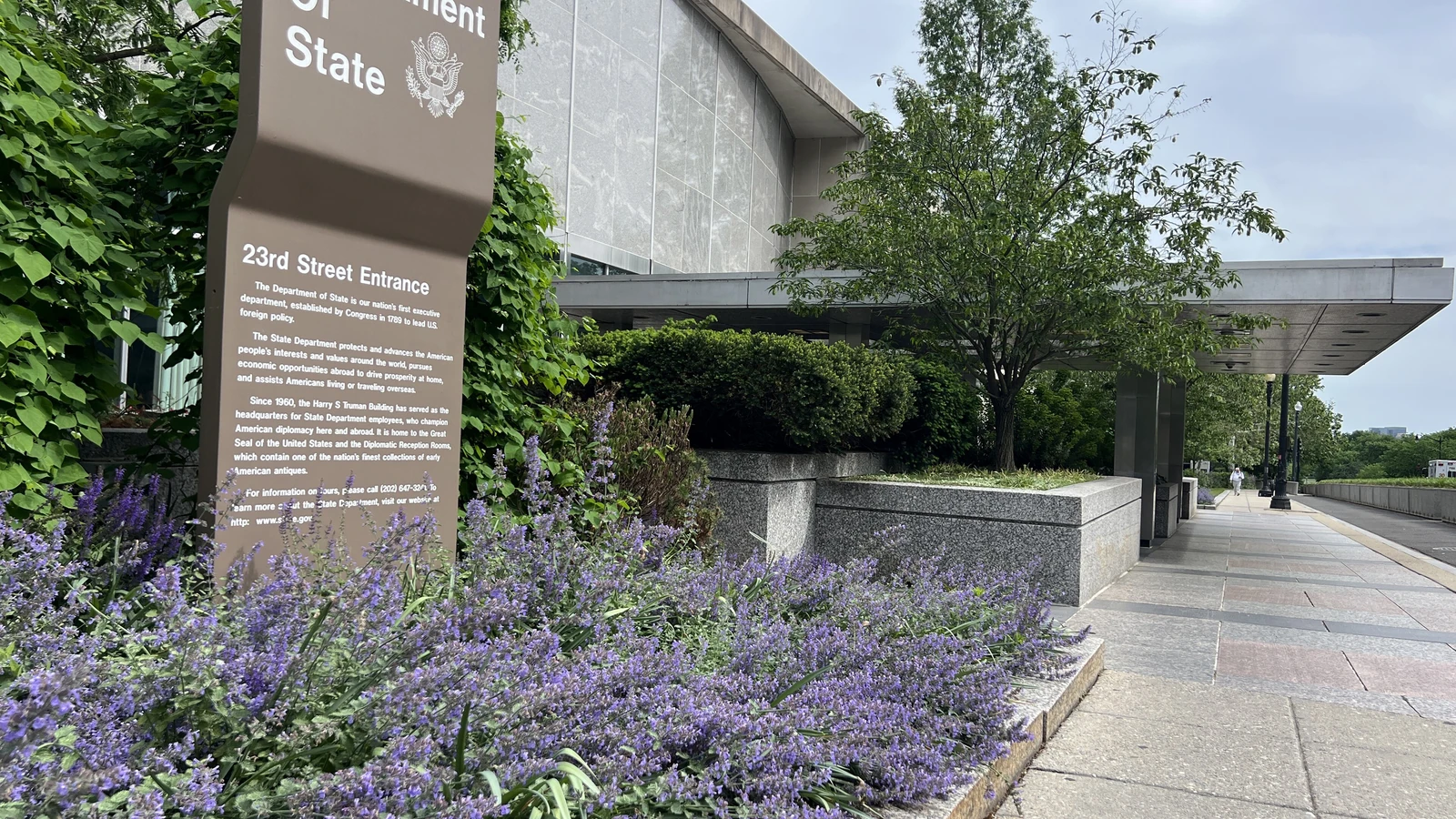
The State Department is preparing to close five small overseas posts at the same time it is beginning to return personnel to larger Middle East missions. Those two moves can sound like opposite sides of a global workforce transfer: diplomats leave Grenada, Japan, Indonesia, Canada and Cameroon, then help refill posts in Israel, Jordan, Oman and elsewhere.
The staffing numbers show why that is the wrong frame.
The five planned closures cover six U.S. direct-hire positions and 73 locally employed positions, according to staffing figures reported from congressional notifications. Four of the six U.S. positions are at the consulate in Medan, Indonesia. Two planned closures have no U.S. direct-hire positions at all.
That is not a meaningful reserve of American diplomats for a large regional restaffing. The closures are better understood as footprint and operating-cost decisions whose heaviest direct employment effect falls on local staff. The much larger measurable U.S. workforce change is elsewhere: Office of Personnel Management records show that State's covered Civil Service workforce fell from 14,593 employees in September 2024 to 11,354 in June 2026, a decline of 3,239, or 22.2%.
These are different personnel systems and different decisions. Foreign Service officers and specialists rotate among domestic and overseas assignments. Civil Service employees are concentrated in the United States. Locally employed staff provide language, political, economic, administrative and operational knowledge at posts abroad. Contractors and temporary-duty personnel add another layer. Combining them into a single State Department headcount would obscure more than it explains.
The evidence instead points to a redistribution problem. State is trimming a few small diplomatic locations, consolidating some visa work into regional hubs, rebuilding selected missions after security drawdowns, and operating with a substantially smaller OPM-covered workforce at home. The question is not simply whether the department has fewer posts. It is whether the workforce left across headquarters and the overseas network has the right skills, location and experience for the work being reassigned.
Five closures, six U.S. direct hires
The Associated Press and Reuters reported in August that the department had notified Congress of plans to close the embassy in St. George's, Grenada; consulates in Nagoya, Japan, and Medan, Indonesia; the American Presence Post in Winnipeg, Canada; and the embassy branch office in Douala, Cameroon.
The notices themselves were not publicly posted. State did not publicly confirm the individual locations in response to the reports, saying more generally that it follows congressional notification requirements and evaluates its overseas footprint. Final closing dates were not publicly available as of Aug. 26, 2026.
| Planned closure | Post type | U.S. direct hire | Locally employed | Reported positions |
|---|---|---|---|---|
| St. George's, Grenada | Embassy | 1 | 5 | 6 |
| Nagoya, Japan | Consulate | 1 | 5 | 6 |
| Medan, Indonesia | Consulate | 4 | 47 | 51 |
| Winnipeg, Canada | American Presence Post | 0 | 2 | 2 |
| Douala, Cameroon | Embassy branch office | 0 | 14 | 14 |
| Total | 6 | 73 | 79 |

The notices estimated about $4.4 million in annual savings, according to AP. Without the underlying cost tables, that estimate cannot be separated into leases, security, facilities, information technology, allowances and personnel. It should not be read as six salaries divided into $4.4 million. An overseas post has fixed operating costs even when its U.S. staff is small.
The 79 reported positions also are not necessarily 79 people on board on a later date. A position may be vacant, an incumbent may move before closure, and local employment rules affect how separations are handled. The table describes the staffing figures attached to the reported plans, not a verified termination roster.
The distribution matters. Locally employed staff make up 92% of the reported positions. They do not transfer into the U.S. Foreign Service pool that fills vacancies elsewhere. Their departure can remove institutional knowledge that is difficult to recreate from a regional hub: local contacts, language, administrative practice and an understanding of the host country's institutions.
State's own Foreign Affairs Manual treats opening and closing posts as formal organizational actions. It assigns regional bureaus and supervisory missions responsibility for implementing closures, disposing of property, protecting records and establishing an official closing date. A closure can save money and rationalize a network. It is not equivalent to moving a complete post's work and knowledge elsewhere at no cost.
The two U.S. direct-hire workforces are not interchangeable
Public State Department workforce reports provide a longer baseline for the distinction between Civil Service and Foreign Service.
State reported 9,023 full-time permanent Foreign Service employees and 6,486 Civil Service employees in fiscal 2000. By September 2024, the comparable published figures were 14,399 Foreign Service and 12,831 Civil Service employees. The two systems both grew over that period, but along different paths and under different assignment rules.

The chart does not interpolate missing years. It uses exact benchmarks from State annual reports and Global Talent Management fact sheets. The latest comparable official total found for this analysis is Sept. 30, 2024. No equivalent public 2026 Foreign Service strength figure was located, so the article does not estimate one.
The 2024 fact sheet described a worldwide organization with 279 posts and 50,703 locally employed staff. Among the 27,230 U.S. direct-hire Civil Service and Foreign Service employees, 9,513 were overseas and 17,717 were domestic. That overseas figure combines the two systems; State's workforce plan has historically shown that most career Foreign Service employees serve abroad while nearly all Civil Service employees serve domestically.
This is why OPM records cannot answer whether State now has too few diplomats overseas. OPM's modern State records principally measure the covered Civil Service workforce and do not contain a comparable Foreign Service population. The Foreign Affairs occupational series, code 0130, is a Civil Service job series. It is not a count of Foreign Service officers.
The distinction is easy to miss because both groups can perform foreign-policy work. A Washington-based Civil Service foreign affairs specialist may shape sanctions, treaties, security assistance or regional policy. A Foreign Service officer may spend a domestic tour in the same bureau. Their work can overlap, but their personnel systems, career patterns and public data sources do not.
A 3,239-position Civil Service decline
FederalHiringData constructed a long-run State series from OPM employment data. For legacy FedScope years in which State records included Foreign Service pay plans, the analysis removed the FA, FE, FO, FP and FZ pay plans before aggregation. Modern OPM Federal Workforce Data contain Civil Service pay plans such as GS, GG and ES in the State rows and no Foreign Service pay plans.
The resulting measure is broader than State's published full-time permanent Civil Service count because it can include nonpermanent appointments. It is best described as OPM-covered Civil Service-compatible employment.
That workforce reached 14,593 in September 2024. It fell to 12,863 in September 2025 and 11,354 in June 2026. The decline from the peak was 3,239 employees, or 22.2%.

Personnel-action data show how the contraction developed. State recorded 2,592 accessions and 2,090 separations in calendar 2024, a net difference of plus 502. In 2025 it recorded 1,121 accessions and 4,108 separations, a net difference of minus 2,987. From January through June 2026, the data show 225 accessions and 492 separations, a further net difference of minus 267.
Accessions and separations are actions, not a perfect bridge between two headcount snapshots. Transfers, conversions and data timing can affect them. They nevertheless make clear that the decline was driven by both far more separations and far less hiring than in 2024.
The occupational losses reached work central to diplomacy and headquarters operations. Between September 2024 and June 2026, OPM-covered employment fell by:
- 944 in Foreign Affairs, series 0130;
- 335 in Management and Program Analysis, series 0343;
- 264 in Information Technology Management, series 2210;
- 255 in the Administration and Office Support Student Trainee series, 0399;
- 162 in Miscellaneous Administration and Program, series 0301;
- 119 in Human Resources Management, series 0201;
- 80 in Security Administration, series 0080; and
- 76 in Public Affairs, series 1035.

Those are net changes, not a list of abolished positions. They cannot distinguish a resignation from a retirement, transfer, appointment expiration or other separation. They also do not show whether duties disappeared, moved to another employee, shifted to a contractor or remained vacant.
There is useful counterevidence inside the same data. Passport and Visa Examining, series 0967, rose slightly from 1,992 to 2,009. Not every State function contracted at the same rate. A department can reduce headquarters policy, support and trainee pipelines while protecting a high-volume operational workforce. That is why occupation-level measures are more informative than one total.
Most of the measured contraction was domestic
Duty-station records further separate the Civil Service decline from the overseas-post story.
The OPM-covered State workforce assigned to domestic locations fell from 13,776 in September 2024 to 10,593 in June 2026, a net decline of 3,183. The OPM-covered overseas count fell from 817 to 761, a decline of 56.

This chart does not show the much larger Foreign Service presence abroad, locally employed staff or contractors. It shows where the workforce visible in OPM's Civil Service-oriented records changed. Roughly 98% of the measured decline was domestic.
That is the scale comparison the five-post debate needs. The planned closures involve six reported U.S. direct-hire positions at overseas locations. The recent OPM-visible workforce decline involves thousands of employees, overwhelmingly at domestic duty stations. The two figures should not be subtracted from each other because they come from different scopes, but they establish where the larger observable change occurred.
Domestic capacity supports the overseas network. Regional bureaus, consular systems, security, information technology, human resources, finance, acquisition, legal review, intelligence analysis and public diplomacy do not stop at the edge of Washington. A smaller headquarters and support workforce can be an intentional efficiency decision. It can also leave less capacity to absorb work from closed posts, manage emergency departures or sustain regional hubs. Public headcount data alone cannot decide which effect dominates.
Federal Hiring Data Weekly
Get the biggest federal workforce changes in your inbox.
Subscribe to Federal Hiring Data Weekly for federal hiring trends, salary data, agency movements, and original investigations, with email confirmation before delivery.
Restaffing after a security drawdown is not ordinary vacancy filling
The timing makes the staffing picture especially fluid.
Reuters reported on Aug. 25 that State had begun returning personnel to Middle East missions after security-related departures during the Iran war. According to people familiar with the plan, missions in Israel, Jordan and Oman were expected eventually to return to full staffing, while the United Arab Emirates, Saudi Arabia, Qatar and Lebanon would initially operate at up to 85%.
State publicly said it continuously reviews staffing and security posture but did not confirm those numerical caps in the response Reuters reported. The percentages therefore should be treated as reported planning figures, not official public headcounts. They reveal neither the number of positions at each mission nor how many people had returned by a given day.
Emergency drawdowns and authorized departures create a different labor problem from ordinary vacancies. Personnel may remain assigned to a post while temporarily working elsewhere. Some employees return as security conditions change. Temporary-duty teams can fill gaps. Family-member and local-staff arrangements differ from direct-hire movements. A public staffing percentage can conceal those categories even when accurately reported.
The six U.S. positions in the closure notices would not materially solve that problem. The skills and grades may not match. Assignments require bidding, clearances, language preparation, medical clearance and security decisions. Two closure locations have no U.S. direct hires to transfer. The closure and restaffing announcements are simultaneous evidence of a network being reconfigured, not proof of a direct personnel exchange.
Regional hubs can preserve service while reducing local presence
State is also redistributing work without closing every affected post.
Effective Aug. 1, the department moved routine visa services from 25 African locations to regional processing hubs, according to an official State Department notice. Applicants in affected countries must use designated embassies or consulates elsewhere for routine immigrant or nonimmigrant visa processing. State said the realignment did not change the operating status of the affected embassies and consulates, many of which continue American Citizen Services and limited visa services.
That model can concentrate adjudication expertise, technology and supervision. It can also move travel costs and logistical burdens onto applicants and increase dependence on a smaller number of hubs. The announcement does not establish that staff at all 25 originating locations were eliminated or transferred. Service geography changed; workforce consequences require separate evidence.
The same caution applies to post counts. State reported 276 posts in 2017 and 279 in 2024. Five reported closures would not mechanically produce a current total of 274. Posts open, close, suspend operations, change status and use branch or presence arrangements. The U.S. Embassy in Damascus, for example, remained under suspended operations in the department's August 2026 travel advisory even as Syria's own embassy in Washington reopened. Those are different institutions and should not be conflated.
A network can therefore have a similar number of named posts while moving substantial work among them. Conversely, closing a very small location can matter strategically even when it barely changes worldwide headcount. Post count, staffing, service responsibility and diplomatic reach are related but distinct measures.
The public recruiting signal collapsed after 2024
FederalHiringData's historical USAJOBS archive offers a partial view of how State recruited for Civil Service-oriented work.
The archive contains 2,544 distinct Department of State announcements opened in 2023 and 2,038 in 2024. It contains 380 opened in all of 2025 and 438 from Jan. 1 through Aug. 25, 2026. Coverage for 2017 begins in March, so that year's 309 announcements also are partial.

Announcements are not vacancies, applications, offers or hires. One announcement may cover multiple positions or locations, and a notice can close without a selection. Internal placements and some hiring authorities do not appear as ordinary public recruiting. Most generalist Foreign Service hiring follows State's own examination and selection process rather than a standard USAJOBS announcement.
The archive is therefore not a measure of the entire diplomatic hiring pipeline. It does show that the public-facing channel used heavily for Civil Service occupations contracted at the same time OPM records show low accessions. Across the archive since March 2017, the most common State occupational series include Foreign Affairs, Management and Program Analysis, Information Technology Management, Miscellaneous Administration and Program, Security Administration, Human Resources Management and Passport and Visa Examining.
The 2026 count could rise before year-end. It already exceeds the full 2025 total through Aug. 25. That is a possible early rebuilding signal, but it remains far below the annual pace recorded from 2018 through 2024. A durable recovery would require more than announcements: selections, accessions and retention would need to follow.
Vacancies were a structural issue before 2026
The overseas network was not fully staffed even before the current restructuring.
The Government Accountability Office found that 14% of authorized overseas Foreign Service positions were vacant in both 2008 and 2012. In March 2018 the overall rate was 13%. Political positions were 20% vacant and economic positions were 16% vacant.
Related research
Put this finding in context
Data investigationsAugust 23, 2026
Passport Waits Fell. State's Plan for the Next Surge Is Still Unfinished.
State rebuilt passport staffing and processed record demand after the 2023 crisis, but key measures of durable surge capacity remain unpublished.

Data investigationsAugust 25, 2026
The Coast Guard Plans to Add 15,000 Military Members. Only 26% of Its Workforce Requirements Are Current.
Recruiting rebounded, but cutter vacancies widened and covered civilian employment fell 9.9% as Force Design accelerated.

These are historical benchmarks, not 2026 vacancy rates. They should not be used to estimate the number of empty positions today. They demonstrate that State's assignment system has long had difficulty filling every authorized overseas position, particularly in selected career tracks and locations.
GAO identified several constraints: shortages in some skill groups, assignment preferences, language requirements and the challenge of staffing hardship posts. A post can be authorized for a position while temporarily relying on a gap, a stretch assignment, temporary duty or a person working outside the exact career specialty.
That history makes current redistribution harder to evaluate. A mission returning to 85% could be rebuilding from an emergency departure, approaching its pre-crisis staffing level, or operating against an authorized structure that already contained vacancies. Without post-level denominators and category definitions, the percentage does not reveal which.
State also bears real costs for the network it maintains. GAO reported that the department spent about $3.1 billion on pay, benefits and allowances for its overseas workforce in fiscal 2023. That total covers a much broader population and cost scope than the $4.4 million annual-savings estimate for five closures. The figures should not be directly compared as if they describe the same budget base. Together they show why footprint decisions attract scrutiny: small posts can be expensive to operate, but worldwide capability depends on much more than the number of Americans assigned to each building.
What to watch next
The next useful evidence will not be a single worldwide headcount.
First, State should publish final implementation dates and service arrangements for the five planned closures. That would show where consular, political and public-diplomacy responsibilities move and whether another post receives people or only duties.
Second, later OPM releases will show whether the Civil Service decline stabilizes. The most consequential indicators are accessions and occupational composition: foreign affairs, information technology, security, human resources, contracting and program analysis. A rising total built only in one operational series would not restore the same capacity that left.
Third, the department's own public Foreign Service totals are necessary. OPM cannot fill that gap. A current strength report should distinguish Foreign Service officers, specialists and limited/noncareer appointments, and should separate domestic from overseas assignments without disclosing sensitive post-level information.
Fourth, service measures should accompany workforce measures. Visa processing times, passport workload, security and facility performance, diplomatic reporting, grants and exchanges, and assignment vacancy rates reveal whether consolidation is reducing duplication or shifting bottlenecks.
The five planned closures may be defensible on cost, demand or strategic grounds. Their small U.S. staffing also means they cannot explain, or repair, the department's larger workforce contraction. The central 2026 story is not five posts yielding a pool of diplomats. It is a global institution trying to move work among posts while the measurable Civil Service workforce that supports that network is 3,239 employees below its 2024 peak.
Methodology and limitations
FederalHiringData combined four kinds of evidence that are not interchangeable.
State Department annual reports and Global Talent Management fact sheets supply exact full-time permanent Civil Service and Foreign Service benchmarks. Missing years are not interpolated. The latest comparable official figure located was Sept. 30, 2024; no 2026 Foreign Service total is estimated.
The OPM Civil Service-compatible series combines September legacy FedScope employment cubes for 2000 through 2014 with modern OPM Federal Workforce Data for September 2015 through 2025 and June 2026. Legacy State rows can include Foreign Service pay plans, so FA, FE, FO, FP and FZ are excluded. The resulting series is broader than State's full-time permanent Civil Service total and excludes locally employed staff, contractors and the Foreign Service.
Occupation and duty-station changes compare September 2024 with June 2026. They are net headcount changes and do not establish why an employee left, whether a position was abolished, or where duties moved. Domestic and overseas classifications follow OPM duty-station geography.
USAJOBS counts are distinct control numbers in the FederalHiringData historical archive with Department of State as the department and open dates from March 2017 through Aug. 25, 2026. The 2017 and 2026 observations are partial. Announcements are not openings, applicants, selections or hires, and standard USAJOBS recruiting does not capture most ordinary Foreign Service entry processes.
Closure staffing and savings come from AP's account of congressional notifications and are cross-checked against Reuters reporting. Because the notices were not publicly posted, the analysis labels them reported plans and does not assign final closing dates. Middle East restaffing percentages are attributed to Reuters sources; State's public response confirmed only its continuing review of security posture.
GAO-19-220 supplies historical overseas Foreign Service vacancy rates. GAO-25-107098 supplies the fiscal 2023 overseas compensation figure. Those are historical and scope-specific benchmarks, not current post staffing estimates.
The analysis was completed Aug. 26, 2026. Fast-moving security and implementation decisions may change after publication. No OpenAI API calls were used for research, analysis, writing, charts or imagery.
Sources and related reading
Primary sources include State's FY 2005 workforce report, FY 2010 report, FY 2012 report, September 2024 workforce fact sheet, OPM Federal Workforce Data, the Foreign Affairs Manual post-closure framework, State's Africa visa-services realignment, GAO's overseas vacancy review, and GAO's overseas compensation review.
The planned closures were reported by the Associated Press and Reuters. The Middle East return plan was reported by Reuters.
Explore current federal jobs, review federal hiring statistics, browse agency profiles, or read more FederalHiringData investigations.
Continue reading
More from FederalHiringData
Data investigationsAugust 25, 2026
The Civil Rights RIF Was Rescinded. OCR's Workforce Still Fell 50%.
Education rescinded its Office for Civil Rights RIF, but OPM data show the component had 298 fewer covered employees by June 2026 as complaint timeliness worsened.
Data investigationsAugust 18, 2026
IRS Workforce Fell 29% as GAO Warned of Filing-Season Risks
The IRS had 29,663 fewer covered civilian employees in June 2026 than in January 2025. GAO says workforce-planning gaps and post-filing pressures pose risks to future operations.

Data investigationsAugust 26, 2026
BIS Funded 585 Positions. Its Covered Workforce Has Since Fallen to 433.
BIS gained 182 funded positions as export controls expanded, but covered headcount later fell to 433 and licensing/compliance occupations contracted.
Federal Hiring Data Weekly
Get the biggest federal workforce changes in your inbox.
Subscribe to Federal Hiring Data Weekly for federal hiring trends, salary data, agency movements, and original investigations, with email confirmation before delivery.