August 29, 2026
535,822 Federal Job Announcements Named the Disability Path, but Not the Public
FederalHiringData found 535,822 disability-path announcements that did not also name the public. Schedule A can open an application lane, but it is not preference or a job guarantee.
Published August 29, 2026Last edited August 29, 2026

On USAJOBS, a blue icon can change who is allowed through the application door.
The icon reads Individuals with disabilities. It can appear beside Veterans, Federal employees, Military spouses and other hiring paths. Sometimes it appears beside The public. Usually, FederalHiringData found, it does not.
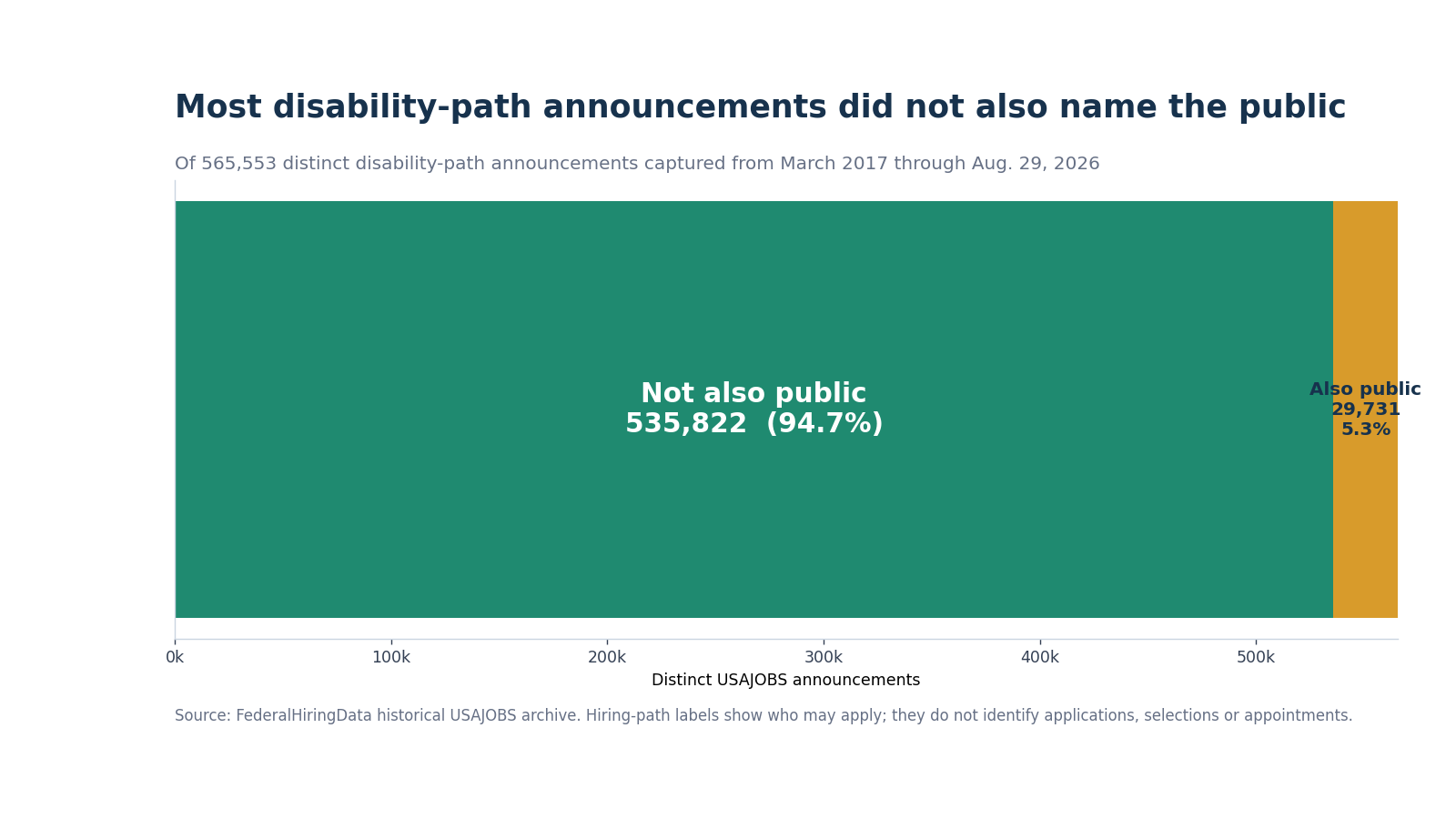
Across 3,098,260 distinct USAJOBS announcement controls opened from March 2017 through Aug. 29, 2026, 565,553 carried the disability hiring-path signal. Of those, 535,822 did not also name the public. Another 29,731 named both.
That is an unusually large application lane, but it is easy to describe incorrectly. USAJOBS connects the Individuals with disabilities path to eligibility under Schedule A. Schedule A is an optional excepted-service hiring authority. It is not veterans-style preference, it does not erase the qualification requirements in an announcement, and it does not guarantee referral, an interview, selection or an appointment.
The archive can show where agencies advertised the path. It cannot show which applicant used it, which authority a hiring office ultimately selected, or whether a person was hired. That distinction is the foundation of this analysis.
535,822 announcements named the disability path without naming the public
The main finding is about eligibility displayed on an announcement. FederalHiringData classified an announcement as carrying the disability path only when its stored USAJOBS audience fields explicitly included the modern `disability` code, the human-readable Individuals with disabilities label, an equivalent people/persons-with-disabilities label, or Schedule A itself.
The public comparison was equally conservative. An announcement counted as public only when its audience fields explicitly identified The public, U.S. citizens or nationals, all citizens, or the modern `public` path code.
Under those definitions, 94.7% of disability-path announcements did not also carry the public path. The remaining 5.3% carried both.
The absence of the public path does not mean only one type of applicant could apply. Most of these announcements named several groups. A person might have qualified through Schedule A, veterans eligibility, current federal service, military-spouse authority or another route listed in the same announcement.
It does mean a member of the general public who had no listed eligibility could not treat the announcement like an ordinary open-to-all-citizens posting. USAJOBS says the hiring paths in an announcement identify the groups eligible to apply, and that agencies reject applicants who do not fall within a listed path before reviewing their qualifications.
This is why the disability icon matters. It can expose positions that a Schedule A-eligible applicant may pursue even when those positions are not advertised to the public at large.
Schedule A is an authority, not a preference
USAJOBS describes Schedule A as an optional and potentially quicker way for an agency to hire a person with an intellectual disability, a severe physical disability or a psychiatric disability. It provides an exception to the traditional competitive process.
That exception is not the same as veterans preference. Veterans preference affects how eligible preference claimants are considered in certain competitive hiring processes. Schedule A allows an agency to make an excepted-service appointment without using the ordinary competitive examining route.
The distinction is more than terminology. A Schedule A applicant must still meet the job's qualification requirements. OPM's current guidance says the person must have the competencies and relevant experience necessary to perform the work. The hiring office still decides whether to use the authority and whom to select.
The Equal Employment Opportunity Commission's applicant guide is direct on both points: an agency is not required to use Schedule A, and eligibility does not guarantee a job. A candidate must be qualified, and the agency must decide that the candidate is best suited for the position.
That also explains why the archive should not be described as containing 565,553 Schedule A appointments. It contains 565,553 announcements that told a defined group they could apply. Applications, referrals, interviews, selections, appointments and hires are different events, none of which is recorded in these announcement fields.
Veterans Health Administration advertised the path most often
Veterans Health Administration led the archive with 64,373 disability-path announcements. It accounted for 11.4% of the national disability-path set. Of its total, 61,113 did not also name the public.
The next four organizations were U.S. Army Reserve Command, Defense Logistics Agency, Air Force Materiel Command and Indian Health Service. The ranking shows a large Defense presence, but it is not exclusively a Defense story. Health agencies, land-management bureaus, aviation organizations and civilian administrative offices also appear throughout the results.
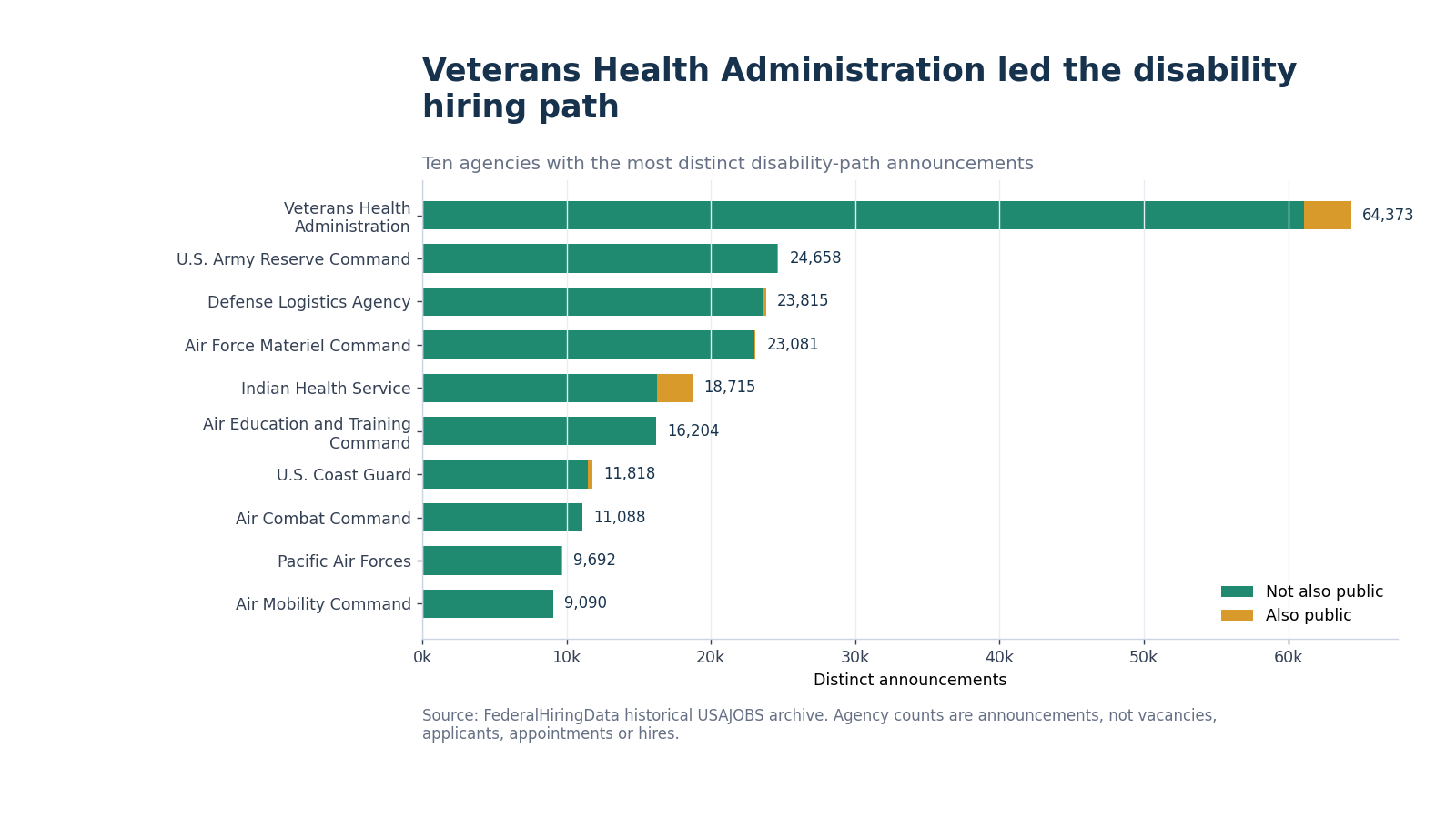
| Agency | Disability-path announcements | Also named public | Did not name public |
|---|---|---|---|
| Veterans Health Administration | 64,373 | 3,260 | 61,113 |
| U.S. Army Reserve Command | 24,658 | 59 | 24,599 |
| Defense Logistics Agency | 23,815 | 235 | 23,580 |
| Air Force Materiel Command | 23,081 | 43 | 23,038 |
| Indian Health Service | 18,715 | 2,474 | 16,241 |
| Air Education and Training Command | 16,204 | 20 | 16,184 |
| U.S. Coast Guard | 11,818 | 351 | 11,467 |
| Air Combat Command | 11,088 | 12 | 11,076 |
| Pacific Air Forces | 9,692 | 14 | 9,678 |
| Air Mobility Command | 9,090 | 9 | 9,081 |
These are distinct announcement controls, not vacancies. One announcement can advertise one opening, many openings or a number that is not stated. The agency field also reflects the organization displayed on the announcement, which can be more specific than a cabinet department.
The differences in public overlap are noteworthy but not a league table of accessibility. Indian Health Service named the public on 2,474 of its disability-path announcements, compared with 43 at Air Force Materiel Command. That can reflect how an organization structures announcements, the positions it fills, other statutory authorities and the eligible pools it targets. The archive does not show why a hiring office chose one set of paths.
Administrative, analytical, HR and IT roles led the list
The disability path was not concentrated in a single occupational field. Series 0301, Miscellaneous Administration and Program, led with 59,799 announcements. Management and Program Analysis followed at 38,632. Miscellaneous Clerk and Assistant had 27,942; Human Resources Management had 25,896; and Information Technology Management had 22,982.
Related research
Put this finding in context
Hiring processAugust 27, 2026
181,700 USAJOBS Announcements Used Applicant Cutoffs. Remote Postings Used Them Far More Often.
FederalHiringData found 181,700 official applicant-cutoff announcements since 2019, with especially heavy use in remote, emergency and park recruiting.

Data investigationsAugust 20, 2026
634 Applications, Eight Completed Rotations: Why the Federal Cyber Exchange Stalled
Employees showed interest in the federal cyber rotation program. Home-agency approval, unreimbursed staffing costs and senior qualification demands narrowed the path.
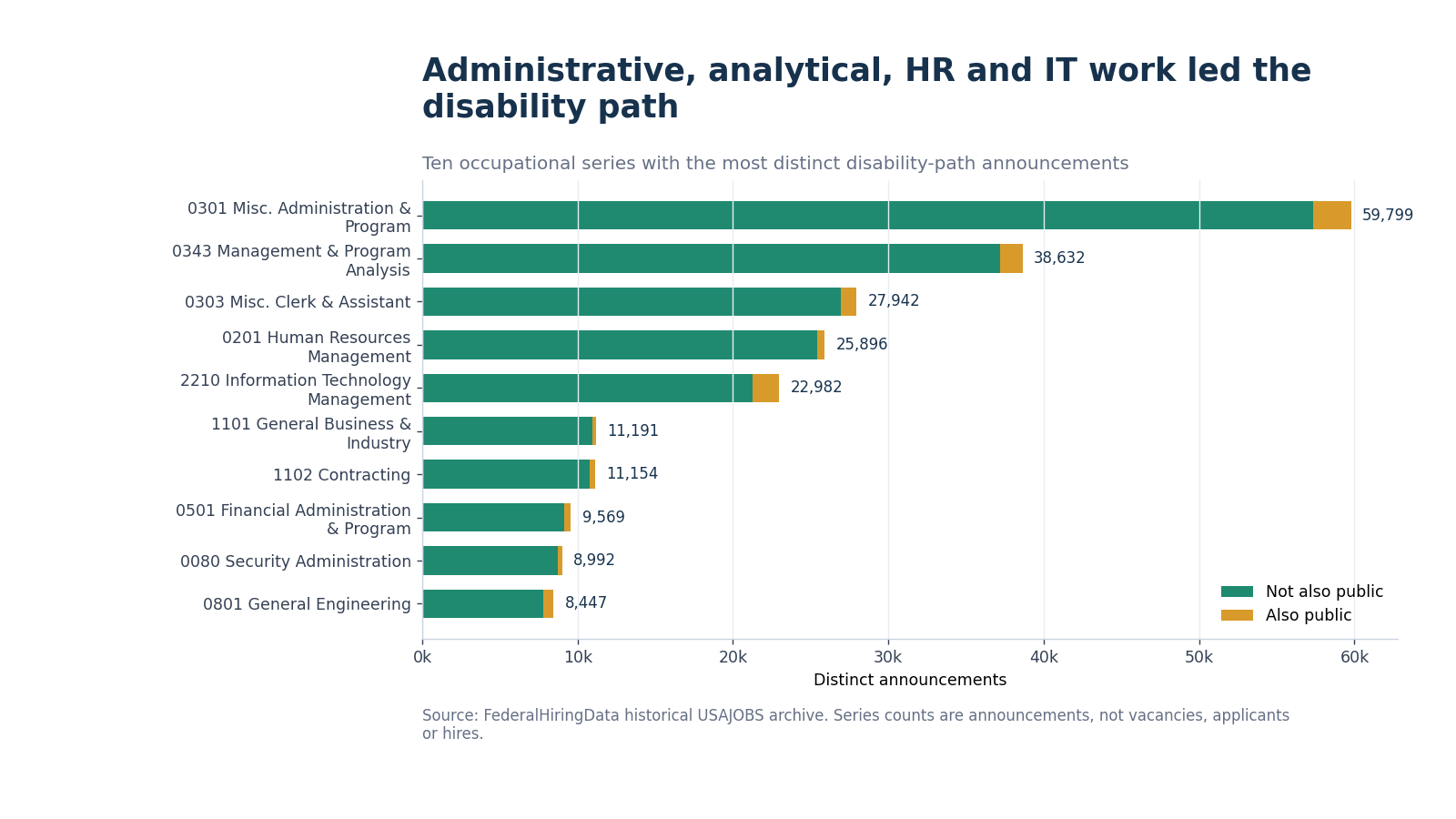
The top group extends beyond general administration. Contracting, financial administration, security administration, engineering and logistics all appear among the leading series. The breadth is practically important for applicants: the path is not a separate occupation or disability program job category. It is an eligibility route that can accompany jobs across the civil service.
At the same time, a series total says nothing about an individual's qualifications. A 2210 Information Technology Management announcement can require specialized experience, certifications, education, security eligibility or technical competencies. Schedule A eligibility does not substitute for any requirement the announcement applies to the position.
The series counts also should not be treated as labor demand in the private-sector sense. An announcement can cover multiple grades, locations or vacancies, and agencies can reuse announcement structures. The defensible conclusion is narrower: these were the occupational series in which the archive most often displayed the disability path.
Nearly half of the announcements spanned GS 8 through GS 12
FederalHiringData grouped the advertised low and high grades into broad bands. GS 8-12 led with 256,434 disability-path announcements, 45.3% of the total. GS 13-15 accounted for 132,880, and GS 5-7 accounted for 130,765. GS 1-4 contributed 37,432. Another 8,043 were non-GS or could not be classified reliably.
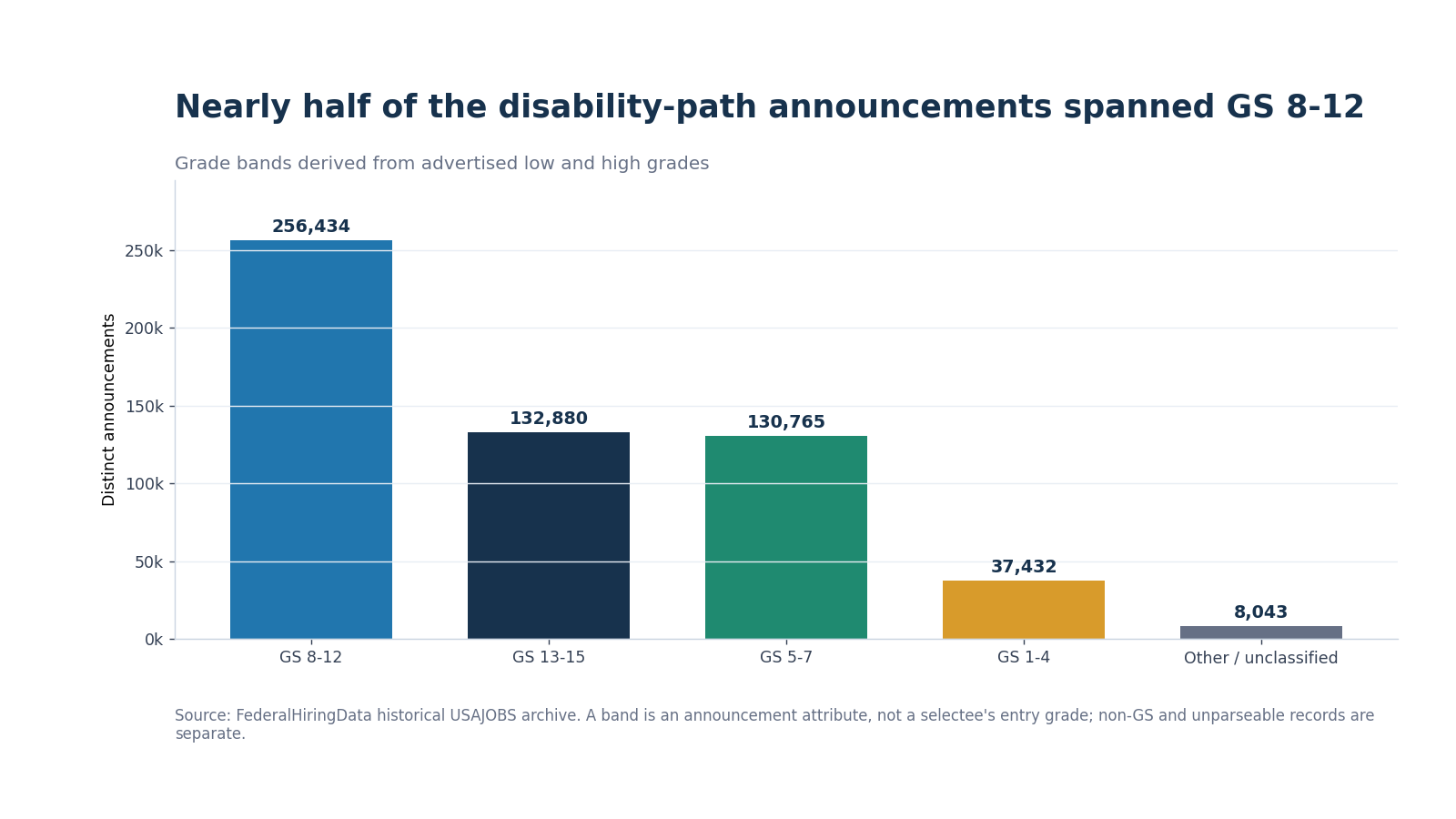
This distribution pushes against the idea that Schedule A is only an entry-level route. The largest band includes journeyman and developmental positions, while nearly one-quarter of the announcement set reached the GS 13-15 band.
But the bands are announcement attributes. A GS 7-12 career-ladder posting appears in the GS 8-12 group because its advertised range crosses the band. The chart does not identify the grade at which anyone entered, whether an agency selected at all, or whether a selectee used Schedule A rather than another listed authority.
Applicants should therefore read the Qualifications and How you will be evaluated sections rather than using the hiring-path icon as a proxy for grade readiness. Eligibility answers whether the agency may consider a person through a lane. Qualifications answer whether the person's record meets the job's requirements.
The mature archive years show a durable announcement channel
The historical series begins March 1, 2017, so the 24,097 disability-path announcements that year cover only ten months. The complete archive years from 2018 through 2024 range from 61,129 in 2020 to 86,310 in 2023. The 2024 count was 81,417.
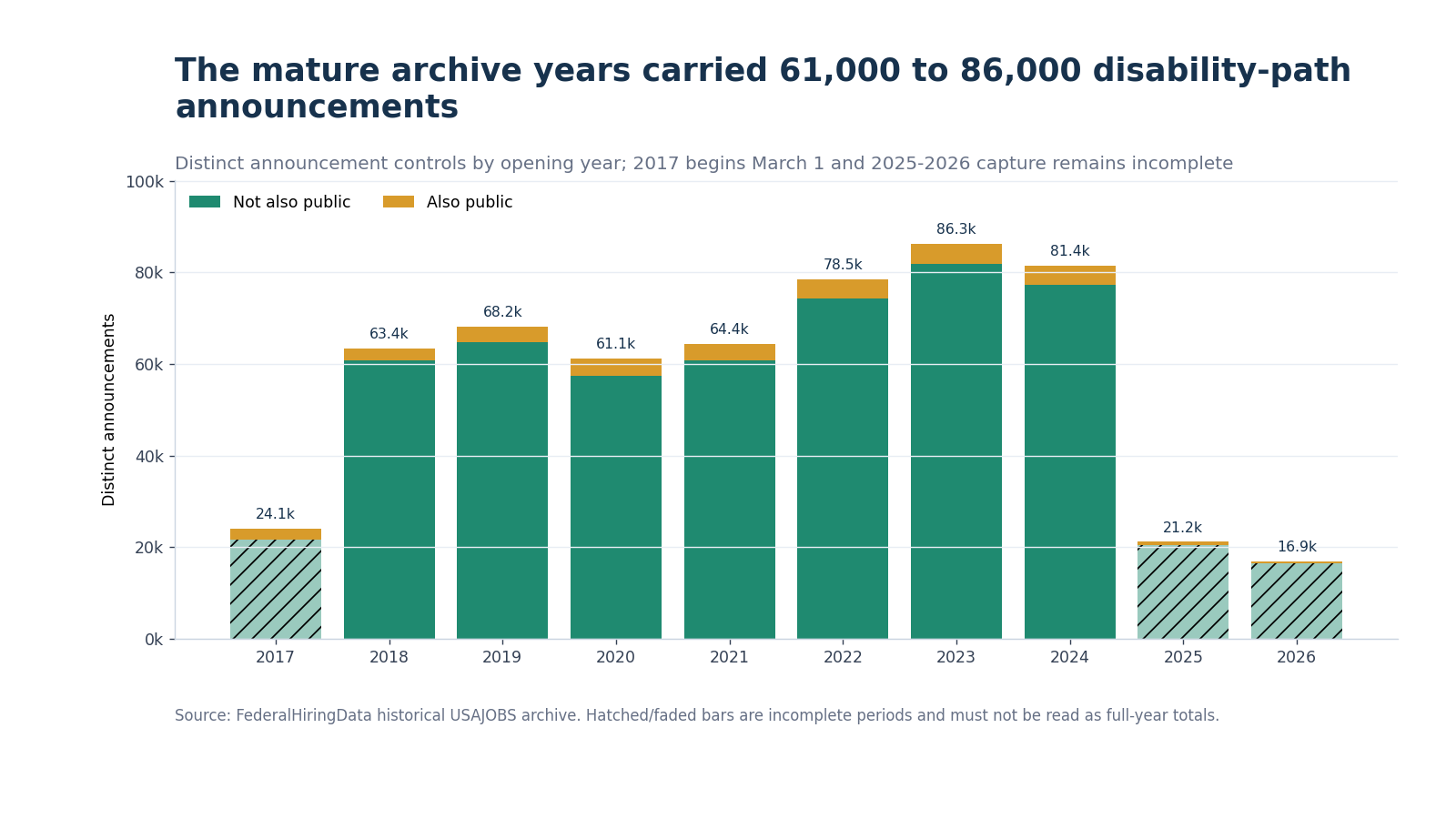
The series shows that the path was not a small or isolated feature of USAJOBS in the mature archive period. More than 60,000 distinct controls carried it in each full year from 2018 through 2024.
The chart deliberately marks 2025 and 2026 as incomplete. FederalHiringData's post-2024 historical collection is still being completed, and the canonical current-job table only supplements controls not already in the archive. The visible 21,173 for 2025 and 16,867 for 2026 are capture totals, not defensible full-year comparisons. They cannot support a claim that use of the disability path collapsed.
The same caution applies to monthly data in incomplete periods. A low month can mean missing historical coverage rather than low agency activity. The article uses monthly extracts as an audit trail but does not turn those gaps into a trend claim.
The path appeared across the country, with Washington leading
Washington, D.C. produced 60,675 state-level announcement-location pairs in the disability-path set. Virginia followed with 51,737, California with 44,698, Texas with 34,590 and Maryland with 30,150.
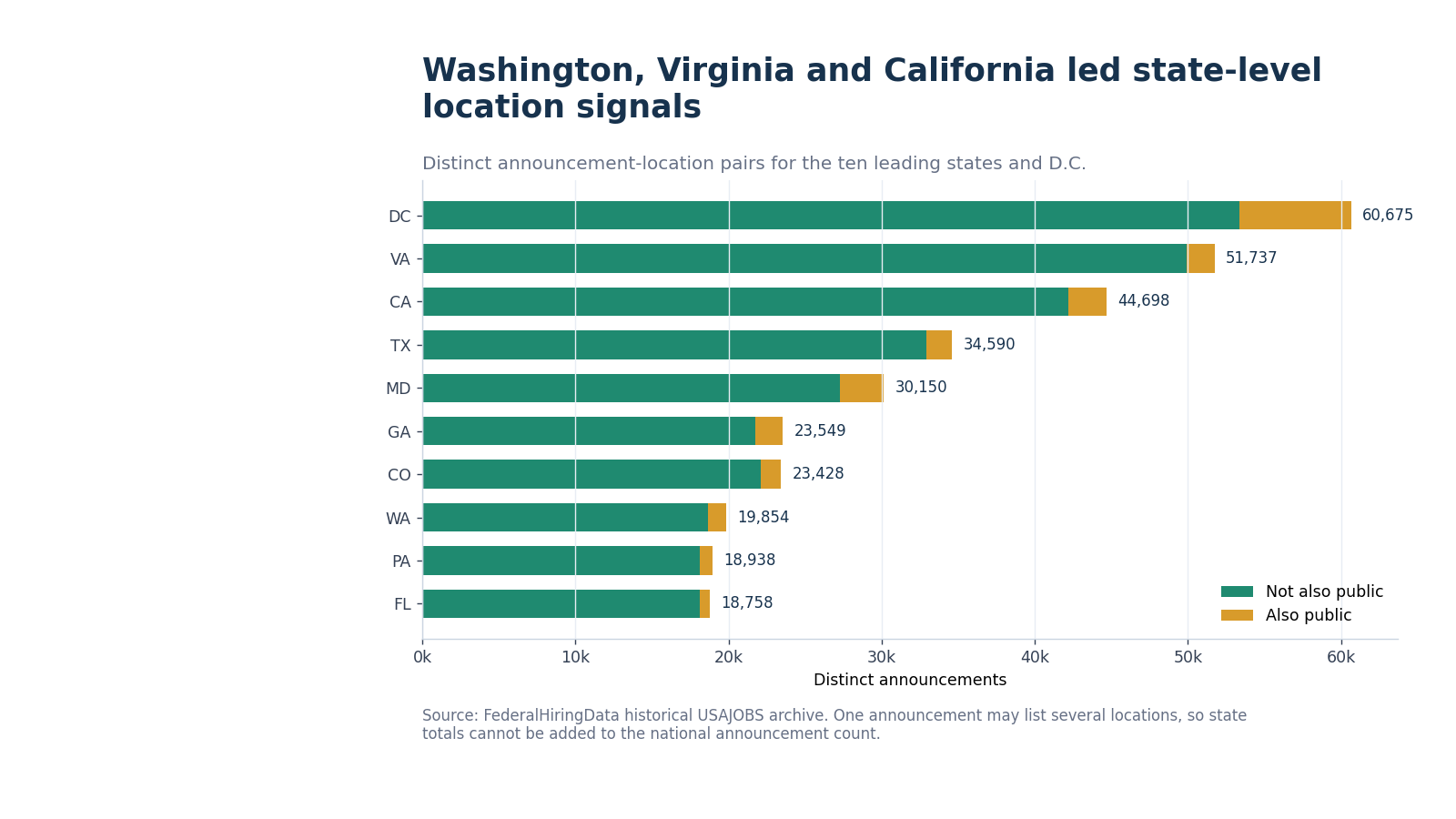
These are location signals, not a second national total. A single announcement can list Washington and several field locations, or dozens of duty stations nationwide. FederalHiringData counts a control once within each location but does not force a multi-location posting into one state. Adding the bars would double count announcements.
Federal Hiring Data Weekly
Get the biggest federal workforce changes in your inbox.
Subscribe to Federal Hiring Data Weekly for federal hiring trends, salary data, agency movements, and original investigations, with email confirmation before delivery.
The city-level results reinforce the distinction. Washington was the largest named city signal. The archive also contains remote nationwide entries and location-negotiable entries, along with large installation-specific totals at Hill Air Force Base, Fort Belvoir, Robins Air Force Base, Wright-Patterson Air Force Base and Tinker Air Force Base.
A historical location does not mean a job is open now. Readers searching for current opportunities should use the FederalHiringData jobs search and confirm the current announcement on USAJOBS. Duty locations, remote status and closing dates can change from one announcement to the next.
Most announcements also named veterans and status candidates
The disability path rarely stood alone. Of the 565,553 disability-path announcements, 551,246 also carried a veterans path and 540,270 carried at least one federal or status-related path. Another 269,742 named a separate special-authority path. Only 29,731 also named the public.
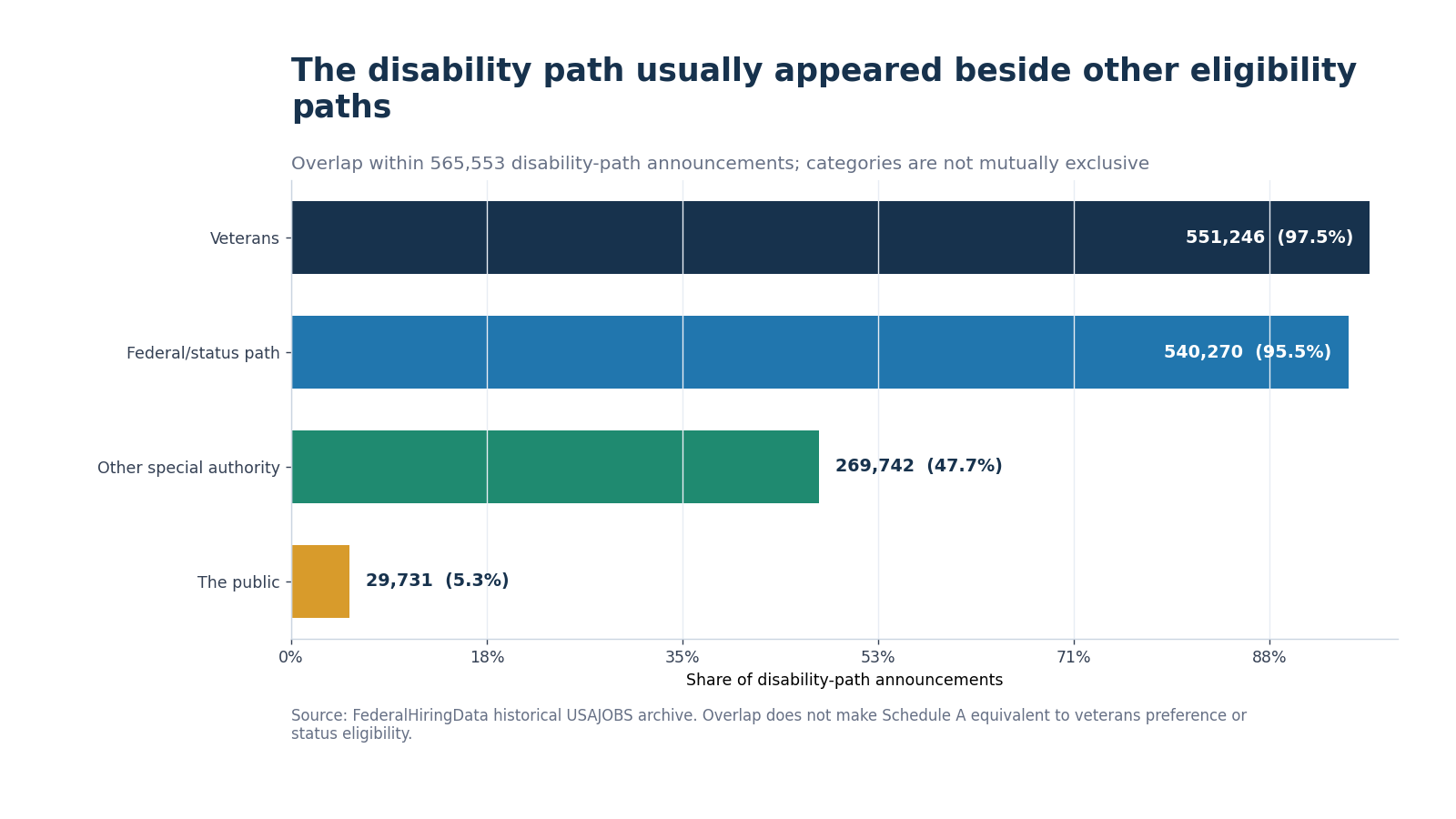
The categories overlap with one another, so they cannot be added. An announcement might be open to individuals with disabilities, veterans, current competitive-service employees, displaced employees, military spouses and other special authorities at the same time.
This overlap explains two common applicant mistakes. First, seeing the veterans icon beside the disability icon does not turn Schedule A into veterans preference. They are separate legal paths. Second, seeing several paths does not allow every applicant to use every one. Each candidate must establish eligibility under at least one applicable route and submit the documents required for that route.
USAJOBS presents the icons as a navigation and eligibility system. The agency's Clarification from the agency text can narrow or explain the listed groups. Applicants should read that text before assuming an icon alone settles their eligibility.
Proof of disability establishes eligibility, not medical detail for a hiring manager
Under 5 CFR 213.3102(u), an agency can make a permanent, time-limited or temporary appointment of a person with an intellectual disability, severe physical disability or psychiatric disability. Before making the appointment, the agency must require proof that the person falls within the authority.
OPM says acceptable documentation can come from a licensed medical professional, a licensed vocational rehabilitation specialist, or a federal, state or local agency that issues or provides disability benefits. USAJOBS likewise tells applicants to provide a proof-of-disability letter.
The EEOC guide says the letter generally needs to establish Schedule A eligibility, not describe the applicant's specific disability, medical history or need for accommodation. An agency can request additional documentation, but a candidate should follow the exact Required Documents section rather than volunteering unnecessary medical detail.
Applicants can apply through USAJOBS and can also contact an agency's Selective Placement Program Coordinator or Disability Program Manager. That contact can explain agency procedures and help ensure the application is considered through the appropriate path. It is not a substitute for submitting a complete application by the deadline.
Reasonable accommodation is related but separate. An applicant can request an accommodation for the application or interview process. Schedule A eligibility concerns the hiring authority; accommodation concerns access to the process or the ability to perform the job with an appropriate workplace change.
Appointment and conversion remain agency decisions
The regulation allows several appointment forms. An agency may make a permanent or time-limited appointment when it has the required proof and determines the person is likely to succeed in the job. It may use a temporary appointment to observe job readiness or when the work itself is temporary.
OPM says a Schedule A employee may be subject to a probationary period lasting up to two years, depending on the appointment. The employee is held to the same performance standards as other employees.
After at least two years of satisfactory service under a non-temporary Schedule A appointment, an employee may be eligible for noncompetitive conversion to the competitive service. 5 CFR 315.709 also requires a supervisor's recommendation, compliance with the other governing conditions, and conversion without a break of one workday.
Conversion is not automatic. The EEOC guide says the agency retains discretion. Time spent in a temporary appointment used for temporary work does not count toward the two-year conversion requirement under the regulation.
Those downstream rules are another reason not to equate the USAJOBS path with a completed employment action. The path can tell an eligible person, “you may apply.” It cannot tell the public, “this agency appointed someone under Schedule A,” much less that the person later converted.
The public data cannot count Schedule A appointments directly
FederalHiringData audited the available announcement appointment and service fields. They are missing for 548,121 disability-path controls, 96.9% of the set. Where values exist, they describe the advertised appointment or service, not the authority an agency ultimately used for an individual personnel action.
Only 12 stored audience records literally included the words Schedule A. That does not mean the authority was nearly absent. Modern USAJOBS data normally uses the normalized `disability` code, while older records commonly use Individuals with disabilities. USAJOBS itself says that path is for people eligible under Schedule A.
Nor can public workforce disability counts fill the outcome gap. OPM explains that Standard Form 256 disability information is collected for workforce-demographic purposes and is Privacy Act protected. Employees can voluntarily self-identify even when they were not seeking Schedule A consideration. Disability status is not the same variable as appointment authority.
A defensible direct appointment count would require personnel-action data that consistently identifies the appointing authority at the needed level. The public fields used here do not provide that. The article therefore reports announcement access and stops there.
Methodology and limitations
FederalHiringData ran a read-only production query over the historical USAJOBS archive and the non-overlapping canonical Job table. The unit was a distinct control number, not a location row or snapshot. Historical controls were selected from March 1, 2017 forward; a canonical Job control was added only if it was absent from the historical archive.
The classifier inspected normalized hiring-path and `whoMayApply` fields. It required an explicit disability-path or public-path signal. Generic equal-opportunity statements and incidental uses of disability language elsewhere in an announcement did not qualify.
Agency, occupation and grade rankings use distinct controls within each grouping. Location analysis uses distinct control-location pairs because one announcement can name several places. Annual and monthly series use the announcement opening timestamp. March-December 2017 is partial, and post-2024 archive collection is incomplete.
FederalHiringData separately reviewed current guidance from USAJOBS, OPM's disability-employment office, the Code of Federal Regulations and the EEOC applicant guide. Rules were treated as verified facts; archive totals were treated as FederalHiringData calculations.
The analysis does not observe vacancies when an announcement omits them, applications, referrals, interviews, selections, appointments, hires, probation outcomes or conversions. It does not infer disability status about any applicant or employee.
The hero photograph shows a Naval Surface Warfare Center Philadelphia Division career fair targeted to Schedule A candidates and wounded warriors on Oct. 23, 2019. It is a public-domain U.S. Navy image by Petty Officer 1st Class John Banfield, distributed through DVIDS.
The icon is a door, not a destination
For an eligible applicant, the disability hiring path can reveal a large part of the federal job market that is invisible to a public-only search. The archive's 535,822 disability-path announcements without a public path make that practical value measurable.
But the icon does not finish the application. The candidate still has to document eligibility, meet every qualification, provide the required materials and persuade an agency to select them. The agency still has to decide whether to use Schedule A. An appointment and any later conversion remain separate decisions.
The best use of the data is therefore neither to minimize the path nor oversell it. Search with the Individuals with disabilities filter, then read each announcement as its own set of rules: This job is open to, Clarification from the agency, Qualifications, Required Documents and How to Apply. The path can open a door that is closed to the public. It cannot promise what happens after a person walks through it.
Related research
More from FederalHiringData
Hiring processAugust 17, 2026
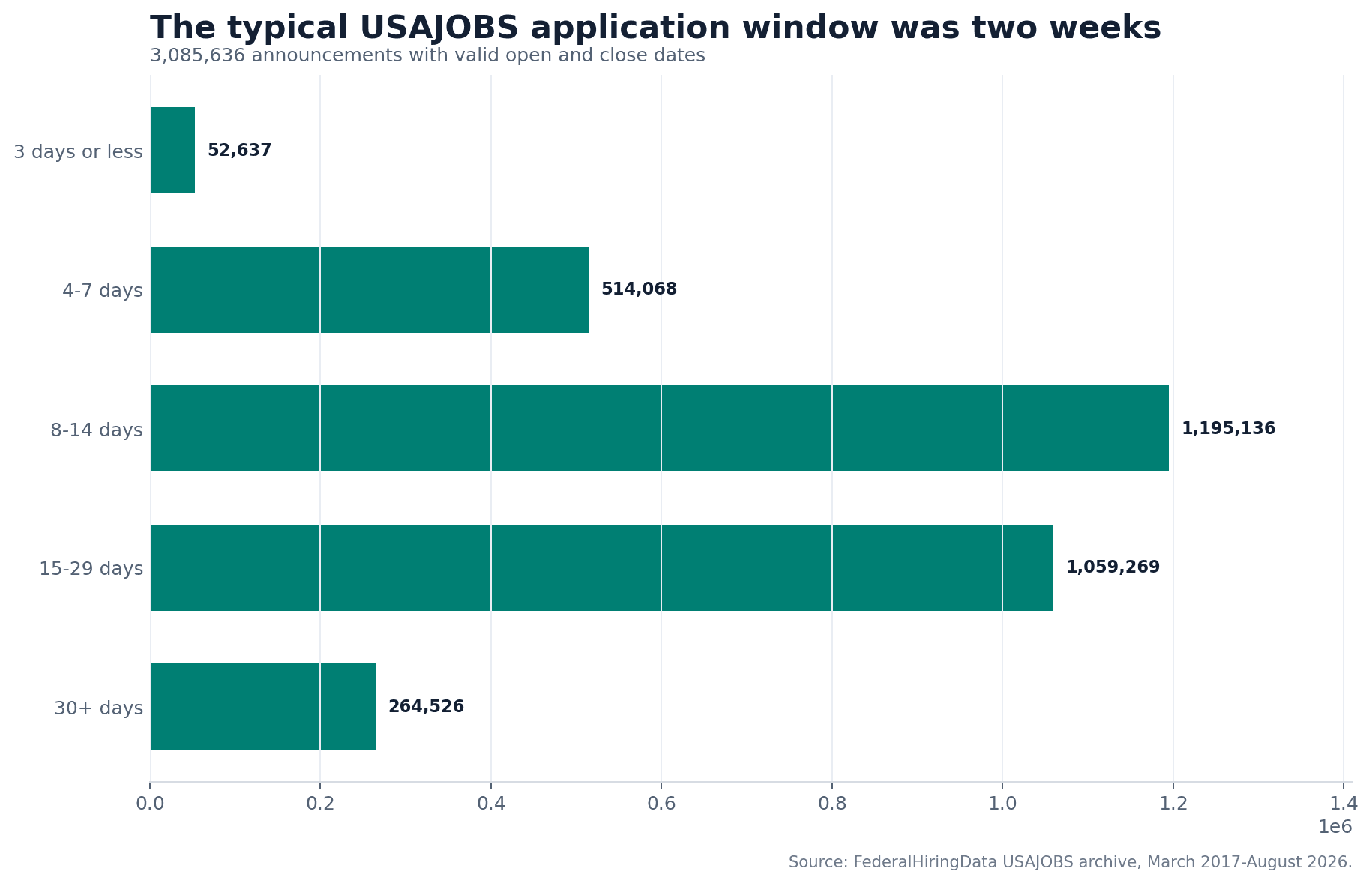
How Long USAJOBS Announcements Stay Open: 3.09 Million Records
Across 3,085,636 announcements, the median application window was 14 days and 566,705 closed within a week.

Data investigationsAugust 25, 2026
The Nuclear Regulatory Commission Recorded 215 Engineering Separations in 2025. It Recorded 17 Accessions.
NRC's two largest engineering series recorded 215 separations and 17 accessions in 2025 as advanced-reactor applications and engagements expanded.

Data investigationsAugust 23, 2026
The Secret Service Added 451 Employees. GAO Still Wants Proof Its Agents Can Train Enough.
Secret Service headcount grew 5.6% after June 2024, but the current protective-training rate and revised staffing requirement remain undisclosed.
Federal Hiring Data Weekly
Get the biggest federal workforce changes in your inbox.
Subscribe to Federal Hiring Data Weekly for federal hiring trends, salary data, agency movements, and original investigations, with email confirmation before delivery.