August 27, 2026
181,700 USAJOBS Announcements Used Applicant Cutoffs. Remote Postings Used Them Far More Often.
FederalHiringData found 181,700 official applicant-cutoff announcements since 2019, with especially heavy use in remote, emergency and park recruiting.
Published August 27, 2026Last edited August 27, 2026
A USAJOBS announcement can advertise a closing date weeks away and still stop accepting applications tonight.
The deciding number may be 50, 75, 100 or 200 applications. Once the agency reaches its stated threshold, USAJOBS says the announcement will usually close at 11:59 p.m. Eastern time that day. The listed date becomes an outer boundary, not a promise that the Apply button will remain available until then.
This is not a rare footnote in federal recruiting. FederalHiringData identified 181,700 distinct announcements using USAJOBS' official Applicant Cut-Off closing type from 2019 through Aug. 27, 2026. The share of announcements with a known closing type rose from 5.28% in 2019 to 9.37% in 2024 before falling to 6.05% in 2025. The partial 2026 share was 7.61%.
The practice was also sharply concentrated. Federal Emergency Management Agency announcements used applicant cutoffs in 92.29% of cases with a known closing type. National Park Service used them in 55.29%. Announcements with a confirmed remote location signal used them in 41.71%, compared with 6.55% when no remote location was confirmed.
Those numbers come from a closing rule, not an applicant counter. They cannot reveal whether an announcement actually reached its threshold, how many people completed the agency's application, how many were eligible or qualified, who was referred, or who was hired. But they do show where federal applicants face a race against a number that is separate from the date printed near the top of the page.
A cutoff is a closing rule, not a headcount
USAJOBS recognizes three announcement closing types: a fixed closing date, an open-continuous announcement and an applicant cutoff. Its closing-types guide explains that an applicant-cutoff announcement closes when the hiring agency receives a stated number of applications. If that number is reached during the day, the site usually remains open until 11:59 p.m. Eastern time.
OPM's Delegated Examining Operations Handbook adds an important operational detail. When an open period is defined by a number of applications, the announcement should state the trigger, and the agency should accept and process applications received through close of business on the threshold day, or through 11:59 p.m. Eastern time for electronic filing.
That end-of-day rule prevents a literal first-100 interpretation. An announcement with a 100-application trigger can receive more than 100 applications because submissions made later on the same day may still be accepted. It also means a person who sees the limit has not necessarily lost the opportunity simply because the counter was reached earlier that afternoon.
The word "applicant" introduces another distinction. USAJOBS says the applicant number displayed for some closed jobs counts people who started through USAJOBS and continued to the hiring agency. The number may not represent completed applications, and agencies choose whether to display it. That optional post-closing number is not interchangeable with the advance closing threshold.
FederalHiringData therefore uses the structured official closing-type field to identify applicant-cutoff announcements. It does not use a visible applicant count as a substitute, and it does not treat phrases such as "multiple vacancies" or assessment page limits as application caps.
Use rose through 2024, then broke from the trend
The FederalHiringData historical USAJOBS archive begins in March 2017, but a long archive does not guarantee that every source field is usable from day one. Closing-type coverage was only 0.36% in the 2017 source rows and 43.38% in 2018. Those years cannot support a defensible annual share.
Coverage reached 99.97% in 2019 and was effectively complete after that. FederalHiringData uses 2019 as the trend start rather than turning missing early fields into false fixed-date announcements.

| Year | Applicant-cutoff announcements | Announcements with known closing type | Cutoff share |
|---|---|---|---|
| 2019 | 18,242 | 345,679 | 5.28% |
| 2020 | 19,796 | 323,700 | 6.12% |
| 2021 | 23,706 | 365,283 | 6.49% |
| 2022 | 30,720 | 435,752 | 7.05% |
| 2023 | 38,098 | 451,988 | 8.43% |
| 2024 | 34,357 | 366,624 | 9.37% |
| 2025 | 8,871 | 146,659 | 6.05% |
| 2026 through Aug. 27 | 7,910 | 103,902 | 7.61% |
The count peaked in 2023 while the share peaked in 2024. That difference matters: fewer total announcements in 2024 still produced a greater likelihood that a known closing type was an applicant cutoff.
The following year did not continue the climb. The 2025 share fell by 3.32 percentage points, and the partial 2026 rate recovered only part of that decline. FederalHiringData did not identify a public USAJOBS policy change that explains the break, and this analysis does not assign it to federal hiring restrictions, applicant behavior or agency workload. Annual announcement composition changed, and the data describe the result rather than its cause.
The 2025 total combines nonoverlapping canonical archive records and newer enriched Job records. The 2026 total is current through publication, not a full-year projection. Neither year should be compared as if every month were observed equally.
FEMA and parks used cutoffs as routine machinery
The Veterans Health Administration had the largest raw count: 42,658 applicant-cutoff announcements from 2019 through the current data. VHA also published far more announcements than most organizations. Its cutoff share was 7.24%, close to the cross-agency level.
FEMA and the National Park Service were different. Their shares show that applicant cutoffs were not occasional exceptions but central parts of their announcement patterns.

| Source agency name | Applicant-cutoff announcements | Known closing types | Cutoff share |
|---|---|---|---|
| Veterans Health Administration | 42,658 | 589,411 | 7.24% |
| Federal Emergency Management Agency | 20,889 | 22,635 | 92.29% |
| National Park Service | 18,897 | 34,181 | 55.29% |
| U.S. Marine Corps | 8,282 | 51,358 | 16.13% |
| Bureau of Land Management | 4,953 | 17,303 | 28.63% |
| Veterans Benefits Administration | 3,646 | 16,084 | 22.67% |
| Defense Information Systems Agency | 3,378 | 7,984 | 42.31% |
| DHS Headquarters | 3,314 | 4,746 | 69.83% |
| U.S. Census Bureau | 2,943 | 11,312 | 26.02% |
| Food and Drug Administration | 2,045 | 7,842 | 26.08% |
Two different stories sit in that table. VHA's size produces the largest volume. FEMA's announcement design produces the most extreme repeated use among large agencies. A high count is not necessarily a high share, and a high share does not reveal the number of applications behind each announcement.
The agency names are the exact source display names carried in the historical data after the archive's canonical control-number join. FederalHiringData did not merge organizations into broad department families for this ranking. That preserves operational differences but means readers should not sum related components and call the result a department total.
The strong park signal also appears below the agency level. Park Ranger series 0025 recorded 3,203 cutoff announcements among 7,032 announcements with known closing types, a 45.55% share. Seasonal work helps explain why the series appears often in the validation records, but the dataset does not establish agency intent or applicant demand for any individual vacancy.
Administrative and emergency series carried the largest burden
The highest occupation-series counts were not concentrated in one profession. Miscellaneous Administration and Program series 0301 led with 17,053 applicant-cutoff announcements. Management and Program Analysis series 0343 followed with 15,602, Information Technology Management series 2210 with 11,417, and Human Resources Management series 0201 with 8,587.

Emergency Management series 0089 is the sharper result. It had 5,940 cutoff announcements among 10,218 with a known closing type, or 58.13%. That aligns with FEMA's agency pattern without proving that every emergency-management announcement came from FEMA or used the same recruiting strategy.
Other prominent series included Nurse 0610 with 5,389, Medical Support Assistance 0679 with 4,919, Park Ranger 0025 with 3,203, and Contracting 1102 with 2,827. A single announcement can list multiple occupational series, so series rows cannot be added together to recreate the 181,700 unique announcement total.
Cutoffs also appeared throughout the General Schedule grade range. After normalizing leading-zero variants and restricting the comparison to numeric starting grades 1 through 15, grade 13 had the largest count at 23,971. Grade 14 had the highest share, 11.00%, followed by grade 15 at 9.78% and grade 13 at 9.45%. The pattern is not confined to entry-level work: grade 5 had 14,585 cutoff announcements, grade 7 had 16,019 and grade 9 had 18,633.
Grade alone is an imperfect job-level measure. Some announcements span grades, some use non-GS systems, and a number without its pay system can be misleading. The analysis uses normalized starting grades only for a bounded comparison and does not relabel every row as GS.
Advertised annual salary intervals were modestly higher in the cutoff group. Among plausible per-year records, cutoff announcements had a median advertised minimum of $74,854 and maximum of $109,908. Fixed-date announcements had medians of $70,834 and $101,316. These are advertised ranges, not employees' actual payroll salaries, and the comparison does not control for occupation, grade, location or year.
Fifty and 100 dominated the numeric limits we could verify
The official closing-type code reveals that an applicant cutoff exists. It does not always carry the number that triggers closure. That number usually lives in free-form announcement text.
Federal Hiring Data Weekly
Get the biggest federal workforce changes in your inbox.
Subscribe to Federal Hiring Data Weekly for federal hiring trends, salary data, agency movements, and original investigations, with email confirmation before delivery.
FederalHiringData could not responsibly reconstruct a numeric-cap series across the full archive. The retained historical search text is compact discovery material, not the complete announcement body. Treating it as full text would undercount older limits and create a false trend.
The newer enriched layer is different. It contains announcement text for 8,203 official cutoff rows in 2025 and 2026. FederalHiringData applied a conservative parser to phrases tying a number directly to applications, applicants, receipt, acceptance or closure. It recovered one unambiguous numeric cap in 1,475 announcements, or 17.98% of the official cutoff rows.

| Stated limit | Parsed announcements | Share of parsed numeric caps |
|---|---|---|
| 50 | 449 | 30.44% |
| 100 | 445 | 30.17% |
| 200 | 140 | 9.49% |
| 75 | 128 | 8.68% |
| 150 | 85 | 5.76% |
| 25 | 77 | 5.22% |
| 30 | 33 | 2.24% |
| 250 | 28 | 1.90% |
Limits of 50 and 100 accounted for 894 of the 1,475 parsed rows, or 60.61%. Real records in the validation set included National Park Service seasonal announcements capped at 50, 60, 75, 100 and 200, and Supreme Court Senior Judicial Assistant announcements with a stated 250-applicant limit.
The parser deliberately excluded four records with multiple or contradictory values. Two contained phased limits of 100, 200, 300 and 400; another contained both 100 and 600; one contained 100 and 120. Forcing a single number from those announcements would make the distribution look cleaner and less accurate.
A manually reviewed sample of 120 parsed records produced 120 true positives and no false positives. That supports high precision in the records included. It does not prove perfect recall. More than four-fifths of official cutoff rows did not yield a single numeric value under the conservative rules, and those rows remain outside the distribution.
This is the practical difference between a defensible subset and a manufactured full-history number. FederalHiringData can say that 50 and 100 dominated the limits it could parse in enriched 2025-2026 text. It cannot say they dominated every applicant cutoff since 2019.
Shorter advertised windows do not prove faster closure
Applicant-cutoff announcements had a median advertised window of nine days from open date to listed close date. The middle half ran from six to 14 days. Fixed-date announcements had a 13-day median and a seven-to-17-day interquartile range.

There were 28,318 cutoff announcements whose advertised outer window was five days or less, compared with 173,788 fixed-date announcements. The raw counts are not comparable without their much different denominators: the fixed-date universe was about 13 times larger.
Most importantly, these are listed dates. The archive does not provide a reliable timestamp showing when the threshold was reached or when the Apply button disappeared. An announcement advertising 30 days may have closed on day two, may have remained open for the full period, or may have been amended. The nine-day median therefore describes how agencies designed the outer window, not actual time-to-cutoff.
It also cannot be converted into hiring speed. Closing an announcement is followed by eligibility and qualification review, assessment, referral, selection, tentative offer, suitability or security work, and onboarding. An application cutoff can reduce the intake universe without making any of those later stages faster.
Remote recruiting was the clearest concentration
The strongest cross-cutting association involved location. Among 41,150 archive announcements with an explicit remote-job or Anywhere in the U.S. location signal, 17,162 used the Applicant Cut-Off type. That is 41.71%.
Among 2,387,336 announcements without a confirmed remote location signal, 156,335 used it, or 6.55%.

Telework is not counted as remote. A position can permit employees to work away from the office on some days while still requiring a duty station. FederalHiringData's remote group requires an explicit source location signal, and the comparison is limited to the historical source years supporting the location analysis.
Related research
Put this finding in context
Hiring processAugust 17, 2026
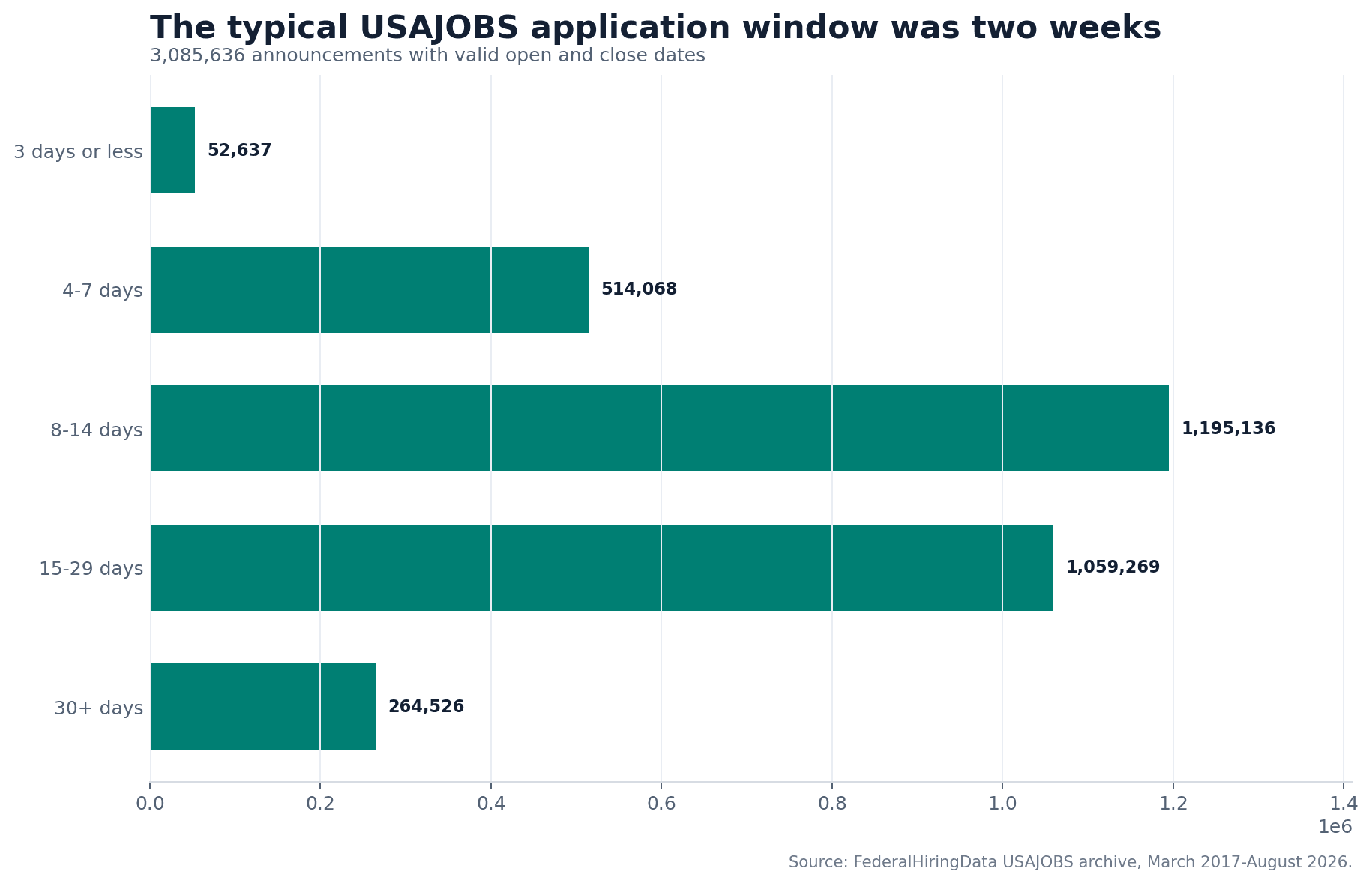
How Long USAJOBS Announcements Stay Open: 3.09 Million Records
Across 3,085,636 announcements, the median application window was 14 days and 566,705 closed within a week.

Hiring processAugust 26, 2026
USCIS Recruiting Rebounded 153%. Immigration Services Officer Postings Rose by Three.
USCIS recruiting rebounded from its early-2025 low, but frontline Immigration Services Officer and asylum-officer postings remained sparse.
The gap is consistent with agencies anticipating broad interest in geographically unrestricted announcements, but applicant volume is not present in the dataset. The analysis cannot show whether remote postings attracted more people, whether agencies set lower limits for them, or whether the cutoff itself changed who applied. It reports only that the two source features appeared together much more often.
Hiring paths showed a smaller difference. Public-only announcements used applicant cutoffs in 8.71% of known cases. Internal or federal-employee paths without a public path used them in 6.30%. Announcements listing both public and internal/federal paths were at 6.63%, while other or missing path combinations were at 5.62%.
Direct hire was not a major dividing line in the conservative test. Among 14,571 archive announcements whose titles explicitly contained direct-hire language, 1,202 used applicant cutoffs, or 8.25%. Titles without that language were at 7.14%. Because agencies do not label every authority in the title, this is a title-signal comparison, not a complete direct-hire census. Readers can see the separate FederalHiringData explainer on what Direct Hire means and what title-labeled announcements reveal.
Geography partly reflected agency and occupation mix. The District of Columbia had 31,688 cutoff announcements and a 16.45% share among location-expanded records with known closing types. Texas had 19,571 and an 11.54% share. Virginia had 14,663 at 7.35%, California 12,275 at 5.93%, and Maryland 9,735 at 7.64%. Multi-location announcements can appear in more than one state, so state counts are not a unique national total.
What a job seeker can do with this information
An applicant cutoff changes timing, not qualification standards. It rewards readiness because the effective deadline can move forward.
Read the closing type before relying on the date. The overview should identify Application cut-off when an application limit is in use. Search the announcement for "first," "applications," "applicants," "limit" and "cut-off" to find the operational language.
Treat the listed close date as the latest possible date. If the announcement says it may close at a threshold, prepare around the opening date. A saved USAJOBS search can alert you, but it does not reserve a place in the application pool.
Finish the agency steps. USAJOBS may transfer an applicant to an agency system for questionnaires, documents or other requirements. USAJOBS advises applicants to return to their profile after submission and confirm that the hiring agency received the application. Starting is not the same as completing.
Do not read a cap as your odds. A 100-application limit is not 100 completed, eligible or qualified candidates. End-of-day acceptance can push the total above the trigger. Veterans' preference, eligibility, qualifications, assessments and category-rating rules still operate after receipt.
Preserve the record. Save the announcement and submission confirmation. If the agency later amends or closes the posting, those records help document what instructions applied when you submitted.
Do not sacrifice accuracy for speed. A fast but incomplete resume or missing document can fail agency review. The useful strategy is to maintain a current federal resume, transcripts and eligibility documents before the opening appears, then tailor and submit promptly when a relevant cutoff announcement opens.
The USAJOBS application-process guide describes the transfer to the hiring agency and later review stages. FederalHiringData's current jobs search can help identify open announcements, while the statistics page describes the archive's broader scope.
Methodology and limitations
FederalHiringData joined retained official historical USAJOBS parquet fields to the canonical promoted controls in its local historical archive. The join produced 2,984,987 rows and the same number of distinct control numbers, with zero duplicate controls. The archive source layer begins March 1, 2017.
The primary long-run measure is the official `announcementClosingTypeCode` value `03`, described as Applicant Cut-Off. Annual denominators include only announcements with a known official closing type. Because coverage was inadequate in 2017 and 2018, trend analysis begins in 2019. Current enriched Job records were added only where they did not overlap the archive controls.
Agency names remain exact source display identities. Occupation and state analyses expand source arrays, so one multi-series or multi-location announcement can contribute to multiple rows. Grade analysis normalizes numeric starting grades 1 through 15 but does not infer a pay system. Salary comparisons include plausible annual intervals only. Advertised pay is not actual payroll pay.
The remote classification requires explicit remote-job or Anywhere in the U.S. source location text. Telework eligibility alone does not qualify. The direct-hire comparison uses explicit title language and is intentionally conservative. Neither classification identifies applicant demand or agency motive.
For numeric limits, FederalHiringData parsed only the enriched 2025-2026 announcement-text layer. Rules required a number tied directly to applications, applicants, receipt, acceptance, reach or closure. Values below five or above 10,000 were rejected, and rows with more than one distinct candidate value were excluded. A 120-record manual validation sample found no false positives. High observed precision does not establish complete recall.
The archive does not contain a reliable actual-close timestamp, applicant count for every announcement, completed-application count, qualification result, referral, selection, offer, hire or onboarding record. Announcement counts are not vacancies or hires. Cutoff shares are descriptive associations and should not be read as causal effects.
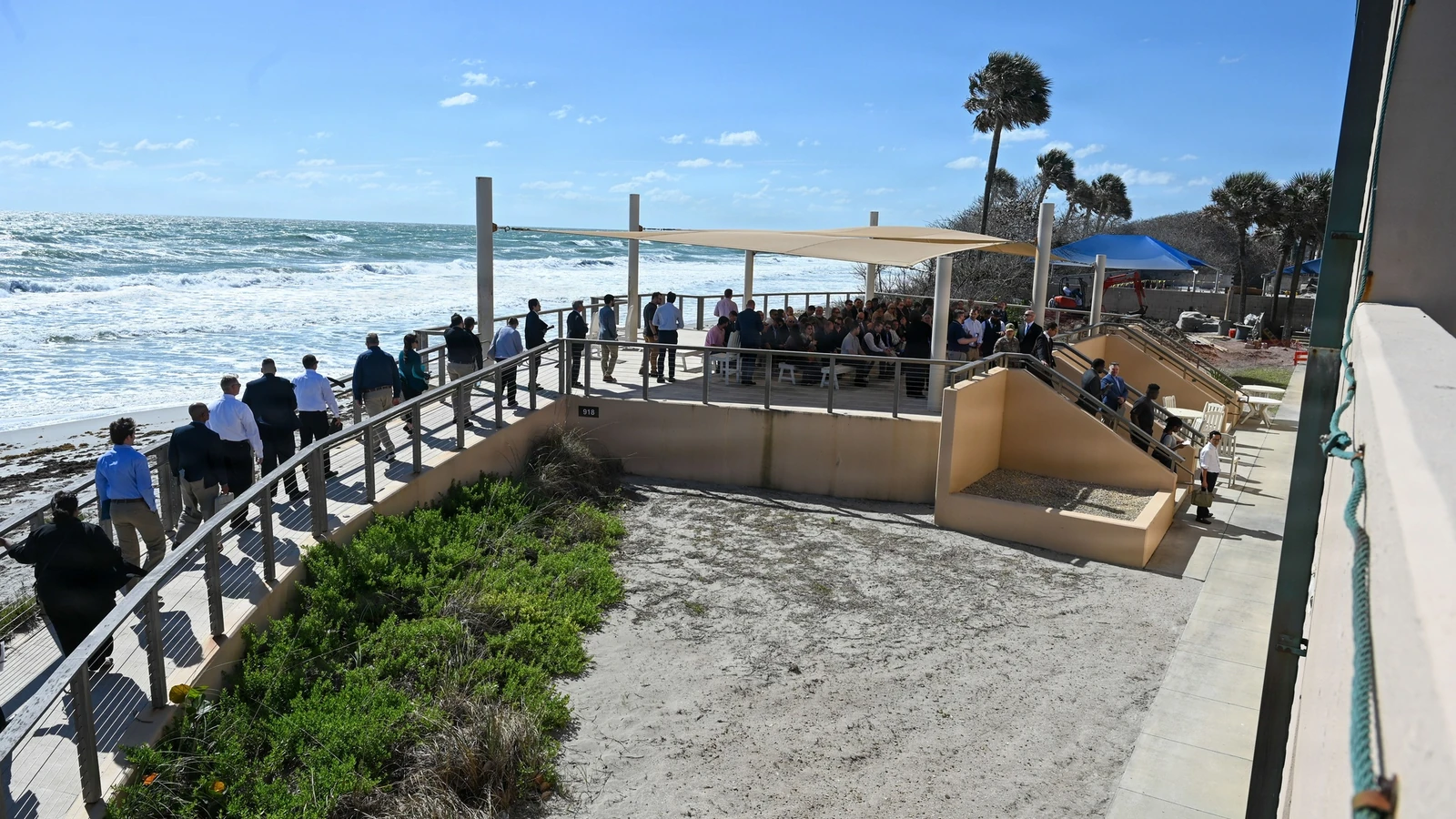
Hero image: attendees line up at a Space Training and Readiness Command civilian career fair at Patrick Space Force Base on April 21, 2026. Photo by Brandon Kalloo Sanes via DVIDS, public domain. The event image provides recruiting context; it is not evidence that a specific announcement used a cutoff.
The central finding is not that every federal job seeker faces a 50-application race. It is that applicant cutoffs became common enough to shape how people must read USAJOBS, and concentrated enough that the risk is much higher in particular agencies, occupations and remote searches. The date still matters. For 181,700 announcements since 2019, it was not the only deadline.
Continue reading
More from FederalHiringData

Hiring processAugust 17, 2026
What Direct Hire Means on USAJOBS, and What 16,320 Labeled Announcements Reveal
Engineering, IT and contracting led a conservative cohort of USAJOBS announcements with Direct Hire in the title. A 14-day median application window still does not measure selection speed.
Work arrangementsAugust 17, 2026
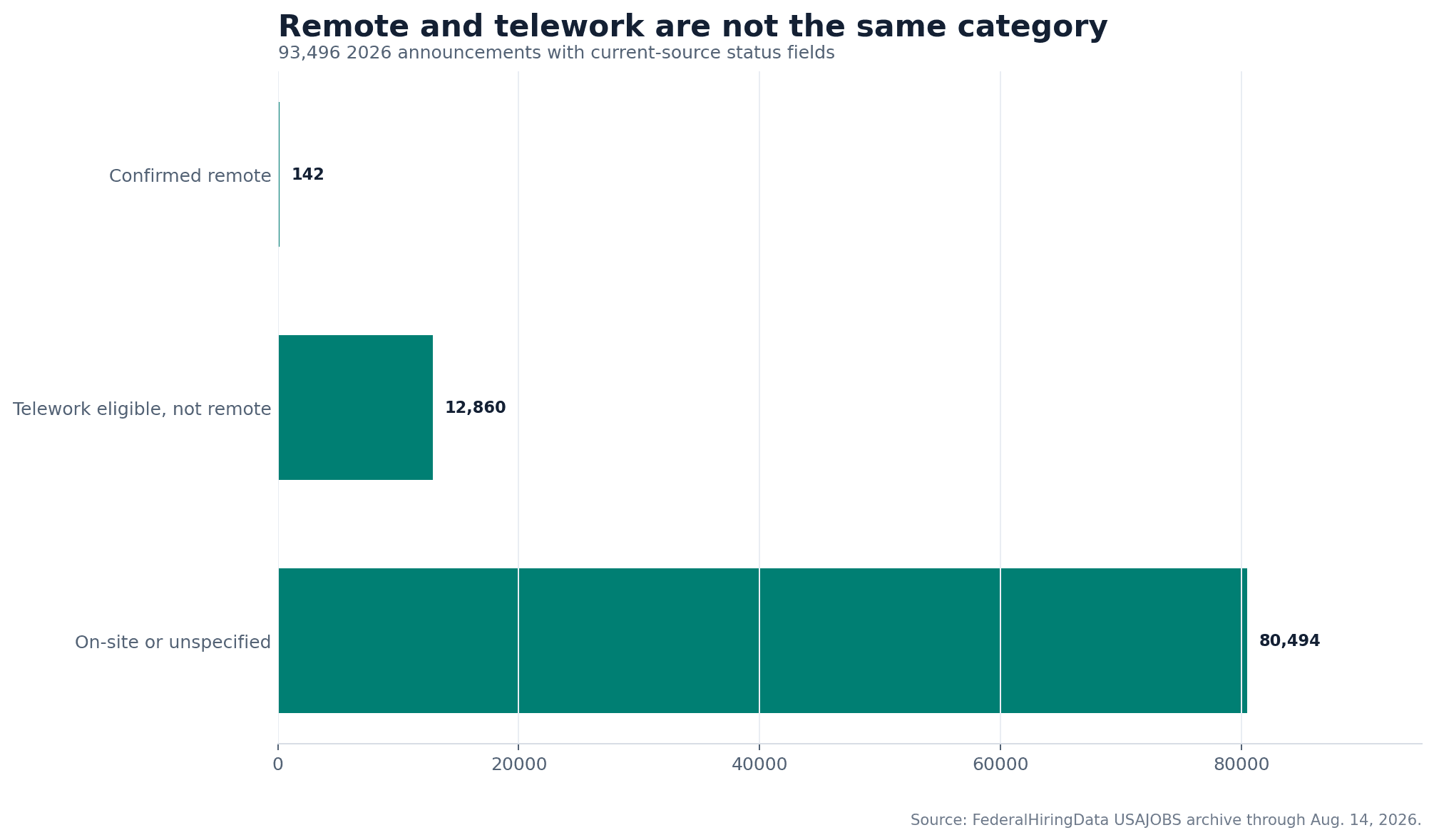
Remote Is Not Telework: What 93,496 Federal Announcements Show
Only 142 of 93,496 analyzed 2026 announcements were confirmed remote. Another 12,860 were telework eligible but not remote.

Data investigationsAugust 19, 2026
106,533 Applications, 2,610 Academy Graduates: Why the FAA Still Has a Controller Shortage
FAA has abundant applicant interest, but its audited funnel reaches only 2,610 Academy graduates before years of facility training. The binding constraint is certification capacity.
Federal Hiring Data Weekly
Get the biggest federal workforce changes in your inbox.
Subscribe to Federal Hiring Data Weekly for federal hiring trends, salary data, agency movements, and original investigations, with email confirmation before delivery.