August 26, 2026
USCIS Recruiting Rebounded 153%. Immigration Services Officer Postings Rose by Three.
USCIS recruiting rebounded from its early-2025 low, but frontline Immigration Services Officer and asylum-officer postings remained sparse.
Published August 26, 2026Last edited August 27, 2026

U.S. Citizenship and Immigration Services opened 453 job announcements from Jan. 1 through April 9, 2026. That was 153% more than the 179 announcements it opened during the same stretch of 2025.
The rebound looks dramatic until the jobs are separated by title.
Non-supervisory Immigration Services Officer announcements rose from 22 to 25. Non-supervisory asylum-officer announcements rose from two to four. Operations and mission-support announcements climbed from 13 to 56, while a broad collection of other USCIS roles rose from 65 to 199. The agency advertised more work, but the public recruiting channel did not return its largest frontline adjudication roles to their early-2024 pace.
That distinction matters because USCIS entered 2026 with a smaller covered workforce. FederalHiringData's analysis of Office of Personnel Management records found 20,241 USCIS employees in June 2026, down 2,551, or 11.2%, from a January 2025 peak of 22,792. Headcount had begun to recover from its December trough, but the June count remained below every monthly observation in 2024.
The result is a recruiting picture with two truths at once. USCIS did not stop hiring. Its announcement count recovered sharply from an unusually weak period. But the rebound was much broader in support, supervisory and miscellaneous roles than in the public-facing officer titles most closely associated with adjudicating immigration benefits and asylum cases.
This analysis does not measure authorized vacancies or actual hires. A USAJOBS announcement can cover one position, several positions, multiple grades or many locations. An OPM employee record counts a person already on board. Putting those sources together reveals the scale and composition of the agency's recruiting channel; it does not turn postings into appointments.
The rebound was real, but it started from a deep low
USCIS opened 2,399 distinct announcements in 2024 and 668 in 2025, a decline of 72.2%. The historical series shows that 2025 was not simply a continuation of a steady downward trend. The archive contains 2,572 USCIS announcements in 2019, only 401 in 2020, then between 1,817 and 2,550 in each year from 2021 through 2024.

FederalHiringData begins the annual chart with 2017 because the local historical USAJOBS archive starts on March 1 of that year. The partial 2017 count should not be compared with a full year. The chart stops at 2025 because 2026 is still in progress.
For a fair recent comparison, FederalHiringData used identical Jan. 1-April 9 windows. USCIS opened 671 announcements in that period in 2024, 179 in 2025 and 453 in 2026. The 2026 total was therefore 274 higher than the 2025 low, but still 218 lower than 2024.

The title mix explains why the percentage alone can mislead.
| Selected announcement group | Jan. 1-April 9, 2024 | Same period, 2025 | Same period, 2026 |
|---|---|---|---|
| All USCIS announcements | 671 | 179 | 453 |
| Immigration Services Officer | 122 | 22 | 25 |
| Supervisory ISO | 57 | 13 | 41 |
| Asylum officer | 20 | 2 | 4 |
| Supervisory asylum officer | 20 | 3 | 5 |
| Immigration services assistant | 50 | 7 | 32 |
| Operations / mission support | 70 | 13 | 56 |
| Attorney | 3 | 0 | 12 |
The non-supervisory ISO count increased by three from 2025, not by 153%. It remained 79.5% below the comparable 2024 count. Non-supervisory asylum recruiting doubled from two announcements to four, but four is too small a denominator to support a claim of broad recovery. Supervisory ISO announcements, assistants, attorneys and support roles accounted for more of the visible return.
The current-job snapshot points in the same direction without suggesting recruiting has stopped. At the production snapshot used for this article, FederalHiringData showed 49 active USCIS announcements: 15 Immigration Services Officer announcements, eight operations or mission-support announcements, three immigration services assistants, two other immigration-officer announcements, one asylum-officer announcement, one attorney announcement and 19 other USCIS roles.
Those 49 are current announcements, not current openings in the colloquial sense of 49 available seats. Some announcements use an indeterminate number of vacancies, and an announcement can serve more than one duty station.
USCIS employment fell quickly, then recovered modestly
The recruiting decline overlapped with a marked workforce contraction.
USCIS covered employment rose from 20,933 in January 2024 to 22,792 in January 2025. It then declined for eight consecutive monthly observations, reaching 21,962 in September. The largest break in the series came in October, when the count fell to 20,042. It reached 19,903 in December and 19,896 in January 2026 before rising to 20,241 by June.

The latest direction is important counterevidence. June was 338 employees above December. Describing USCIS as continuing an uninterrupted collapse would be wrong. Describing the workforce as restored would also be wrong: June remained 2,551 below the January 2025 peak and 692 below January 2024.
The broad General Inspection, Investigation, Enforcement, and Compliance series, 1801, followed a similar path. It fell from 11,434 USCIS employees in January 2025 to 10,289 in January 2026, then rose to 10,538 in June. The series represented just over half of the agency's covered workforce.
Series 1801 cannot be relabeled “Immigration Services Officers.” It is an OPM occupational family, while ISO is an announcement title. It can include different inspection, investigation, enforcement and compliance work. The title archive and personnel series are complementary measures, not interchangeable counts.
Longer-run data show how much USCIS's workforce model changed. Covered employment grew from 8,801 in September 2004 to 22,004 in September 2024. Series 1801 rose from 3,885 to 11,242. Administration and program, program analysis, compliance support, hearings and appeals, legal, information-technology and security occupations also expanded.

The recent contraction did not affect every occupation equally. Between September 2024 and June 2026, USCIS lost 704 employees in series 1801, 253 in Management and Program Analysis, 198 in Miscellaneous Administration and Program, 196 in Hearings and Appeals, 69 attorneys and 47 information-technology specialists. Compliance Inspection and Support, series 1802, gained 27.
That gain is another reason to avoid a single “frontline workforce” number. Occupational series, position title and organizational assignment answer different questions. A compliance-support employee may be essential to case processing without being an adjudicating officer. A person in series 1801 may not use ISO in a public vacancy title. Public data do not identify pending workload assigned to an individual employee.
The officer pipelines use different ladders
USCIS recruiting has historically used several recurring grade structures.
Among 2,926 non-supervisory ISO announcements in the local archive, the most common grade pair was GS-9 through GS-12, appearing in 1,015. Another 641 advertised GS-5 through GS-9, and 213 advertised GS-5 through GS-7. Separate one-grade announcements at GS-13 accounted for 559.
Immigration services assistants were concentrated lower: 721 of 1,525 announcements advertised GS-5 through GS-7, while 387 were GS-9-only. Title-labeled Fraud Detection and National Security officer announcements were concentrated higher, including 236 at GS-12 through GS-13, 192 at GS-14 and 181 at GS-11.

Asylum recruiting is more mixed. The most frequent non-supervisory pattern in the archive was a GS-13-only announcement, with 137. Another 61 spanned GS-9 through GS-12. In a March 2024 national engagement, USCIS said it was expanding the Asylum Officer 2 ladder from GS-9/11/12 to GS-7/9/11/12. Historical announcements contain that broader ladder, but the policy statement does not mean every asylum posting used it or that a vacancy remained continuously available.
Grades describe the advertised entry and promotion range, not a guaranteed path for every selectee. Promotion potential can depend on performance, position design, budget and agency action. An announcement that spans several grades may accept applicants at different qualification levels.
Recent advertised pay shows the practical difference between these pipelines. FederalHiringData calculated medians only from announcements with annual salary values and kept the minimum and maximum separately.
| Role | 2026 pay records | Median advertised minimum | Median advertised maximum |
|---|---|---|---|
| Immigration services assistant | 50 | $64,495 | $89,194 |
| Immigration Services Officer | 49 | $70,623 | $123,052 |
| Asylum officer | 10 | $76,463 | $118,204 |
| Operations / mission support | 81 | $69,373 | $116,362 |
| Attorney | 15 | $113,356 | $177,762 |
These are nominal announcement figures, not inflation-adjusted comparisons or payroll averages. Locality pay, grade, step, special rates and the advertised duty station affect the range. A maximum is not the salary a new hire should expect. The asylum median rests on ten records, so it is especially sensitive to the mix of announcements.
Recruiting geography was national, but role-specific
Federal Hiring Data Weekly
Get the biggest federal workforce changes in your inbox.
Subscribe to Federal Hiring Data Weekly for federal hiring trends, salary data, agency movements, and original investigations, with email confirmation before delivery.
USCIS's officer recruiting footprint was not evenly distributed.
Across the historical archive, Los Angeles appeared on 162 ISO announcements, followed by Dallas with 102, San Francisco with 92, Chicago with 82 and New York with 81. Fairfax, Sacramento, Fresno, Denver and Indianapolis each appeared on at least 66.
Asylum-officer recruiting was concentrated differently. New Orleans appeared on 114 non-supervisory asylum announcements, Bethpage on 109, Houston and Arlington on 104 each, Miami on 99, San Francisco on 96 and Chicago on 91.

Location counts are many-to-many. A single announcement posted for Los Angeles, San Francisco and Chicago contributes once to each location. The bars therefore do not sum to the number of announcements and should not be interpreted as vacancies by city.
The geography still matters to applicants. National totals can conceal whether a particular title is being recruited near a field office, service center or asylum office. A broad rebound can coexist with little opportunity in a particular labor market. Readers looking for current openings should use the live federal job search, because the archive in this analysis includes closed announcements.
The duty-station question has an operational side as well. USCIS's asylum office locator says that, beginning May 18, 2026, legal representatives generally may no longer participate remotely in affirmative asylum and certain related interviews. That practice affects interview participation, not the federal employee's official remote-work status. It should not be used to infer that an asylum-officer posting is on-site, remote or newly created unless the announcement itself says so.
Public access was narrower than the total announcement count
FederalHiringData identified 17,678 distinct USCIS control numbers across its production historical archive and current-job table at the research snapshot. The two stores had no overlapping controls.
Of those announcements, 3,601 carried a public hiring-path signal and 11,511 carried an internal or federal-employee signal. Another 253 carried a recent-graduate signal and 200 a student signal. Hiring-path signals can overlap, and source coverage is better in some years than others, so those values do not form an exhaustive partition.
The gap nevertheless prevents a common mistake: treating every USCIS announcement as an opportunity open to any member of the public. Some announcements are limited to current federal employees, agency employees, veterans, recent graduates, students or other eligibility groups. The title and salary can look identical while the eligible applicant pool is entirely different.
The pattern also varies by role. Among 2,939 ISO announcements in the production cohort, 664 had a public signal and 1,743 had an internal/federal signal. Among 1,532 assistant announcements, 690 had a public signal and 675 an internal/federal signal. Of 950 title-labeled FDNS announcements, only 41 carried a public signal while 649 carried an internal/federal signal. In the 304 non-supervisory asylum announcements, 86 carried a public signal and 159 an internal/federal signal.
These are announcement attributes, not applicant or selection counts. They do not reveal how many people were eligible, applied, qualified or accepted an offer.
Some announcements could close after 25, 50 or 100 applications
Opening an announcement to the public does not guarantee it will stay open through the displayed end date.
USAJOBS defines an Applicant Cut-Off closing type as one that can close on the day the stated application limit is reached. In the 810 newer-source USCIS job rows examined for this article, 199 used that closing semantic. FederalHiringData could parse an explicit numeric limit from 195 of them.
The most common limit was 50 applications, used in 67 announcements. Another 39 used 100, and 38 used 25. Fifteen announcements each used 75 and 150. Eleven used 200. The remaining parsed limits ranged from 15 to 250.

The count is deliberately narrow. FederalHiringData only parsed text explicitly identifying an application limit and the first stated number of applications. It did not infer caps from ordinary closing dates. The official USAJOBS closing-types guide warns that an applicant-cutoff announcement may close that day when the limit is reached.
USCIS's own application guide tells applicants to apply early and says only the first five pages of a resume are reviewed. Those are separate constraints: the application count affects whether a submission can enter the pool, while the resume-page rule affects what reviewers consider.
Related research
Put this finding in context
Work arrangementsAugust 17, 2026
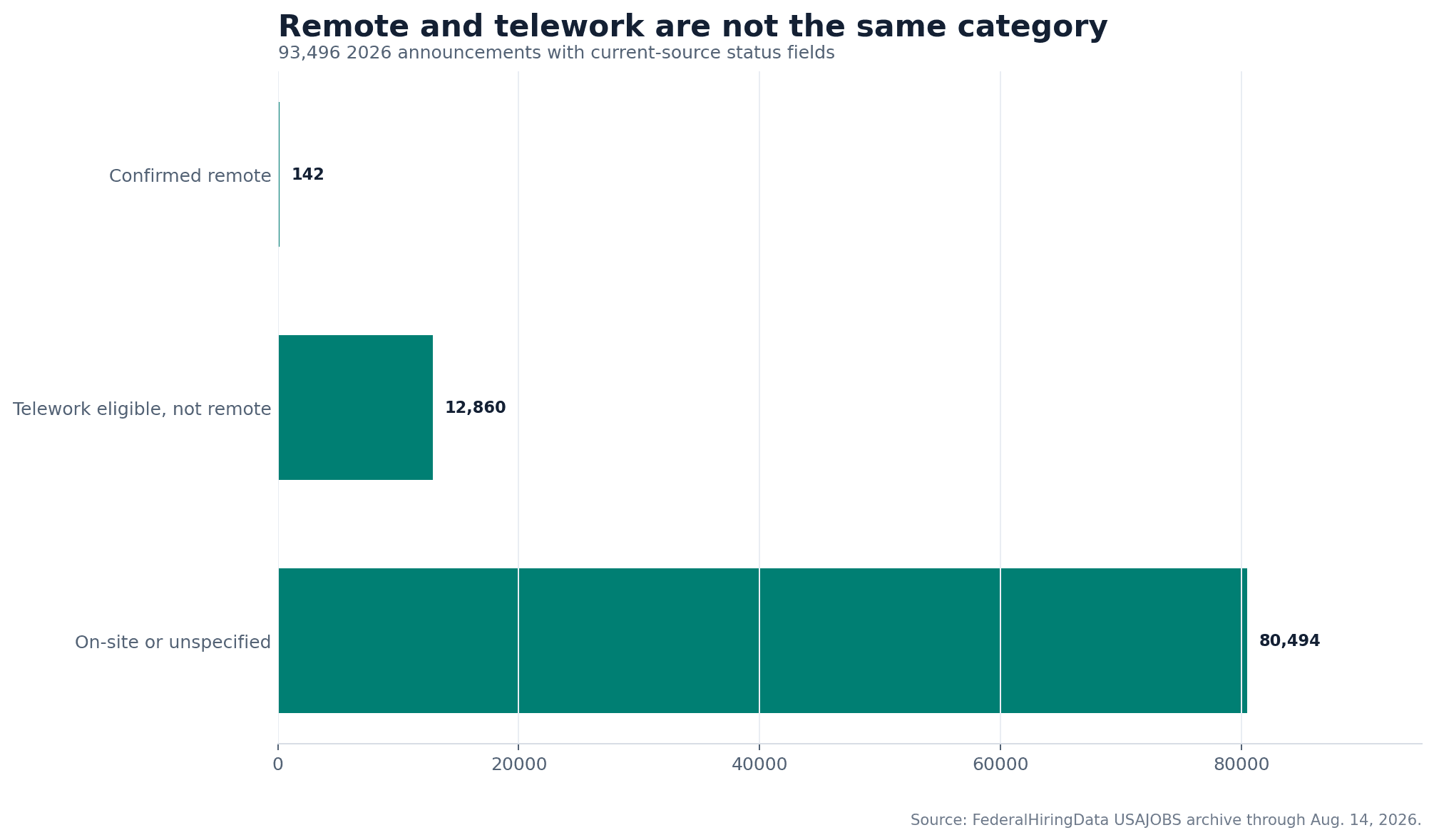
Remote Is Not Telework: What 93,496 Federal Announcements Show
Only 142 of 93,496 analyzed 2026 announcements were confirmed remote. Another 12,860 were telework eligible but not remote.

Data investigationsAugust 23, 2026
The Forest Service Set a 4-Billion-Board-Foot Timber Goal. Key Staff Fell 22%.
Timber sales rose 29% through June, but nine occupations needed to plan, contract and oversee forest projects had 1,445 fewer employees than in 2024.
The median open interval for most major USCIS title groups in the historical archive was ten calendar days. Attorneys had a 15-day median. A median is not a promise. An applicant-cutoff announcement can close sooner, and some postings remain open continuously or follow other closing rules.
The applicant lesson is practical and limited. Read the closing-type language, eligibility section, grade requirements and document rules before spending time tailoring a package. Submitting early can matter when a cap is explicit. It does not improve qualifications or guarantee review, referral, interview or selection.
What the data say about USCIS's recruiting recovery
The strongest evidence of recovery is the overall announcement count. In the same early-year window, USCIS advertised 274 more announcements in 2026 than in 2025. Covered employment also rose in each monthly observation from February through June 2026.
The strongest evidence against calling the pipeline restored is composition. Non-supervisory ISO recruiting increased by only three announcements from the 2025 low and remained 97 below 2024. Non-supervisory asylum recruiting increased by two and remained 16 below 2024. The agency's June headcount remained 11.2% below its January 2025 peak, while series 1801 remained 896 below its own peak.
Public access was another constraint. Only about one-fifth of the production USCIS announcement cohort carried a public signal, while nearly two-thirds carried an internal/federal signal. Those shares are descriptive, not a clean probability of public eligibility, because signals overlap and older source records can be incomplete. They are enough to show that a headline announcement count overstates the number of broadly open opportunities.
Applicant cutoffs narrowed the window further in part of the newer data. A posting advertised for ten days may have stopped accepting applications after the first 25 or 50 submissions. That is not evidence that USCIS hired 25 or 50 people. It is evidence that the initial applicant pool was bounded.
There is also counterevidence to a pessimistic reading. The agency still had 49 active announcements at the snapshot. ISO was the largest named role group among them. Assistants and support roles recovered substantially from early 2025. Compliance-support employment was slightly higher than in September 2024. The monthly workforce trend had turned upward.
Taken together, the record describes an incomplete, uneven recovery. USCIS reopened more recruiting channels after 2025's collapse, but the public-facing officer pipelines did not expand in proportion to the total. Whether that is sufficient for agency workload cannot be answered from announcement and personnel records alone.
What remains unknown
Public data do not disclose USCIS's complete position-control plan. FederalHiringData could not determine from these records:
- authorized positions, funded vacancies or internal staffing targets by office;
- applications received, qualified applicants, referrals, selections or offer acceptance;
- hires produced by each announcement or the time from posting to entry on duty;
- academy or job-training starts, completions and attrition;
- contractor staffing or work transferred between employees and contractors;
- case workload assigned to particular occupational series or offices;
- individual remote, telework or in-office schedules; or
- the extent to which internal announcements moved existing employees rather than adding staff.
Those missing denominators are why this article does not divide pending cases by employees or label a posting a hire. FederalHiringData previously analyzed the separate question of USCIS's pending and backlog measures in its caseload investigation. This analysis focuses on recruiting composition and covered employment.
A more complete public workforce account would connect funded positions, onboard headcount, accessions, separations, recruiting announcements, applicant pools, selections and office-level workload without exposing personal data. Until then, public announcements remain an early signal rather than a hiring ledger.
Methodology and limitations
FederalHiringData analyzed distinct USAJOBS control numbers associated with U.S. Citizenship and Immigration Services. Historical archive records use agency subelement code HSAB. Newer Search API records use the exact canonical agency identity and HSAB organization path; the parent Department of Homeland Security code alone was not sufficient. The production snapshot contained 16,868 historical rows and 810 current-table rows, with zero control-number overlap.
Role groups use conservative title text. “Immigration Services Officer” excludes supervisory titles. Generic “Immigration Officer” titles remain separate unless the title itself names Fraud Detection and National Security. “Asylum officer” excludes supervisory asylum titles. “Other USCIS role” is intentionally broad and is not treated as a frontline category.
The main recent comparison uses announcements opened from Jan. 1 through April 9 in 2024, 2025 and 2026. April 9 is a fixed complete-window cutoff selected for comparable coverage. The annual 2026 count is not used as a full-year total. One control number equals one announcement. Announcements do not equal vacancies, applications, selections, hires or onboard employees.
Workforce figures come from public OPM Federal Workforce Data and FedScope datasets. September observations are used for long-run anchors; June 2026 is the latest partial-year monthly observation used here. Counts describe covered federal civilian employees and exclude contractors. OPM occupation series are not announcement titles.
Salary medians use records with annual salary values and preserve advertised minima and maxima. They are nominal dollars, not inflation-adjusted pay or guaranteed offers. Location counts are many-to-many. Hiring-path signals can overlap. Applicant limits were parsed only from explicit application-limit text in newer-source records.
The production current-job and hiring-path snapshot was captured Aug. 26, 2026, Pacific time. Active counts can change after publication as announcements open or close. Source records and calculations were reviewed through Aug. 26.
Hero image: an official tour of USCIS in Camp Springs, Maryland, May 29, 2026; DHS photo by Mikaela McGee, U.S. Government Work.
Readers can browse current federal job announcements, review sitewide federal hiring statistics, explore the USCIS caseload and workforce investigation, or visit the full FederalHiringData article archive.
Continue reading
More from FederalHiringData
Data investigationsAugust 23, 2026
USCIS Had 12.1 Million Cases Pending. Its Formal Backlog Was 7 Million.
Receipts exceeded completions by 929,000 in the first half of fiscal 2026 as covered employment remained 11% below its January 2025 peak.

Data investigationsAugust 20, 2026
Federal Fire Staffing Rebounded in 2026. All of the Net Gain Came From Nonpermanent Appointments.
Interior built a new wildland fire service, but the Forest Service has not joined it. Federal records show the 2026 staffing rebound came entirely from nonpermanent appointments.

Data investigationsAugust 22, 2026
Real Contract Spending Rose 99% Since 2000. The GS-1102 Workforce Rose 50%.
Federal purchasing nearly doubled in real terms while the dedicated contracting workforce grew half as much, then contracted sharply after 2024.
Federal Hiring Data Weekly
Get the biggest federal workforce changes in your inbox.
Subscribe to Federal Hiring Data Weekly for federal hiring trends, salary data, agency movements, and original investigations, with email confirmation before delivery.