August 29, 2026
2,392 Active Federal Job Posts Spanned GS Steps 1-10. Higher Starting Pay Still Requires Approval.
FederalHiringData matched 2,392 active postings to complete GS step ladders and found 722 with explicit higher-starting-pay language.
Published August 29, 2026Last edited August 29, 2026

A federal job announcement can display a salary range wide enough to cover all 10 steps of a General Schedule grade. That does not mean every applicant can choose a number inside it.
FederalHiringData examined 6,700 active GS announcements and matched the cleanest salary ranges to the Office of Personnel Management's official 2026 tables. Among 3,306 postings opened in 2026 that advertised one grade, one exact location and a positive annual salary range, 2,392 displayed minimum and maximum rates that exactly matched step 1 and step 10 in at least one OPM locality table. Two more matched a narrower pair of official steps.
The public range shows the rates attached to the position. The written offer shows the rate attached to the person.
For a qualifying new GS appointee, the ordinary starting point is step 1. An agency can set a higher starting step under the superior-qualifications and special-needs authority, but only after making and documenting its own determination. The authority is discretionary. It must be approved before the employee enters on duty, and it cannot be granted retroactively.
The current rule also changed the evidence applicants and agencies can use. Since agencies reached the October 2024 compliance deadline for OPM's pay-equity regulation, they may not set this pay by relying on a candidate's non-federal salary history or a competing job offer. Relevant qualifications, labor-market evidence, recruitment difficulty and agency need can matter. A private salary slip cannot serve as the shortcut.
A full salary range is not a standing offer
USAJOBS publishes a minimum and maximum because a position has a pay range. That range may reflect 10 steps within one grade, several grades in a career ladder, different locality tables across duty stations, a special salary rate, or some combination of those things.
FederalHiringData used a deliberately narrow test. We retained active annual-pay GS announcements opened in 2026 only when the posting identified one numeric grade and one exact mappable duty location. We then required a positive salary range and compared both endpoints with all 59 official 2026 OPM GS tables.
Of 3,306 announcements in that strict comparison set, 2,394 matched two rates in the same official table. In 2,392, the endpoints were step 1 and step 10. The remaining 912 did not exactly match a standard table pair. Many of those postings use special rates, local market supplements or another pay treatment; an unmatched row is not automatically an error.

| Strict 2026 salary-range result | Active announcements | Share |
|---|---|---|
| Exact step 1-to-step 10 match | 2,392 | 72.4% |
| Other exact official-step match | 2 | 0.1% |
| No exact standard-table pair | 912 | 27.6% |
| Strict comparison set | 3,306 | 100% |
The match demonstrates why the maximum is easy to misread. A GS-12 announcement that lists step 1 through step 10 is telling candidates the grade's published salary ladder for that location. It is not reporting that the agency has budgeted step 10 for every selection, that a selectee meets the superior-qualifications standard, or that a request would be approved.
That distinction also protects the analysis from a second mistake. FederalHiringData did not treat multi-grade announcements as step ladders. A GS-7/9/11 range can span promotion potential or several target grades. Nor did we force “Multiple Locations” postings into one locality table. Those rows answer different questions and remain outside the strict match count.
GS-12 and GS-13 had the largest exact-match counts
The full-ladder pattern appeared throughout the schedule. GS-12 produced 462 exact matches, followed by GS-13 with 418, GS-11 with 324 and GS-9 with 287. At GS-15, 112 of 125 strict-comparison announcements matched an official range; 111 matched step 1 through step 10.

| Grade | Strict comparison postings | Exact table matches | Match share |
|---|---|---|---|
| GS-12 | 641 | 462 | 72.1% |
| GS-13 | 587 | 418 | 71.2% |
| GS-11 | 405 | 324 | 80.0% |
| GS-9 | 361 | 287 | 79.5% |
| GS-7 | 265 | 205 | 77.4% |
| GS-14 | 264 | 213 | 80.7% |
| GS-15 | 125 | 112 | 89.6% |
The geography is broad. Exact matches included 241 announcements in Virginia, 222 in the District of Columbia, 149 in California, 101 in Texas and 89 in Florida. Veterans Health Administration had 459; military treatment facilities under the Defense Health Agency had 291; Army National Guard units had 241; and Air National Guard units had 159.
Those counts are postings, not vacancies or hires. One announcement can contain one, many or an unspecified number of openings. The match also does not identify the official pay table with certainty when different tables share the same endpoint pair. It establishes that the advertised pair is an exact official step-table pair, not why the agency selected it.
What the superior-qualifications rule actually permits
5 CFR 531.212 creates the exception to the step-1 starting rule for eligible GS appointments. An agency may set a newly appointed employee above step 1, up to step 10, because the candidate has superior qualifications or because the agency has a special need for the candidate's services.
“Newly appointed” generally means a first appointment as a civilian employee of the federal government or a reappointment after a break in service of at least 90 days. The regulation contains exceptions to the 90-day rule, so a former employee should ask HR which pay-setting authority applies rather than self-classifying from the calendar alone.
Superior qualifications must be relevant to the position. OPM says the level, type or quality of a candidate's experience, education, skills, competencies or accomplishments must be significantly higher than what is needed to be minimally qualified, or more specialized than those of other candidates. Merely meeting the qualification standard is not the same as exceeding it.
The special-needs side looks at the agency. The candidate's qualities must be relevant and essential to an important mission, goal, program or activity. Agency workforce needs documented in a strategic human-capital plan can also support that determination.
Once the threshold is met, the agency still has to justify the step. OPM directs agencies to consider comparable step-setting decisions for similarly qualified new appointees in similar positions when applicable. The regulation also permits factors such as labor-market pay data, candidate availability, recent recruiting success, turnover, position criticality, the desirability of the location or work environment, and documented workforce needs.
No part of that framework creates an applicant entitlement. “May” is the controlling word. Agencies establish their own policies, approval chains and documentation procedures within the governmentwide rule.
Related research
Put this finding in context

Pay and benefitsAugust 27, 2026
Eight GS-15 Steps Pay the Same in San Francisco. Federal Pay Compression Has Spread to 37 Localities.
FederalHiringData found 21,453 identifiable GS-15 employees in officially capped steps as the 2026 ceiling flattened upper rates in 37 locality tables.
Pay and benefitsAugust 29, 2026
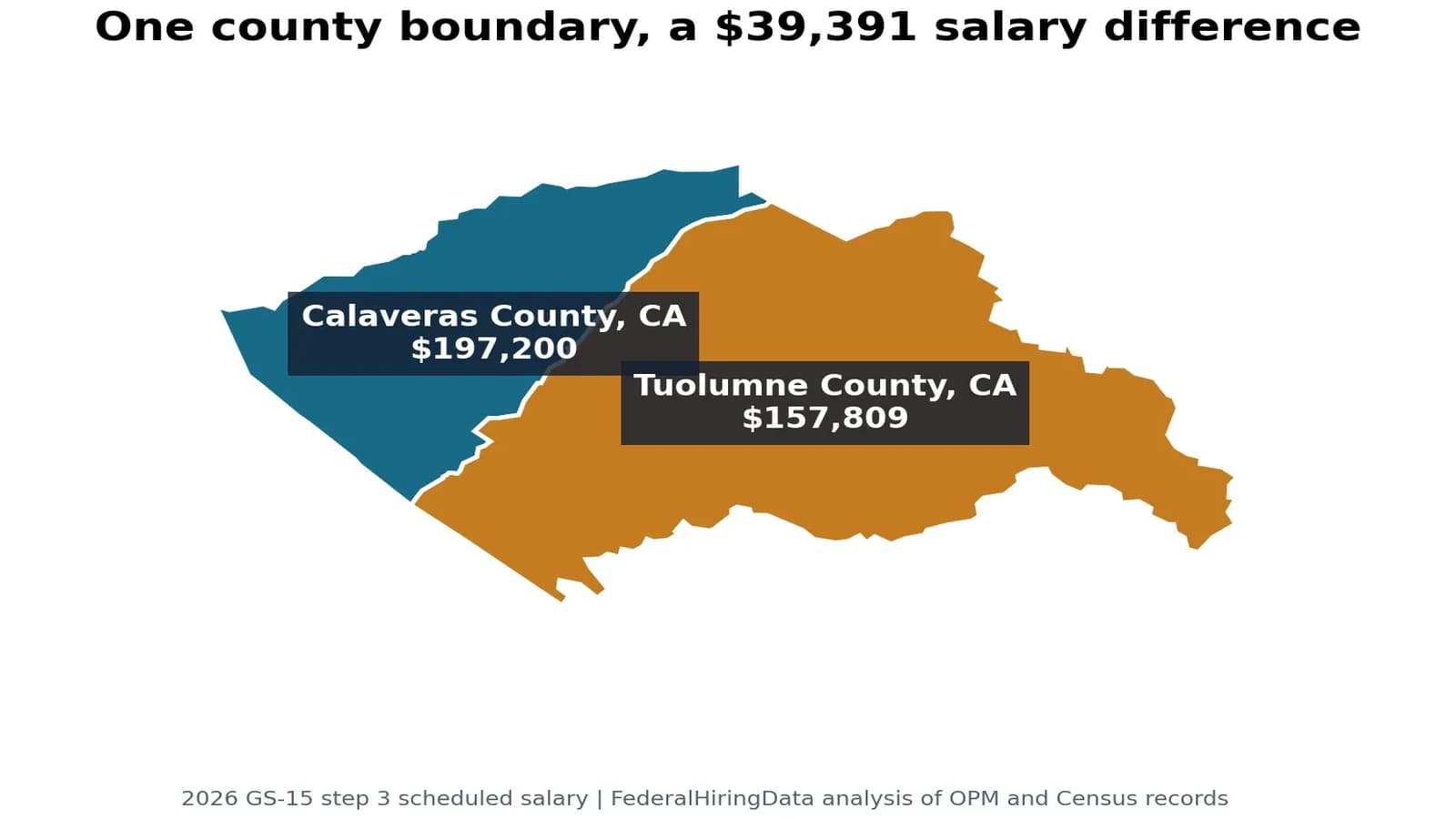
A County Line Can Change a Federal Salary by $39,391
A national analysis of OPM pay tables and Census county borders found 1,262 neighboring county pairs where the same GS grade and step can pay differently.
Active postings do disclose the possibility, but unevenly
FederalHiringData searched complete current and recent announcement text for high-confidence pay-setting language. The classifier separated phrases about higher step rates, above-minimum rates, advanced in-hire, salary negotiation and superior-qualifications appointments from nearby language about crediting prior experience for annual leave.
The result was 722 active GS announcements with explicit higher-starting-pay language. That is 10.8% of the 6,700 active GS snapshot. It is evidence that agencies sometimes tell applicants the authority may be considered. It is not a count of requests, decisions or approved steps.
The Veterans Health Administration accounted for 571 of the 722. Its recurring announcement language says a higher step rate may be determined after considering higher or unique qualifications or a special need of VA. Military treatment facilities accounted for 46, often using “advanced in-hire.” The Army Corps of Engineers had 28.

| Agency | Active pay-language announcements |
|---|---|
| Veterans Health Administration | 571 |
| Military Treatment Facilities under DHA | 46 |
| U.S. Army Corps of Engineers | 28 |
| Air National Guard Units | 9 |
| National Institutes of Health | 9 |
| HHS Office of the Secretary | 9 |
| Army National Guard Units | 6 |
| Centers for Disease Control and Prevention | 6 |
The occupation pattern follows that agency concentration. Social work led with 117, psychology with 87, medical support assistance with 79, practical nursing with 62 and nursing assistance with 49. Diagnostic radiologic technology contributed 46 and clinical laboratory science 31.

The wording varies. FederalHiringData identified 572 active announcements with an explicit higher-step or above-minimum-rate phrase, 97 with advanced-in-hire language and 54 with a superior-qualifications pay phrase. These categories overlap and cannot be added together.

Some announcements say only that an authority “may be authorized” or “may be considered.” Others identify the agency official with final approval. None of those phrases turns the posted maximum into an offer. Their value is procedural: they tell a selected candidate that asking the servicing HR office about the policy is grounded in a real pay-setting tool.
Salary history stopped being the shortcut
OPM published its Advancing Pay Equity in Governmentwide Pay Systems final rule in January 2024. It became effective April 1, and agencies had to be fully compliant by October 1, 2024.
Under the current rule, an agency may not consider a candidate's non-federal salary history when setting pay under the superior-qualifications authority. That prohibition covers existing or prior non-federal pay and a salary in a competing job offer. OPM also says agencies should not request that information.
FederalHiringData found no active GS announcement in the broad pay-setting candidate set that explicitly mentioned “salary history.” That does not prove every hiring conversation follows the rule, but it avoids a troubling public-text signal. Some older announcement language used “existing pay” when describing above-minimum VA rates. Applicants should follow the current OPM rule, not recycled advice that says to provide a private-sector pay stub.
The rule does not leave applicants without evidence. OPM identifies relevant non-federal salary surveys, labor-market conditions, candidate availability, recruiting outcomes, turnover, mission importance and job-location desirability as possible factors. The difference is crucial: an agency can examine what the market pays for the required skills without anchoring one person's federal salary to what that person happened to earn before.
Recruitment incentives are a separate decision
A higher GS step changes basic pay. A recruitment incentive is an additional payment used when an agency determines that a position would otherwise be difficult to fill.
Federal Hiring Data Weekly
Get the biggest federal workforce changes in your inbox.
Subscribe to Federal Hiring Data Weekly for federal hiring trends, salary data, agency movements, and original investigations, with email confirmation before delivery.
The distinction affects more than terminology. The higher step becomes the employee's basic GS rate and feeds later pay actions under the applicable rules. A recruitment incentive is not basic pay for any purpose. It normally requires a written service agreement, can be paid in different forms, and may create repayment obligations if the agreement ends under specified conditions.
OPM requires an agency using superior qualifications to document why it authorized a rate above step 1 instead of or in addition to a recruitment incentive. That does not mean applicants choose freely between the two. It means the agency must explain its compensation decision.
FederalHiringData has separately examined which USAJOBS announcements advertise recruitment and relocation incentives. An applicant who sees both possibilities should ask two distinct questions: What step would set my continuing basic pay, and what temporary incentive would come with a service obligation?
| Pay tool | What it can change | Timing | Main caution |
|---|---|---|---|
| Superior qualifications / special needs | Starting GS step and basic pay, up to step 10 | Approval before entry on duty | Discretionary; requires documented qualifications or agency need |
| Recruitment incentive | Separate payment | Determined before appointment and governed by agreement | Not basic pay; service and repayment terms can apply |
| Maximum payable rate / highest previous rate | Possible GS rate based on prior federal basic pay | Specified federal pay actions | Separate rule; not a private-sector salary match |
| Pay-band authority | Rate within another pay system | Depends on that system | The GS step rule should not be generalized to every pay plan |
Current and former federal employees may be under another rule
The superior-qualifications authority is designed for qualifying newly appointed GS employees. A current employee moving, promoting or changing systems may instead be covered by promotion rules, retained pay or the maximum payable rate rule.
The maximum payable rate rule can let an agency set a GS rate above the normal result based on the highest rate of basic pay the employee previously received in a qualifying federal job. It has its own agency policy, comparisons and documentation. It is not authority to match non-federal salary history.
Pay bands also require care. The letters at the top of an announcement matter. GS has 10 numbered steps. Systems such as NH, FV, ZA or agency-specific medical pay can use bands, ranges, market supplements or other rules. A broad salary range in one of those systems does not become a GS superior-qualifications case merely because the applicant is new to government.
When and how an applicant can make the request
The practical window opens after an agency has selected a candidate and communicated a proposed rate, but it closes before entry on duty. Agency workflows vary: some issue a tentative offer, collect a written justification and supporting evidence, route the request through HR and an approving official, then issue a final offer. Others may initiate consideration without waiting for the candidate to ask.
An applicant should not resign from another job, delay required onboarding steps or assume the start date will move while a request is reviewed. The safe approach is to ask the HR contact for the agency's process and timing in writing.
Confirm the pay system first. Record the pay plan, grade, proposed step, official worksite and published locality or special-rate table. If the announcement covers several grades or locations, ask which position and rate the offer actually uses.
Tie evidence to the job. A useful request explains how specialized experience, education, credentials, accomplishments or scarce competencies exceed the minimum qualification requirement and directly support the duties. A long career is not automatically superior for a particular position.
Use permitted market evidence. Relevant salary surveys, documented recruiting conditions, turnover, scarce-skill data and the mission consequences of delay can support the agency's analysis. A private salary or competing offer cannot be the basis under the current rule.
Ask about comparators and alternatives. OPM requires agencies to consider how they set steps for similarly qualified new appointees in similar positions when applicable. Ask whether the agency is considering a recruitment incentive, student-loan repayment or advanced leave accrual separately. Each has different eligibility and consequences.
Wait for the written answer. A supervisor's encouraging comment, a USAJOBS maximum or an HR discussion is not the official rate. The final written offer controls. Once the employee enters on duty, 5 CFR 531.212 cannot be used retroactively to raise the starting step.
Wide salary ranges have been common for years
The 2026 snapshot is not a new quirk. FederalHiringData's historical archive contains 2,058,764 GS announcements from approximately March 2017 through 2025. Of those, 1,597,583, or 77.6%, identified one grade and a positive advertised salary range.

The annual share moved from 80.1% in the partial 2017 archive to 73.6% in 2025. That series should be read as salary-range coverage, not negotiation history. The historical records do not reveal which range endpoints were steps, which applicants asked, which authority an agency considered, or who was hired.
That limitation is the central finding, not a footnote. USAJOBS is rich enough to show applicants the possible pay span and sometimes rich enough to disclose the pay-setting tool. It is not an offer database.
What the public data cannot answer
No public governmentwide dataset reviewed for this investigation reports superior-qualifications requests, approvals, denials or approved steps. USAJOBS does not publish final offers. OPM's aggregate personnel data can identify grade, step and accession actions in many records, but it cannot isolate 5 CFR 531.212 cleanly from reappointments, highest-previous-rate decisions, special rates and other lawful pay-setting paths. FederalHiringData therefore did not turn accession steps into a supposed approval rate.
The text count has limits, too. Agencies use different templates. Some disclose above-minimum consideration in the benefits or additional-information section; others may use the authority without advertising it. The 722 active signals are a lower-bound disclosure count, not the universe of eligible jobs.
The salary match is similarly bounded. Exact endpoints can appear in more than one locality table, and special-rate postings often will not match the ordinary table even when correct. FederalHiringData excluded broad and multi-location records from the strict comparison rather than guessing.
The useful number is the proposed step
The maximum in a federal job announcement is real, but it answers a limited question: how high does the posted range go? For a new GS employee, the ordinary answer still begins at step 1.
Superior qualifications and special agency needs give an agency room to move above that starting point. They do not make negotiation automatic, and they do not turn the step-10 maximum into a promise. The useful applicant workflow is straightforward: identify the actual pay system, wait for selection and a proposed rate, ask HR about the agency's policy, document job-relevant evidence, and get the decision before entering on duty.
Browse current federal job announcements, compare the broader federal hiring statistics, or read FederalHiringData's investigation of GS-15 pay compression for the separate problem of steps that exist on paper but share the same capped salary.
Methodology and limitations
FederalHiringData captured production USAJOBS records on Aug. 29, 2026. The active snapshot contained 6,700 announcements whose pay plan was GS. The salary-table analysis retained announcements opened in 2026 with one numeric grade, one exact mappable location, annualized minimum and maximum pay, and a positive range. It compared each pair with every grade and step in 59 official OPM 2026 GS tables. An exact full-ladder match required the minimum to equal step 1 and maximum to equal step 10 in the same table.
The text analysis searched complete current and recent GS announcement fields for above-minimum, higher-step, advanced-in-hire, salary-negotiation and superior-qualifications wording. It excluded superior-qualifications references used only to discuss annual-leave credit. A deterministic 95-row sample across pay and leave classes was reviewed. Categories can overlap and are not additive.
Historical counts use one distinct USAJOBS control number. Announcements are not vacancies, applications, referrals, selections, personnel actions or people hired. Advertised salary is not payroll or guaranteed compensation. The historical archive begins partway through 2017, so that year is incomplete. Research and writing used no OpenAI API calls.
Related research
More from FederalHiringData

Pay and benefitsAugust 28, 2026
1.64 Million Federal Workers Pay 4.4% Into FERS. The 0.8% Cohort Is No Longer the Majority.
OPM's actuarial counts show the 4.4% FERS-FRAE tier became the majority in 2023, while the same-pay deduction gap reaches $3,600 at $100,000.

Pay and benefitsAugust 19, 2026
Federal Pay Rose 14%. Prices Rose Nearly Twice as Fast.
Consumer prices rose 27.7% from January 2021 through July 2026 while the GS base schedule rose 14.4%. Locality pay narrowed, but did not erase, the loss in scheduled purchasing power.

Pay and benefitsAugust 27, 2026
One in Four USAJOBS Announcements Outside Urban Areas Advertised a Hiring Incentive
FederalHiringData found incentive language in 26.43% of exact-location postings outside Census urban areas, versus 17.57% inside them.
Federal Hiring Data Weekly
Get the biggest federal workforce changes in your inbox.
Subscribe to Federal Hiring Data Weekly for federal hiring trends, salary data, agency movements, and original investigations, with email confirmation before delivery.