August 28, 2026
USAJOBS Capped Resumes at Two Pages. Median Qualification Text Shrunk Just 10%.
A 7,688-announcement analysis found the median qualifications section only 9.6% shorter after the two-page federal resume rule, while the 90th percentile grew slightly.
Published August 28, 2026Last edited August 28, 2026

An applicant reading a typical federal job announcement in FederalHiringData's January 2026 sample faced about 440 words in the qualifications section. At the 90th percentile, the section ran 969 words. The resume available to answer it could be no longer than two pages.
That does not mean an applicant should copy 969 words into a resume. Qualification sections mix general standards, education routes, license rules, specialized experience and instructions that do not all apply to every person. It does show the compression problem created by the new format: applicants must identify the parts that govern their grade and hiring path, then make the relevant evidence legible in a much smaller document.
FederalHiringData compared complete official USAJOBS cohorts before and after the limit took effect: 5,222 announcements opened Jan. 1-7, 2025 and 2,466 opened Jan. 1-7, 2026. The median qualifications section was 9.6% shorter after the rule. But the upper tail did not shrink. The 90th percentile moved from 953 to 969 words, and a conservative parser found no change in the typical number of structured specialized-experience elements.
The result is neither "nothing changed" nor "federal requirements were simplified." The application container changed decisively. The text applicants had to interpret changed much less consistently.
The rule changed the resume, not the qualification standard
The U.S. Office of Personnel Management announced that the two-page standard would take effect Sept. 27, 2025. OPM's agency guidance says the limit applies to Title 5 competitive- and excepted-service announcements, internal and external, and that agencies should review only resumes that comply. USAJOBS now prevents users from uploading or building a resume longer than two pages.
The same guidance says a compliant resume still must be legible enough to review for eligibility, minimum qualifications and other position requirements. Medical and research positions can request a longer curriculum vitae through another-document handling when the announcement directs it. That exception does not turn a general applicant's third page into something reviewers may consider.
USAJOBS resume guidance preserves several facts that consume space. For each relevant job, applicants should provide the employer, title, start and end dates by month and year, hours worked per week, and a brief description showing performance of tasks at the required level. Federal positions also need series and grade. Education, certifications or licenses must be included when the announcement requires them.
The page limit therefore did not erase the underlying qualification system. It asked applicants to make a more selective argument inside it.
The median shortened; the longest sections did not
FederalHiringData measured the official `requirementsQualifications` field after removing HTML. The comparison uses announcements opened during the same seven calendar days one year apart, reducing seasonal mismatch without claiming that two weeks represent every federal announcement.
| Qualification measure | Jan. 1-7, 2025 | Jan. 1-7, 2026 | Change |
|---|---|---|---|
| Announcements | 5,222 | 2,466 | -52.8% |
| Median words | 486 | 440 | -9.6% |
| 75th percentile | 719 | 686 | -4.6% |
| 90th percentile | 953 | 969 | +1.7% |

The lower announcement count is a cohort fact, not evidence that the resume rule reduced hiring. Federal hiring volume and agency composition changed sharply between early 2025 and early 2026. The word-count comparison describes the text in the records available during each period.
At the center, the sections did become shorter: 46.5 fewer words at the median. The upper quarter also declined modestly. But the 90th percentile added 16 words. Applicants targeting the densest announcements were not operating in a uniformly simplified environment.
Word count is an imperfect complexity measure. A concise four-part standard can demand more careful evidence than a long section filled with boilerplate. A longer health-care section may include education and license language that a qualified applicant can document compactly. The value of the measure is narrower: it establishes how much official qualification text applicants had to read and sort, not how difficult a job was to win.
Higher-grade GS announcements did not follow the overall decline
The aggregate change concealed a split by pay system and grade. Among announcements with parsed GS or GG grades, median qualification text rose in all three grade bands. The decline was concentrated in other pay systems, a broad group whose occupation and agency mix also changed.
| Grade or pay-system group | 2025 announcements | 2026 announcements | 2025 median words | 2026 median words | Change |
|---|---|---|---|---|---|
| GS/GG 1-8 | 862 | 363 | 512 | 567 | +10.7% |
| GS/GG 9-12 | 1,451 | 630 | 535 | 542 | +1.3% |
| GS/GG 13-15 | 1,089 | 367 | 426 | 473 | +11.0% |
| Other pay systems | 1,820 | 1,106 | 433 | 314 | -27.5% |

This is not proof that agencies made GS-13 through GS-15 announcements harder after the rule. The records are announcements, not controlled versions of the same jobs. A January 2026 cohort with more complex specialties can produce a higher median even if agencies edited individual templates. The responsible conclusion is that no broad GS simplification is visible in this comparison.
For an applicant, that distinction matters. A two-page limit is universal, while the text it must answer varies by grade, occupation, agency and appointment. A generic resume written once and sent everywhere is poorly matched to that structure.
Specialized experience still arrived as a list
The central applicant question is not simply how many words appear. It is how many distinct kinds of experience the announcement asks a person to demonstrate.
FederalHiringData searched for the exact phrase "specialized experience" and then used a conservative parser on the list or enumeration that followed its first occurrence. It did not count every verb in the qualifications section. Single statements and contexts that could not be parsed reliably were excluded from numeric element summaries.
The exact phrase appeared in 3,286 of 5,222 pre-rule announcements, or 62.9%, and 1,172 of 2,466 post-rule announcements, or 47.5%. Among those mentions, 2,392 pre-rule and 825 post-rule records contained a structured list the parser could count. In both cohorts, the median was four elements and the 90th percentile was eight.

This measure passed the project's publication gate, but it is deliberately secondary. FederalHiringData manually reviewed a deterministic sample of 60 announcements. The parser matched the human count exactly in 42, or 70%, and came within one element in 52, or 86.7%. Mean absolute error was 0.63 element. Those results are good enough to distinguish a typical four-part list from an eight-part upper tail; they are not good enough to claim that every individual announcement has been mechanically scored with perfect precision.
The decline in exact specialized-experience wording also requires care. Some announcements describe experience without using that exact phrase. Others rely on occupation-specific qualification standards or education. The change may reflect the jobs being posted, drafting conventions or both. It does not establish that fewer applicants needed specialized experience.
Health and social-service announcements carried the densest text
The post-rule occupation ranking demonstrates why a governmentwide median cannot answer every applicant's question. Among series with at least 20 announcements in the January 2026 cohort, Practical Nurse had the longest median qualifications section at 1,093 words. Nurse followed at 939, Medical Records Technician at 855, Social Work at 788 and Psychology at 776.
| Occupation series | 2026 announcements | Median qualification words | Exact specialized-experience phrase |
|---|---|---|---|
| Practical Nurse (0620) | 38 | 1,093 | 2.6% |
| Nurse (0610) | 135 | 939 | 3.0% |
| Medical Records Technician (0675) | 21 | 855 | 0.0% |
| Social Work (0185) | 62 | 788 | 27.4% |
| Psychology (0180) | 31 | 776 | 48.4% |
| General Inspection and Compliance (1801) | 23 | 641 | 78.3% |

The low exact-phrase rates in nursing are not evidence of light requirements. Health occupations often use basic education, licensure, registration, certification or occupation-specific grade standards. That language remains consequential even when it is not labeled specialized experience.
Agency comparisons show the same variation. Among agencies with at least 30 announcements in each cohort, Customs and Border Protection had a 905-word post-rule median, Headquarters Air Force Reserve Command 835, Veterans Health Administration 739, Air Education and Training Command 579 and National Park Service 574. VHA's median fell only 2.6%, from 759 words; its median parsed experience list remained five elements.
Other agencies were much shorter. Commander, Navy Installations Command had a 222-word post-rule median, and U.S. Marine Corps 179. These differences can reflect mission, occupation, grade, template and hiring path. They should not be interpreted as an agency quality ranking.
Federal Hiring Data Weekly
Get the biggest federal workforce changes in your inbox.
Subscribe to Federal Hiring Data Weekly for federal hiring trends, salary data, agency movements, and original investigations, with email confirmation before delivery.
Required documents did not fit inside one universal checklist
The typical required-documents section contained seven unique HTML list entries in the 2025 cohort and nine in 2026.

That does not mean the typical applicant had to upload nine documents. USAJOBS explains that document requirements depend on the job and on what the applicant claims: current or former federal service, veterans preference, disability eligibility, education, a professional license or another hiring path. A section can list an SF-50 for one group, a DD-214 for another and transcripts for a third. FederalHiringData counted the choices and instructions displayed, not a person's final packet.
The distinction is useful under a two-page limit. The resume is one document. Transcripts, personnel actions, veterans documents, licenses and a directed CV can be separate attachments when the announcement calls for them. Trying to reproduce those records inside the resume wastes the space OPM wants reserved for relevant experience.
Education remained a common qualification route. FederalHiringData found education-route language in 59.7% of the 2025 cohort and 59.3% of the 2026 cohort. The exact phrase "selective placement factor" appeared in 4.6% and 3.9%, respectively. Explicit two-page language, by contrast, rose from 2.3% to 76.0%.

The 76% figure confirms widespread implementation, not imperfect enforcement. Some announcements convey the limit with wording outside FederalHiringData's exact phrase set, and some records in the official text feed have agency-specific structures. The platform rule applies regardless of whether the same sentence appears in every text record.
No single number measures an announcement's difficulty
The six measures in this analysis answer different questions. Word count captures reading volume. The structured-element parser approximates how many distinct experience claims appear in a recognizable list. Required-document entries describe the menu of possible attachments. Education and selective-factor flags show whether certain qualification routes or gates are visible. None can stand in for the others.
A 300-word qualifications section can still contain a strict license, a positive education requirement and one sharply defined experience standard. A 1,000-word section can include several grade levels, extensive definitions and alternative routes, only one of which applies to a particular applicant. Counting every word as an obligation would overstate the burden; ignoring the section's structure would understate the interpretation it requires.
The same caution applies to assessments. USAJOBS tells applicants to examine "How you will be evaluated" and any linked questionnaire. Those materials can test competencies beyond the qualifications prose. The Announcement Text API does not turn every questionnaire answer into a comparable list, and FederalHiringData did not claim to measure the full assessment burden. The analysis is about the announcement's stored qualification and document text.
Nor is text length a proxy for human-resources scoring. FederalHiringData has no linked ratings, category placements, referrals, interviews or selections for these records. A reviewer may find a concise resume persuasive because it establishes level, duration and relevant results. Another resume can consume two pages without demonstrating the required work. The archive cannot observe that judgment.
What the measures can establish is the shape of the instructions. The 2026 cohort combined a shorter median with an unchanged structured-list center, a slightly longer 90th percentile, more document-list entries and wide occupation differences. That pattern is why the practical response must begin with the exact announcement rather than a universal number of bullets, jobs or accomplishments.
What "one year at the next lower grade" means
USAJOBS says GS-7 and higher jobs generally require specialized experience. At least one year must be equivalent to the next lower grade. Its example is direct: qualifying for GS-12 generally requires a year of specialized experience equivalent to GS-11.
"Equivalent" does not mean an applicant had to hold that exact federal grade. Relevant private-sector, military, state, local, nonprofit or volunteer experience can qualify when it demonstrates work at the required level. The announcement defines the specialized work. The agency evaluates whether the resume shows it.
The duration evidence still matters. USAJOBS asks for month-and-year dates and hours per week because reviewers need to determine how long the applicant performed the work. A person who lists a title and accomplishments but omits the hours may leave the agency unable to credit part-time experience correctly. A current federal employee who omits series and grade also withholds information the official guidance expressly requests.
Related research
Put this finding in context

Hiring processAugust 28, 2026
Only 8.6% of Public USAJOBS Announcements Listed Veterans. That Is Not the Preference Rate.
A 3.1 million-announcement analysis shows why the USAJOBS Veterans label cannot tell applicants where preference applies.

Hiring processAugust 27, 2026
181,700 USAJOBS Announcements Used Applicant Cutoffs. Remote Postings Used Them Far More Often.
FederalHiringData found 181,700 official applicant-cutoff announcements since 2019, with especially heavy use in remote, emergency and park recruiting.
One year is not an instruction to write one year of duties. It is a duration and level standard. The applicant's task is to connect the relevant work periods to the announcement's elements with enough specificity that a reviewer need not guess.
A two-page resume must be selective, not skeletal
The official guidance offers a more defensible strategy than generic resume folklore.
First, identify the exact grade and qualification route. A multi-grade announcement may set different experience standards for GS-9, GS-11 and GS-12. Education may substitute at one grade and not another. An applicant should answer the route actually being claimed, rather than compress every possible route into the document.
Second, preserve the facts USAJOBS says reviewers need: employer, title, dates, hours per week, and series and grade for federal work. Cutting those fields to make room for adjectives can make the resume shorter but less reviewable.
Third, use brief descriptions to demonstrate the announcement's required tasks at the stated level. USAJOBS advises applicants to use concise, results-focused language, similar terms where accurate, and experience relevant to that job. It also says agencies will not make assumptions. A useful bullet therefore connects an action, its scope and a result to a required element; it does not merely repeat the element's label.
Fourth, remove unrelated history before shrinking type. OPM recommends prioritizing recent and relevant experience, removing outdated material and using a legible format. USAJOBS currently recommends a standard 8.5-by-11-inch file, half-inch margins, a 10-point main-text font and PDF when practical. These are formatting recommendations, not permission to produce an unreadable page.
Finally, treat eligibility and qualifications as separate gates. USAJOBS distinguishes the hiring paths that determine who may apply from the experience, skills and education that determine whether someone qualifies. A strong qualifications narrative cannot cure ineligibility for a closed hiring path. Eligibility alone does not establish specialized experience.
The two-page reform is visible; simplification is not uniform
The strongest evidence of the policy in the announcement data is the policy text itself: explicit two-page language became routine. The broader promise of simplification is harder to see.
The median qualifications section was shorter, and that is meaningful counterevidence to a claim that nothing changed. Yet the reduction was about 10%, not anything close to the reduction many applicants made when converting a traditional long-form federal resume. The 90th percentile was slightly longer. Structured experience lists remained four elements at the median and eight at the upper tail. GS/GG grade bands did not show the overall decline. Required-document sections displayed more list entries.
None of those findings proves the rule harmed applicants, changed referral rates or altered how human-resources specialists scored resumes. FederalHiringData does not have applicants, ratings, referrals or selections linked to these texts. The analysis cannot say whether a 440-word qualifications section is fair, whether an eight-element list is necessary or whether a particular two-page resume would pass.
It can answer the narrower question applicants raised when the rule arrived. Agencies did not reduce announcement requirements in proportion to the new page limit. The practical burden shifted toward selection: finding the relevant grade, separating eligibility from qualifications, identifying the specialized elements that truly apply and showing them with enough dates, hours, level and results to survive review.
Two pages can hold that argument. They cannot hold every argument.
Methodology and limitations
FederalHiringData captured complete official USAJOBS Historic JOA and Announcement Text API cohorts for announcements opened Jan. 1-7, 2025 and Jan. 1-7, 2026. The pre-rule cohort contains 5,222 unique controls and the post-rule cohort 2,466. Every Historic JOA record matched one Announcement Text record, producing 7,688 analyzed controls. The same calendar week limits seasonality but does not remove changes in occupation, agency, grade or hiring volume.
Qualification words come from the official qualifications field after HTML removal. Specialized-experience presence uses the exact phrase. Element counts use conservative list and enumeration patterns after the first exact mention; unparseable and single-statement contexts are excluded from element summaries. A 60-record manual audit produced 70% exact and 86.7% within-one agreement. Required-document counts are unique HTML list entries and may represent conditional paths. Education routes and selective placement factors use conservative text indicators.
The downloadable aggregate table includes overall, grade-band, occupation-series and agency summaries. It excludes raw announcement text.
Primary rules come from OPM's implementation announcement, applicant guidance, agency guidance, and USAJOBS guidance on resume contents, experience, eligibility versus qualifications and required documents.
The topic was selected partly because three related Reddit discussions drew roughly 205, 212 and 186 points. Reddit was used only as a demand signal. Comments and vote totals were not evidence for any rule, announcement measure or applicant outcome.
Photo: Eric Kowal, Picatinny Arsenal, via DVIDS, public domain.
Continue reading
More from FederalHiringData
Hiring processAugust 17, 2026
How Long USAJOBS Announcements Stay Open: 3.09 Million Records
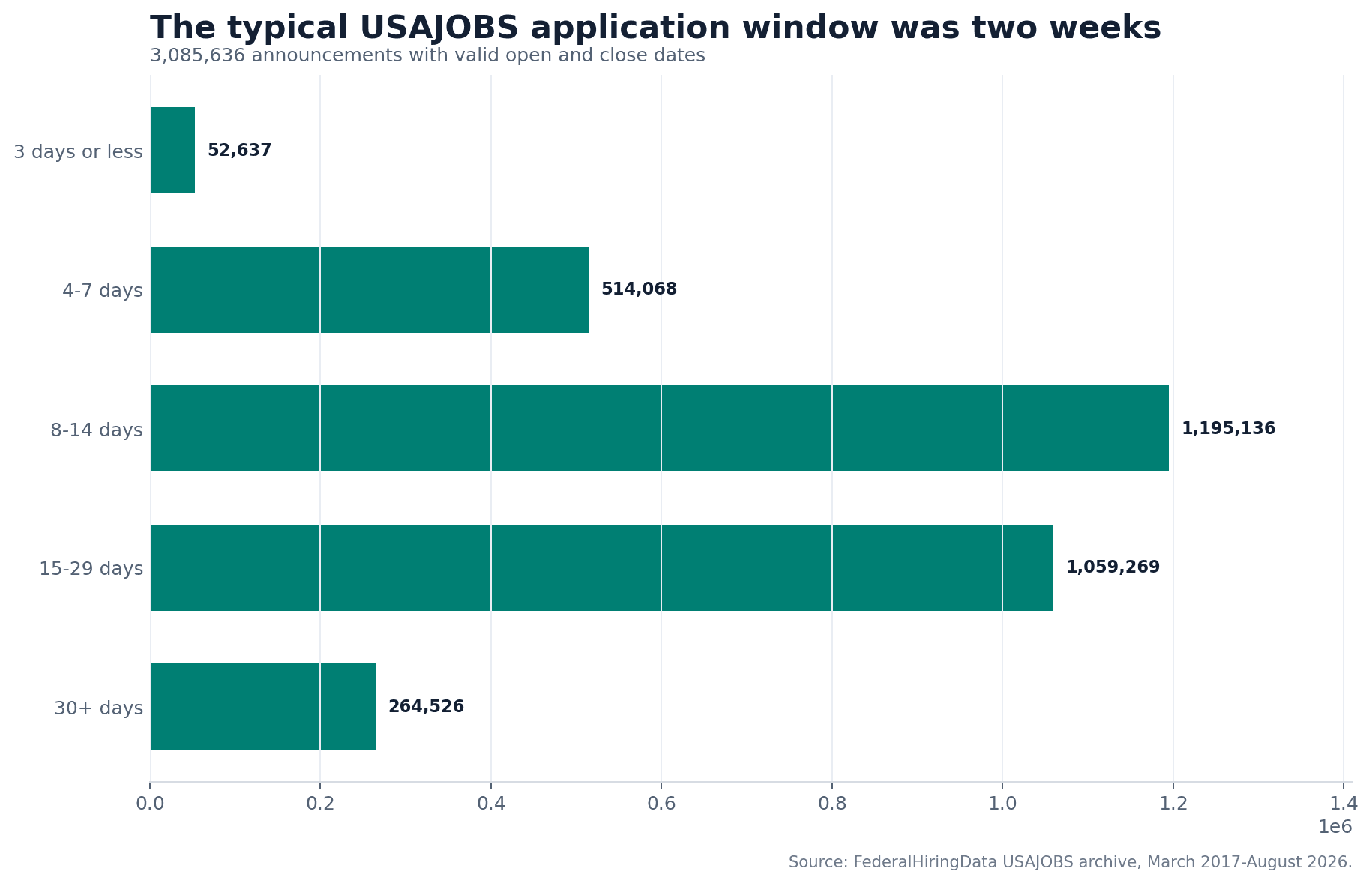
Across 3,085,636 announcements, the median application window was 14 days and 566,705 closed within a week.

Hiring processAugust 17, 2026
What Direct Hire Means on USAJOBS, and What 16,320 Labeled Announcements Reveal
Engineering, IT and contracting led a conservative cohort of USAJOBS announcements with Direct Hire in the title. A 14-day median application window still does not measure selection speed.

Historical researchNovember 30, 2025
Why Federal Job Announcements Spiked in Late September 2025, Then Fell
A two-page resume transition concentrated 4,412 announcement closings on Sept. 26, followed by an abrupt weekend drop and a slower fall period shaped by a government shutdown.
Federal Hiring Data Weekly
Get the biggest federal workforce changes in your inbox.
Subscribe to Federal Hiring Data Weekly for federal hiring trends, salary data, agency movements, and original investigations, with email confirmation before delivery.